Church Handyman Ministry Pitfalls and Fixes
Slip. Trip. Fall. Three small words that show up on the majority of liability claims filed against churches.
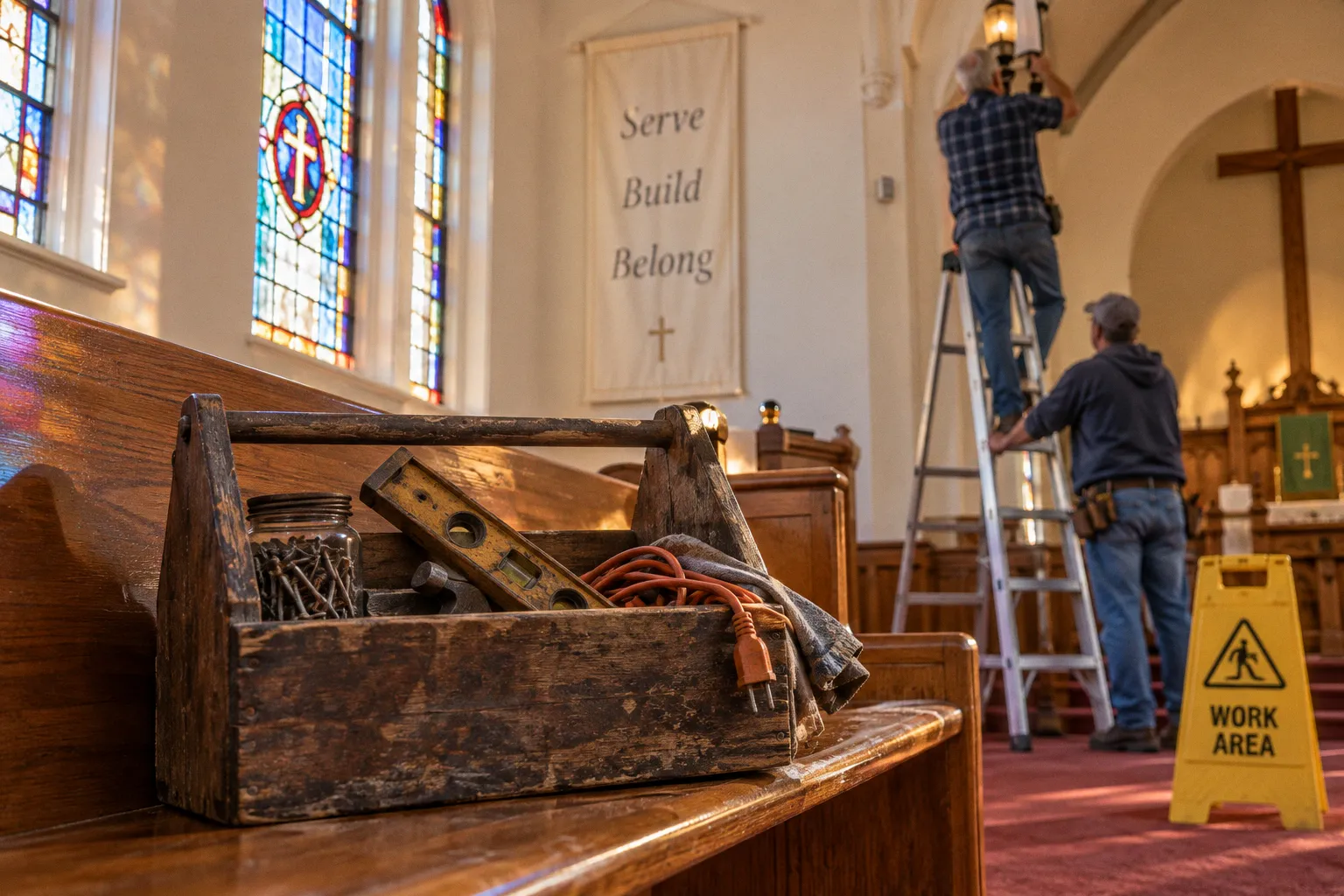
When your handyman team rolls out to fix a beneficiary's porch railing or replace a stair tread, that is the first thing your insurance carrier is thinking about. The second is whether your volunteers were screened, trained, and working inside a defined scope. The third is whether you have a paper trail showing you exercised reasonable care for the people on the receiving end of your service.
This is not a "maybe someday" conversation. If your congregation runs any kind of home repair outreach — a Saturday work day, a widow's railing project, a ramp build for a member in chemo — you are operating a small construction deployment that carries real legal weight. The good news: every pitfall on this list has a fix. None of them require a theology degree. They require operational discipline.
A handyman ministry is a deployment. Treat it like one — with scope, vetting, safety, and a written record. Mission longevity follows operational discipline.
The Blurred Scope Trap: Keeping Volunteers Inside the Line
Most handyman ministries do not blow up because a volunteer cut the wrong piece of lumber. They blow up because the team said yes to a job that required a licensed electrician, a bonded roofer, or a structural engineer — and then did it anyway with good intentions and a cordless drill.
The fix starts at intake, not on-site. Before your team ever loads the truck, the request must be classified. Is this a minor repair (a sticky door, a patch of rotted siding, a wobbly handrail on a single-story porch) or a regulated trade (anything involving the service panel, the roof structure, load-bearing framing, gas lines, or work above a defined height threshold)?
| Repair Category | Volunteer-Eligible | Requires Licensed Contractor |
|---|---|---|
| Door adjustment, weatherstrip, lockset swap | Yes | — |
| Single-story handrail replacement (non-structural) | Yes, with a written safety plan | — |
| Drywall patch, paint, caulk | Yes | — |
| Deck board replacement (no structural framing) | Yes, with a fall plan | — |
| Gutter cleaning (single-story, stable ladder) | Yes, with a two-person rule | — |
| Service panel work, new circuits, panel swap | — | Yes — licensed electrician |
| Roof shingle replacement above single story | — | Yes — bonded roofer |
| Load-bearing wall removal or modification | — | Yes — structural engineer plus permit |
| Gas appliance hookup or line repair | — | Yes — licensed plumber or gas fitter |
| Work above six feet without engineered fall protection | — | Yes — compliant contractor |
If your intake form does not sort the request into one of these buckets before scheduling, your ministry will eventually accept work it has no business touching. The pattern is predictable. A beneficiary pleads. A volunteer feels the pull of the mission. The team agrees to "just take a quick look." That quick look turns into a Saturday of improvisation. A month later, the ceiling fan falls because the box was never rated for the fixture weight, and your insurance carrier gets the call.
If the job touches the service panel, the roof deck, or a load-bearing wall, it is not your project. It is a contractor's project. Saying no is part of the ministry.
Vetting Beyond Sunday-Nod Familiarity
"We know him. He's been in the pews for fifteen years." That sentence has ended more safe ministry programs than any other. Familiarity is not vetting. It is a feeling. Insurance carriers, courts, and — frankly — the families you serve do not accept feelings as a substitute for a written screening protocol.
The minimum viable screening stack for a handyman volunteer looks like this:
- Application form — every volunteer, every time, signed and dated.
- Background check — at minimum, a county and state criminal background check, refreshed on a defined cadence. Annually is the common practice for ministries serving vulnerable populations.
- Reference check — two non-relational references, ideally one personal and one professional.
- Skill verification — a documented list of what the volunteer is actually qualified to do. "Handy" is not a skill. "Five years finish carpentry, two years residential electrical under a licensed contractor" is.
- Safe ministry training — completion of a recognized abuse prevention and boundary training module.
- Sign-off on scope and safety policy — the volunteer has read, understands, and signed your written scope-of-work policy and your site safety policy.
The hard part is not the paperwork. The hard part is enforcing it on your most enthusiastic volunteers — usually the retired contractor who "doesn't need a background check because everyone knows him." He does. The protocol is not about him. It is about the woman in the wheelchair whose ramp he is going to build, and it is about the kid whose bedroom he will walk through to reach the bathroom shutoff.
Stopping the #1 Claim Before It Starts
Slip, trip, and fall incidents represent the majority of liability claims filed against churches. That is not a handyman-specific number — it is the church-wide reality — but every step your volunteer takes on a beneficiary's property, every ladder they climb, every porch they cross, multiplies that exposure on your coverage.
The fix is a pre-site audit, not a post-incident report. Before the team arrives, a lead volunteer walks the job — in person or via a detailed photo and video intake submitted by the beneficiary — and flags:
- Floor surfaces — uneven thresholds, loose rugs, slick tile, missing treads on exterior stairs.
- Vertical work — any task above six feet requires a written fall protection plan or it gets reassigned.
- Ladder setup — level ground, proper footing, a spotter present, and a ladder rated for the load.
- Pets and occupants — secured pets, children cleared from the work zone, and the beneficiary briefed on staying out of the active area.
- Tool and debris control — cords managed, drop cloths down, fasteners and sharp tools contained.
- Weather and lighting — no exterior work in wet conditions or after dark without task lighting rated for the environment.
The audit gets written down. The team lead signs it. The beneficiary signs it. If you cannot produce that document after an incident, you are arguing from memory in front of an adjuster. Memory loses.
Every ladder is a liability event. Every porch step is a claims line. Treat the site audit like a flight checklist, not a suggestion.
Work Order Intake: The Front Door of Your Deployment
Burnout in handyman ministries rarely comes from the work. It comes from chaos — five jobs booked for Saturday, three volunteers who actually showed up, one beneficiary who added four items to the scope at 8:15 a.m., and no documented plan for any of it. Scope creep is the silent killer of volunteer capacity.
The fix is a single intake form that every request must pass through before it becomes a job. At minimum, the form captures:
- Beneficiary name, address, phone, and emergency contact.
- Description of the requested repair in the beneficiary's own words.
- Classification of the repair — minor, licensed-trade, or defer.
- Photos or a short video of the issue.
- Estimated hours, estimated volunteers, and estimated materials.
- Hazard flag — anyone in the home with mobility, cognitive, or medical considerations.
- Access notes — pets, gate codes, parking, and working hours acceptable to the beneficiary.
- Beneficiary acknowledgment that the work is volunteer in nature and that hazardous items will be referred out.
That last line matters. When the beneficiary signs the acknowledgment, the conversation about what your team can and cannot do has already happened. The Saturday of improvisation evaporates. Your volunteers show up knowing exactly what they are doing, with the right tools, on a pre-scoped job.
Pair the intake form with a weekly job board. Posted visibly in your volunteer gathering space, the board shows open jobs, scheduled jobs, jobs deferred to a contractor, and jobs completed. Volunteers sign up for specific jobs by skill. The retired framer does not get voluntold onto the electrical referral because he is the only one who showed up. He gets assigned to the deck rebuild where his skill actually matches. The ministry stops asking its most valuable volunteers to do work they are not trained for, and retention climbs.
Insurance, Waivers, and the Duty You Already Owe
You owe a duty of care to every person on your premises and every beneficiary your team serves. That duty is not a theological idea. It is a legal standard attached to religious organizations, and it requires you to exercise reasonable care in how you run the deployment. Cutting corners on documentation does not save time. It transfers risk onto the congregation, the leadership team, and the volunteers themselves.
Three documentation anchors hold this up:
1. Insurance alignment. Your general liability policy must explicitly cover volunteer-led home repair work on third-party premises. Many church policies were never written with this kind of deployment in mind. Call your carrier. Get the coverage — or the exclusion — in writing. If your carrier cannot or will not extend coverage for off-premises volunteer work, your deployment is operating uninsured and your leadership is personally exposed.
2. Waivers and acknowledgments. A waiver is not a get-out-of-jail-free card, but it is evidence that the beneficiary understood the volunteer nature of the work, the scope of what was being done, and the limits of liability. Keep signed copies. Date them. File them in a locked cabinet or a restricted digital folder.
3. Incident log. Every near-miss, every scrape, every twisted ankle gets logged the same day. A near-miss log is how a serious ministry avoids a serious claim — because the pattern is visible before the pattern becomes a lawsuit.
Operational Discipline Is the Ministry
The instinct of a handyman ministry is to say yes. That instinct is not wrong. It is the heart of the work, and it flows directly from a Lutheran understanding of vocation — the neighbor in front of you, the hands you already have, the job that will not wait. But the heart of the work has to be wrapped in operational discipline, or the work stops. A single uncovered claim can shutter a ministry overnight. A single documented process can keep one running for a generation.
Scope the job. Vet the volunteer. Audit the site. Document the deployment. Cover the risk. File the record. Repeat.
Your congregation is not running a contracting company. You are running a mission that happens to use tools. The difference between a handyman ministry that lasts fifteen years and one that folds after a single claim is not theology. It is the willingness to write the procedure down, enforce it on your best friend, and keep the receipts.
That is the deployment. Run it like one.