Handyman ministry volunteers: safety and tool checklist
A 74-year-old widow on your church's benevolence list calls on a Tuesday. Her gutter is pulling away from the fascia. Her porch railing wobbles. She cannot climb a ladder and she cannot afford a contractor.
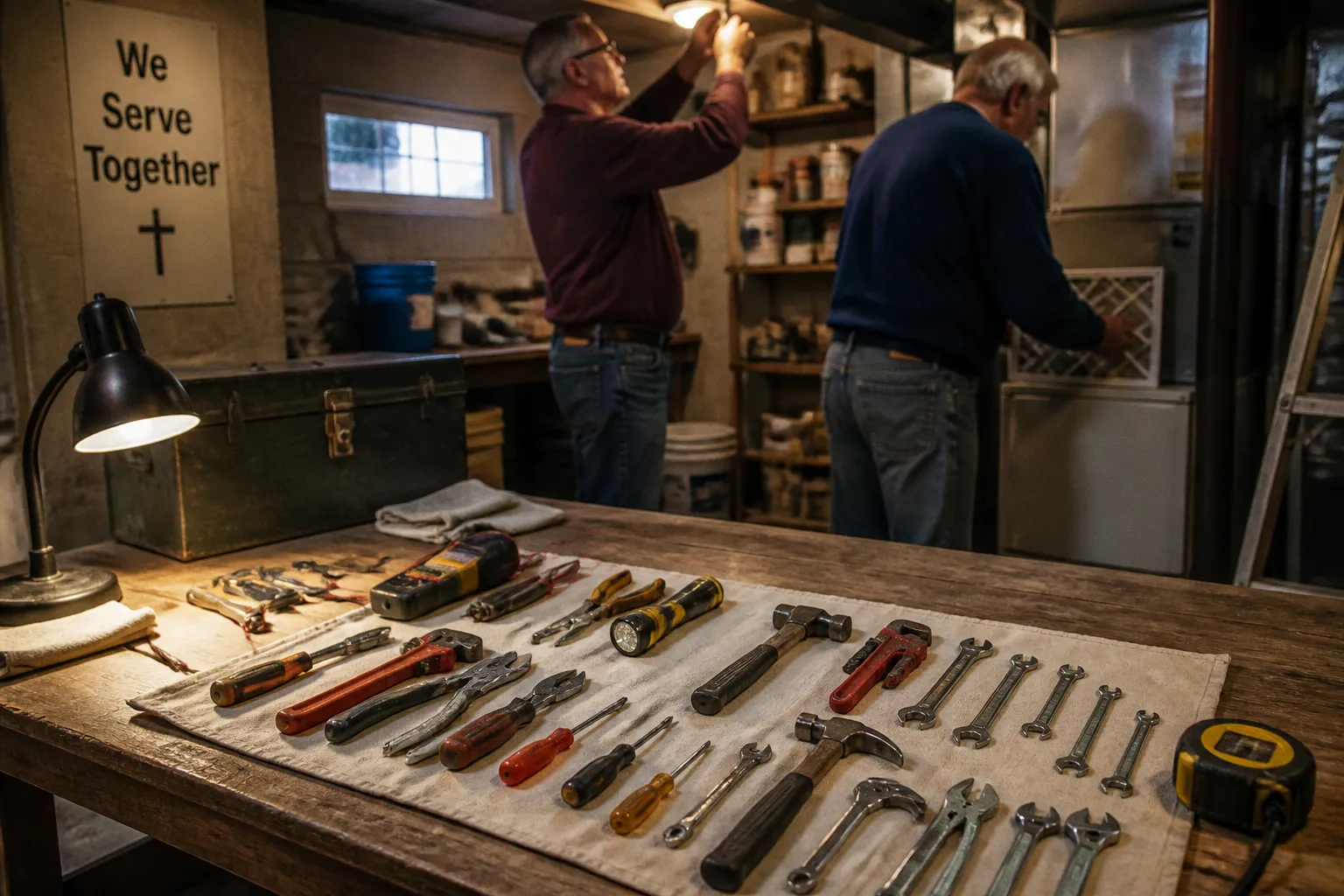
Your handyman ministry is the difference between her staying safely in her home and a trip to the ER. That is the mission. Now let's make sure none of your volunteers become the next emergency call.
Your congregation already has the heart. What you need is the operational playbook that keeps a Saturday deployment running without a single trip to urgent care, a single tool-related lawsuit, or a single volunteer who never comes back because the day felt chaotic. This guide walks you through the five non-negotiable systems every church handyman ministry needs before the next work order hits the board.
Two volunteers per project. Always. The pair is not optional — it is the smallest unit of safety, accountability, and witness your ministry can put in the field.
The Two-Volunteer Rule and Team Dynamics
Across denominations and community service models—from Baptist mission groups to local interfaith help organizations—the two-volunteer rule stands as a foundational safety recommendation. No one works alone. No one is on a roof solo. No one crawls under a house solo. No one troubleshoots a breaker box solo. Two team members. Same site. Same window of work. Same communication channel.
Here is why this rule is non-negotiable for your ministry:
- First aid happens fast. A fall from a six-foot step ladder can fracture an ankle. If the volunteer is alone, that person is calling 911 from the ground. If paired, the second volunteer stabilizes, calls, and starts the incident log before the ambulance arrives.
- Lift complications get solved in real time. A wheelchair ramp section outweighs what one person should carry. Two volunteers distribute the load and reposition safely.
- Witness testimony protects the ministry. When a client later claims a tool scratched a floor or a fixture was damaged, you have a second volunteer who saw what actually happened. Document it on the spot.
- Spiritual presence is the point. A two-person team delivers a relational touch, not just a transactional fix. The widow with the gutter gets conversation, prayer, and a finished job in one deployment.
Build your dispatch system around the pair. Schedule two volunteers per work order. If only one volunteer is available, the job waits or gets reassigned. There is no "I'll just pop over and do this real quick." That sentence has ended handyman ministries.
When you staff a project, assign roles explicitly:
- Lead volunteer — directs the work, owns the tool inspection log, makes the call on whether conditions are safe to proceed.
- Support volunteer — handles the second pair of hands on ladders, holds materials, drives the second vehicle, and acts as the safety observer.
Rotate the lead role across deployments so you are building future ministry directors, not creating a single point of failure.
Essential Tool Inspection and Electrical Safety Standards
Every tool that leaves your storage closet is a liability until it has been inspected that morning. The pre-deployment check takes five minutes. Skipping it is how ministries get sued and how volunteers get hurt.
Pre-Deployment Tool Inspection
Run this checklist before any tool is loaded into the truck:
- Cords are intact. No fraying, no cracked insulation, no exposed wire.
- Plugs are three-prong and the ground pin is present. Not broken off. Not bent.
- Switches work cleanly. No sticking, no sparking, no need to cycle the trigger twice.
- Tool bodies are free of cracks, missing screws, or loose handles.
- Blade guards, if equipped, retract and return properly.
- Battery packs on cordless tools are charged, and the charger is in the transport bin, not plugged into an unknown outlet on the jobsite.
Any tool that fails any of these checks gets a piece of bright orange tape across it and the words DO NOT USE written in marker across the body. It goes back to the storage closet. It does not get "fixed on-site." It does not get used "just this once."
PPE and Personal Preparation
Pull your volunteers aside before the work starts and run this list:
- No loose clothing. No dangling hoodie drawstrings. No scarves.
- No jewelry on hands or wrists. Rings off. Watches off. Bracelets off.
- Closed-toe shoes, ideally with non-slip soles. No sandals. No flip-flops. No bare feet, even in the yard.
- Safety glasses for any work overhead, any grinding, any drilling into masonry.
- Gloves for handling treated lumber, sharp metal, or rough surfaces — but never gloves around rotating power tools where the glove can be caught and pull the hand in.
Electrical Safety on the Jobsite
The three safety rules for any corded power tool on a ministry site:
1. Three-wire cords only. Your corded power tools must have a ground wire and a three-prong plug. The ground is not a suggestion. It is the path fault current takes away from the volunteer.
2. Grounded receptacles only. If the home has two-prong outlets, do not use a cheater plug to force a three-prong tool into a two-prong socket. That bypasses the safety system. Use a properly rated adapter or stop the work.
3. No wet environments unless rated. Gutter cleaning, yard work after rain, basement work with any moisture — these are wet conditions. Standard power tools are not rated for wet conditions. If the job demands power in a wet area, the tool must be specifically rated for it (look for the marking on the tool body and the manual).
| Parameter | Standard Cordless Tool | Wet-Rated Power Tool |
|---|---|---|
| Power Source | Battery pack; no mains grounding conductor | Typically corded; relies on mains ground |
| Moisture rating | Dry conditions only; protect battery from moisture | Tested and rated for damp/wet conditions |
| Typical use | Dry interior, dry yard | Damp basements, post-rain exterior work |
| Key Inspection | Battery terminals clean, charger intact | Cord insulation intact, plug ground prong secure |
If you cannot verify the rating, the tool stays in the truck.
Mastering Ladder Safety and Height-Related Risk Management
Working at height is the single highest-risk activity your handyman ministry will perform. Gutter cleaning, exterior painting, porch ceiling repair, light fixture replacement on a tall foyer ceiling — every one of these qualifies. Treat ladders with the seriousness they demand.
The Three Ladder Rules
Drill these into your volunteers until they repeat them in their sleep:
1. Stable surface only. Both feet on level ground. Both rails contacting the support. If the ground is soft, use a ladder leveler or move the ladder. Do not shim with a piece of scrap wood.
2. Three points of contact at all times. Two feet and one hand, or two hands and one foot. The third point never leaves the ladder. If you cannot maintain three points of contact, you are not positioned correctly — climb down and reposition.
3. Respect the weight limit. Every ladder has a duty rating printed on the side of the rail. That number includes the volunteer, the tool belt, and any materials being carried up. If the volunteer plus a five-gallon bucket of paint exceeds the rating, the bucket goes up on a rope, not in the volunteer's hand.
The Ladder Pair Protocol
Standard risk assessments classify working at height as high-risk. With proper ladder training and two people per ladder, the risk is significantly mitigated. That is the deployment target. Two people per ladder means:
- One volunteer climbs.
- The second volunteer holds the base, watches the climber's footing, and hands up materials from the ground.
- The ladder is never left unattended while extended.
Fold ladders down and secure them before the vehicle moves. A loose ladder is a projectile hazard, whether on a highway or a quiet church parking lot.
Ladder and Height Task Quick Reference
- Inspection before every use. Check rungs, side rails, feet, and any locking mechanisms. A bent rail or a cracked rung is a retired ladder.
- Extension ladders for roof access — angle at 4-to-1 (one foot out for every four feet of height). Mark the angle with a piece of tape on the rail so volunteers do not have to eyeball it.
- Step ladders for interior work — fully opened and locked with the spreader bar engaged. Never use a step ladder folded partially closed as a leaning extension ladder.
- Scaffolding — if the job requires it, rent it. Volunteer-built scaffolding is not in your ministry's scope.
Serving Seniors and Residents with Special Needs
The core client base of a handyman ministry is seniors aging in place and households with a family member who has a disability. Programs like community help initiatives have built entire operational models around this population, and the lesson is clear: the modifications that keep people safely in their homes are small, repetitive, and life-changing.
Typical Work Orders for Senior and Special Needs Households
Your deployment load will look like this week after week:
- Bathroom safety bars installed near toilets and inside showers.
- Raised toilet seats mounted and secured.
- Wheelchair ramp construction or repair at side or rear entries.
- Grab bars along hallways and at stair transitions.
- Threshold modifications to remove trip hazards for walkers and wheelchairs.
- Light bulb replacement in high fixtures the resident cannot safely reach.
- Air filter changes in HVAC systems the resident cannot access.
- Gutter cleaning to prevent ice dams and water intrusion.
- Yard cleanup and leaf removal for residents who cannot manage the physical work.
- Minor plumbing repairs — leaky faucets, running toilets, slow drains.
- Minor electrical repairs — outlet replacement, switch replacement, light fixture swaps.
Critical Boundaries for Volunteers
Your volunteers are handymen and handywomen, not licensed contractors. This boundary is what protects your ministry from liability, your clients from shoddy work, and your volunteers from taking on risk they are not trained for.
- Major electrical work — full panel upgrades, new circuit runs, service entrance work — is licensed electrician territory. Refer it out.
- Major plumbing work — sewer line repair, water heater replacement, gas line work — is licensed plumber territory. Refer it out.
- Structural roofing — full re-shingling, structural repair — is roofing contractor territory. Refer it out.
- Anything requiring a permit — pulled.
The minor version of each task is squarely in your lane. The minor version is also the version that changes a senior's daily life. Run that lane hard.
Client Intake Before Deployment
Before any work order is dispatched, capture this information:
- Resident name and phone number.
- Exact address with access notes (gate code, dog in yard, side door entry).
- List of requested tasks with priority ranking.
- Confirmed scope of work — what the volunteer team will do and what falls outside the ministry.
- Resident acknowledgement that the work is volunteer-staffed and the ministry is not a licensed contractor for permit-required work.
That last point is not legalese theater. It sets expectations and protects the relationship.
Formalizing Health and Safety Policies for Ministry Liability
The fifth system is the one most ministries skip because it feels like paperwork. Then a volunteer falls off a ladder, a client sues, and the insurance carrier asks for the written policy. If the answer is "we'll write one up," the ministry is exposed.
The Written Health and Safety Policy Trigger
In many organizational contexts, a written Health and Safety Policy is considered best practice once a team reaches a certain size. A common framework, such as that referenced in UK guidance, suggests a threshold of five or more employees. When applying this to volunteers, the status is not legally equivalent to employment. However, treating a regular team of five or more consistent volunteers as a trigger for creating a formal policy is a prudent, professional standard. It demonstrates due diligence to your congregation, your denomination, and your insurance provider. The policy document does not need to be a hundred pages. It needs to exist, be current, and be signed.
Your written policy should include:
- Statement of responsibility — who in the congregation owns safety for the handyman ministry (this is you, the Director of Outreach, or whoever the named accountable party is).
- Risk assessment process — how each job is evaluated before dispatch.
- Volunteer screening and training requirements — who can serve, what training they must complete before their first deployment.
- Incident reporting procedure — what happens the moment something goes wrong, who is called, how it is documented.
- Tool inspection and maintenance schedule — not just the per-deployment check, but the annual deep audit.
- Insurance coverage summary — what your church's liability policy covers and what it excludes.
Volunteer Screening and Liability Waivers
Two separate documents, both required:
1. Volunteer application — name, contact, skills, availability, any relevant training or certifications, emergency contact.
2. Liability waiver — signed annually, acknowledging the volunteer understands the risks, has read the safety policy, and agrees to follow it.
A waiver does not protect your ministry from gross negligence. It does protect you from the routine slip, the unexpected stumble, the honest mistake. Sign them every year.
Risk Assessment Per Job
Before dispatch, the lead volunteer or ministry director scores the work order:
- Low risk — interior task, no height, no electrical, no plumbing. Example: changing an air filter, replacing a smoke detector battery.
- Medium risk — exterior ground-level work, minor electrical or plumbing with power off, two-person ladder work. Example: gutter cleaning with a stable ladder pair.
- High risk — anything above single-story height, anything involving the main electrical panel, anything requiring structural judgment. Example: ramp construction with concrete pouring.
Low and medium risk deployments go out with a standard pair of volunteers. High risk deployments require a third volunteer with specific training for that task type, or the job gets referred to a licensed contractor.
Annual Ministry Audit
Once a year, before the spring deployment season, run a full audit:
- Tool inventory with condition ratings.
- Ladder inspection logs for the year.
- Volunteer roster current.
- Liability waivers current.
- Insurance certificate current.
- Incident log reviewed for patterns.
- Training records current.
This is the audit that shows your denomination, your insurance carrier, and your congregation that the ministry is being operated at professional standards by volunteers who care about safety as much as service.
The Deployment-Ready Ministry
A handyman ministry is one of the most tangible expressions of faith your congregation can operate. A widow's gutter gets fixed. A veteran's porch gets a ramp. A young mother with a disabled child gets bathroom safety bars installed by people who then sit at her kitchen table and pray with her. That is the work. The safety systems are what keep the work possible year after year.
Lock in the five operational systems before your next work order:
1. Two volunteers per project, every time.
2. Pre-deployment tool inspection, every tool, every time.
3. Ladder and height protocols with three-point contact and pair support.
4. Senior and special needs service scope that stays within the minor-repair lane.
5. Written Health and Safety Policy, signed waivers, and per-job risk assessment.
Run those five systems consistently and your handyman ministry becomes a deployment-ready operation your congregation can scale, your insurance carrier can underwrite, and your community can count on for the next decade. The widow on Tuesday morning is counting on it.