Church Handyman Projects: How to Select Safe Service Requests
A church handyman ministry usually fails before the first tool is lifted. The failure occurs when a congregation accepts every repair request as equally appropriate, assigns work according to…
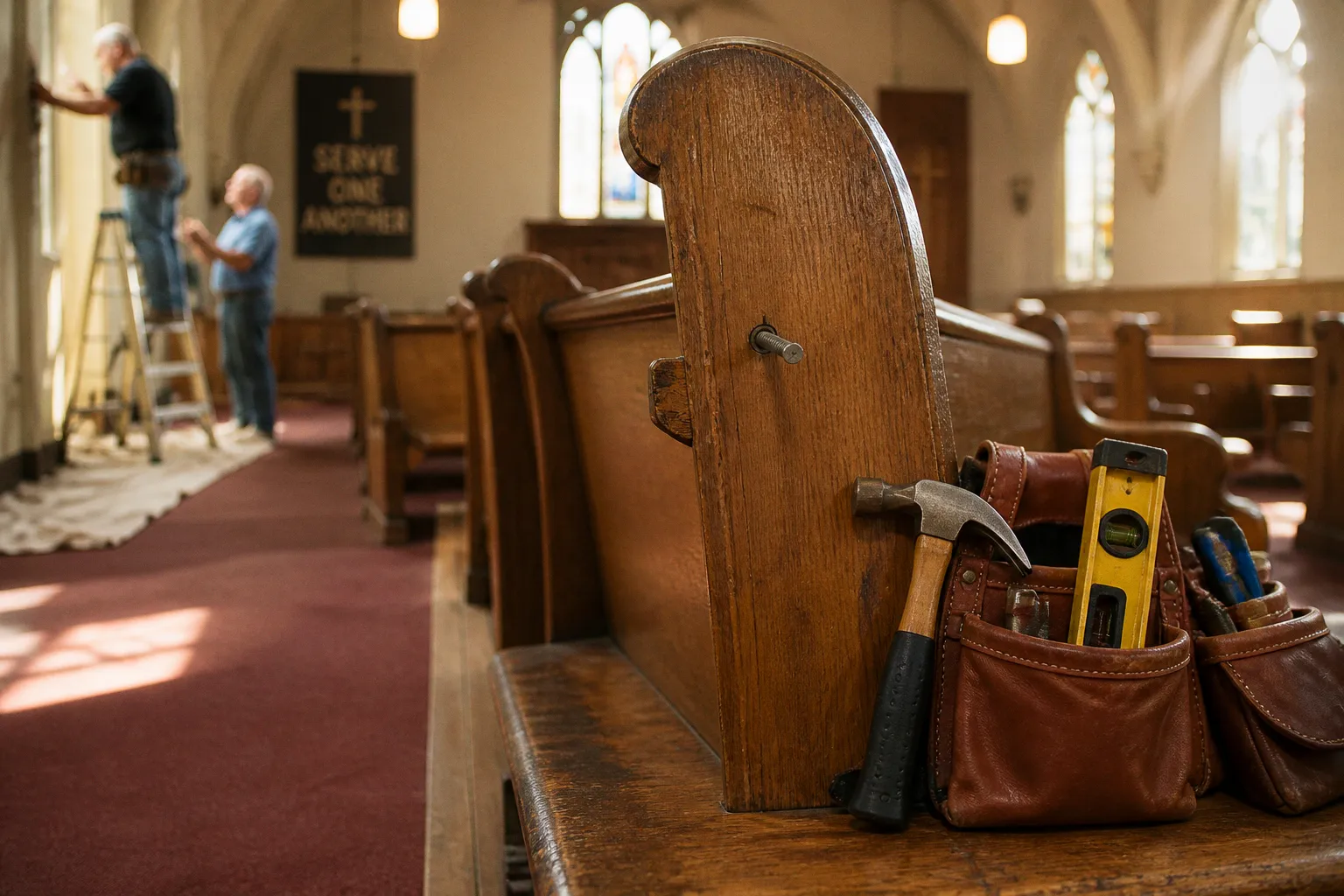
A church handyman ministry usually fails before the first tool is lifted. The failure occurs when a congregation accepts every repair request as equally appropriate, assigns work according to availability rather than competence, and treats safety as an informal courtesy instead of an operating requirement. A ministry may possess willing volunteers and genuine community need, yet still lack the framework required to determine which projects belong within its scope.
The central task is therefore not to create a longer list of services. It is to establish church handyman ministry project criteria that connect four variables: the recipient’s need, the project’s technical complexity, the volunteers’ verified capabilities, and the risks present at the work site. This framework permits a congregation to serve consistently without confusing charitable intent with technical authorization.
Defining the Scope of Service
A church handyman ministry is generally suited to minor household repairs and maintenance that can be completed by trained volunteers using ordinary tools and established procedures. The ministry is not a substitute for licensed construction, engineering, electrical, plumbing, or remediation contractors. Its efficacy depends on maintaining that distinction.
Typical projects may include:
- Replacing light bulbs and air filters where access is safe and ordinary equipment is sufficient.
- Completing minor painting and patching work.
- Performing basic plumbing maintenance, such as replacing accessible fixtures or addressing simple leaks within the volunteer team’s competence.
- Completing limited electrical maintenance only where the task is lawful, low-risk, and within the volunteer’s demonstrated capability.
- Cleaning gutters when the access conditions, height, weather, and equipment make the work appropriate.
- Removing light yard debris and completing basic seasonal cleanup.
- Installing or repairing handicap ramps only when the design, materials, slope, anchoring, permits, and construction requirements have been properly addressed.
- Performing small maintenance tasks for older adults, widows, and persons with physical disabilities who may be unable to complete them independently.
The phrase “minor repair” requires operational definition. A task does not become minor merely because the requested outcome appears simple. Replacing a light bulb from floor level is materially different from replacing one above a stairwell. Cleaning a gutter from a stable single-story position is materially different from working near an unstable roof edge. A small plumbing issue may become a water-damage event if the shutoff mechanism is inaccessible or the pipe condition is unknown.
A useful intake process classifies each request before assigning a volunteer. The classification should record the following:
1. Recipient need — whether the request concerns health, accessibility, basic habitability, ordinary maintenance, or convenience.
2. Task description — the precise work requested, not a general label such as “fix the bathroom.”
3. Required competence — the practical skills, tools, and experience needed.
4. Site conditions — height, confined spaces, electrical exposure, structural concerns, animals, weather, and occupant safety.
5. Regulatory implications — whether the work may involve permits, inspections, licensed trades, or local building requirements.
6. Completion standard — the condition that will establish whether the work is complete and safe.
This classification prevents the intake coordinator from making an informal promise before the ministry has established whether the work is suitable.
A service request is acceptable only when the ministry can define the work, match it to verified competence, and control the foreseeable risks.
The recipient’s circumstances also affect prioritization. A leaking faucet in an otherwise functional home may be less urgent than a failed air filter affecting a person with respiratory limitations, or an inaccessible entrance preventing a person with a disability from leaving the home safely. Prioritization is not a competition among worthy requests; it is an exercise in stewardship, allocating limited volunteer capacity where practical intervention has the clearest effect.
A Project-Selection Framework for Congregations
Selecting church handyman projects becomes more reliable when the congregation uses categories rather than individual impressions. The following table provides a workable initial framework.
| Project category | Usually suitable for volunteers | Conditions for acceptance | Escalation required |
|---|---|---|---|
| Routine maintenance | Light bulbs, air filters, minor painting, yard cleanup | Safe access, appropriate tools, no concealed hazard | Specialist if access or underlying damage is uncertain |
| Basic plumbing | Minor fixture replacement, simple accessible repairs | Water shutoff is known, no evidence of major leakage or contamination | Licensed plumber for concealed, extensive, or recurring problems |
| Limited electrical work | Low-risk maintenance within verified competence | Power can be isolated, local requirements are satisfied, task is clearly defined | Licensed electrician for service panels, high-voltage systems, damaged wiring, or uncertain conditions |
| Gutter and exterior maintenance | Limited cleaning or low-height work | Stable access, suitable weather, no roof-edge exposure | Specialist for steep roofs, structural deterioration, or significant height |
| Accessibility modifications | Minor ramp or access improvements | Design and anchoring are appropriate; permits and standards are addressed | Qualified contractor or inspector when structural, regulatory, or design complexity exceeds volunteer capacity |
| Structural or hazardous work | Generally outside ordinary handyman scope | Only with qualified professionals and documented controls | Contractor, engineer, remediation specialist, or other licensed trade |
The table is not a permission structure for volunteers to expand their work informally. It is a boundary-setting instrument. Even within an ordinarily suitable category, the project should be declined or referred when the conditions cannot be established.
Three outcomes should be available after intake:
- Accept: The work is within scope, the site can be controlled, and a qualified team is available.
- Accept with conditions: The work is suitable only after a site visit, additional equipment, recipient preparation, a permit, or consultation with a qualified professional.
- Refer: The task exceeds the ministry’s technical, legal, or safety capacity.
A referral is not a failure of ministry. It is a correct administrative decision when the potential harm of proceeding exceeds the ministry’s ability to manage it. Congregations can maintain a referral directory containing local contractors, accessibility specialists, municipal resources, and disaster-relief organizations. That directory converts an unsuitable request into a managed handoff rather than an abandoned need.
Handyman Ministry Safety Guidelines for Work Sites
Safety protocols should be written before the ministry encounters a serious incident. Informal instructions are difficult to apply consistently because they depend on memory, personality, and the confidence of the most experienced volunteer present. A written protocol creates a common operating language.
The most basic rule is that every project should have at least two team members on site. This two-person requirement serves several functions. It reduces the risk associated with falls, sudden illness, and isolated work; it provides a second person to observe hazards; and it establishes a basic accountability structure for the ministry. The second volunteer is not merely an assistant for carrying equipment. That person is part of the safety control.
Before work begins, the team should complete a brief site assessment covering:
- Safe entry and exit from the property.
- The location of electrical panels, water shutoffs, gas equipment, and other relevant controls.
- Floor, ladder, roof, and exterior surface conditions.
- Presence of children, pets, or other occupants who may enter the work area.
- Personal protective equipment appropriate to the task.
- Weather conditions for exterior work.
- Condition and suitability of ladders, power tools, extension cords, and hand tools.
- Any evidence of mold, asbestos, structural instability, pests, sewage, or other hazards outside the ministry’s ordinary scope.
- A clear stopping point if conditions differ from the intake description.
The work area should be controlled before tools are used. This may require moving furniture, isolating power or water, restricting occupant access, protecting finished surfaces, and establishing where tools will be placed. The discipline is ordinary, but its absence creates preventable incidents.
The ministry should also define stop-work conditions. Volunteers must be authorized to stop without needing to defend the decision to the recipient or another team member. Stop-work conditions may include:
1. The task is materially different from the approved request.
2. The work requires a skill or authorization not held by the assigned team.
3. A ladder, roof, floor, wall, or other structural element appears unsafe.
4. Power, water, or gas cannot be isolated with confidence.
5. Weather makes exterior work unsafe.
6. The recipient requests additional work that has not been assessed.
7. The team lacks the required protective equipment or suitable tools.
8. A concealed condition creates a risk of injury or property damage.
A ministry that cannot stop work is not operating a safety program. It is operating on personal confidence, which is not a sufficient risk-control method.
The Designated Safety Supervisor
A designated safety supervisor should have authority over maintenance and construction projects, including the authority to dictate safety rules and suspend work. This role should not be assigned solely by seniority or technical skill. The supervisor must understand the ministry’s scope, recognize when work exceeds volunteer competence, and be willing to reject a project or terminate an unsafe activity.
The position is distinct from the project leader. A project leader coordinates the task, communicates with the recipient, and organizes materials. The safety supervisor evaluates whether the work can proceed under the stated conditions. In a small congregation, one person may hold both roles, but the responsibilities should remain conceptually separate.
The supervisor’s framework should include four stages:
1. Pre-approval
The supervisor reviews the request, determines whether the task falls within ministry scope, and identifies whether a site visit or professional consultation is necessary. The approval should record the project limits. For example, “replace accessible bathroom fixture” is more useful than “repair bathroom plumbing.”
2. Team assignment
Volunteers should be assigned according to demonstrated competence rather than general enthusiasm. A person who can safely complete minor painting may not be prepared for gutter work, electrical troubleshooting, or accessibility construction. The ministry should maintain a simple skills register noting practical experience, training, equipment familiarity, and any limitations volunteers have identified.
3. Work-site control
The supervisor confirms that the two-person requirement is satisfied, the site assessment has been completed, and the necessary controls are in place. The supervisor should be reachable during the project, particularly when the work involves unfamiliar conditions or a vulnerable recipient.
4. Closeout
The team documents what was completed, what was not completed, any damage or incident, and whether follow-up or referral is necessary. Photographs may be appropriate when consent and privacy are properly addressed, but documentation should serve the ministry’s accountability rather than become an unnecessary collection of personal information.
The supervisor must also protect the ministry from scope drift. A recipient may reasonably identify another household problem while volunteers are present. That observation can be recorded for later assessment; it should not automatically become an extension of the current project. Scope drift is one of the common mechanisms by which a controlled repair becomes an improvised construction job.
Liability, Insurance, and the Limits of Good Intentions
A church handyman liability policy should be examined before the ministry begins accepting requests, but the term “liability policy” can conceal several distinct questions. The congregation must determine what protection exists for property damage, bodily injury to recipients, bodily injury to volunteers, vehicle use, tools and equipment, and work performed away from church property.
Volunteer participation may require volunteer missionary or liability insurance coverage, particularly when volunteers are working in private homes or on community service projects. The existence of a church’s general liability policy does not, by itself, establish that every volunteer injury, vehicle incident, or specialized activity is covered. Policy terms, exclusions, deductibles, and definitions of insured persons control the result.
The ministry’s administrative file should therefore contain:
- The relevant insurance declarations and policy language.
- A written description of the handyman ministry’s activities.
- Confirmation of whether off-site volunteer work is covered.
- Procedures for reporting injuries, property damage, and near misses.
- A record of any required waivers or recipient acknowledgments.
- A process for handling incidents without making premature admissions of fault.
- Documentation of referrals when work is outside the approved scope.
A waiver is not a substitute for competent supervision, safe methods, or appropriate insurance. Nor should a waiver be presented as permission to perform work that the ministry is not qualified or authorized to undertake. The correct order is operational: define the service, control the risk, confirm coverage, and document the assignment.
The ministry should also avoid broad promises. Public announcements should describe the service as a limited volunteer repair and maintenance program, subject to assessment, capacity, and safety requirements. Statements implying that the church can repair any household problem create expectations that the ministry may be unable to satisfy and may encourage recipients to conceal the actual complexity of a request.
Prioritizing Seniors, Widows, and Persons with Disabilities
Community repair ministries frequently serve senior citizens, widows, and persons with physical disabilities because minor household defects can impose disproportionate burdens on these recipients. The same broken fixture that is inconvenient for one household may create a mobility, sanitation, or access problem for another.
Prioritization should be based on functional effect rather than sentiment. The ministry can evaluate requests through three practical questions:
- Does the problem interfere with safe movement, sanitation, heating, ventilation, or basic use of the home?
- Does the recipient lack the physical ability, household support, or financial capacity to address the issue independently?
- Can a defined volunteer intervention materially improve the condition without introducing greater risk?
This approach supports both compassion and administrative clarity. It prevents the ministry from selecting projects merely because they are visible or easy while more consequential access problems remain unaddressed.
Accessibility projects require particular discipline. A handicap ramp installation may appear to be a straightforward carpentry assignment, yet slope, landing space, anchoring, surface stability, drainage, and local requirements can determine whether the completed structure is usable or hazardous. The ministry should not claim that volunteers may construct any ramp without professional design, permits, or inspection. Where the project exceeds basic maintenance, the correct response is to obtain qualified assistance or refer the work.
Recipient communication is also part of the service standard. The team should explain what has been approved, what materials are available, what the volunteers will not do, and what follow-up may be required. This is especially important when the recipient is vulnerable to misunderstanding, pressure, or dependency. The ministry serves the person, not merely the building.
Integrating Service with Congregational Stewardship
A handyman ministry is a practical expression of congregational stewardship, but stewardship does not mean unrestricted deployment of labor. It means the ordered use of people, tools, funds, time, and institutional authority for a defined purpose. In a Lutheran congregation, this practical work can be understood within the broader vocation of neighbor service: the ministry addresses concrete needs through ordinary means, while retaining clear distinctions between worship, pastoral care, diaconal service, and technical contracting.
That distinction improves the ministry. Worship planning follows a liturgical rubric; repair projects require a safety rubric. Both depend on defined roles, sequence, limits, and accountability. Neither becomes more faithful through improvisation alone.
A functioning program can be organized around the following administrative cycle:
1. Receive the request through a designated contact rather than through informal hallway commitments.
2. Classify the work by recipient need, task complexity, site conditions, and regulatory implications.
3. Inspect when the written description is insufficient or the risk cannot be evaluated remotely.
4. Assign a two-person team whose competence matches the approved task.
5. Supervise the site through a designated safety authority with stop-work power.
6. Complete or refer the request without expanding the scope informally.
7. Document the result, incident history, materials used, and any required follow-up.
8. Review recurring requests to determine whether the congregation needs new training, equipment, partnerships, or revised boundaries.
This cycle also creates useful data without turning ministry into a bureaucratic exercise. If repeated requests concern accessibility, the congregation may need a relationship with a qualified contractor. If volunteers regularly encounter unsafe ladders or inadequate tools, the equipment budget requires attention. If the same neighborhoods generate requests after severe weather, the church may need a disaster-relief partnership rather than an improvised response.
The strongest handyman ministry is not the one that accepts the most requests. It is the one that can state, with precision, why each accepted project is safe, suitable, and accountable.
A Defined Standard for Project Approval
The final decision should be recorded in a form that another responsible person can understand. A project approval need not be lengthy, but it should identify:
- The recipient and the relevant household need.
- The exact task approved.
- The assigned volunteers.
- The equipment and materials required.
- The principal hazards and controls.
- The identity of the safety supervisor.
- Any conditions, referrals, permits, or professional consultations.
- The expected closeout and documentation process.
Requests lacking sufficient information should remain pending rather than being accepted by default. Requests involving major structural work, unverified high-voltage electrical systems, significant roof exposure, hazardous materials, extensive water damage, or other specialized conditions should be referred unless qualified professionals and appropriate controls are formally involved.
This standard protects three parties simultaneously: the recipient, who deserves competent service; the volunteer, who should not be exposed to unmanaged risk; and the congregation, which carries responsibility for the ministry’s structure and oversight. It also protects the ministry’s credibility. A consistent refusal, properly explained, is more trustworthy than an enthusiastic promise followed by incomplete or unsafe work.
Church handyman projects are therefore best selected through a framework rather than through availability alone. Define the scope, assess the recipient’s actual need, match the work to verified competence, require two-person teams, appoint a safety supervisor with real authority, confirm insurance conditions, and maintain a disciplined referral process. Under those conditions, practical service becomes durable ministry rather than a sequence of improvised repairs.