Handyman ministry safety: essential checklist for volunteers
A church handyman ministry can do work that is difficult to outsource: repairing a loose porch step, making a home safer for an older neighbor, patching drywall after a leak, or replacing a damaged fixture. The work is tangible. The impact is immediate.
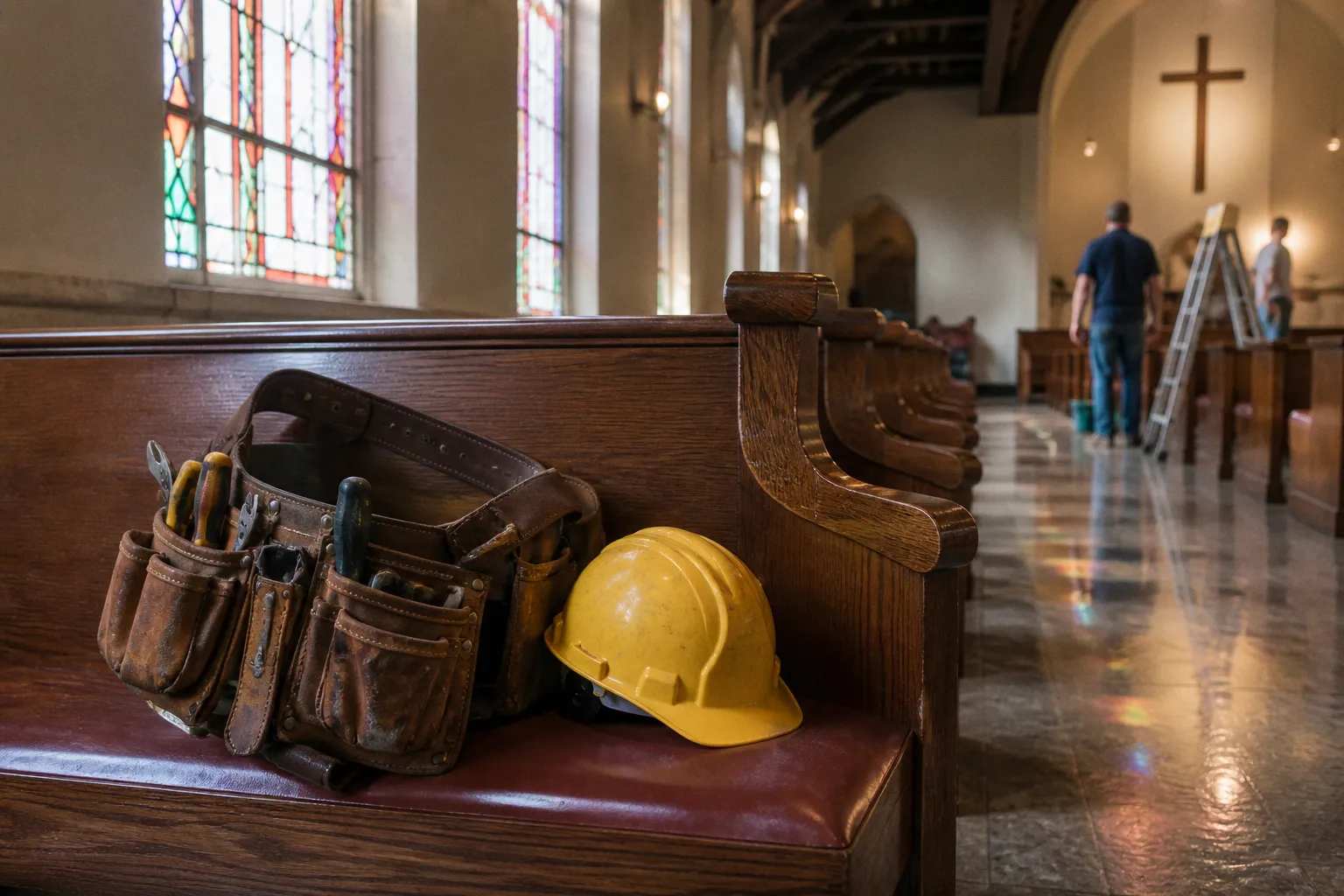
And the liability exposure is real — one fall from an unsecured ladder, one electrical shock from a damaged cord, or one poorly understood repair can turn a service project into a crisis.
Good intentions are not a safety system. A team that relies only on enthusiasm and common sense will eventually face a situation that requires clearer rules: Who is responsible for the site? Who has the right experience for the task? What happens when a volunteer is injured? Which jobs belong with a licensed professional rather than a church team?
If your congregation runs a handyman ministry — or you are building one from scratch — treat safety as part of the ministry itself. The goal is not to make volunteers feel unwelcome or bury a simple repair under paperwork. The goal is to make sure the people who serve are prepared, the people receiving help are protected, and the church knows when a project is outside its scope.
Volunteer Screening and Liability Management
Before a single hammer swings, you need to know who is on your team and whether they are prepared to work in someone else’s home. This is not bureaucratic overhead. It is the foundation that protects volunteers, homeowners, and the congregation.
A consistent screening process should account for more than a person’s willingness to help. Someone may be dependable and kind but still lack the experience, physical ability, or judgment required for a particular repair. The process should also recognize that entering a private home creates responsibilities that do not exist at a church workday.
A practical intake process can include:
- A formal application — Ask about relevant work experience, tools the volunteer can use safely, availability, transportation, and any limitations that affect assignment decisions.
- References when appropriate — For volunteers taking on leadership, entering homes regularly, or handling specialized work, references can help confirm reliability and previous experience.
- A short interview — The ministry coordinator should be able to discuss the volunteer’s skills, comfort level, and willingness to stop work when conditions become unsafe.
- Background screening where appropriate — Follow the church’s safeguarding policies, especially when a project involves children, vulnerable adults, or regular access to a private residence.
- A clear skills record — Record what a volunteer can do independently, what requires supervision, and what is outside the volunteer’s experience.
The last point matters more than many ministries expect. “Good with tools” is not a useful enough description for assigning a task. A volunteer might be comfortable with basic carpentry but have no experience with a roof transition, a gas appliance, or a circuit that keeps tripping. Skill records should be specific enough to guide assignments without turning volunteers into permanent categories.
Action step: Build a standard intake packet and use the same process for every volunteer. Include the application, emergency contact information, relevant training, consent forms required by your church, and a written description of the ministry’s expectations. If the church makes an exception, document why and who approved it.
Use a pre-service assessment before accepting the job
The safest project is often the one that was scoped correctly before the team arrived. A phone call or site visit should establish what the homeowner is asking for, what the team can reasonably provide, and what hazards may be present.
A pre-service assessment should look at:
- The exact repair, not just the homeowner’s description of it.
- The age and condition of the structure where relevant.
- Access to the work area, including stairs, narrow passages, uneven ground, and poor lighting.
- The presence of children, pets, occupants with mobility concerns, or other people who may enter the work zone.
- Signs of water damage, mold, unstable surfaces, exposed wiring, gas odors, or other conditions that require a professional assessment.
- The tools, materials, and number of volunteers needed.
- Weather and daylight conditions for outdoor work.
- Whether the work can be paused safely if the team discovers a larger problem.
Do not promise a repair before the assessment is complete. A request to “replace a light” can reveal a damaged box, an overloaded circuit, or wiring that does not match the expected setup. A request to “fix the porch” can involve deteriorated framing or a support that is carrying more weight than it should. The ministry should be willing to narrow the job, postpone it, or refer it out.
On the insurance side, do not rely on a general understanding of what church insurance “usually” covers. Coverage depends on the congregation’s policy, endorsements, exclusions, limits, the nature of the work, and the circumstances of a claim. A policy may treat routine volunteer maintenance differently from construction, work performed in a private residence, or tasks involving elevated or specialized risks.
Ask the church’s insurance agent or carrier specifically about handyman ministry work. Request an explanation of:
- Whether volunteers are covered while working on private residences.
- Whether donated labor and materials are treated differently.
- Which maintenance and repair activities are included or excluded.
- Whether the policy imposes requirements for supervision, training, protective equipment, or documentation.
- How injuries to volunteers are handled under the church’s coverage.
- Whether a contractor, permit, or professional referral is expected for certain work.
- Whether work at height, roof access, structural repairs, or powered equipment requires special conditions.
A volunteer home repair liability waiver may be part of the ministry’s paperwork, but it is not a substitute for safe conduct or insurance review. A waiver does not automatically release the church from responsibility for negligent acts, unsafe premises, or failure to address a known hazard. Its legal effect also depends on the document and the law that applies.
Your ministry’s credibility starts before the first project. Screen every volunteer, document every skill, and know exactly where your insurance coverage ends.
The useful distinction is simple: a waiver documents informed participation; due diligence shows that the ministry took reasonable steps to prevent harm. Both may have a place in the program, but neither should be treated as a magic shield.
Action step: Review the congregation’s current liability policy with the agent in the context of handyman ministry work. Ask what tasks are covered, what conditions apply, and when the church should refer a job to a contractor. Keep the written response with the ministry’s operating records and revisit it when the program changes.
The Buddy System: Essential Rules for Maintenance Teams
No volunteer should be assigned to work alone in a private home or on a task where an accident could leave them unable to call for help. The buddy system is not a ceremonial rule. It is a basic control that gives the team another set of eyes, another person to manage the work area, and another person to summon help if something goes wrong.
The second person is not automatically a qualified supervisor. Pairing two inexperienced volunteers does not create expertise. The team still needs a project coordinator who understands the assignment, knows the limits of the work, and can stop a job that has changed from a simple repair into a safety problem.
A two-person team can provide:
- Immediate response capability — One volunteer can call emergency services while the other stays with the injured person or clears the area.
- Hazard recognition — A second person may notice an unstable ladder, an exposed conductor, a trip hazard, or a homeowner entering the work zone.
- Physical assistance — Materials, ladders, and tools can be handled without asking one person to overreach or carry an unsafe load.
- Accountability — Two people can confirm what work was performed, what conditions were found, and whether the homeowner received appropriate instructions.
- Better task control — One person can perform the repair while the other maintains a clear work area and watches the immediate surroundings.
Here is how to make the system work in practice:
1. Pair by skill level, not friendship. Match an experienced volunteer with someone who is still learning when the task calls for supervision. A friendly pairing is not necessarily a safe pairing.
2. Assign roles before arrival. Identify the task lead, the safety observer, and the person responsible for communication with the project coordinator. On a small team, one person may hold more than one role, but the responsibilities should still be explicit.
3. Set boundaries for the safety observer. The observer is not there to stand passively nearby. They should watch the work area, keep children and pets away, notice changing conditions, and speak up without hesitation.
4. Do not waive the rule for a quick job. A short task can still involve a fall, a cut, a hidden wire, or an unexpected structural defect. If a job cannot be performed safely with the available team, it should wait.
5. Use check-ins. Teams should report when they arrive, when the scope changes, and when they leave. The coordinator should know the address, the expected work, the people assigned, and the planned completion time.
6. Keep private-home boundaries clear. Volunteers should avoid entering areas unrelated to the project, handling personal property unnecessarily, or transporting a homeowner without the church’s approval and appropriate safeguards.
The buddy system also protects the homeowner. A two-person team reduces the chance that a volunteer will misunderstand instructions, damage property without a witness, or become involved in a dispute that cannot later be clarified. That is not suspicion of either party. It is responsible ministry administration.
A volunteer working alone is not a hero by default. The buddy system is about having someone there when judgment, balance, or luck runs out.
Action step: Print a team assignment sheet for every deployment. List the address, the approved scope of work, the task lead, the safety observer, the coordinator’s contact information, and the emergency procedure. Complete it before anyone leaves the church parking lot.
Ladder Safety and Working at Height Protocols
Ladders deserve deliberate attention because they are often treated as ordinary household equipment. They are not forgiving when placed on uneven ground, used at the wrong angle, overloaded, or climbed by someone carrying materials. A ladder that looks serviceable in a storage room may have worn feet, bent rails, loose hardware, or a missing label.
The first decision is whether the task should involve a volunteer at all. A short, stable step ladder used on a clear interior floor is not the same assignment as reaching a second-story gutter, transitioning from a ladder to a roof, or working near a steep slope. Height, access, weather, surface condition, and the consequence of a fall all matter.
| Protocol | Practical standard | Ministry action |
|---|---|---|
| Surface placement | Set ladders on firm, level ground with all feet supported | Inspect the setup area first; do not improvise with boxes, loose boards, rocks, or unstable platforms |
| Three points of contact | Maintain two hands and one foot, or two feet and one hand, while climbing and working | Use a tool belt or hoist line for small tools; do not climb while carrying bulky materials |
| Weight rating | Stay within the manufacturer’s rated capacity, including the person, clothing, tools, and materials | Check the label before use and remove ladders with missing or unreadable ratings from service |
| Condition | Rails, rungs, feet, spreaders, locks, and hardware must be intact and functional | Inspect before each use; tag or isolate damaged equipment so nobody retrieves it by mistake |
| Extension-ladder setup | Follow the manufacturer’s instructions for angle, overlap, and securement | Secure the ladder against movement and keep the base and landing area controlled |
| Top access | Use an appropriate ladder and a safe transition method when access extends above the work surface | Do not use the top rungs or top step as a standing platform; refer difficult roof access to a professional |
| Weather and surroundings | Wind, rain, ice, wet surfaces, overhead lines, and nearby traffic can change the risk immediately | Stop work when conditions cannot be controlled rather than trying to finish the last few minutes |
The familiar four-to-one principle is a useful rule for many extension-ladder setups, but it does not replace the manufacturer’s instructions or a site-specific assessment. The ladder must also be secured where movement is possible, and the landing area must be clear. Someone holding the base can help, but a spotter should not be treated as the only control when the ladder is too long, the surface is unstable, or the work requires substantial force.
Do not use a ladder as a work platform for a task that requires prolonged side loading, heavy materials, aggressive drilling, or repeated stretching. If the volunteer has to lean away from the rails, climb above the permitted standing level, or use one hand to wrestle a large object into place, the setup is wrong.
Working near electrical lines deserves its own stop point. A ladder, gutter, long board, or metal tool can create a dangerous path even when the volunteer never touches a wire directly. The team should identify overhead and nearby electrical hazards during the pre-service assessment and change the plan or refer the work when safe clearance cannot be maintained.
Action step: Conduct a ladder audit before every deployment. Check for cracked rungs, bent rails, loose bolts, damaged feet, faulty locks, contamination, and missing safety labels. Any ladder that fails inspection stays behind. Do not allow a volunteer to “make it work” with equipment that should have been removed from service.
For roof repairs, steep slopes, second-story access, fragile roofing, and elevated work that requires specialized fall protection, use a conservative referral standard. Whether a particular task is covered by insurance or legally restricted is a matter for the policy, the jurisdiction, and the facts of the project. The ministry does not need to settle that question by taking the risk. If the congregation does not have the training, equipment, supervision, and authorization required for the work, refer it.
Power Tool Inspection and Electrical Safety Standards
A power tool should be inspected before it is connected, not after it begins making an unfamiliar noise. A tool can appear clean and still have a damaged cord, a missing guard, a loose blade, or a switch that does not operate correctly. The same discipline applies to extension cords, adapters, chargers, and temporary power arrangements.
Pre-use inspection for power tools
Before use, the assigned volunteer should check:
- The housing and guard — Look for cracks, missing components, exposed moving parts, and signs that the tool has been dropped.
- The cord and plug — Check for cuts, crushed insulation, exposed conductors, bent prongs, loose strain relief, or heat damage. Do not tape over serious cord damage and return the tool to service.
- The switch and controls — Confirm that the tool starts and stops normally and that safety switches, locks, and guards function as intended.
- Blades, bits, and accessories — Use the correct accessory for the tool and material. Dull, damaged, or incorrectly installed accessories can increase force, kickback, and loss of control.
- Battery packs and chargers — Remove batteries that are swollen, cracked, leaking, unusually hot, or otherwise damaged. Use the charger and battery combination specified by the manufacturer.
- The work area — Remove trip hazards, secure the material, improve lighting, and keep bystanders outside the immediate work zone.
- Personal protective equipment — Select protection for the task, such as eye protection, hearing protection, gloves where appropriate, respiratory protection when required, and suitable footwear.
If a tool looks wrong, pull it from service immediately. Mark it clearly and store it where another volunteer will not pick it up for the next task.
Electrical safety at the work site
Use equipment and cords in accordance with manufacturer instructions and applicable safety guidance. Ground-fault protection is especially important where electricity may come into contact with damp locations, outdoor surfaces, concrete, plumbing, or the human body. A portable GFCI device may be appropriate where the existing arrangement does not provide the required protection, but volunteers should not assume that plugging in an adapter solves every electrical problem.
Do not use damaged receptacles, loose plugs, improvised connections, or extension cords that are too light for the load. Keep cords away from water, sharp edges, heat, doors, and walkways. If a cord must cross a path temporarily, protect the area against trips without creating a new crushing or overheating hazard.
Wet conditions require a stop-and-assess decision. Rain, condensation, damp basements, wet hands, and conductive surfaces can change the risk quickly. Many tools are not intended for wet use, and even a tool that is rated for a particular environment cannot make an unsafe power source acceptable.
Use products with the approvals, markings, and instructions applicable to the place where the work is being performed. A compliance mark by itself does not prove that a used tool is safe, suitable for the task, or maintained properly. The church should follow the manufacturer’s instructions and any local requirements rather than treating one label as a universal guarantee.
Hand tools deserve the same attention. Hammers with loose heads, chisels with mushroomed striking ends, files without handles, utility knives that do not lock, and screwdrivers with damaged tips are injury hazards disguised as small inconveniences.
Action step: Create a tool inventory log. Record the make and model when available, current condition, date of inspection, defects found, and the person responsible for removing or repairing the tool. A simple green/yellow/red system can help, but the color should never replace a written reason for the rating. Equipment that remains questionable after inspection should be retired or professionally repaired.
A defective tool is an invitation to improvise. Pull it from service the moment you find a problem — not after the project and not after someone gets hurt.
Emergency Response and Professional Referral Boundaries
Every team needs a written emergency response protocol, and volunteers should know it before work begins. The protocol does not need to be complicated. It needs to be visible, current, and specific to the address and communication methods the team will use.
For a serious injury or immediate threat:
1. Call 911 or the appropriate emergency number. Do not delay the call while trying to decide whether the situation is serious enough. Describe the location, the type of emergency, and any immediate hazards.
2. Make the area safe if you can do so without creating another injury. Shut off a tool or power source only when it is safe. Keep other people away from exposed wires, unstable structures, fire, chemicals, or falling objects.
3. Do not move the injured person unnecessarily. If there may be a head, neck, back, or serious internal injury, wait for trained responders unless remaining in place presents a greater danger.
4. Provide first aid within your training. Apply direct pressure to serious bleeding when appropriate, follow dispatcher instructions, and use the first-aid supplies available. Do not perform procedures beyond your training.
5. Assign communication roles. One person should speak with the dispatcher and meet responders at the entrance. Another should stay with the injured person if it is safe.
6. Protect the scene and document afterward. Once the emergency has been handled, record the date, time, people present, task underway, equipment involved, and actions taken. Take photographs only when doing so does not interfere with care or invade the injured person’s privacy.
7. Notify the church’s designated leaders and insurer according to policy. Do not make promises about payment, fault, or coverage at the scene.
Each deployment kit should include a charged phone, first-aid supplies, emergency contacts, the project address, and a printed response card. The project coordinator should know how to reach the church’s leadership and who is responsible for incident reporting.
Emergency planning also means knowing when not to begin. A team should stop work when it discovers an active leak near electrical equipment, unstable framing, suspected gas, severe mold, damaged asbestos-containing material, significant pest contamination, or another condition that cannot be controlled with the available resources. The correct response is to secure the area, explain the concern respectfully, and arrange an appropriate referral.
Professional referral is part of responsible service
A volunteer handyman ministry may be well suited to painting, minor drywall patching, basic carpentry, simple non-structural repairs, replacing approved fixtures, and other routine maintenance within the team’s competence. The exact scope should be defined by the church’s policy, training, insurance guidance, and local requirements.
The following categories generally deserve a professional assessment or referral unless the team has the specific qualifications, authorization, equipment, and supervision required:
- Electrical systems — Requirements for permits, licensing, and who may perform particular electrical work vary by state, municipality, and task. Work involving service equipment, panels, new circuits, significant rewiring, uncertain wiring conditions, or repeated faults should be referred unless the church has confirmed that the proposed work is lawful, insured, and within the worker’s qualifications.
- Structural repairs — Load-bearing walls, foundations, major framing, compromised stairs, and roof structures can affect the stability of the entire building. Cosmetic work should not be used to conceal a structural problem.
- Gas systems — Gas lines, appliances, suspected leaks, and combustion-related problems require qualified attention. If a gas odor is present, follow emergency guidance and do not treat it as a routine handyman task.
- Hazardous materials — Suspected asbestos, lead hazards, extensive mold, contaminated materials, and unknown chemicals require an appropriate assessment. A volunteer should not disturb material merely to discover what it is.
- Roof and elevated work — Roof access, steep slopes, fragile surfaces, second-story work, steeples, and tasks requiring specialized fall protection should be referred when the ministry cannot provide the necessary controls.
- Trees and heavy equipment — Tree removal, large limbs near structures or utility lines, and operation of equipment outside the team’s training are not suitable places for improvisation.
- Permitted or regulated work — If the local authority requires a permit, inspection, license, or other approval, the ministry should confirm the requirement before work begins.
Licensing rules are not identical across jurisdictions, and insurance consequences are not identical across policies. Performing a task outside the scope of a volunteer’s training may create serious exposure, but the church should not claim that every non-licensed task automatically voids coverage or that every project requires a contractor. Confirm the actual rule with the relevant authority, the church’s insurer, and a qualified professional.
Action step: Develop a referral network before the next urgent request. Identify reputable electricians, plumbers, general contractors, roofers, and other specialists in the area. Ask whether they are licensed or otherwise authorized where required, insured, and willing to explain the work to a homeowner and church coordinator. A referral is not a failure of ministry. It is often the safest way to keep a promise without exceeding the team’s ability.
Building a Culture of Safety, Not Just a Checklist
A checklist gets the team started. A culture determines what happens when the checklist does not answer the next question.
The strongest handyman ministries do not hand volunteers a laminated card and send them out. They make safety part of planning, supervision, communication, and follow-up:
- Pre-deployment briefings — Review the specific job, access route, weather, tools, electrical conditions, homeowner expectations, assigned roles, and stop-work triggers.
- Task-specific training — Teach volunteers how to inspect ladders, secure materials, use the tools assigned to them, and report hazards. General enthusiasm is not task training.
- Post-project debriefs — Discuss what changed from the original plan, what felt unsafe, what equipment failed, and what should be handled differently next time.
- Near-miss reporting — Record events that could have caused injury or property damage even when nobody was hurt. A slipping ladder, a hidden wire, or a dropped tool is useful information when the ministry responds to it.
- Equipment maintenance — Store ladders, cords, tools, and protective equipment so that damage is visible and repairs do not disappear into a closet.
- Homeowner communication — Explain what the team did, what it did not do, and what future work requires a professional. Do not imply that a temporary repair has solved a larger building problem.
- Leadership review — Revisit the ministry’s insurance, forms, referral list, and training when the scope of work changes or a significant incident occurs.
Safety protocols for faith-based repair teams work best when volunteers are explicitly authorized to stop. A person who notices an unstable ladder or an unexpected electrical condition should not need to win an argument with the most experienced person on site. The expected response is to pause, move people away if necessary, and ask the coordinator to reassess.
The same principle applies to the homeowner’s requests. A family may be under financial pressure and may sincerely ask the church to “just take care of one more thing.” Compassion can make boundaries harder, not easier. The ministry should be honest about what it can complete safely and what needs another solution. Referring a dangerous repair protects the household instead of leaving it with a partial fix and a false sense of security.
Your handyman ministry exists to serve. That mission works only when the people doing the serving come home safe and the people receiving help are not exposed to new hazards. Good church outreach maintenance project planning does not remove every risk; it identifies the risks early enough to control them, postpone the work, or bring in someone qualified.
A safe ministry is not timid. It is prepared. It knows the difference between a useful volunteer repair and a task that requires professional judgment. It documents decisions, pairs people thoughtfully, maintains its equipment, and treats every near-miss as information rather than embarrassment.
Start with the basics: screen volunteers, assess the home before accepting the project, work in pairs, inspect every ladder and tool, prepare for emergencies, and refer work that exceeds the team’s training or authorization. That is not paperwork standing between the church and its mission. It is how the mission remains trustworthy.