Church handyman ministry: step-by-step launch guide
A church handyman ministry usually begins with a small request: a loose handrail, a burned-out hallway bulb, a gutter that has started to pull away from the house, or a furnace filter that the…
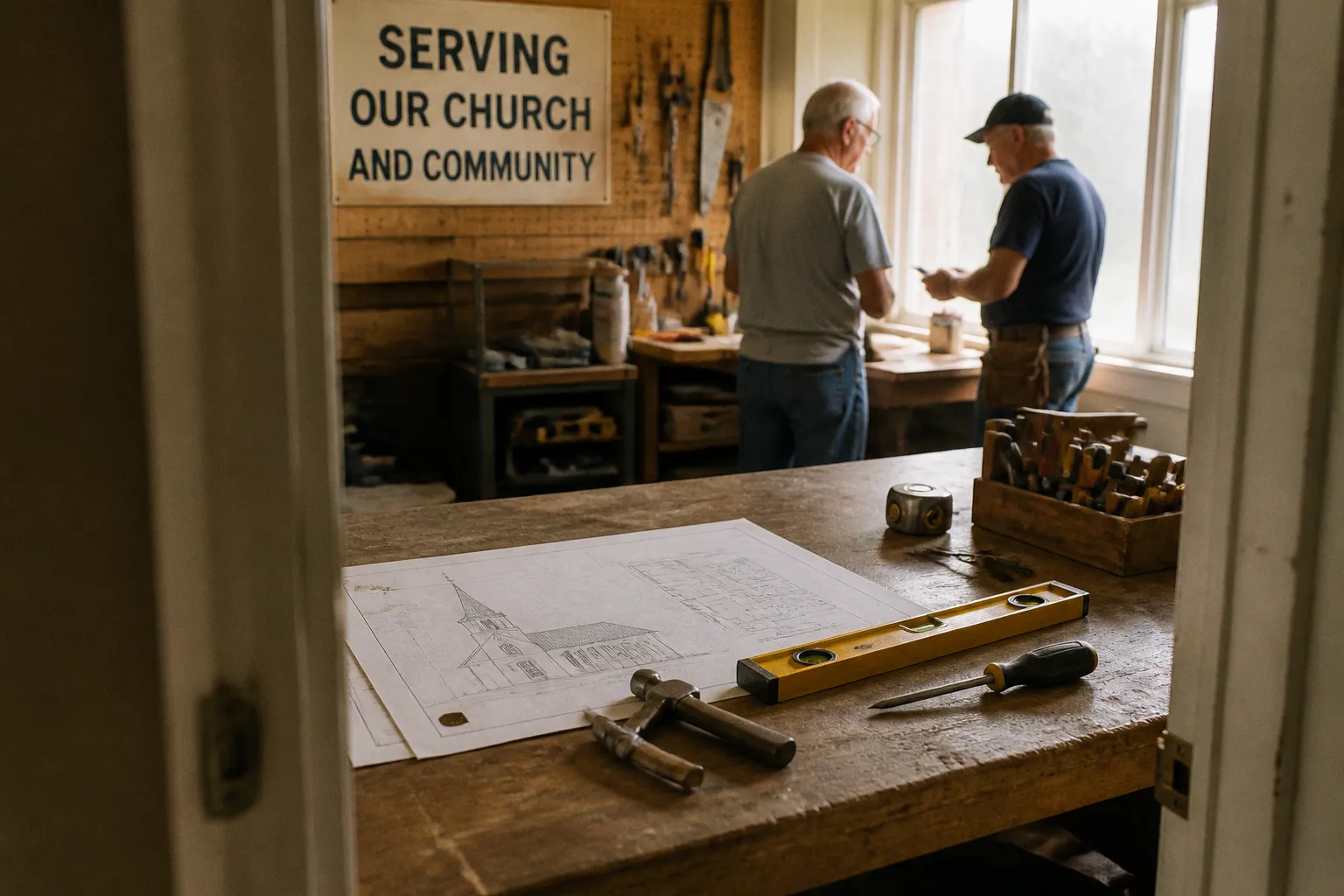
A church handyman ministry usually begins with a small request: a loose handrail, a burned-out hallway bulb, a gutter that has started to pull away from the house, or a furnace filter that the homeowner can no longer safely replace.
The repair may be modest. The need behind it may not be.
Older adults living alone, people with disabilities, widows and widowers, and neighbors whose budgets leave no room for a contractor often face a difficult choice. They can live with a hazard, attempt work that is no longer safe for them, or ask someone for help and risk feeling like a burden. A congregation can meet that need through practical service, but only if it builds a ministry with clear limits.
A church handyman ministry is quiet, unglamorous, deeply theological work. It gives physical form to a congregation’s promise that neighbors should not have to choose between safety and asking for help. Good intentions can open the door. They cannot replace insurance, screening, training, or the willingness to refer work to someone better equipped.
The most reliable church handyman ministry launch steps are not complicated: define the people and projects you can serve, establish a safety structure, confirm insurance, create a dependable intake process, and refuse work that belongs to licensed professionals or requires permits. The ministry becomes stronger, not smaller, when it knows what it must not do.
Defining the Scope: Serving Seniors and Vulnerable Neighbors
A handyman ministry exists to serve people whose housing is starting to fail them and whose bodies or finances cannot keep pace with ordinary maintenance. In practice, that may include older adults still living in their own homes, widows and widowers navigating the tasks a spouse once handled, neighbors living with disabilities, and households facing temporary financial or physical hardship.
These are not categories invented in a committee room. They are the contours of need that become visible when a church begins to listen. A request for a loose handrail may be a request about fall prevention. A request for a deadbolt may be about a person who no longer feels secure at home. A request for help changing a furnace filter may be the part of a larger story that the homeowner can say out loud.
The ministry should not try to become a general contractor, home inspection service, emergency repair company, or substitute for public assistance. Its purpose is narrower and more useful: complete small, clearly defined tasks that volunteers can perform safely and consistently, then connect the homeowner with the right resource when the problem exceeds that scope.
Typical projects may include:
- Replacing light bulbs, furnace filters, batteries, or standard hardware.
- Tightening or securing a loose handrail when the underlying structure is sound.
- Applying weather-stripping or caulk in minor, accessible areas.
- Completing small interior touch-up painting projects.
- Cleaning leaves and debris from accessible, one-story gutters when conditions are safe.
- Performing light seasonal yard cleanup.
- Adjusting doors, cabinet hardware, or other minor fixtures.
- Making small cosmetic repairs that do not involve structural systems.
The defining feature is calibration. Each task should be small enough to be completed safely by the available team with ordinary tools, and meaningful enough to improve the person’s daily life. The point is not to prove that volunteers can do everything. The point is to do the right things reliably.
Typical Project Categories
| Category | Examples | What the Team Must Confirm |
|---|---|---|
| Light interior work | Bulb replacement, filter changes, smoke-detector batteries | Safe access, compatible replacement items, no electrical fault beyond a simple replacement |
| Exterior upkeep | Accessible gutter cleaning, yard debris, light trimming | Stable ground, appropriate height, safe weather, no roof access |
| Minor repair | Loose handrails, weather-stripping, door hardware | Sound underlying materials and no structural or security-system concern |
| Minor finish work | Touch-up painting, basic caulking | Limited surface preparation and no hidden water, mold, or structural damage |
The list is a starting point, not a promise to accept every request that sounds similar. Gutter cleaning may be within scope when it involves a low, accessible section and suitable equipment. It is not within scope when the job requires walking on a steep, damaged, or icy roof. Replacing a door handle may be reasonable; replacing an exterior door that affects fire safety, security, or structural framing may require a professional.
The same distinction applies to plumbing and electrical requests. Replacing a standard light bulb is different from diagnosing a circuit. Replacing a showerhead is different from opening a wall to repair a leak. Tightening an existing handrail is different from rebuilding the framing that supports it.
A useful scope statement should be written in ordinary language. It should tell a homeowner what the ministry can usually do, what information the coordinator needs, and what kinds of work will be referred elsewhere. Clarity at the front door is kinder than an enthusiastic yes followed by a late cancellation.
Start With a Written Boundary
Before announcing the ministry, the church should write two short lists:
Work the ministry may consider
- Small maintenance tasks that do not require a permit.
- Work that does not involve structural changes or concealed systems.
- Projects volunteers can complete with their documented skills and available equipment.
- Tasks that can be performed without unsafe heights, hazardous materials, or specialized machinery.
- Jobs where the homeowner understands the limited nature of the service.
Work the ministry will refer out
- Any project that requires a building, electrical, plumbing, mechanical, or other permit.
- Work on structural components, foundations, roofs, or major framing.
- New electrical circuits, panel work, rewiring, or diagnosis of recurring electrical faults.
- Gas lines, combustion appliances, furnaces, or other systems where improper work could create fire or carbon-monoxide hazards.
- Major plumbing repairs, concealed leaks, sewer work, or water-damage remediation.
- Mold, asbestos, lead-paint hazards, pest infestation, or other environmental hazards.
- Tree removal, dangerous branches, steep-roof work, and jobs requiring specialized equipment.
- Work that calls for a licensed contractor, engineer, inspector, or other regulated professional.
The second list is not an admission that the church lacks compassion. It is how compassion avoids creating a second emergency.
The ministry is not measured by how many jobs it accepts. It is measured by whether the jobs it accepts are completed safely, respectfully, and well.
Risk Management and Liability Insurance Essentials
Before volunteers paint a wall or carry a ladder through someone’s hallway, the church needs to ask a question that may not feel pastoral at all: what happens if a volunteer is hurt? What happens if a homeowner is hurt? What happens if a tool damages flooring or a repair fails and causes additional property damage?
Risk management is the unglamorous infrastructure of mercy. Without it, the ministry can become a liability that endangers the congregation that launched it. With it, the church has a better chance of serving steadily instead of disappearing after one preventable incident.
A general liability limit of $1,000,000 is commonly discussed for church operations that include off-premises volunteer activities and hands-on work. It should be treated as a subject for discussion with the church’s insurance professional, not as a universal legal or underwriting requirement. Actual coverage depends on the insurer, policy language, exclusions, deductibles, state law, and the work being performed.
The church should describe the ministry specifically. A policy that covers ordinary worship, education, and fellowship activities may not answer every question about ladders, power tools, vehicles, or work inside a private residence. The ministry needs written clarity before its first project, not an interpretation assembled after an accident.
A conversation with the insurance broker or agent should cover at least these points:
1. Explain that volunteers will perform limited home maintenance at private residences.
2. Provide the proposed project categories instead of using only a broad label such as community service.
3. Ask whether the existing commercial general liability policy covers volunteer-driven home repair away from church property.
4. Ask about exclusions involving ladders, power tools, roofs, electrical work, plumbing, vehicles, and damage to property in the homeowner’s care.
5. Confirm whether volunteers are treated as insureds for the activities the church intends to conduct.
6. Request written confirmation of the coverage position and any required conditions.
7. If the policy is insufficient, discuss an endorsement, rider, or separate volunteer-activities policy.
8. Review the coverage whenever the ministry changes its scope and during the church’s regular insurance review.
The questions about vehicles deserve particular attention. Volunteers may drive personal vehicles to a project, transport tools, or carry materials purchased by the church. Personal auto insurance, church coverage, and volunteer activity coverage do not necessarily overlap in the way people assume. The coordinator should know who is responsible for what before a volunteer loads a ladder into a truck.
Other practical questions belong in the conversation:
- Are volunteers covered while traveling between project sites?
- Are tools and materials covered if they are damaged, lost, or stolen?
- What is the deductible, and who is responsible for it if a claim arises?
- Are there exclusions for work involving heights, electrical systems, plumbing, roofs, or structural components?
- Does the policy require background checks, supervision, training, or particular documentation?
- What incident-reporting process does the insurer expect?
- Does the policy cover damage caused by an unsuccessful repair, or only bodily injury and certain property losses?
If the answer is unclear, the project is not ready to leave the church parking lot. Uncertainty is not the same as coverage.
The Role of a Liability Waiver
A handyman ministry liability waiver for a church may be one part of the ministry’s paperwork, but it should never be presented as a magic shield. A waiver does not make unsafe work safe, does not replace insurance, and does not eliminate the church’s responsibility to train and supervise volunteers.
The church should have the waiver and any homeowner acknowledgment reviewed by legal counsel familiar with nonprofit and volunteer law in the relevant state. A generic online template may not address the actual circumstances of home repair ministry. It may also create false confidence if volunteers believe that a signature releases the church from every responsibility.
The paperwork should communicate the real boundaries of the service:
- The ministry provides limited volunteer assistance, not a guarantee of professional construction.
- The homeowner must identify known hazards and disclose relevant access or safety concerns.
- The team may stop or decline work if conditions are unsafe or the project differs from the approved request.
- The homeowner remains responsible for decisions outside the agreed task.
- The ministry does not accept permit-required work or work reserved to licensed professionals.
- Damage, injury, or a near miss must be reported promptly through the church’s process.
The language should be understandable to the person signing it. A homeowner should not have to interpret dense legal phrasing to learn what the volunteers will and will not do.
Insurance, a waiver, and an incident form serve different purposes. Insurance addresses financial protection under the policy. A waiver documents informed acknowledgment of the service and its limits. An incident form creates a record for follow-up and risk improvement. None of the three replaces sound judgment at the worksite.
Volunteer Screening and Team-Based Safety Protocols
A team-of-two approach is a strong best practice for a church handyman ministry, especially when volunteers enter a private home, work at a height, or operate power tools. A church may adopt it as a standing rule for its own projects.
That does not mean two people automatically make a project safe. They still need to understand the limits of their skills, use appropriate equipment, and stop when conditions change. A second volunteer is not a substitute for a licensed electrician, a sound ladder, or a permit.
For a small congregation, the team-of-two rule offers several forms of protection at once. A volunteer who falls, receives an electrical shock, or experiences a medical emergency is not necessarily alone. The homeowner has two people who can witness the work and the conversation. The arrangement also reduces misunderstandings about what was requested, what was completed, and what was said during the visit.
The church should decide whether the rule applies to every home visit or whether certain low-risk tasks may be handled under another approved supervision structure. Whatever standard it chooses, the church should communicate it clearly and avoid improvising at the door of a homeowner’s house.
Screening Before the First Visit
Screening should be completed before participation, not after a volunteer has already been welcomed into a home. The process should be consistent for everyone, handled confidentially, and aligned with the church’s established policy and applicable law.
A background check is not a judgment on a volunteer’s character. It is a structural kindness to the homeowner who is opening the door and to the volunteer who deserves to know that the church has taken reasonable steps to protect everyone involved. The church should also verify relevant skills honestly. A person who is comfortable changing a faucet is not necessarily qualified to diagnose a water-pressure problem. Someone who has used a household ladder is not automatically prepared for every exterior task.
Orientation should cover more than tool safety. It should address:
- The ministry’s purpose and intended population.
- The written scope of work and the projects referred out.
- The team-of-two or other supervision standard.
- Permission before entering rooms, moving belongings, or touching personal property.
- Respect for privacy, medication, mail, photographs, and personal conversations.
- Boundaries around money, gifts, transportation, and private contact.
- Procedures for pets, unsafe conditions, suspected abuse, or a homeowner in crisis.
- How to document completed work, damage, injuries, and follow-up needs.
- When to stop work and contact the coordinator.
- How to respond if a homeowner asks for additional work outside the approved request.
The relational posture matters as much as the technical one. Volunteers are entering a space where a person may already feel embarrassed by a broken fixture, a neglected yard, or an inability to manage ordinary maintenance. The ministry should never turn that vulnerability into a sermon about personal responsibility. The volunteers are there to help with the agreed task, not to inspect someone’s life.
Volunteer Onboarding Sequence
1. Receive a written application describing skills, availability, relevant experience, and references.
2. Complete and document the required background check before assigning a home visit.
3. Conduct an orientation covering purpose, scope, safety, privacy, and ministry boundaries.
4. Place an emergency contact and any required acknowledgment forms on file with the coordinator.
5. Pair a new volunteer with an experienced team leader for the first projects.
6. Review the volunteer’s fit and any concerns after the first month or two of participation.
7. Provide refresher training whenever the ministry adds a new kind of work.
The goal is not to create a bureaucracy around a light repair. The goal is to make good habits ordinary: ask before entering a room, protect a floor before using tools, return furniture to its place, report a mistake instead of hiding it, and understand that a homeowner’s dignity is part of the work.
Establishing Intake Procedures and Project Boundaries
A handyman ministry tends to fail in one of two ways: no one knows how to request help, or too many people call and the church cannot answer well. Both are pastoral problems.
The intake procedure is the front door of the ministry. It deserves the same attention the church would give any public-facing ministry. A request might come through a dedicated phone number, a voicemail monitored by the coordinator, an online form, or a referral from a pastor, social-service agency, senior organization, or community partner. The method matters less than the reliability behind it.
The church should name one coordinator and at least one backup. If messages sit unanswered, the ministry quickly becomes another source of disappointment for people who already have limited options.
Many ministries aim to return a request within a few days, often using a two- to three-day window for an initial call or assessment. That is a practical target, not a sacred deadline. The church should make a promise the team can keep. If winter weather, a volunteer shortage, or an unusually high number of requests makes the normal response time impossible, the coordinator should communicate that rather than allowing silence to do the talking.
The first call is for triage, not diagnosis. The coordinator should listen, ask clarifying questions, identify immediate safety concerns, and determine the next appropriate step. A request may need a site visit, more photographs, a materials discussion, or an immediate referral.
A reasonable intake form captures:
- The homeowner’s name, address, and preferred way to communicate.
- A description of the project in the homeowner’s own words.
- Photographs, if the homeowner can provide them safely.
- Whether the issue affects heat, water, sanitation, security, or access.
- Whether anyone in the home has mobility, hearing, vision, or communication needs.
- Known hazards, including pets, unstable surfaces, mold, exposed wiring, or recent water damage.
- Whether the homeowner owns or rents the property.
- Whether the landlord, property manager, or another agency must approve the work.
- The desired timing and any weather-related constraints.
- Whether the homeowner can purchase materials or needs help identifying a resource.
- Any previous attempts to repair the problem.
The coordinator should not collect more personal information than the ministry needs. Sensitive information should be stored securely and shared only with people who need it to plan a safe response.
From Intake to Approval
A simple review process keeps the ministry from making decisions impulsively:
1. Receive the request. Record the date, contact information, and basic description.
2. Check for immediate danger. If the request involves fire, gas, exposed electrical wiring, a failed furnace in dangerous weather, a major leak, or an urgent security threat, direct the homeowner to the appropriate emergency or professional resource.
3. Clarify the project. Ask what is broken, what has already been attempted, and whether the homeowner has photographs or relevant information.
4. Compare the request with the written scope. If the work is permit-required, structural, hazardous, or reserved to a licensed professional, refer it out.
5. Assign a qualified pair. Match the project to volunteers whose skills and equipment fit the approved task.
6. Confirm the visit. Tell the homeowner who is coming, what the team expects to do, and what it will not do.
7. Document the result. Record the work completed, materials used, concerns discovered, and any referral or follow-up needed.
The homeowner should understand that approval is limited to the described task. If the team discovers a larger problem, it should stop and contact the coordinator rather than expanding the project on the spot. A volunteer who notices water staining behind a fixture is not authorized to open a wall simply because the wall is already in front of them.
Listening is the actual work of intake. A person who calls about a handrail may also be grieving. A parent who calls about a broken lock may also be under severe financial pressure. The person who answers the phone is not merely a dispatcher; for that call, they are the ministry.
That does not mean the coordinator becomes a counselor, emergency responder, or social worker. It means the coordinator treats the person with patience and respect while knowing when another kind of help is needed. A broken lock may be an urgent security concern. A failed furnace may require an immediate professional referral. A request involving a fall, suspected abuse, or an unsafe living condition may need to be directed to appropriate community or emergency services rather than placed on the ordinary project calendar.
Navigating Permit Restrictions and Professional Contractor Limits
Permit rules are where an informal volunteer project can become a legal and safety problem. Requirements vary by jurisdiction and by the type of work, so the church should not assume that a project is exempt simply because it is small, charitable, or performed without payment.
The ministry’s rule should be direct:
The volunteer handyman ministry does not accept projects that require a building, electrical, plumbing, mechanical, or other permit. Those projects must be referred to the appropriate licensed contractor, qualified professional, public program, or permitting authority.
The church should not accept permit-required work on the theory that it can later confirm the process, find a qualified person, or handle the paperwork. If a project requires a permit, it is outside the volunteer ministry’s scope and should be referred out before work begins.
That boundary also applies when the permit question is uncertain. The coordinator should pause the request and seek guidance from the local building department, a qualified contractor, or the church’s legal and insurance advisers. The volunteer team should not make a field decision based on the homeowner’s assurance that a permit is unnecessary.
A project should be referred when it involves:
- Structural changes, additions, load-bearing components, or foundation work.
- New wiring, circuit changes, electrical panels, service upgrades, or recurring electrical faults.
- Gas piping, fuel-burning appliances, furnace installation, or combustion-system repairs.
- Significant plumbing changes, concealed leaks, sewer connections, or major drainage work.
- Roof replacement, structural roof repair, or work requiring a person to walk on a steep or damaged roof.
- Window or door changes that affect egress, fire safety, structural openings, or security systems.
- Major drywall removal after water damage or any suspected mold, asbestos, or lead hazard.
- Work requiring engineering plans, inspections, specialized equipment, or a licensed trade.
- Any task for which the available volunteers lack the necessary training or experience.
The right referral may not be obvious, and the ministry should invest time in building a local resource list. That list might include licensed contractors willing to offer reduced-cost work, county or municipal housing programs, senior-service agencies, disability resources, weatherization programs, legal-aid organizations, and emergency repair services. A referral is more useful when the church can give the homeowner a name, phone number, or clear next step rather than simply saying to find someone else.
The church should also be honest about rental housing. A tenant may need help, but the landlord or property manager may be responsible for the repair. Volunteers should not perform work that creates a conflict with a lease, violates a property owner’s rights, or leaves the tenant responsible for an unauthorized modification.
A Decision Point for the Coordinator
Before approving a project, the coordinator should be able to answer these questions:
- Is the work clearly within the ministry’s written scope?
- Does it avoid permit requirements?
- Does it avoid licensed-trade and structural work?
- Can the assigned volunteers complete it with appropriate tools and training?
- Can the work be performed without unsafe heights, hazardous materials, or dangerous conditions?
- Does the homeowner understand the limited nature of the service?
- Does the church’s insurance position cover the activity?
- Is a referral more appropriate than a volunteer visit?
If any answer is no or unknown, the ministry should pause. The pressure to help immediately is understandable, especially when the caller is vulnerable. But taking on work that the church cannot safely complete may delay the homeowner’s access to the professional help they actually need.
Building a Ministry That Can Last
A first season will teach the church what no planning document can fully predict. The congregation may discover that requests for small accessibility repairs outnumber requests for painting. Volunteers may be comfortable with interior maintenance but not exterior work. The insurance review may narrow the original scope. A local contractor may become a dependable referral partner.
Those discoveries are not signs of failure. They are how the ministry becomes honest.
The coordinator should review completed projects regularly and ask practical questions:
- Which requests were easy to understand and which required repeated clarification?
- Where did volunteers feel uncertain or unsafe?
- Were any projects approved too broadly?
- Did the team encounter recurring needs that call for a new referral partnership?
- Were homeowners clear about what the ministry could provide?
- Were materials, transportation, and scheduling handled fairly?
- Did any incident, near miss, complaint, or property concern go undocumented?
- Does the current insurance and training structure still match the work being offered?
A volunteer handyman ministry checklist can be useful here, but it should support the ministry rather than replace judgment. At minimum, the coordinator should have a record of the request, the scope decision, the assigned team, the safety concerns, the work completed, and any referral. A short, consistent record is better than a complicated system no one maintains.
The church should also guard against becoming dependent on one exceptionally skilled volunteer. If one person is the only person who understands the tools, schedules the visits, handles intake, and communicates with the insurer, the ministry is fragile. Cross-training and shared coordination protect the work from disappearing when that volunteer moves, becomes ill, or needs to step away.
Sustainability also depends on the way volunteers speak about the people they serve. A ministry can complete every repair correctly and still damage trust if it treats homeowners as projects, shares photographs without permission, or tells stories that identify people without consent. The church should ask permission before taking or sharing images and should avoid using a person’s hardship as promotional material.
The ministry’s spiritual character is not found in grand language. It appears in the details: calling when promised, arriving when scheduled, taking off muddy shoes, explaining what was done, admitting what was not done, and leaving a home safer and more dignified than the team found it.
A church handyman ministry works best when it is neither an improvised favor nor an amateur construction company. It is a small, disciplined ministry of presence and practical care. Its boundaries allow volunteers to serve without pretending to possess every skill. Its intake process helps vulnerable neighbors be heard. Its insurance and documentation protect the church from avoidable confusion. Its referral network ensures that saying no to unsafe work can still lead to meaningful help.
The faithful answer to a repair request is not always a toolbox. Sometimes it is a pair of trained volunteers. Sometimes it is a careful assessment. Sometimes it is the name of a licensed contractor and assistance making the call. All three can be acts of Christian care.
Start with the work the church can do well. Put the safety structure in place before the first visit. Refer every permit-required or professional-level project out rather than accepting an exception. Then let the ministry grow at the pace of trust, competence, and the neighbors it is called to serve.