Stewardship campaign launch: a checklist for parishes
You have roughly sixteen Sundays between now and Commitment Sunday. That's the window.
Run a transactional ask during that window and your congregation will quietly mail back pledge cards out of obligation, attend worship the next week without thinking about it, and never connect the act of giving to the work of the congregation. Run a structured six-month campaign grounded in Lutheran theology and clear logistics, and you build a culture of generosity that pays out year-round, not just on one Sunday in autumn.
The difference between those two outcomes is not budget size, congregational wealth, or pastor charisma. It is planning discipline. The parishes that consistently hit their stewardship goals treat the campaign as a deployment cycle with milestones, deliverables, and a team that owns each one. They choose a Lutheran framework before they draft a brochure. They build a Narrative Budget three months before the ask. They train ambassadors early enough to have real conversations and walk every non-pledger list four weeks after.
This checklist hands you that deployment cycle. Use it as a working document: print it, pin it to your planning room wall, and track each item against a calendar from Commitment Sunday backward.
A stewardship campaign is not a fundraising drive with a sermon attached. It is a six-month formation process where every touchpoint—letter, budget, testimony, pew card—teaches your congregation what it means to be a steward of God's love.
Anchor the campaign in Lutheran theology before you touch a calendar
Logistics without theology produces an appeal. Theology without logistics produces a sermon series that never moves money. Lutheran stewardship has to land on both feet. Before your team sets a date, lock in the theological framework that will carry every piece of communication your congregation reads between August and November.
The reason theology comes first is practical, not abstract. A congregation that hears "give because the budget needs it" will respond out of guilt for exactly one season. A congregation that hears "you already belong to a God who gives everything, and your generosity is your participation in that divine pattern" will respond out of identity. The difference shows up not just on Commitment Sunday but in January, when the first quarterly update lands and households decide whether they meant what they wrote on the card.
Two denominational resource families do this work well, and most parishes can stand up a full campaign on either one without buying anything else.
The ELCA's Stewards of God's Love resource gives you a year-round stewardship model rooted in Martin Luther's teaching that every baptized person is a steward of God's gifts. The framework treats generosity as a baptismal vocation—something you are, not something you do when the budget gets tight. Pair it with The Generosity Project if you want an intergenerational, household-centered track that walks whole families through the conversation at home, not just at church. The Generosity Project works especially well for parishes with active confirmation programs, because it folds stewardship into the household faith practices that confirmation families are already building.
The LCMS's Stewardship Under the Cross offering frames generosity through the lens of the cross: Christ first gives to us, and our giving flows from that receiving. The resource anchors every stewardship conversation in the Gospel before it touches the budget, which prevents the campaign from drifting into moralism. For Bible study integration, run the eight-part Stewardship Basics curriculum with a small group in the months leading up to Commitment Sunday. It teaches the biblical foundation every member will lean on when the pledge card lands in their hand. Small groups that complete the curriculum before the campaign begins produce ambassadors who can speak theologically about money without flinching—a skill most church volunteers have never been taught.
Either choice gives your pastor and your stewardship chair a shared vocabulary. That shared vocabulary is what stops the campaign from drifting into generic Christian-ese or, worse, into pure ask-mode. Pick the framework at your first planning meeting, six months out, and let it shape every word in every channel that follows.
| Resource | Body | Best fit | Core output |
|---|---|---|---|
| Stewards of God's Love | ELCA | Year-round generosity culture | Congregational toolkit, sermon outlines |
| The Generosity Project | ELCA | Households and families | At-home discussion guides |
| Stewardship Under the Cross | LCMS | Christ-centered giving | Book and planning guide |
| Stewardship Basics | LCMS | Small group formation | 8-part Bible study |
Six-month strategic planning roadmap
Commitment Sunday is your anchor. Lock that date first, then build the plan backward. A steady-paced campaign runs five to six months. Compressing the timeline below four months is possible, but it demands a congregation that has already internalized the theological vocabulary of stewardship and a leadership team with the volunteer capacity to absorb a faster cycle. Parishes attempting a compressed campaign without that foundation tend to produce a transactional ask rather than a formation process—and the following year's campaign starts from a lower baseline because the congregation never internalized the "why" behind the giving.
If your parish has not run a structured stewardship campaign in the past three years, give yourself the full six months. The formation work that happens in months five and six is what converts reluctant givers into willing stewards. Skipping it saves calendar time but costs you the culture change that makes the next year's campaign easier.
Six months out: formation begins
Convene the stewardship committee. Review last year's campaign with honest eyes: pledge return rate, average gift, narrative budget clarity, ambassador follow-through. Identify the single biggest bottleneck. For most parishes it is one of three problems—weak ambassadors, a confusing budget, or a pastor letter that reads like a grant request. Name the bottleneck and assign a lead to fix it.
By the end of month six you need three decisions locked in: Commitment Sunday date, campaign chairperson, and an aspirational goal framed as a ministry target, not a dollar figure. "We want to fully fund our youth mission trip and expand the food shelf's hours" is a ministry target. "We want to increase pledges by eight percent" is a financial target. The first one recruits volunteers. The second one makes everyone check their watch.
Five months out: build the team and the message
Recruit your ambassador team—ideally one ambassador for every eight to twelve households. Match ambassadors to households by life stage and pew section, not by personal friendship. A thirty-something parent should not be calling a retired couple; an empty-nester should not be cold-calling new parents with toddlers. Life-stage matching produces real conversation because the ambassador understands the financial pressures and the spiritual questions that shape the household's giving.
Draft the theme. Your theme has to do real work. It connects theological grounding to missional action. Good theme work produces a phrase that makes the budget feel inevitable: "Every household a hub of generosity" or "Rooted in grace, reaching our neighborhood." Bad theme work produces a phrase that could hang on the wall of any nonprofit: "Together we can make a difference." Hold a two-hour message workshop with the stewardship committee to land a theme that belongs to your congregation and to no other.
Four months out: produce every written asset
Finalize three core pieces: the campaign brochure, the pledge card, and the pastor solicitation letter. Each one has a distinct job and cannot do the job of another.
The brochure tells the story of ministry in plain language and points readers toward the budget. It should answer the question a first-time reader will ask: "Where does my money go, and why should I trust this process?" The pledge card is a quiet, dignified tool—never a guilt grid with giving levels in bold caps. Keep it simple: household name, pledge amount, frequency, and a line for the signature. The pastor letter is pastoral, not transactional. It names the biblical call, thanks the household for past generosity, and invites the next step as a spiritual practice rather than a financial transaction. Letters that open with a budget deficit number produce anxiety. Letters that open with a story about what the congregation's generosity made possible last year produce momentum.
Three documents, three jobs. The brochure evangelizes the vision. The card opens the door. The pastor's letter walks the household through the door with a personal voice.
Three months out: lock the narrative budget
Build the Narrative Budget this month—see the next section for the full method. Get council approval before you send anything to print, because council approval is what protects the campaign from a late-stage rewrite at the twelve-week mark. The most common failure at this stage is a council member who reads the Narrative Budget for the first time in September and objects to how a category is framed. That objection, raised three weeks before the brochure goes to print, will derail your timeline and demoralize your team. Get the document in front of council in month three. Take every objection then. By month two, the budget should be frozen.
Two months out: print, mail, and brief
Send the brochure, pledge card, and pastor letter to the printer five weeks before Commitment Sunday—not four, because vendors miss deadlines under load and you need a buffer. Use a printer who serves other parishes; they know the format and will catch costly spec errors. Ask for a proof, and have two people—not one—review that proof against the final digital file before you authorize the run.
Train the ambassadors three to four weeks before Commitment Sunday. Each ambassador needs a one-page script, a list of assigned households, eight pledge cards, and a deadline to return completed cards the morning of Commitment Sunday. Training too early means ambassadors forget the script; training too late means they have no time to make their calls. The three-to-four-week window gives every ambassador at least two full weekends to reach households before Commitment Sunday arrives.
One month out: the final stretch
Hold a campaign prayer service. Preach it yourself or invite a guest preacher with a track record on stewardship. The service prepares the congregation spiritually for the ask and gives laggards a chance to engage before the pew cards land. A prayer service is not a pep rally. It is worship, with stewardship woven into the liturgy, the hymns, and the intercessions—not bolted on as an announcement between the offering and the benediction.
Complete all ambassador phone calls two weeks before Commitment Sunday. Mail the campaign packet to every household the same week. Do not split this into two mailings. One packet, one mailing, one clean message.
Crafting a narrative budget for missional impact
The line-item budget is a tool for the finance committee. The Narrative Budget is a tool for the congregation. They carry the same numbers but translate those numbers into ministry language that a household can evaluate against its own values.
The reason a Narrative Budget matters is that most church members have never read a line-item budget, and those who have cannot connect "Utilities: $42,000" to the warm building where their children were baptized. A Narrative Budget does that translation. It takes the raw numbers and arranges them around the ministry they enable, so that every dollar a household pledges becomes a visible piece of congregational life rather than a line on a spreadsheet they will never see.
Group your expenses into five to ten larger ministry categories. Smaller parishes hold to five; larger parishes with multiple program streams can stretch to ten without losing the story. Each category gets a one-paragraph narrative, an annual cost, and a measurable ministry outcome.
Five categories that work for most Lutheran parishes:
1. Worship and Sacraments — pastoral leadership, music, liturgy supplies, sanctuary operations. This category usually absorbs thirty to forty percent of a parish budget and is the first thing members think of when they think of "church."
2. Faith Formation — Sunday school, confirmation, adult education, youth ministry. Name the number of students served and the curriculum used. Concrete details build trust.
3. Fellowship and Community Life — coffee hour, shared meals, small groups, parish events. This category is often underfunded and undervalued; a Narrative Budget can surface its importance.
4. Local Mission and Outreach — benevolence, neighborhood partnerships, emergency assistance. This is the category that most directly answers the question, "What is my giving doing in the world?" Give it real estate in the Narrative Budget equal to its theological weight.
5. Building and Operations — utilities, insurance, repairs, debt service. Frame these costs as hospitality—the warm, safe, well-lit space where ministry happens—not as overhead.
A Narrative Budget in this format does three jobs at once. It educates members on where the money goes. It reframes giving as participation in mission rather than payment for services. And it gives your ambassadors a concrete talking point for every household visit—"Your giving supports a youth group of thirty-two kids and a food shelf that served two hundred families last year"—rather than a vague "we need your pledge."
A Narrative Budget earns trust before the ask. Households that understand the mission are households that respond with generosity.
Execution phase: from ambassador training to Commitment Sunday
The execution phase is where most campaigns either lock in their momentum or visibly stall. Treat the four weeks before Commitment Sunday as a deployment operation with daily touchpoints, not as a sermon-writing project.
Pastor's role
Preach on stewardship every Sunday in the four weeks before Commitment Sunday. Tie the preaching arc to your chosen theological framework—Stewards of God's Love or Stewardship Under the Cross—so members hear one continuous voice from the pulpit, the brochure, and the small group curriculum. The pastor letter and the preaching should not contradict each other on any single point. If the letter says giving is a joyful response to grace and the sermon says giving is a duty, the congregation will feel the dissonance and default to doing nothing.
Build each sermon around one concrete stewardship story from the congregation's own life. A story about a family who started tithing after a job loss and discovered freedom in it will do more theological work than three paragraphs of systematic theology. Stories make abstract principles tangible, and tangible principles produce action.
Ambassador team in motion
Ambassadors carry the campaign in the final ten days. Their calls are not fundraising calls. They are pastoral check-ins that end with a clear next step: "Would you prayerfully consider your pledge and bring your card to worship on Commitment Sunday?" Train ambassadors to leave space after that question. Silence is part of the script. An ambassador who fills the silence with a second pitch signals to the household that the first invitation was not sincere.
Give each ambassador a short list of talking points drawn from the Narrative Budget. If an ambassador can say, "Your pledge this year will help us keep the food shelf open an extra day each week," the conversation has substance. If the ambassador can only say, "We really need your support this year," the conversation has nothing for the household to hold onto.
Commitment Sunday logistics
Prepare the sanctuary. Place extra pledge cards in every pew—running out of cards signals to members that the campaign matters less than the service itself, and that single detail can quietly reduce your response rate. Have cards available at the welcome desk, in the narthex, and in the restrooms. Members who forgot their card at home should never have to ask for one.
Announce the commitment early in the service, before the sermon, when the congregation is most attentive. Have one lay member deliver a three-minute personal testimony on what stewardship means in their household. Keep the testimony honest and specific—a real story about a real decision, not a rehearsed speech about the joy of giving. The pastor preaches on stewardship immediately after the testimony, building to a direct invitation to complete the card during the closing hymn.
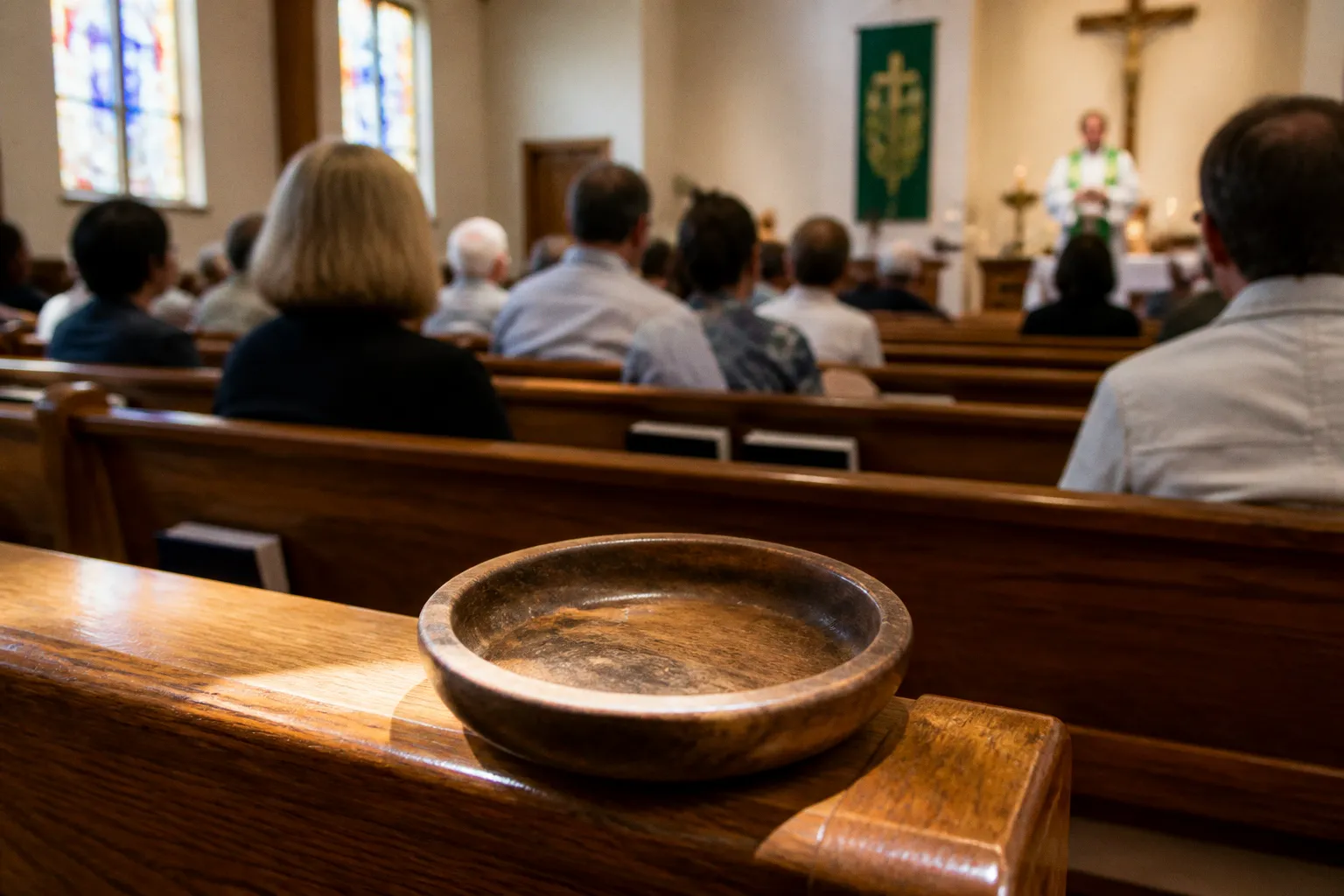
Collect cards as members exit. Have ushers and ambassadors stationed at every pew end and at every sanctuary door with a wooden plate or a labeled basket. Do not pass the plate; that crosses the offering line. The campaign collection is its own act. Members who complete their card and place it in the basket as they leave are making a physical gesture of commitment that reinforces the spiritual one they just made in the pew.
Post-campaign stewardship and celebration
The campaign ends on Commitment Sunday. Stewardship begins the next morning. Post-campaign follow-through separates parishes that grow year over year from parishes that reset to zero every January.
Send personal thank-you notes to every pledging household within seven days of Commitment Sunday. A handwritten note carries weight precisely because it is inefficient—the household knows a real person sat down, picked up a pen, and wrote their name. Budget the postage and the cards in your campaign plan from the start so that cost is never an excuse for skipping this step.
Announce pledge results to the congregation for three consecutive Sundays. Use a milestone metric—"115 households have committed to date, representing a strong response from our community"—rather than raw dollars for the first two Sundays. Save the dollar total for the celebration event, where the number lands in a context of gratitude rather than comparison.
Hold the celebration event three weeks after Commitment Sunday. This is a fellowship meal, not a follow-up fundraising appeal. The job of the event is to thank the congregation for the collective act of giving, name the ministry that the pledges will fund in the coming year, and signal that the conversation about generosity continues year-round, not just in autumn. Invite the youth group to describe their mission trip plans. Have the food shelf director share a story from the past month. Let the congregation see, in real human faces, what their pledges will make possible.
Follow up with non-pledgers on a tight schedule. Mail a thank-you-without-judgment letter at two weeks. Make personal phone calls at one month. Frame both contacts as care, not pressure: "We missed your pledge card and want to make sure you know you are still part of this community." Anyone who explicitly opted out of pledging in a prior year should be removed from this list—repeated contact erodes trust. The goal is invitation, not pursuit.
Common operational mistakes to avoid
1. Running a campaign without a formation phase. A compressed timeline can produce a functional ask, but parishes that skip the theological and narrative groundwork tend to see lower pledge return rates the following year because the congregation never connected giving to identity.
2. Combining financial pledges with a time-and-talent recruitment fair. These are two distinct conversations with two distinct audiences. Mixing them confuses the ask and weakens engagement on both fronts.
3. Treating ambassadors as askers rather than listeners. Ambassador calls that lecture households about tithe math produce resistance. Calls that listen first, name a specific ministry need, and then invite produce trust.
4. Skipping the Narrative Budget. A line-item budget mailed to pledge households produces confusion and disengagement. A Narrative Budget produces ownership, because households can see exactly what their generosity sustains.
5. Publishing dollar totals on Commitment Sunday. Members who gave sacrificially will feel exposed by the public number; members who didn't pledge will disengage for the rest of the year. Hold the number for three weeks and release it in a context of celebration.
Run this as a campaign, not an appeal
Your congregation will receive one structured stewardship season every year. Make that season count by treating it like a deployment cycle: locked milestones, owned deliverables, an ambassador team in motion, and a post-campaign follow-through that does not stop at the door.
Parishes that execute this checklist with discipline build pledge cultures that deepen over time, because every cycle reinforces the theological foundation and the relational trust that the previous cycle established. Parishes that wing it reset every autumn and wonder why generosity feels like extraction rather than worship.
Pick your framework. Pick your dates. Pick your team. Then run the checklist top to bottom, every item, no shortcuts. The kingdom work funded by your congregation next year depends on the discipline you bring to the planning room this week.