Lutheran voters' assemblies: structure and authority
A Lutheran congregation may worship together every Sunday, but its most consequential decisions are often made in a different room, on a different day, under rules many members have never read.
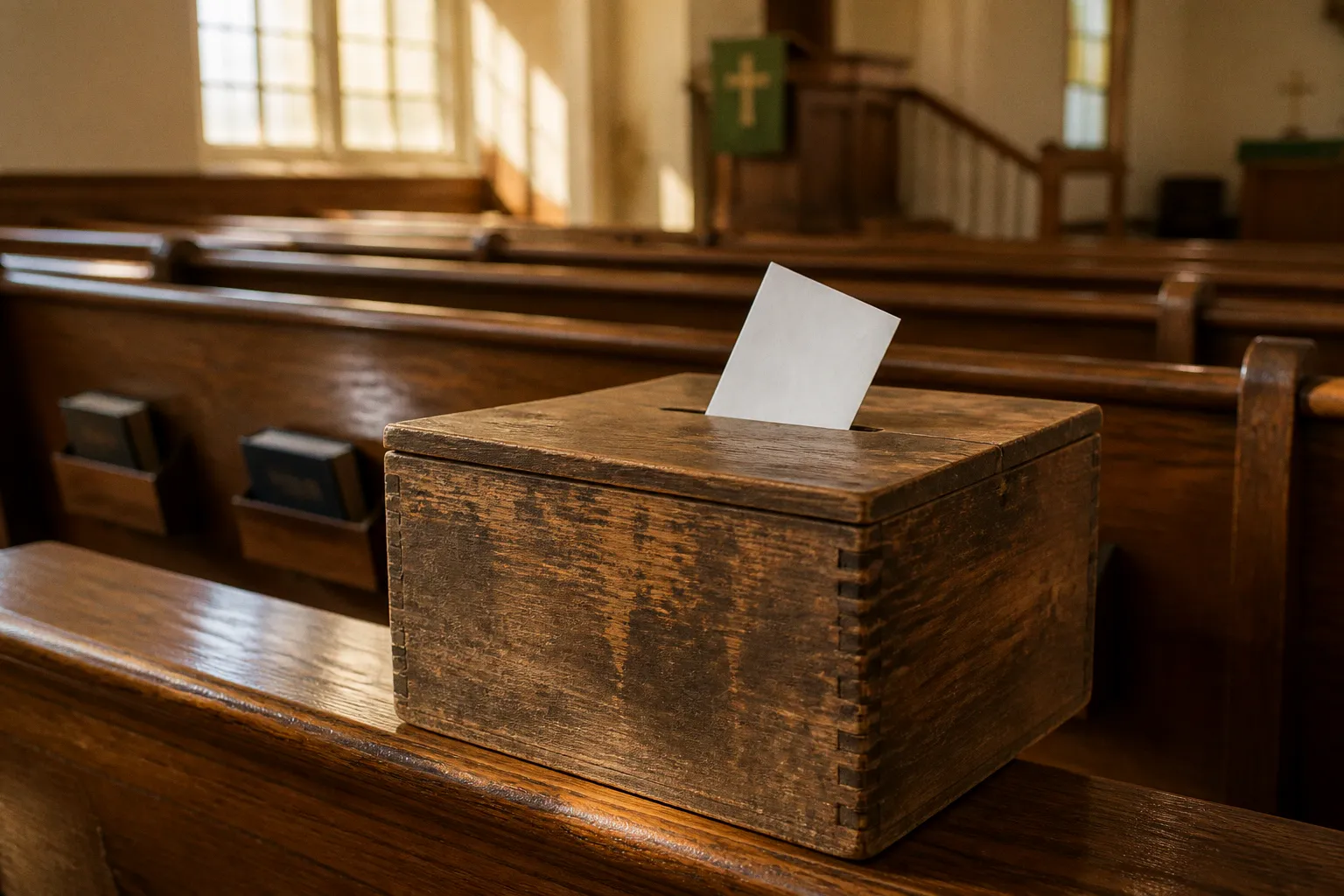
Lutheran voters' assemblies: structure and authority
The voters' assembly is the body that may approve the budget, authorize a property transaction, elect officers, amend the constitution, and formally call a pastor. If you have ever left a church council meeting wondering, “Who actually decides this?” the answer is usually found in the congregation’s constitution and bylaws—and, in many congregations, on the assembly floor.
The phrase voters' assembly is used most often in congregations shaped by a congregational polity in which eligible voting members exercise authority directly. Other Lutheran bodies may use terms such as congregational meeting or assign more routine responsibilities to a congregation council. The names differ, but the underlying question is the same: which body has the authority to make a decision binding on the parish?
The voters' assembly is not simply a larger committee. It is the place where the congregation exercises whatever authority its constitution reserves to the voting membership.
That last qualification matters. A voters' assembly does not have unlimited power merely because it is the largest formal gathering of members. Its authority is defined by the congregation’s governing documents, shaped by its synodical relationship, and bounded by the church’s doctrine and legal obligations.
The Role of the Voters' Assembly in Congregational Polity
A useful way to understand the assembly is as the congregation’s legislative body. It does not conduct every ministry, supervise every staff member, or settle every weekly operational question. Those tasks normally belong to the pastor, congregation council, board, committee, or staff member assigned to them. The assembly sets direction, authorizes major actions, and holds the elected leadership accountable.
In a congregation with a strong voters' assembly tradition, the council prepares proposals and administers decisions, while the assembly gives those decisions their formal authority. The pastor leads worship and provides spiritual care. The treasurer manages the financial records. Committees carry out specific ministries. None of those roles should be confused with the body that has final authority over matters reserved to the congregation.
Typical assembly business may include:
- adopting the annual operating budget;
- approving major capital projects and expenditures;
- purchasing, selling, mortgaging, or leasing church property;
- electing officers, council members, and other leaders;
- calling ordained or commissioned ministers where the governing documents assign that responsibility to the congregation;
- approving constitutional amendments and bylaw changes;
- receiving reports from the pastor, council, treasurer, and ministry boards;
- making decisions about membership discipline when the constitution assigns that action to the assembly.
The exact list is never safely inferred from tradition alone. Two congregations in the same town may use the same word—assembly—while assigning different responsibilities to the council and the voting membership. One constitution may require a congregational vote for a large building project. Another may authorize the council to act within a budget already approved by the assembly. One may reserve the election of every committee chair to the assembly. Another may leave those appointments to the council.
The first task for any parish is therefore not to ask what Lutheran congregations usually do. It is to ask what this congregation’s constitution says.
That question becomes especially important when a dispute involves authority that has been delegated informally over time. A committee may have handled a task for years without anyone objecting. That history does not automatically prove the committee has constitutional authority to continue doing so. Delegation should be explicit, recorded, and limited. Otherwise, a congregation can discover that a routine practice has quietly displaced the procedure required by its own governing documents.
Exclusive Powers: Calling Ministers and Managing Property
The call of a pastor or other rostered minister is one of the clearest examples of a decision that deserves careful treatment. In many Lutheran congregations, the formal call belongs to the congregation’s voting members and cannot simply be issued by a search committee or congregation council. A search committee may gather information, interview candidates, recommend a name, and explain the candidate’s gifts to the congregation. The committee’s work is preparatory. The formal call is made by the body authorized to make it.
The same principle applies when the congregation considers ending a call. The procedure may involve resignation, retirement, mutual agreement, disciplinary action, or another circumstance described in the governing documents. Whatever the reason, the congregation should not treat termination as an informal personnel decision if its constitution reserves the call to the assembly.
The practical distinction is straightforward:
1. A committee develops a recommendation.
2. The council or another authorized body places the matter before the congregation.
3. The body named in the constitution votes on the call.
4. The action is recorded in the minutes and communicated through the required channels.
The exact process can vary. Some congregations require a special meeting, advance notice, a particular majority, or consultation with the synod. Some distinguish between ordained and commissioned ministers. Some use a written ballot for a call vote. These are not details to improvise once the meeting has begun.
The authority over property is different in character but equally consequential. A congregation may delegate maintenance, routine repairs, or expenditures within an approved budget to a board or council. The purchase or sale of real estate, the assumption of debt, or the granting of a mortgage generally deserves a higher level of congregational scrutiny. Whether assembly approval is mandatory—and whether synodical approval or consultation is also required—depends on the constitution, bylaws, and applicable church procedures.
A property vote should not be reduced to a question of price. Members may need to consider:
- whether the proposed use fits the congregation’s mission;
- how the transaction affects long-term debt and operating costs;
- whether the property is accessible and suitable for worship and ministry;
- whether the congregation can maintain it;
- whether restrictions, zoning, insurance, or title issues affect the decision;
- whether the synod or another church body must review the transaction.
This is where good governance is more than procedural caution. A building decision can shape worship, education, childcare, community programs, staffing, and the congregation’s financial capacity for years. The assembly should receive enough information to make a real decision, not merely ratify a conclusion reached elsewhere.
The assembly should not be asked to choose between a surprise and a prepared proposal. Major decisions require notice, documents, alternatives, and enough time for members to deliberate responsibly.
Budgets and staffing decisions sit between routine administration and major congregational authority. A council may supervise employees within an approved plan, but the assembly may need to approve the budget that creates or funds those positions. Compensation, benefits, and staffing structures should be handled according to the division of authority set out in the bylaws. When the documents are silent, the congregation should clarify the rule before a disagreement turns into a test case.
Navigating Quorum Requirements and Procedural Bylaws
The most important governance document in a voters' assembly meeting may be the least dramatic one: the bylaws. They determine who may vote, how meetings are called, what notice is required, how quorum is established, and what majority is necessary for different kinds of action.
Three concepts cause most procedural confusion.
Who is eligible to vote?
“Parish voting members” may not mean everyone who attends worship. A constitution may define voting membership by age, baptism, confirmation, reception into membership, contribution, regular participation, or some combination of those requirements. Some congregations maintain a formal roster. Others require members to meet stated participation standards before voting at a particular meeting.
The membership list should be settled before the meeting, not debated for the first time when a controversial vote is about to begin. If the rules require a sign-in process, a certification by the secretary, or a review by the council, follow that process consistently. Selective enforcement creates doubts about the result even when the underlying decision is sound.
What counts as quorum?
Quorum is the minimum number of eligible voting members required for the assembly to conduct binding business. Common approaches include:
| Quorum method | How it works | Governance concern |
|---|---|---|
| Fixed number | A stated number of voting members must be present | A small number may be workable for a small parish but too low after membership grows |
| Percentage | A fraction of the voting membership must attend | The number changes with the roster and requires an accurate membership count |
| Members present | A properly announced meeting may conduct business with those who attend | Notice and eligibility rules become especially important |
A quorum is not the same as a majority. Quorum determines whether the body may act at all. The voting threshold determines whether a particular motion passes.
The meeting should establish quorum at the beginning, and the chair should understand what happens if members leave. Some bylaws treat quorum as a continuing requirement. Others address it less explicitly. If a high-stakes vote is scheduled late in the meeting, confirming that quorum remains present is a prudent practice even when the bylaws do not expressly require a second count.
Which majority is required?
Routine motions often pass by a simple majority of votes cast, but that phrase has a precise meaning. Abstentions may not count as votes cast, while an absolute majority may be calculated from the entire eligible membership or from those present. A two-thirds threshold may apply to constitutional amendments, property transactions, discipline, indebtedness, or a pastoral call.
The agenda should identify the governing rule for significant votes. Members should know whether the motion requires:
- more than half of the votes cast;
- more than half of those present and eligible;
- two-thirds of votes cast;
- two-thirds of the total voting membership; or
- another threshold specified in the constitution.
Do not rely on the chair’s memory of “how we have always done it.” If the wording is unclear, pause and obtain an authoritative interpretation before proceeding. A short delay is preferable to a vote that must later be repeated because the congregation used the wrong standard.
A reliable meeting also depends on notice. The notice should state the time, place, and purpose of the meeting, especially when the agenda includes a constitutional amendment, property transaction, call, disciplinary action, or other matter for which the bylaws require special notice. Adding a major issue from the floor may feel efficient, but it can deprive absent members of the opportunity to participate and may invalidate the action.
Turnout is a related practical concern. Congregations sometimes experiment with childcare, clearer advance communication, transportation assistance, or a meeting time that does not compete with Sunday schedules. Moving a meeting from immediately after worship to a separately scheduled session may give members more room to prepare. These changes may improve participation, but no scheduling choice guarantees a particular attendance result. The goal is not to manufacture a vote; it is to make participation realistically possible for the members the constitution recognizes as responsible for the decision.
Synodical Variations in Governance and Voting Rights
There is no single Lutheran model of congregational governance. The authority of a local voters' assembly depends partly on the synod to which the congregation belongs and partly on the congregation’s own constitution.
ELCA congregations
In the Evangelical Lutheran Church in America, many congregations use a congregational meeting and a congregation council rather than the traditional “voters' assembly” terminology. The council generally serves as the congregation’s elected governing body between meetings, while the congregation acts on matters assigned to it by the constitution and bylaws.
ELCA governance is connectional. A congregation participates in a synod and in the churchwide organization, and its constitution is normally related to a model constitution and required provisions. That connection does not mean every local decision is made by the synod or churchwide body. The local congregation retains responsibility for the matters assigned to it, while broader church structures exercise the authority given to them by the church’s governing documents.
Congregations should therefore distinguish between:
- decisions made by the local congregation;
- actions administered by the congregation council;
- synodical responsibilities involving rostered ministers, discipline, consultation, or ecclesial relationships; and
- churchwide matters handled through the denomination’s representative legislative process.
LCMS congregations
In the Lutheran Church—Missouri Synod, the voters' assembly is a familiar form of local governance. Congregations commonly use the assembly to elect leaders, approve budgets, authorize major property decisions, and act on calls or other matters reserved to the congregation.
The local congregation is not identical to the synod. District and synod structures have their own conventions, officers, and responsibilities, and local congregations participate through the representation and processes established by those bodies. The district president may have an important role in pastoral calls, ecclesiastical supervision, and dispute resolution, but that role should not be confused with the congregation’s formal act of extending a call when local law and the congregation’s constitution reserve that act to the voters.
An LCMS congregation should read its own constitution alongside current synodical requirements. Older local documents sometimes use language that no longer matches the congregation’s actual practice, especially around commissioned ministers, officer elections, or property procedures.
WELS congregations
The Wisconsin Evangelical Lutheran Synod also uses congregational voters' assemblies, but its rules concerning voting and offices differ from those of many other Lutheran bodies. In WELS congregations, voting and the exercise of authority in the congregation are shaped by the synod’s interpretation of biblical teaching and by the congregation’s governing documents. Questions about who may vote, serve as an officer, or exercise authority should be answered from current WELS guidance and the local constitution rather than from assumptions based on another synod.
At the wider-church level, WELS uses district conventions, conferences, and a synod convention, each with a defined purpose. Conferences can support discussion, preparation, and coordination, but they should not be described as a substitute for the formal convention structures through which synodical business is conducted. The relationship between local congregations and the wider church is therefore mediated through several bodies, not through a single uniform model shared by ELCA, LCMS, and WELS.
These differences matter during a merger, affiliation change, pastoral call, or constitutional revision. A congregation moving from one synodical context to another may need to revise its terminology, voting eligibility rules, officer structure, property provisions, and procedures for handling calls. The transition is not merely administrative. It changes which documents govern the congregation and which outside bodies must be consulted.
Legislative Authority Beyond the Local Parish
Local authority does not mean isolation. A congregation’s decisions operate within a wider church relationship and, in some cases, within civil law.
Calls and rostered ministry
A congregation may have the authority to call a pastor while still relying on the synod for roster information, consultation, candidate recommendations, and ecclesiastical oversight. The local body and the synod do different work. The congregation identifies the person it wishes to call through its authorized process. The synod helps ensure that the candidate is eligible for service within that church body and that the call is handled in accordance with the relevant standards.
That division can feel uncomfortable when a congregation strongly prefers a candidate who is not available, not eligible, or not approved for the proposed form of service. It is not necessarily a conflict between local and synodical authority. It is a reminder that the call belongs to a particular church body, not only to a local employer.
Disputes and procedural failures
Synods often provide consultation, mediation, ecclesiastical supervision, or other forms of dispute resolution. The exact role differs by denomination. A synodical officer may help a congregation resolve a conflict over an election, budget, call, discipline, or property. That assistance does not automatically erase a properly conducted local vote. It may, however, expose a procedural defect that makes the vote unreliable or requires the congregation to act again.
A congregation should be especially cautious when a disputed decision involves inadequate notice, an unclear voting roster, loss of quorum, a conflict of interest, or a motion that was never properly placed before the assembly. Winning a procedural argument in the moment is not the same as producing a durable decision.
Doctrine and the limits of local legislation
The assembly has legislative authority over many aspects of congregational life, but it cannot simply redefine the faith the congregation confesses. A local vote cannot turn a doctrinal question into an ordinary budget motion. Congregational constitutions typically connect the parish to Scripture, the Lutheran confessions, and the standards of its synod. Those commitments limit what the assembly may lawfully or ecclesially decide.
This does not mean every disagreement is doctrinal. A debate about worship scheduling, staffing, building use, or outreach may involve theological values without being a formal doctrinal amendment. The point is to identify the level of the question before choosing the procedure. A congregation that tries to settle a doctrinal dispute through an improvised local resolution may create confusion rather than clarity.
Stewardship and the wider church
Annual support for synodical work, seminaries, missions, disaster response, and other ministries may appear as ordinary budget items. The assembly is often responsible for approving the financial commitment, but the decision also expresses the congregation’s relationship with the wider church.
Members should be able to see how the amount was calculated, what obligations are fixed, what commitments are proposed, and how the decision affects local ministry. Treating wider-church giving as either untouchable or irrelevant avoids the real work of stewardship. The assembly’s role is to deliberate openly about the congregation’s resources and obligations.
Making the Assembly Work Better
A congregation does not need a complicated parliamentary culture to govern well. It needs clear documents, prepared officers, and a shared understanding of which questions belong to which body.
Before a significant meeting, the council or assembly chair should confirm:
1. The source of authority. Identify the constitutional or bylaw provision that places the matter before the assembly.
2. The eligible voters. Use the membership rules consistently and resolve questions before the meeting opens.
3. The notice requirement. Check whether the matter requires a stated purpose, special notice, or a separate meeting.
4. The quorum. Know both the number required and whether quorum must be maintained throughout the meeting.
5. The voting threshold. State whether the motion requires a simple majority, an absolute majority, a supermajority, or another standard.
6. The supporting documents. Circulate budgets, property information, proposed amendments, call materials, or other relevant records in time for members to review them.
7. The minutes. Record the motion, the result, the applicable threshold, and any required follow-up.
The assembly also works better when it is not asked to perform the council’s job in public. Members should receive a clear proposal rather than a collection of unresolved questions. At the same time, preparation should not become preemption. A recommendation is not a substitute for the vote reserved to the assembly.
The chair’s role is procedural rather than merely managerial. A good chair protects the rights of members who support the motion and those who oppose it. That means recognizing speakers fairly, keeping discussion connected to the motion, preventing personal attacks, and refusing to rush a decision simply because the meeting is running long. The secretary’s record is equally important. Minutes should show what the congregation actually decided, not merely that “a discussion was held.”
When the governing documents are outdated, the congregation should revise them deliberately. A bylaws review can clarify:
- the difference between the assembly and the council;
- the eligibility and responsibilities of voting members;
- the quorum formula;
- the thresholds for property, debt, discipline, and constitutional changes;
- the process for calling and releasing ministers;
- the authority delegated to committees;
- the relationship between local officers and synodical bodies;
- the procedure for electronic notice or other modern communication practices, where permitted.
A revision should not be written only to solve the conflict currently occupying the congregation. Good bylaws should still make sense after the personalities involved have moved on.
The Authority of the Assembly Is Only as Strong as Its Rules
The voters' assembly is powerful because it gives the congregation a visible, accountable way to act together. It can approve a budget, authorize a building decision, elect leaders, amend the rules, and issue a pastoral call. But its authority is not created by attendance, volume, or custom. It comes from the constitution and bylaws, the congregation’s relationship to its synod, and the limits that govern the church’s common life.
That is why the best question at a contentious meeting is not “Who has the most influence?” It is “Where does the authority for this decision come from, and have we followed the rule that governs it?”
Once that question is answered, the procedure becomes easier to defend. The council can prepare without overreaching. Committees can recommend without pretending to decide. Synodical officers can advise without replacing the congregation. And parish voting members can take responsibility for the decisions that belong to them.
A healthy assembly is not one that votes on everything. It is one that knows what it must decide, what it may delegate, and when the congregation’s formal voice is required.