Church calendar planning: fixing scheduling fatigue
Ask any pastor what keeps them awake on a Tuesday night, and you will often hear about something that has no business haunting the work of ministry: the calendar.
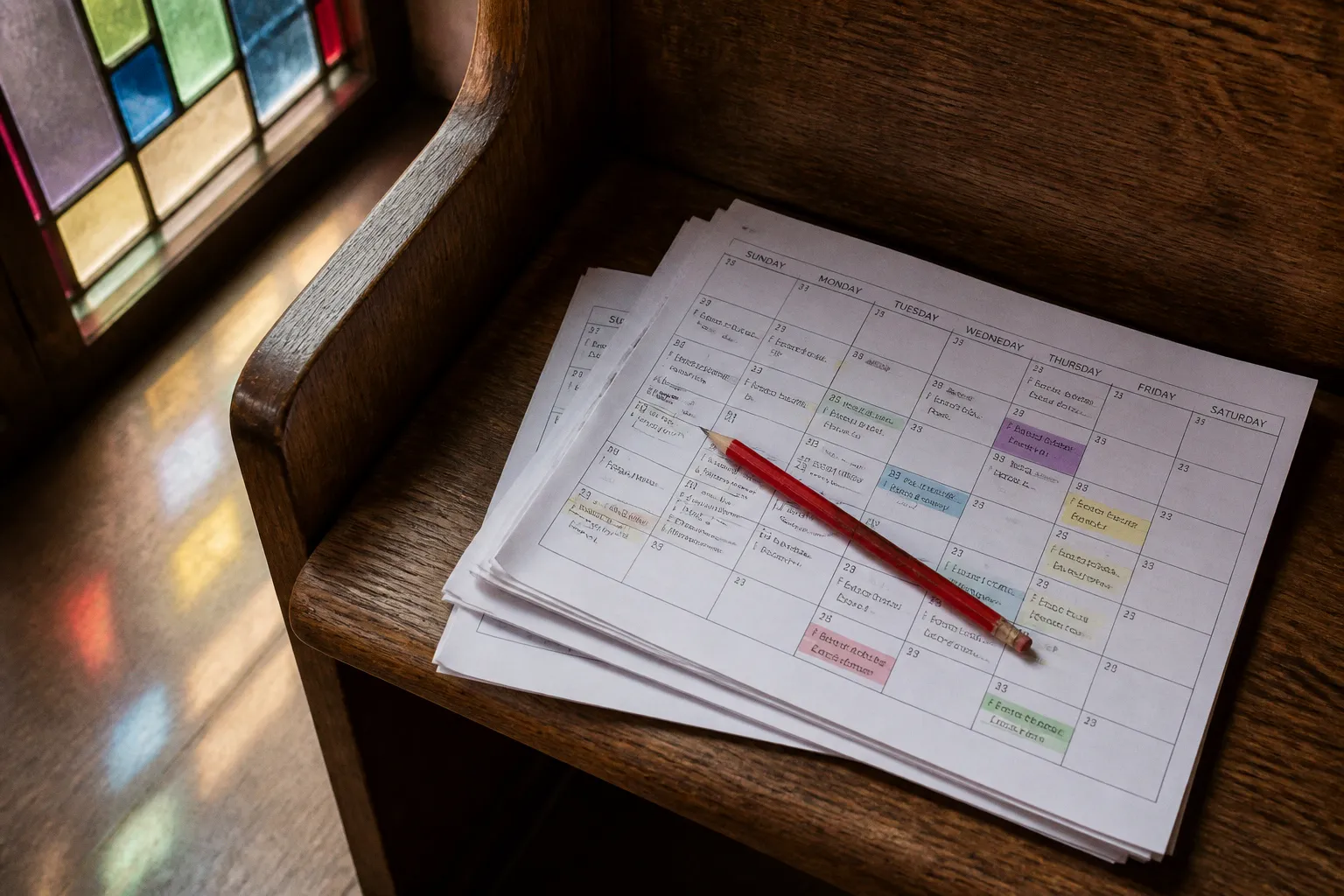
Church Calendar Planning: Ending the Cycle of Scheduling Fatigue
Not the proclamation of the gospel itself, not the slow formation of disciples, but the relentless logistics — the constant triage of who is serving when, the unspoken pressure on volunteers to fill every empty slot, the way a single well-intentioned program can quietly devour the margin a family needs to recover from Sunday morning. We have entered an era where scheduling fatigue is no longer a side effect of parish life; it has become a defining feature of it. And if we are honest, the church calendar planning mistakes we have made over the years — layering event upon event without counting the cost — are what built this weight.
This is a season to pause, take a breath, and remember that a calendar is not a record of activity. It is a confession of priorities. What we schedule, what we refuse to schedule, and what we hold open for the unexpected — these are theologies written in ink. Below is a practical framework for repairing a calendar that has begun to exhaust the very people it is meant to serve.
The Case for a Fixed Calendar: Protecting Pastoral and Volunteer Time
Most church calendars operate on what we might call a fluid model. Sermons are chosen a few weeks out, events are added when inspiration strikes or a ministry leader has a compelling idea, and the whole arrangement shifts weekly depending on who has bandwidth. It feels responsive. In practice, it is the architecture of fatigue — one of the most common parish calendar scheduling conflicts that congregations face without recognizing its roots.
A fixed calendar takes a different approach. Specific days are reserved for specific kinds of work — Mondays and Wednesdays, for instance, become sacred space for message preparation; Tuesdays and Thursdays hold meetings and pastoral conversations; Fridays are intentionally closed. The point is not rigidity for its own sake. The point is that without fixed boundaries, the work of ministry expands to fill every available moment, including those that should belong to family, sleep, and prayer.
Consider the cascading effect when boundaries are absent. A pastor agrees to a Tuesday evening meeting because no rule says otherwise. The meeting runs long. Wednesday's sermon prep gets compressed. By Thursday, the pastor is already behind on visitation, so Friday — the intended day off — absorbs the overflow. The family sees a parent who is physically present but mentally composing bulletins. Multiply this across a month, and the pattern becomes structural rather than incidental.
When pastors work seven days a week, the congregation eventually pays the price. Exhausted clergy preach shorter sermons with less preparation. Weary volunteers quietly stop showing up, not because they lack faith but because the asks never end. When scheduling demands remain excessive and relentless, volunteer burnout shortens service periods — people who might have led ministries for years instead step away after a season or two, depleted rather than fulfilled. The fixed calendar is not a productivity tool; it is an act of pastoral stewardship. It says: this person is finite, this family is finite, this body needs rest, and we will structure our common life to honor that truth.
A calendar is a confession of priorities, not a record of activities.
Here is what the shift often looks like in practice:
| Aspect | Fluid Calendar | Fixed Calendar |
|---|---|---|
| Sermon series selection | 4–6 weeks out, often rushed | 9–12 months out, prayerfully discerned |
| Meeting rhythm | Whenever a leader is free | Reserved days (e.g., Tue/Thu), protected |
| Pastoral day off | One day, often eroded | Two full days, sacred and unhurried |
| Volunteer commitments | Last-minute asks via text | Posted well in advance on a shared calendar |
| Annual scope | Reactive, opportunistic | Strategic, with a clear six-month view |
The transition is rarely instantaneous. Begin with one or two protected blocks — perhaps a Monday morning for writing and a full Friday off — and watch what happens when the congregation learns to honor those edges. Resilience grows in the soil of predictable rest.
Rethinking Annual Planning: Why September Beats January
We have inherited a secular rhythm: new year, new plan, new resolve. January is when gyms fill and magazines publish their glossy best-of lists, and somewhere along the way we adopted this cadence for the church. But the liturgical year tells a different story. We are already deep into the long green of ordinary time by January. The work of visioning for the year ahead should happen not at the turn of the calendar, but as the leaves begin to turn.
The most sustainable approach is to begin annual church calendar planning in September or early October. This is roughly six to nine months before the new program year actually launches, which gives staff and key volunteer leaders time to pray, discuss, and prepare rather than react. One of the most persistent church event planning errors is treating the planning cycle as if it starts in January — by then, Easter is barely three months away, Advent commitments are already overdue, and the entire year becomes a game of catch-up.
The aim of September planning is not to fill more time with more activity; it is to discern what the season actually requires and what it has room to refuse. A helpful framework is to block out roughly six days of focused work, spread across two or three retreats or planning days rather than crammed into a single exhausting weekend. One session might focus on the sermon arc for the coming year — which series will walk through the Gospel of Luke, which season will hold the long parable stretch, where the liturgical calendar invites a preaching pause. Another session might focus on major events: Easter, the church picnic, the fall stewardship campaign, the long Advent walk toward Christmas Eve. A third might focus on the rhythms of small groups, on who needs a sabbatical from leadership, and on which programs have quietly expired and can be laid to rest with gratitude.
The September rhythm also solves a problem that January planning cannot: congregation calendar coordination with the broader community. Schools have already set their calendars. Community organizations have published their fall schedules. The town festival date is known. When a church plans in September, it can place its events with awareness of what is already happening around it — avoiding the collision where the men's retreat lands on the same weekend as the high school homecoming, or the stewardship dinner competes with the elementary school open house. This kind of awareness sounds mundane, but it is the difference between a calendar that serves a community and one that fights against it.
When we plan in September, we gift ourselves the most under-appreciated spiritual discipline: the luxury of thinking slowly. Decisions made under time pressure tend toward the loudest voices and the most recent emergencies. Decisions made in September, with margin to spare, can listen for the quieter promptings of the Spirit.
Scaling Outreach for Smaller Congregations: The Three-Event Rule
For congregations with an average attendance under seventy-five, the calculus of church calendar planning is fundamentally different from what works in a multi-staff parish. In a smaller body, almost every member is already carrying some load. There are no deep reserves of volunteers waiting in the wings. The cost of every additional event is paid directly by the same dozen or two dozen faithful people, and avoiding church volunteer burnout in that context is not a luxury — it is a matter of congregational survival.
For this reason, practitioners of sustainable ministry increasingly recommend that smaller congregations simplify their calendar to the essentials: weekly worship, ongoing small groups, and no more than three major outreach events per year. The traditional anchors of Easter and Christmas Eve are obvious candidates. The third event should be chosen carefully — perhaps a back-to-school blessing in late summer, a neighborhood meal in the cold of February, or a single large-scale service project that gathers the whole body around one shared act of mercy.
The temptation, of course, is to add a fourth, then a fifth. Each new event feels small on paper. A Vacation Bible School here, a fall carnival there, a Lenten supper series — none of them seem unreasonable in isolation. Cumulatively, they erode the very margin that makes faithful presence possible. A member who serves at the Easter breakfast, hosts a small group, attends Christmas Eve, helps with the school supply drive, and shows up for the fall festival is not more engaged than a member who serves at two. They are simply more depleted.
Here is a diagnostic worth running honestly with your leadership team:
1. List every event that required volunteer labor in the past twelve months. Not just the big ones — include the breakfast setup, the nursery rotation, the sign-up-for-a-meal requests, the Advent wreath assembly, the fellowship hour cleanup. The full picture is always larger than the memory of it.
2. Count the number of people who served at three or more of those events. In most small congregations, this number is shockingly low — often fewer than fifteen people carry the majority of the load.
3. Ask those people how they are doing. Not as a formality. As an honest question. The answers will tell you whether your calendar is sustainable or whether it is slowly consuming the core of your congregation.
The three-event rule is not a strategy for scarcity; it is a theology of abundance. We assume that more opportunities equal more engagement, but the opposite is often true. When a congregation commits to fewer, deeper offerings, participation in those core offerings tends to grow. People can plan their year. They can defend their Sundays. They can recover between events rather than white-knuckling through them.
Rest is not a reward for finished work; it is the soil in which faithful work grows.
Logistical Precision: Managing Worship Services Weeks in Advance
The rhythm of weekly worship deserves its own careful calendar discipline, distinct from the larger arc of annual planning. Worship services — the bulletin, the music, the prayers, the children's moment, the welcome team, the coffee hour — are not things that happen by themselves. They are the fruit of dozens of small decisions made in advance, and when those decisions are rushed, the service itself feels rushed. Visitors sense it. Regular members sense it. The liturgical assembly becomes a logistical scramble rather than a shared act of embodied faith.
A reliable baseline is to plan regular worship service logistics at least four to six weeks in advance. This is not a heroic standard; it is the minimum threshold at which a worship team can communicate, prepare, and pray into a service rather than frantically assemble it. Liturgy planners need time to confirm musicians, write prayers that connect to the readings, and coordinate with ushers and greeters. Musicians need time to rehearse, especially if the service involves choral anthems or guest instrumentalists. Children's ministry volunteers need time to prepare a lesson that connects to the sermon theme rather than grabbing a generic craft on Saturday night.
When this lead time collapses — when the bulletin is finalized on Thursday, when the musicians learn the anthem on Sunday morning, when the ushers are assigned by text message an hour before the service — the strain is visible to everyone. The worship experience becomes transactional rather than formative. And for the small team making it happen, each week's last-minute sprint drains the energy needed for the next week's preparation, creating a cycle of diminishing returns.
For major liturgical seasons — Advent, Lent, Holy Week, Easter, Pentecost — the lead time should extend even further. Christmas Eve in particular rewards planning that begins in September or October. The volume of services, the special music, the additional baptisms or candlelight elements, the volunteer coordination — none of it tolerates a December surprise.
A practical approach is to maintain a rolling twelve-week worship planning document, updated each week as the immediate horizon moves forward. Each week, the team reviews the upcoming services twelve, eight, and four weeks out, confirming what is settled and flagging what still needs attention. This single habit prevents more liturgical disasters than any software platform, and it gives a small team the holding space they need to do their work well.
One additional discipline worth adopting: after each major season, hold a brief debrief with the worship team. Not a lengthy post-mortem, but a thirty-minute conversation. What worked? What was rushed? Where did we feel under-prepared? These notes become gold when September planning arrives, transforming hard-won experience into wisdom for the year ahead.
Sustainable Rhythms: Implementing Two Full Days of Rest
The final and most difficult piece of the puzzle is the one that depends on us alone: the rhythm of rest. Pastors and ministry leaders who protect two full days off per week sustain their work far longer than those who take only one, especially when that single day off is taken after a week of accumulated exhaustion. This is not anecdotal wisdom; it is the consistent testimony of ministry veterans across denominations and traditions.
Two full days. Not two days when there happen to be no meetings, but I will still answer emails. Not Saturday morning off, but the rest of the weekend is fair game. Two full days, treated with the same intentionality as a Sunday worship service. For many pastors, this means Friday and Saturday — or whatever pair of days best fits the rhythms of family and congregation.
The practical mechanics matter. Phone off. Email closed. No church calls returned just this once. The boundary only holds if it is visible and consistent. Communicate the rhythm to the church. Train key leaders to handle routine pastoral needs on protected days — and trust them to do so. A deacon can visit the hospital. A small group leader can organize a meal train. The church does not collapse when its pastor rests; it learns to function as a body with many members, each bearing their share of the load.
Make it normal for the pastor to be unavailable for two days each week. Within a generation, a congregation that has learned to honor its pastor's rest will learn to honor its own. The practice moves from policy to culture, from rule to reflex. And when the culture shifts, the calendar follows — because a community that believes in rest will build a calendar that makes room for it.
This is, at its heart, an embodied faith practice. We proclaim a God who rested on the seventh day, not because the work was finished but because rest is intrinsic to who God is. A calendar that does not make room for rest is a calendar that has forgotten this most basic confession, and the weariness it produces is not virtuous. It is a warning.
Building a Calendar That Holds Space
If we step back from the logistics, what we are really building is a calendar that holds space — space for the unexpected pastoral emergency, space for a long-overdue coffee with a grieving member, space for the slow formation that discipleship actually requires. The fixed calendar, the September planning, the three-event rule, the four-to-six-week lead time, and the two protected days of rest are not separate strategies. They are interlocking pieces of one larger commitment: to a sustainable way of being the church together.
Begin where you are. Perhaps this month means identifying one protected day and guarding it fiercely. Perhaps it means saying no, with grace, to a fourth major event — trusting that your congregation will be better served by three well-executed offerings than by five half-exhausted ones. Perhaps it means sitting down with a small group of leaders in September to sketch the shape of the coming year, giving yourselves permission to plan with the unhurried confidence that margin affords.
The work does not have to be done all at once. It only has to be done with intention, and with the quiet confidence that what we build on grace will, by grace, endure.
A calendar, in the end, is a confession. Let us confess something true.