Prayer paths for churches: a step-by-step design guide
A church prayer path can offer something that an indoor program sometimes cannot: a gentle structure for moving through prayer with the whole body.
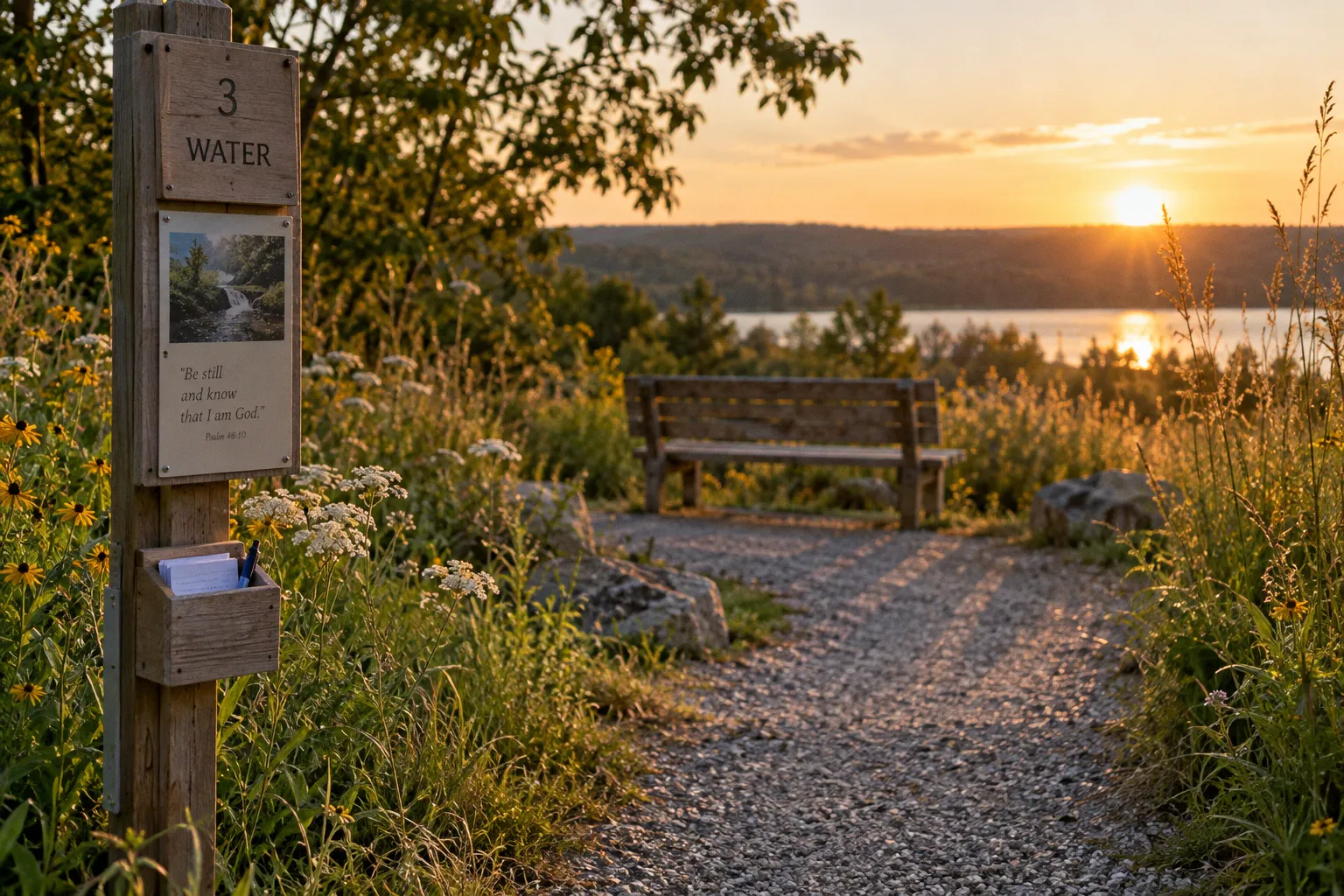
For people carrying grief, caregiver fatigue, anxiety, spiritual uncertainty, or simple weariness, walking may create enough spaciousness for honest attention. The path does not ask them to produce a religious feeling on command. It gives them a place to slow down, notice, lament, receive, and continue.
Good church prayer path design is therefore more than placing a few signs beside a sidewalk. The route needs a theological shape, a practical rhythm, and enough psychological safety for different kinds of worshippers to participate without feeling watched or rushed. A well-designed outdoor prayer space can hold silence as faithfully as it holds spoken words.
The most workable model is a marked walking route with five to seven prayer stations. The walking portion commonly takes 20 to 40 minutes, surrounded by a brief gathering, an opening prayer, and a closing time for reflection. Groups should remain in pairs or small clusters of two to six people, allowing companionship without turning the experience into a crowded procession.
Begin with the spiritual purpose of the route
Before choosing materials, measuring distances, or drafting signs, decide what the path is meant to hold.
A prayer path may serve several purposes at once, but it should still have a recognizable center. Is it intended primarily for intercessory prayer? Quiet personal meditation? Grief support? A family-friendly church recreation program? A seasonal observance such as Lent, Easter, or a harvest thanksgiving? The answer will shape every later decision, from the wording of prompts to the pace of the walking route.
For a Lutheran congregation, the path can be grounded in the conviction that grace does not depend on emotional intensity or spiritual performance. A person may arrive distracted, numb, physically tired, or unable to form a clear prayer. The design should make room for that reality. The path is not a test of attentiveness. It is an embodied form of coming before God with what is actually present.
This distinction matters because outdoor spiritual practices can unintentionally become another demand placed on people who are already carrying too much. A sign that says participants should feel peaceful at the end may exclude those whose grief remains raw. A prompt that assumes confidence in prayer may leave a questioning visitor without language. Safer wording offers invitation rather than pressure:
- Notice what is present in your body and surroundings.
- Bring one concern into the care of God.
- You may pray silently, speak with another person, or simply remain here.
- If this station feels difficult, continue at your own pace.
- There is no required emotional outcome.
The path should communicate, through both its words and its layout, that finitude is not failure. A short pause can be meaningful even when the mind wanders. A person can participate without explaining a private sorrow. Faith can be practiced through a quiet breath, a hand resting on a wooden rail, or the choice to keep walking.
A prayer path does not manufacture peace; it gives people a faithful place to meet whatever they are carrying.
Define the experience before defining the route
Write a one-sentence purpose statement for the project. For example:
This prayer path offers a 20-to-40-minute outdoor practice of noticing, intercession, lament, gratitude, and hope for individuals and small groups.
The statement is not a public slogan. It is a design tool. When a proposed feature appears attractive but does not serve the purpose, the congregation can set it aside without treating the decision as a loss.
Next, identify who will use the path. Consider:
- members who already participate in outdoor prayer or walking groups;
- visitors who may not know the congregation's worship customs;
- children and families;
- older adults and people with limited mobility;
- people living with grief, depression, anxiety, or caregiver exhaustion;
- individuals who prefer solitary prayer rather than group discussion.
A church prayer path becomes more hospitable when it does not assume one ideal participant. Some people will want to read every prompt. Others will need a bench and several minutes of stillness. Some will pray aloud in a pair. Others will walk the full route without speaking.
Build the route around five to seven stations
A route with five to seven designated stations is substantial enough to feel intentional without becoming an exhausting sequence of instructions. Each station should have one clear spiritual movement, one accessible prompt, and one simple way to engage the surrounding place.
The stations can follow a broad arc such as arrival, attention, lament, intercession, gratitude, release, and return. They do not need to create a rigid theological formula. The purpose is to help participants move through prayer with enough orientation that they are not constantly asking what they are supposed to do next.
A practical station framework might look like this:
| Station | Spiritual movement | Possible setting | Invitation |
|---|---|---|---|
| 1. Arrival | Becoming present | Entrance, welcome sign, or shaded seat | Notice your breathing, your pace, and the people who have come with you |
| 2. Attention | Receiving the created world | Trees, flowers, or open ground | Observe one detail without needing to explain it |
| 3. Lament | Naming pain honestly | A quieter or more sheltered place | Bring before God a sorrow, fear, or burden that has no easy answer |
| 4. Intercession | Praying for others | Cross, prayer board, or gathering point | Hold one person, community, or concern in prayer |
| 5. Gratitude | Recognizing gift | Water, fruiting plant, or sunny clearing | Name a small mercy without denying what remains difficult |
| 6. Release | Letting go of control | Stones, earth, or open horizon | Place a concern in God's keeping, symbolically or silently |
| 7. Return | Re-entering ordinary life | Near the church entrance | Consider one gentle practice to carry back into the day |
This sequence allows the path to include both consolation and truth. A route that moves only toward gratitude can feel spiritually coercive to people in acute grief. A route that remains only with lament may fail to offer a place of rest. Resilience is not the refusal to suffer; it is the capacity to remain connected to life and community while suffering is acknowledged.
Keep each station focused
A common design error is to place too much content on every sign. Participants then stop walking in order to read a small page of theology, several Scripture passages, three questions, and a set of instructions. The station becomes a noticeboard rather than a place of prayer.
Aim for one central invitation. If additional material is needed, place it on a separate page, a printed guide, or a clearly marked optional resource. The sign should be readable in ordinary daylight and understandable without a leader explaining it.
A useful station sign can include:
1. A short title.
2. One or two sentences of framing.
3. One prayer prompt.
4. One optional embodied action.
5. A direction to the next station.
For example:
Lament
God meets us not only in certainty but also in sorrow. You may name what hurts, what has changed, or what you cannot repair.
Prayer: Hold one grief before God without trying to make it smaller.
Optional action: Rest your hand on the bench or the tree. Remain as long as you need.
Next: Follow the path toward the cross.
The phrase "as long as you need" should be used with care. If the path is being used by a scheduled group, participants may need practical guidance about rejoining the route. But the overall tone can still make room for different pacing. A prayer experience is less hospitable when every person is expected to reach the next station at exactly the same moment.
Use natural elements as companions, not decorations
Nature-based prayer stations work best when the surrounding features are allowed to carry part of the reflection. A tree should not be treated merely as a backdrop for a sign about trees. Its shade, age, branches, seasonal changes, and living presence can shape the prayer.
One design framework uses seven natural elements as symbolic stations: trees, flowers, water, hills, thorns, fruit, and earth. These elements can support a range of biblical and human themes without forcing a single interpretation onto every participant.
Trees: rootedness and shelter
A mature tree can offer a station about endurance, protection, ancestry, or the slow work of growth. The prompt might invite participants to consider where they have received shelter and where they themselves may offer steadiness to another person.
Avoid suggesting that people must feel rooted or strong. For someone in crisis, the honest prayer may be that they feel uprooted. The tree can hold both realities: stability as a gift, and instability as a lived experience.
Flowers: beauty and impermanence
Flowers invite attention to color, fragrance, seasonality, and change. They can support prayer about beauty, mortality, and the limits of human control. A flower does not need to become an illustration of easy optimism. Its brief life can open a more truthful reflection on finitude.
If flowers are used, choose plantings that are appropriate to the local climate and maintenance capacity of the congregation. The spiritual meaning of a garden is weakened when the garden itself becomes an ongoing burden that volunteers cannot sustain.
Water: cleansing, movement, and baptismal memory
A small water feature, a visible rain garden, or even a basin near a station can evoke baptismal identity, renewal, and the movement of grief. Water can also create a sensory pause through sound and reflection.
The installation does not need to be elaborate. A safe, maintained feature is more valuable than an ambitious one that becomes inaccessible or unreliable. Where standing water creates a concern, the station can use the sound or image of water without requiring participants to touch it.
Thorns: suffering without spiritual shortcuts
A thorny plant or carefully chosen visual marker can provide a place for honest lament. This station should be approached with pastoral care. It is not an opportunity to tell participants that suffering is secretly beneficial or that faith removes pain.
A direct prompt may be more faithful: What wound, injustice, or fear needs to be brought into God's presence? Participants should be free to pass by the station if it feels too exposed on a particular day.
Fruit and earth: nourishment and belonging
Fruit-bearing plants can evoke provision, labor, patience, and shared nourishment. Earth can ground the prayer in the body: feet on soil, the feel of stone, the smell of leaves, the awareness of weather.
These stations can be especially helpful for participants whose spiritual lives have become overly abstract. Embodied faith does not replace doctrine or worship; it gives the body a place within them.
The strongest outdoor prayer spaces do not decorate nature with religious meaning. They let creation become a patient companion in the work of attention.
Consider a labyrinth as one form of prayer path
A labyrinth is related to a prayer path but is not identical to a station-based route. A station route asks participants to move from one distinct prompt to another. A labyrinth offers a single, non-branching path that winds inward toward a center and then outward again.
The Christian labyrinth tradition is often associated with medieval cathedrals. The surviving labyrinth at Chartres Cathedral in France dates to the 13th century, while labyrinth forms appeared in Christian cathedral settings as early as the 12th century. Its path does not function as a maze with dead ends. There is one route, and the changing turns create a slow practice of walking, attention, and return.
For congregations interested in the history and practice of Christian labyrinths, the historical background can provide helpful context, but the local design should remain proportionate to the grounds and the intended use.
A prayer labyrinth may be appropriate when:
- the congregation has a relatively open, level area;
- the community wants a quiet individual practice as well as group prayer;
- there is a plan for regular maintenance;
- participants can understand the entrance and exit without extensive instruction;
- the route can be made visible in different seasons and lighting conditions.
It may be less suitable when the site is too narrow, frequently interrupted by vehicles, or difficult to navigate safely. A labyrinth also requires clear teaching for first-time users. Some participants will assume they are expected to move in silence. Others may interpret the center as a symbolic destination. The sign should explain that the walk is an invitation, not a test, and that there is no spiritual achievement attached to reaching the middle.
A simple labyrinth instruction can include three movements:
1. Walking inward: Notice what you are carrying and allow your attention to settle.
2. Resting at the center: Remain in prayer, silence, or simple awareness.
3. Walking outward: Consider how you will return to ordinary responsibilities with care.
A labyrinth does not need to replace a station route. Some church grounds can include both: a shorter marked path for guided prayer and a labyrinth for slower individual use.
Plan the physical layout before writing the signs
The outdoor prayer space layout should be shaped by how people actually move through the property. Begin with a daytime walk of the proposed area. Notice changes in grade, exposed roots, wet ground, narrow passages, traffic, poor visibility, and places where a person may feel trapped or overly visible.
Draw a basic site plan showing:
- the starting point and return point;
- the location of each station;
- the walking direction;
- benches or places to pause;
- areas of shade and exposure;
- possible crossing points with vehicles or regular foot traffic;
- emergency access routes;
- storage or maintenance needs;
- alternative routes for participants who cannot use every section.
The route should be legible without constant supervision. A participant who becomes distracted or emotionally overwhelmed should be able to tell where they are and how to return to the church.
Design for a natural walking rhythm
Stations should not be so close together that participants feel hurried from one sign to the next. They should also not be separated by long stretches that make the experience feel like an ordinary walk with occasional interruptions. The precise spacing will depend on the grounds, but the guiding question is simple: does each segment allow the previous invitation to settle?
A route can include intentional transitions. Between a lament station and a gratitude station, for instance, the path might pass through a quieter stretch with no additional text. Silence between prompts is not wasted space. It allows prayer to become less verbal and more attentive.
Make access part of the theology
Accessibility should not be added after the spiritual design is finished. It expresses whether the congregation truly expects different bodies to belong.
Where the property allows, choose firm, stable walking surfaces and provide resting places. Mark changes in direction clearly. If one portion of the grounds is difficult to navigate, offer an alternative station or a shortened route rather than implying that participants who cannot complete the full path have failed to participate.
Consider also sensory accessibility. Some participants navigate the world through sound rather than sight, through touch rather than reading. Where possible, offer tactile markers alongside visual ones: a stone at the path edge, a rope guide, a textured post. If audio prompts are used, keep volume low and consider printed alternatives for those who find sound intrusive. A path that only works for people who can read small print on a laminated sign has quietly excluded more people than its planners intended.
Think through lighting and time of day
Most prayer path use happens in daylight, but evening prayer walks during Advent, Lent, or summer gatherings are increasingly common. If the route may be used in low light, plan accordingly:
- choose reflective route markers without creating glare;
- place a light source at each station rather than a single bright light at the entrance;
- avoid dark sections between stations where a person could lose orientation;
- consider small solar lights that require no wiring;
- test the route at the actual hour when groups will use it, not at midday in summer.
Lighting decisions also shape atmosphere. A path that is brightly lit for safety may feel less contemplative. A path lit only by candles may be unsafe on a wet evening. The middle ground is usually warm, low, and consistent, with one or two brighter areas near changes in elevation or crossings.
Choose materials that survive the weather and the years
Outdoor prayer stations live under sun, rain, frost, falling leaves, and the slow accumulation of mildew. A sign that warps after one season becomes an embarrassment to the congregation and a hazard to participants. A station that floods after a storm becomes a maintenance burden that quietly erodes the path's purpose.
Material choices that have held up well on church grounds include:
| Material | Strengths | Watch points |
|---|---|---|
| Cedar or redwood | Naturally weather-resistant, warm in appearance | Higher initial cost; occasional sealing |
| Powder-coated aluminum | Lightweight, durable, clean look | Can read as corporate in a wooded setting |
| Engraved high-density urethane | Resists cracking, holds detail well, often used for memorials | More expensive; limited color range |
| Ceramic or stone tile | Beautiful, permanent, weatherproof | Heavy to install; breakable if struck |
| Laminated printed paper in a sealed frame | Low cost, easy to update | Requires replacement; can become unreadable when wet |
Whatever material is chosen, the practical tests are simple. Leave the sample outdoors for at least one full seasonal cycle before committing to a full installation. Read it after rain, after frost, after a windy week. If the lettering has bled, the mounting has loosened, or the post has shifted, the design is not yet ready.
Keep language legible in real conditions
A sign written in careful theological language becomes useless if it cannot be read at arm's length by an older adult in low afternoon light. Common legibility problems include:
- body text set too small for comfortable reading at the intended distance;
- low-contrast colors such as dark green on brown or muted gray on stone;
- script fonts that look elegant at close range but blur at normal distance;
- signs mounted too high, too low, or angled toward glare;
- text printed behind reflective plastic that becomes unreadable at certain sun angles.
Where possible, test station signs with several people before installation: a child, an older adult, someone who arrived without glasses, and someone who has never used the path before. The purpose is not to gather opinions about wording. It is to discover whether the sign actually communicates in the conditions it will be used.
Plan engagement so the path invites, not performs
A prayer path is at its best when participants engage with it as they are able, not when they perform a religious experience for an unseen audience. This principle shapes the interactive elements chosen for the path.
Some interactive features that have worked well on church grounds include:
- a prayer board where visitors may write or draw a request, mounted so that entries can be added and periodically removed with care;
- small stones placed in a container at the lament station, with a note that each stone is a reminder held in prayer by the community;
- a small wooden cross at the intercession station where participants may tie a ribbon or place a written name;
- a posted map at the entrance showing the route, distances, and station themes;
- a printed or downloadable guide for those who prefer to walk with scripture or a written reflection;
- seasonal installations, such as an Advent wreath walk, a Lenten wilderness walk, or a summer evening gratitude walk, that allow the same route to serve different purposes.
What should be approached with more caution:
- mandatory group sharing at every station, which can silence participants who are not ready to speak;
- photo stations that turn prayer into a social media moment;
- competitive elements such as fastest walker or most stations visited;
- public display of personal prayer requests without consent;
- installations that require participants to handle objects that could be difficult for some users, such as small stones that are hard to grasp for those with arthritis.
Engagement works best when the path treats prayer as a continuing practice rather than a single event. A congregation that commits to one outdoor prayer walk per season will often see the path develop its own rhythm. Some participants will return on their own. Some will bring friends who do not yet belong to a worshipping community. Some will simply walk the route on a difficult afternoon.
Logistics for small group safety and flow
A prayer path is most often used by small groups of two to six people, sometimes by individuals, occasionally by larger gatherings during seasonal events. The logistics should serve each of these uses without becoming cumbersome.
Group size and pacing
Smaller groups can hold silence more easily. A pair can walk closely, share a prompt if they wish, and remain together without overtaking or falling behind. A group of five or six can still function well if the pace is set by the slowest participant and brief station stops are roughly synchronized.
Larger groups can be split into smaller clusters that begin the route at staggered intervals. A common pattern is to start a new pair or small group every few minutes, so that stations are not crowded and participants have room to pause. A volunteer or staff member can stay near the entrance to help orient newcomers and to walk behind the group in case anyone wishes to step off the route for a moment.
Safety considerations
Outdoor prayer spaces can involve uneven ground, weather exposure, and the emotional intensity that comes with prayer itself. A few practical preparations reduce the risk of incident:
- check the route before each scheduled use for fallen branches, wet leaves, or standing water;
- keep a basic first-aid kit accessible near the starting point;
- inform someone on the church staff when a group is using the path and when they have returned;
- offer a printed card listing emergency contacts if the path leaves the immediate church grounds;
- be aware of participants who may be taking medication that affects heat tolerance, hydration, or balance;
- consider providing water during summer use and a sheltered waiting area for those who need a break.
Some churches choose to have a designated pastoral presence nearby without the pastoral person walking with the group. This allows participants to engage freely while still having access to a familiar face if the experience becomes unexpectedly difficult. The presence should be discreet. A pastoral volunteer sitting on a bench reading should be enough.
Flow into and out of the route
The beginning of the path matters as much as the middle. A few minutes of settling in, an opening prayer, and clear instructions about the route allow participants to enter the experience with greater focus. The end of the path also matters. A brief closing time, an optional time of conversation, and a clear invitation to remain as long as needed help the transition back into ordinary activity.
A short printed card can be helpful at the end of the path. It might include:
- a closing prayer or scripture reading;
- an invitation to share a word with someone if desired;
- information about the next gathering or worship service;
- a reminder that the path remains available during daylight hours for individual use.
The path does not need to end with a feeling of completion. Many participants will leave with unfinished prayer, ongoing questions, or simply a quieter mind. A path that makes space for that is doing its work.
A closing note on starting small
A prayer path does not need to be finished before it is used. Some congregations have begun with three stations, a printed guide, and a borrowed bench. Others have started with a single labyrinth sketched in chalk on a parking lot during a retreat weekend and then formalized the design over several seasons.
The first iteration teaches the congregation what the next iteration should do differently. A path that begins small and remains honest about its limitations is more faithful than a path that is delayed indefinitely while planners try to perfect every detail.
The most important design decision is the one that lets the path open. After that, every season brings its own adjustments: a clearer prompt at one station, a new bench in a needed place, a quieter route through a corner of the grounds that has not yet been used. The path becomes a long conversation between the congregation and the land it walks on, and the conversation is the point.