Faith and fitness trails: spiritual exercise explained
A faith and fitness trail turns a church property, community park, or outdoor campus into a coordinated wellness ministry.
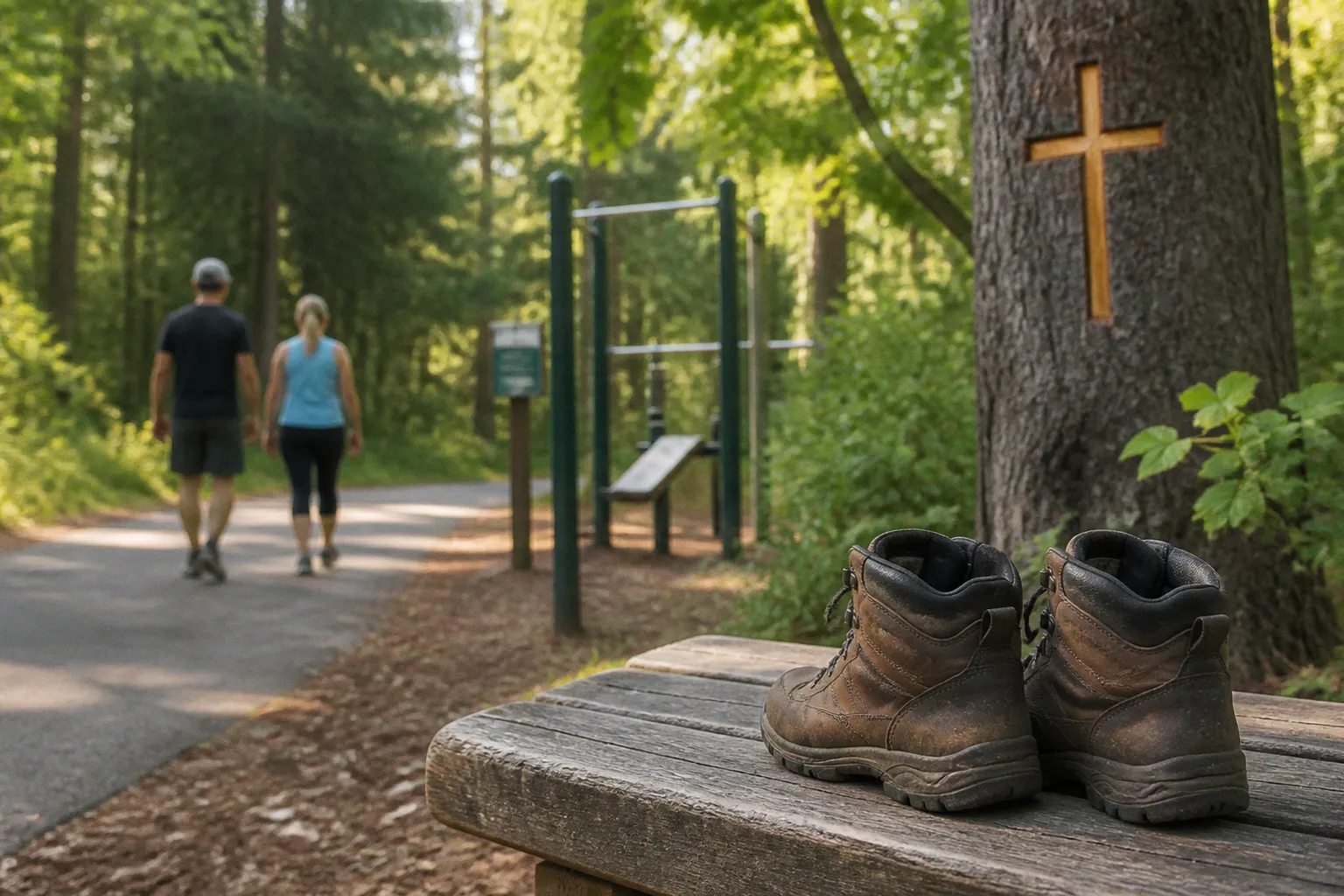
The model combines a walking route or exercise loop with prayer stations, Scripture panels, meditation spaces, stretching points, or strength equipment. The objective is practical: help people move their bodies, settle their minds, and engage their faith in one accessible setting.
The faith and fitness trail purpose and benefits become clearest when you stop treating exercise and spiritual care as separate programs. A paved path can serve older adults working on balance. A prayer bench can give someone in grief a quiet place to breathe. A Scripture panel can create a natural conversation point for a family walking after worship. The infrastructure carries ministry beyond the sanctuary.
Your congregation does not need a large campus or an expensive recreation complex to begin. It needs a defined community need, a realistic deployment plan, safe design, and a team that will maintain the space after the ribbon-cutting.
The theology of movement: why physical training becomes worship
A church fitness trail works because it gives physical health a place within the congregation’s existing understanding of faithful living. Walking, stretching, strength work, rest, prayer, and fellowship become connected actions rather than competing priorities.
That connection must remain tangible. People do not need a lecture about holistic Christian living before they use a walking loop. They need a route that feels safe, a station they can understand, and an invitation that tells them what to do next.
A spiritual wellness walk can support several ministry outcomes at once:
- Physical capacity: Regular walking, stretching, balance work, and light resistance exercise support mobility and everyday strength.
- Mental reset: A slower outdoor route creates space for breathing, silence, gratitude, and focused attention.
- Spiritual practice: Scripture meditation, intercessory prayer, and the Jesus Prayer can become structured parts of movement.
- Social connection: A shared route gives members and neighbors an easy reason to walk together without the pressure of a formal class.
- Pastoral access: People who may not attend a Bible study or support group may still use a church trail and encounter a gentle point of contact.
- Intergenerational participation: Children, parents, adults, and older neighbors can use different sections of the same space at their own pace.
This is not a claim that exercise cures illness or replaces clinical care. A faith trail is ministry infrastructure. It can support resilience, reduce isolation, and create healthy routines, but it should operate alongside qualified medical and mental-health support when those services are needed.
The trail is not the ministry by itself. The ministry is the set of invitations, relationships, and follow-up systems built around the trail.
The Lutheran tradition gives congregations a useful operating principle here: faith takes shape in ordinary life and shared vocation. The trail does not need to become a symbolic monument. It needs to help people practice care for themselves and their neighbors in a concrete way.
That means your congregation should define the intended outcome before selecting equipment. If the primary need is senior mobility, build around shade, seating, balance, and accessible surfaces. If the need is family recreation, prioritize visibility, short loops, and activity prompts. If the need is grief support, create quiet sections with clear boundaries and trained pastoral follow-up.
Start with the need. Then build the route.
Anatomy of a faith trail: from fitness stations to Scripture panels
A faith and fitness trail usually has four working layers:
1. Movement infrastructure
2. Spiritual engagement points
3. Safety and accessibility systems
4. A ministry operating plan
Each layer affects the others. A beautiful prayer garden cannot compensate for a muddy route. A strong walking loop will remain underused if nobody explains how the Scripture stations work. A complete installation can still fail if the congregation has no plan for inspection, programming, and pastoral response.
1. Movement infrastructure
The route should match your users, not your ambitions. A short, well-maintained loop will serve more people than an impressive path that requires difficult terrain or extensive travel between stations.
Possible elements include:
- A paved or stable walking loop.
- Stretching rails or designated stretching platforms.
- Low-impact fitness stations.
- Pull-up bars or bodyweight equipment where appropriate.
- Balance features for older adults, if they meet safety requirements.
- Benches placed at useful intervals.
- Shaded rest points.
- Clear route markers and distance indicators.
- Lighting or operating-hour signage where permitted.
- Accessible entry points and turning areas.
The known examples show how different the model can look. Faith Walk Community Fitness Park in Coeur d’Alene, Idaho, uses a 0.5-mile asphalt perimeter loop, 15 all-season commercial-grade family fitness stations, and 16 perimeter gazebos. Gulf Coast Village in Cape Coral, Florida, built a 0.6-mile shaded route with four fitness stations and stretching areas for senior residents. Lisa’s Faith and Fitness Trail in Lafayette, Indiana, covers 0.41 miles on a paved path.
Those projects do not establish a universal standard. They demonstrate a planning range. A church can create a compact loop for repeated walking, a longer route for neighborhood use, or a smaller series of stations around an existing building.
2. Spiritual engagement points
Spiritual elements should be placed where people can actually pause. Do not crowd every meter of the route with text. Too much content turns a walk into an information board and reduces the space for prayer.
Useful station types include:
- Short Scripture panels connected to a movement prompt.
- Prayer benches with a specific focus, such as caregivers, local schools, or grieving families.
- Quiet areas for silent prayer.
- Gratitude stations.
- Seasonal prayer prompts.
- Outdoor baptismal or creation-themed reflection points, where appropriate.
- Small gathering areas for guided devotion.
- Intercession maps focused on nearby streets, schools, hospitals, or community services.
The wording should direct action. “Pause here and pray for someone who needs strength today” gives the visitor a next step. “Reflect on the mystery of divine strength” may sound attractive, but it does not guide a person who has arrived tired, distracted, or grieving.
Use a consistent format at each station:
- Station title
- One short Scripture passage or reference
- One practical movement or breathing instruction
- One prayer prompt
- One optional next step
For example:
Station: Breathe and Receive
- Walk slowly for one minute.
- Inhale while silently praying, “Lord Jesus Christ.”
- Exhale while praying, “Have mercy on me.”
- Name one burden you are carrying.
- If you need support, contact the church office or speak with a designated ministry leader.
That format keeps Christian mindfulness grounded in prayer without turning the trail into a generic wellness installation.
3. Safety and accessibility systems
A church outdoor prayer and exercise path must operate like a public-facing ministry site. Your risk assessment should include more than the condition of the equipment.
Review:
- Surface stability after rain.
- Drainage and standing water.
- Trip hazards from roots, edging, or loose gravel.
- Visibility from the church or street.
- Emergency access.
- Restroom access during open hours.
- Seating intervals.
- Shade and heat exposure.
- Signage for age and ability ranges.
- Equipment inspection schedules.
- First-aid availability.
- Winter maintenance, if applicable.
- Privacy concerns around prayer or grief stations.
- Clear boundaries for children using strength equipment.
Do not design only for the strongest users. A trail that works for runners but excludes someone using a cane does not meet a broad community wellness objective.
4. The ministry operating plan
A trail requires owners. Assign responsibility before installation.
| Operating area | Responsible role | Minimum action |
|---|---|---|
| Route and equipment | Property or facilities lead | Inspect surfaces, stations, benches, and signs on a scheduled cycle |
| Prayer content | Pastor or spiritual formation lead | Review Scripture, prompts, seasonal changes, and theological clarity |
| Community use | Outreach coordinator | Build neighborhood invitations, partnerships, and open-use hours |
| Senior and adaptive access | Wellness or care team | Test the route with older adults and people with mobility limitations |
| Mental-health response | Pastoral care lead | Prepare referral information and train volunteers to respond appropriately |
| Volunteer coverage | Volunteer coordinator | Create shifts for events, welcome walks, and maintenance days |
| Measurement | Ministry director | Track participation, repeat use, feedback, and follow-up needs |
This is the capacity-building stage. A volunteer should never have to guess whether a broken station, a distressed visitor, or a weather closure belongs to them.
Case studies in community wellness: lessons from Idaho to Florida
Existing projects offer useful lessons because they solve different community problems.
Coeur d’Alene: scale and repeated engagement
Faith Walk Community Fitness Park in Coeur d’Alene combines a 10-acre community park with a 0.5-mile asphalt loop, 15 family fitness stations, and 16 gazebos. The gazebos display 70 illustrations from the King of Glory Bible story series.
The significant feature is not just the number of stations. It is the route’s ability to support repeat visits. A person can walk the loop for exercise, stop at selected gazebos for Scripture engagement, or complete a more structured challenge.
The park also uses Wi-Fi and QR codes. Visitors can scan the codes at the gazebos and participate in a “Faith Quest” challenge based on the Scripture panels and prayer bench inscriptions. This creates a digital layer without making the trail dependent on a phone. The physical route remains usable. Technology adds optional interaction.
For a congregation planning a larger deployment, the lesson is clear: create multiple levels of participation.
- A visitor can simply walk.
- A family can complete a Scripture challenge.
- A small group can use the route for guided prayer.
- A fitness class can use the exercise stations.
- A youth ministry can build a service or scavenger activity around the trail.
The same infrastructure serves different users because the programming does not force everyone into one format.
Lafayette: memorial, grief, and public witness
Lisa’s Faith and Fitness Trail at Immanuel United Church of Christ in Lafayette, Indiana, is a 0.41-mile paved path built in memory of Lisa Strueh, a 26-year-old nurse and runner who died after being struck by an impaired driver in 2016. The trail was dedicated in 2022.
This project shows how a faith trail can hold grief without becoming inaccessible to people who do not share the congregation’s history. A memorial trail creates a place where remembrance, movement, and community care can meet.
The planning challenge is sensitivity. A memorial installation needs:
- A clear account of the person being honored.
- Permission and participation from family members.
- Language that welcomes visitors beyond the immediate church.
- A pastoral response for people affected by sudden loss.
- A maintenance commitment that protects the dignity of the memorial.
Do not treat a memorial as decorative branding. The space should help people remember, walk, pray, and connect with support when needed.
Cape Coral: designing for older adults
Gulf Coast Village in Cape Coral established a 0.6-mile shaded Faith and Fitness Trail with four fitness stations and stretching areas. The design focuses on strength, flexibility, balance, and mobility for senior residents.
That focus changes the route design. Older adults may need more seating, shorter distances between rest points, shade, stable paving, and exercises that support daily function rather than athletic performance.
A church serving an aging neighborhood should conduct a neighborhood audit before choosing equipment. Ask:
- Where do older residents currently walk?
- Which sidewalks become unsafe after rain?
- How far must someone travel to reach a bench?
- Does the route offer shade at the times people are likely to use it?
- Can someone with limited balance understand each station?
- Is the path visible enough for a family member or volunteer to check in?
- Can the route support a walking group without blocking individual users?
The practical lesson is simple: design for the person with the least capacity in your intended audience. Stronger users can adapt upward. A person with pain, fatigue, or limited balance cannot always adapt downward.
Digital integration and contemplative prayer on the path
Digital tools can increase engagement, but they should not become a gatekeeping system. A QR code is useful when it gives visitors an optional audio prayer, a Scripture reading, a map, or a challenge. It fails when the printed station contains no meaningful content without a smartphone.
The Coeur d’Alene model demonstrates a balanced approach. Visitors can use Wi-Fi and scan QR codes to participate in Faith Quest, while the physical gazebos and inscriptions remain part of the experience.
Your digital deployment can remain modest:
- Record one-minute audio prayers for each station.
- Offer a downloadable walking guide.
- Publish route hours and accessibility information.
- Create a family Scripture challenge.
- Add a form for reporting damaged equipment.
- Provide local mental-health and pastoral-care contacts.
- Build a seasonal route for Lent, Easter, harvest, or Advent.
- Invite visitors to submit prayer requests through a moderated channel.
Keep privacy and safeguarding in view. Do not place unmoderated public prayer requests on a screen. Do not collect personal data without a clear purpose. Do not use a digital tool to create the impression that automated content can replace pastoral care.
How to practice prayer while walking
A spiritual wellness walk needs a clear rhythm. Without one, participants may use the trail only as a standard exercise loop. That is not a failure, but it leaves part of the ministry capacity unused.
Offer several options:
1. Scripture repetition: Choose one short verse or phrase. Repeat it slowly for five minutes while walking.
2. The Jesus Prayer: Coordinate the prayer with your breathing and pace. Stop if the practice becomes uncomfortable or distracting.
3. Gratitude walk: Name one person, place, or provision at each station.
4. Intercession route: Assign each section of the trail to a local concern, such as families, schools, health workers, or people experiencing homelessness.
5. Silent interval: Walk one section without conversation, music, or phone use.
6. Breath and body check: Notice tension in your shoulders, jaw, hands, and pace. Release what you can. Seek clinical support when physical or emotional symptoms require it.
7. Companion walk: Walk with another person and use one prepared question, such as, “Where do you need strength this week?”
These practices support mental clarity and stress reduction for many people, but the language must stay responsible. A church leader should never promise that a prayer walk will lower someone’s blood pressure, resolve depression, or eliminate grief. The trail can create supportive conditions. It cannot guarantee a medical outcome.
Build the route so a person can enter with no fitness background, no devotional plan, and no church vocabulary—and still know what to do next.
Designing purposeful spaces for congregational health
The strongest church fitness trail ideas begin with a deployment brief, not a shopping list. Before you compare equipment, answer five operational questions.
1. Who will use the space?
Name the primary audience and the secondary audience. “Everyone” is not a design specification.
Your primary users might be:
- Older adults from the surrounding neighborhood.
- Families with children.
- Church members recovering from inactivity.
- People seeking a quiet outdoor prayer space.
- Individuals who attend grief or mental-health support ministries.
- Community residents who do not currently participate in church programs.
Each group brings different access needs, schedules, and expectations.
2. What problem will the trail solve?
A trail can address many needs, but your first phase should have a defined target. For example:
- The congregation lacks a safe outdoor walking space.
- Older residents need low-impact movement and social contact.
- Families need free recreation near home.
- The church wants a public-facing entry point for outreach.
- Pastoral-care teams need a neutral setting for quiet conversation.
- Members need a structured way to connect prayer with daily wellness.
Use the answer to make decisions. If your primary problem is isolation, benches and scheduled companion walks may matter more than advanced fitness equipment. If your primary problem is inactivity, a measured loop and beginner stations may matter more than extensive interpretive panels.
3. What can you maintain?
The build is a milestone. The operating season is the real test.
Create a maintenance calendar that covers:
- Weekly visual checks.
- Monthly equipment inspection.
- Seasonal surface and drainage review.
- Sign cleaning and replacement.
- Landscape management.
- Lighting checks.
- Weather closure procedures.
- Volunteer orientation.
- Annual content review.
- Feedback collection from users.
Assign backups. If one person holds the entire system, the ministry will stall when that person changes roles.
4. How will you connect the trail to existing ministries?
A faith trail should not become an isolated property project. Connect it to programs already operating in the congregation.
Possible integrations include:
- A monthly prayer-and-walking group.
- A senior mobility class led by a qualified instructor.
- A grief-support walking hour.
- A youth service day for landscape maintenance.
- A family Scripture challenge.
- A wellness fair with local health organizations.
- A pastoral-care referral station.
- A seasonal outdoor worship gathering.
- A “walk your neighborhood” prayer initiative.
- A welcome route for new members and community guests.
This is where the trail becomes a ministry platform. The route provides the place. Your team provides the invitation, schedule, follow-up, and care.
5. How will you measure community impact?
Do not rely only on attendance at a launch event. Measure use over time.
Track:
- Approximate weekly users.
- Repeat visitors.
- Participation by age group, where appropriate and ethical.
- Number of scheduled walks or classes.
- Equipment and surface issues.
- Visitor feedback.
- New contacts made through trail programming.
- Referrals to pastoral care or community services.
- Volunteer hours.
- Partnerships with local organizations.
Use simple tools. A monthly observation count, a short feedback card, and a maintenance log may tell you more than a complicated dashboard no volunteer can update.
A practical launch sequence
A congregation can move from concept to pilot through the following sequence:
1. Complete a neighborhood audit. Walk the surrounding area. Note sidewalks, parks, senior housing, schools, transit access, safety concerns, and gaps in recreation.
2. Form a cross-functional team. Include property, pastoral care, outreach, wellness, accessibility, finance, and volunteer leadership.
3. Interview potential users. Speak with older adults, families, people with disabilities, caregivers, and neighbors who do not attend the church.
4. Map the site. Identify a route, rest points, gathering areas, drainage problems, and emergency access.
5. Set a pilot scope. Start with a manageable loop, a limited number of stations, and clear prayer prompts.
6. Secure qualified input. Consult professionals for construction, accessibility, exercise equipment, and mental-health referrals.
7. Write the operating plan. Establish hours, maintenance, safety response, volunteer roles, and content review.
8. Test before opening. Invite users with different ages and mobility levels to walk the route and report barriers.
9. Launch with programming. Schedule a welcome walk, a prayer walk, a family activity, and an older-adult session rather than relying on one ceremony.
10. Review after 30, 60, and 90 days. Fix problems while the project is still flexible.
The most common failure is not a bad idea. It is an unfinished handoff. A committee designs the trail, a contractor installs it, and everyone assumes the ministry will run itself. It will not.
What makes a faith trail genuinely welcoming
A faith and fitness trail should communicate welcome through operations, not slogans.
Keep the entry point obvious. Explain the route length. Mark the intensity of each station. Provide alternatives for people who cannot perform a movement. Offer seating without requiring visitors to ask. Use readable type and strong contrast. Keep prayer language direct and avoid assuming that every visitor understands church terminology.
A well-designed trail can also make room for people who are spiritually curious, angry, grieving, or unsure. They may not want to join a worship service. They may accept a quiet walk. That first contact matters.
Train volunteers to respond without pressure. A good greeting might be, “You’re welcome to use the path. The blue signs mark the prayer stations, and the benches are available if you need a break.” It does not require a sales pitch. It creates agency.
For mental-health ministry, establish a clear boundary between hospitality and counseling. Volunteers can listen, welcome, provide information, and connect someone with trained support. They should not diagnose, promise confidentiality they cannot provide, or attempt crisis intervention without training.
The same standard applies to physical exercise. Volunteers can demonstrate a posted movement if qualified and authorized. They should not prescribe rehabilitation programs or advise people to ignore pain.
The operational case for outdoor prayer and exercise paths
A church property already has assets that many wellness programs struggle to secure: a known location, community trust, volunteers, gathering space, and an established rhythm of care. A faith trail can extend those assets into the neighborhood.
The model works best when it remains modest and repeatable. You do not need every possible feature. You need a route people can use, prompts they can understand, equipment that fits the audience, and leaders who will keep showing up.
Physical movement can become a doorway to prayer. Prayer can become a doorway to honest conversation. Honest conversation can connect people to pastoral care, friendship, professional support, or a deeper relationship with the congregation. That sequence requires design. It does not happen because a Scripture panel is mounted beside a walking path.
Your next step is not to announce a large project. Walk your site with three questions:
- Who is missing from our current wellness and ministry programs?
- What barrier keeps them from participating?
- What small outdoor intervention could remove that barrier within the next six months?
Then build the first useful version. Test it with real people. Repair what does not work. Add programming only when the operating team can sustain it.
A faith and fitness trail succeeds when movement, spiritual practice, and community care reinforce one another in daily use. The goal is not to create a religiously themed exercise course. The goal is to deploy a dependable place where neighbors can walk, breathe, pray, rest, and find a next step toward greater well-being.