Outdoor prayer path setup: a step-by-step guide
A congregation identifies the need for an outdoor space dedicated to contemplative prayer and structured meditation. The pastoral team schedules a planning meeting.
Outdoor Prayer Path Setup: A Step-by-Step Guide
Within thirty minutes, the conversation fractures into three divergent tracks: one faction advocates a permanent labyrinth with hardscaped pathways, another proposes a seasonal trail marked with temporary signage, and a third argues for a hybrid model incorporating digital components. What should be a focused stewardship decision becomes an administrative impasse—not because of insufficient conviction, but because the congregation has not yet agreed on what kind of spiritual experience it wants the space to support.
The outdoor prayer path creation process benefits from the same care applied to any meaningful ministry: a clear purpose, a realistic budget, thoughtful station design, and an implementation plan that accounts for accessibility, maintenance, and congregational engagement. A path can be temporary or permanent, highly structured or intentionally open-ended, centered on a labyrinth or shaped as a simple walking loop. The point is not to force every congregation into one design. The point is to make the choices deliberately, so the finished space feels spiritually coherent rather than merely attractive.
Defining the Spiritual Journey: The Three-Stage Path Structure
There is no single theological blueprint for an outdoor prayer path. Some churches prefer a quiet garden with no prescribed route. Others build a labyrinth, create a sequence of Scripture stations, or invite people to walk without instructions beyond “slow down and pray.” The right layout depends on the congregation’s tradition, the site, the intended audience, and the kind of participation the leaders hope to encourage.
One useful option is a traditional three-stage structure. It gives the walk a recognizable inward, centered, and outward movement without making that pattern a requirement. Congregations may use all three stages, adapt their language, combine them, or select only the elements that fit their pastoral purpose.
1. Release and self-examination. The inward walk can invite participants to name burdens, acknowledge distraction, or consider where reconciliation and renewal are needed. Stations in this phase might offer written questions, scriptural passages addressing repentance, or a physical act such as placing a stone in a basin. The language should remain invitational rather than coercive. A prayer path should make room for grief, uncertainty, and silence as well as confession.
2. Stillness and presence. A central point can serve as a resting place for quiet attention. It may be marked by a cross, a bench, a stone, a tree, or nothing more than a widening in the path. Unlike an activity station, this area does not need to demand a written response or a particular gesture. Participants may sit, stand, pray, listen, or move on. The value lies in creating a credible pause within the route.
3. Gratitude and sending. The outward walk can turn attention toward hope, thanksgiving, service, and ordinary life beyond the church grounds. Stations might ask participants to identify a person they will encourage, a responsibility they will take up, or a gift they have received. The path then becomes more than an exercise in private calm; it connects contemplation with communal life and daily stewardship.
A three-stage pattern can give a prayer path a strong rhythm, but it is a framework to choose, not a rule to obey. The spiritual integrity of the space comes from intentionality, not from forcing every walk into the same sequence.
This optional structure is especially helpful when a congregation is trying to move from a general idea—“a prayer garden would be nice”—to a usable design. It gives the planning team questions to work with:
- What should participants be invited to notice when they arrive?
- Is there a natural point for stillness, or would the path work better as a continuous loop?
- Should the walk end with a sense of sending, or should it remain open and unstructured?
- Which parts of the experience should be communal, and which should remain private?
- How can someone participate meaningfully if they cannot walk the entire route?
The answers may lead to a three-stage path, but they may also point somewhere else. A short loop with three Scripture markers may be more appropriate than a formal labyrinth. A sensory garden may serve a memory-care ministry better than a route built around written prompts. A congregation that welcomes visitors throughout the week may need a self-guided space with flexible entry and exit points rather than a tightly directed sequence.
Budgeting and Design: Choosing Between Temporary Trails and Permanent Labyrinths
The second planning variable is financial scope. Congregations face a genuine spectrum of options, and the cost differential between an entry-level trail and a legacy installation can be substantial. A prayer path should be evaluated as a ministry, not as a landscaping competition. The most impressive hardscape is not automatically the most useful spiritual resource.
Temporary and semi-permanent configurations require relatively little capital investment. A standard church outdoor prayer path with five to seven stations marked by steel stakes and weather-resistant laminated signage can be established as a modest ministry-budget project. Rope-and-stake labyrinth systems—commercially available kits that lay out classic patterns on grass or dirt—offer a practical way to test the idea over a season before a congregation commits to permanent infrastructure.
A temporary path can also be more responsive. Its route may be adjusted when a station consistently creates bottlenecks, when a section becomes muddy, or when participants indicate that the instructions are too complicated. Signs can be rewritten without removing masonry. Plantings can be moved. The ministry team learns from actual use rather than trying to predict every need in advance.
Permanent community labyrinths occupy the opposite end of the cost continuum. Depending on material selection—stone, brick, painted cement, or custom pavers—and on local labor costs, a legacy installation may require a substantial capital commitment. The draft budget range of $15,000 to $85,000 illustrates how widely these projects can vary. Such a project may involve congregational votes, fundraising, a design process, site preparation, drainage work, and a long-term maintenance plan.
The following comparison is useful at the beginning of a planning conversation:
| Parameter | Temporary Trail | Semi-Permanent Labyrinth | Permanent Labyrinth |
|---|---|---|---|
| Typical cost range | Minimal: stakes, signage, printed guides, and basic materials | Low to moderate: rope kits, seasonal plantings, and improved markers | Potentially substantial; the draft range is $15,000–$85,000 depending on materials and labor |
| Installation timeline | Days | Several days to a few weeks | Several weeks to months |
| Maintenance burden | Low, with seasonal sign replacement and route checks | Moderate, including restaking, replanting, and surface care | Significant, including hardscape, drainage, vegetation, and safety upkeep |
| Approvals and permits | May be unnecessary, but local rules still apply to some site changes | Depends on the property and the work involved | May involve zoning, land-use, building, stormwater, or other local requirements |
| Longevity | Often one season, with materials reusable | Several seasons with consistent maintenance | Intended for long-term use |
| Best suited for | Pilot programs, small congregations, and seasonal events | Ministries testing long-term commitment | Churches with a stable site, capital resources, and a maintenance team |
The critical stewardship question is not which option is “better” in the abstract, but which configuration aligns with the congregation’s financial position, property constraints, and long-range ministry objectives. A $300 seasonal trail that serves two hundred participants with genuine theological depth may represent better stewardship than a $60,000 labyrinth that sits underused because the route is difficult to access or the station design is weak.
The same principle applies to labor. A permanent installation is not complete when the contractor leaves. Someone must inspect the surface, clear leaves, replace damaged signs, manage vegetation, check drainage, and decide whether the route remains safe after severe weather. If no ministry team is prepared to own those tasks, the temporary model may be the more responsible choice.
Before construction or installation, the planning group should identify what work is actually being proposed. Moving portable signs onto an existing lawn is different from excavating soil, adding retaining walls, pouring concrete, installing lighting, or altering drainage. Local requirements can vary by jurisdiction and by the nature of the work. The church should contact the relevant municipal or county offices, review property restrictions, and ask qualified local professionals about approvals that may apply. No general statement can guarantee that a project will require—or avoid—a permit.
Curating Interactive Stations with Natural Elements
Station design constitutes the operational core of the prayer path. Each station should have a distinct purpose, but that purpose does not have to be tied to a particular stage of the traditional framework. If the congregation chooses a three-stage route, stations can be assigned to the inward, center, and outward movements. If it chooses a less structured layout, the same activities can be arranged around themes such as lament, gratitude, Scripture, creation, intercession, or service.
The most effective outdoor stations use the landscape as part of the prayer experience rather than treating it as a decorative backdrop. They also respect the limits of outdoor materials. Paper needs protection from rain. Loose objects need to be collected. Water needs to be kept clean. A station that depends on constant volunteer supervision may work for a retreat weekend but fail as a self-guided installation.
Consider the following approaches:
1. The Thankfulness Tree. A living tree—or, in a seasonal installation, a large branch secured in a stable base—serves as the station’s focal point. Participants receive strips of weather-resistant paper and twine, write expressions of gratitude, and tie them to the branches. The accumulating messages create a visible record of thanksgiving. The team should decide in advance whether notes will remain anonymous, how long they will stay in place, and how they will be removed respectfully.
2. The Worry Water Station. A shallow basin, birdbath, purpose-built stone bowl, or clean container holds smooth stones. Participants are invited to hold a stone, name an anxiety silently or aloud, and place the stone in the water. The act of release is tactile and deliberate. The station should be placed where a volunteer can refresh the water and remove sediment, and where the surrounding surface will not become slippery.
3. The Holding Cross Workshop. At the entrance, participants receive two straight twigs and a length of twine, with simple instructions for lashing them into a cross shape. The completed cross accompanies them through the route as a physical anchor for prayer. This activity can be especially effective for families, but the instructions should include an alternative for participants who cannot manipulate small materials. A preassembled cross, a printed symbol, or a tactile wooden piece can serve the same purpose.
4. The Scripture Walk. Participants receive a printed guide listing scriptural references. At each marker, a weatherproof sign presents a short passage or citation alongside a reflection prompt. The participant reads, listens, or reflects and may record a response. This approach works well for congregations with strong biblical literacy and a preference for text-centered meditation. It should still include plain-language explanations and an audio or large-print option when possible.
5. The Planting Station. Participants plant a seed or seedling in a prepared bed, connecting new growth with hope and outward action. The station requires advance soil preparation, appropriate seasonal timing, and a plan for watering. If planting is not practical, participants can place a plant label in an existing bed, select a plant to tend, or write one concrete act of care on a card to take home.
6. The Listening Place. A bench or low platform is positioned near a tree, wind movement, birdsong, or another gentle natural sound. The instruction is deliberately spare: sit, notice, and listen without trying to produce an answer. This station helps balance more active exercises and reminds participants that a prayer path does not need to turn every moment into a task.
Each station should have an instruction card mounted on a stake or small wooden post. The card can state the purpose, describe the activity, estimate the time required, and offer a closing prayer or benediction. It should also make clear whether participation is optional and whether materials should be left at the station or carried onward.
Ambiguity at the station level produces confusion. Over-instruction can produce a different problem: participants begin completing assignments instead of praying. A short prompt with room for silence is often stronger than a paragraph that explains every possible interpretation.
Integrating Digital Guides and Individual Prayer Kits for Accessibility
The contemporary outdoor prayer path does not need to rely exclusively on physical signage. Digital integration through QR codes or a simple mobile-friendly web page can extend the path’s capacity without increasing its physical footprint. It can also help participants who prefer listening to reading, who want to use a screen reader, or who would benefit from a larger text format.
QR-code implementations are usually the lower-barrier option. Each station sign can include a printed QR code leading to a page with the relevant Scripture passage, an audio reading, reflection questions, and—if the congregation has the capacity to produce one—a guided meditation track. The page should load quickly, use accessible text, and remain usable for someone who has not downloaded an app or created an account.
Digital content should not assume a strong mobile signal across the entire property. A printed guide should remain available, and the station should make sense without scanning anything. A person who leaves a phone in the car, lacks a data plan, or simply wants a screen-free experience should not be excluded from the prayer path.
Dedicated mobile applications offer a more structured digital layer, with timed prompts, progress tracking, journaling, and audio navigation. They may be useful for retreat programs or repeated seasonal use, but they require maintenance, testing, privacy decisions, and support for different devices. A congregation should consider whether it has the staff or volunteer capacity to keep the content current. An outdated application can become a burden rather than an enhancement.
Technology should widen participation without becoming the gatekeeper. A QR code that offers an audio prayer is a welcome supplement; a prayer path that functions only through a smartphone has missed part of its pastoral purpose.
For congregations prioritizing individual preparation and hygiene, individual prayer kits offer a practical solution. These kits can be assembled in advance, sealed in paper bags or small totes, and distributed at the path’s entrance. Preparing them ahead of time also allows volunteers to inspect the contents and provide alternatives for children, older adults, or participants with limited dexterity.
A kit may contain:
- A smooth pebble for a worry-release or blessing station
- A ribbon or strip of weather-resistant paper for a thankfulness station
- A plant label and pencil for written responses
- Two straight twigs and a short length of twine for a holding cross
- A printed path map with station descriptions and theological context
- A large-print or simplified version of the instructions when needed
The contents should be chosen with care. Small objects can create choking hazards for young children. Natural materials may trigger allergies or splinters. Writing tools should be easy to hold, and any activity involving water, soil, or loose pieces should have a non-contact alternative. Accessibility is not an appendix to the design; it changes the design from the beginning.
The route itself should offer choices. A participant may be able to reach the first station but not the center. Someone using a wheelchair may need a wider turning area. Someone with a visual impairment may benefit from a tactile map, audio guidance, or a companion route. Someone experiencing grief may not want to follow a public sequence at all. A strong prayer path allows people to enter, pause, skip, and leave without feeling that they have failed to complete a spiritual exercise.
Landscaping for Reflection: Selecting Flora and Quiet Spaces
The physical environment of the prayer path is not ornamental alone; it is functional. Flora selection, spatial layout, shade, sound, and surface quality all affect the contemplative experience.
Site selection comes first. The ideal location combines relative quiet with practical visibility and safe access. Distance from road traffic, HVAC units, playground equipment, and delivery areas can make a noticeable difference. At the same time, a completely hidden route may be difficult for first-time visitors to find or may create safety concerns after dark. The best site often has a clear entrance, natural boundaries, and enough openness for participants to feel secure.
A flat or gently sloping terrain is preferable for accessibility. Steep grades exclude participants with mobility limitations and make station installation more difficult. Low areas that collect water may appear attractive during dry weather but become unusable after rain. Before choosing the route, walk the site in different conditions and note mud, glare, shade, wind, insects, and noise.
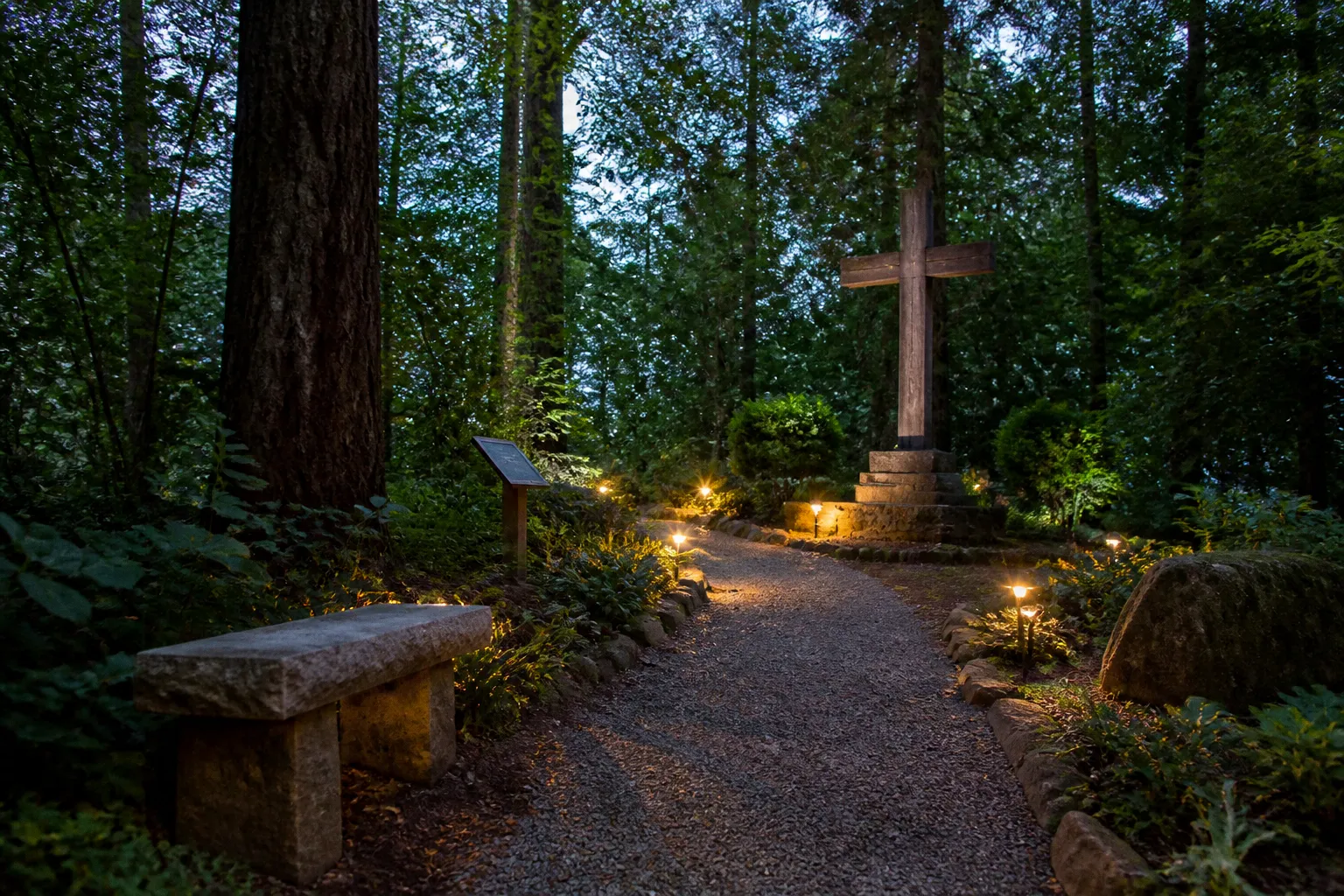
Focal points can anchor a route without dictating its theology. A central area may include a simple wooden cross, a stone, a bench, a water feature, a tree, or an open view. The entrance and exit can be marked with low plantings, a gate, a sign, or a change in surface. These thresholds help participants recognize that they are entering a different pace of attention.
If the congregation adopts the three-stage model, the central focal point can represent stillness, with more active prompts placed before and after it. If the congregation chooses a circular prayer walk without stages, the same focal point can simply be a place to pause. Design should serve the chosen practice rather than forcing the practice to justify a preselected feature.
Plant selection should take climate, soil, maintenance capacity, toxicity, and sensory impact into account. Fragrance can support memory and attention, but strong scents may be uncomfortable for some participants. Flowers can provide seasonal interest, but a path that depends on one short blooming period may feel unfinished for much of the year. Native or well-adapted plants often reduce maintenance and support local ecology, though the appropriate choices depend on the site.
Possible options include:
- Lilies, which can offer visual simplicity and a sense of seasonal renewal, provided the selected varieties are suitable for the property and safe around animals.
- Bleeding hearts, which perform well in appropriate shade conditions and can support themes of compassion, though their seasonal growth pattern should be understood.
- Rosemary, valued for its fragrance and associations with remembrance, where the climate permits it to thrive.
- Lavender, which can provide fragrance and tolerate relatively dry conditions once established, but still requires suitable drainage and sunlight.
- Ornamental grasses, which add movement in the wind, visual softness, and structure beyond the main flowering season.
Avoid placing plants with thorns directly beside a narrow walking route unless the congregation has a clear pastoral reason and can explain the choice. Rose bushes or holly might be used deliberately in a reflection about pain or boundaries, but an unexplained hazard is more likely to produce apprehension than contemplation. Plants that are toxic, highly allergenic, invasive, or difficult to maintain should be evaluated with the same seriousness as building materials.
Path materials vary by budget and accessibility needs. Mowed grass is the simplest surface, but it may become difficult after rain. Mulch or wood chips define a route at relatively low cost, though they can shift under wheels and require replenishment. Flagstone or brick pavers create a stronger sense of permanence and can provide a smoother surface when properly installed, but they require more investment and attention to settling, gaps, and drainage.
Whatever the material, the route should allow a person to move without brushing against plantings or stepping into an unstable edge. Stations need widened areas so that a participant can stop without blocking others. Seating should appear at intervals appropriate to the route, not only at the most visually prominent point. Quiet spaces are created by distance and restraint as much as by objects. A bench under a tree may do more for prayer than a crowded collection of signs, sculptures, and decorative features.
Bringing the Path into Use
A thoughtful design still needs an operational plan. Before the opening day, the planning group should walk the entire route as if it were a first-time visitor. Follow the printed map. Read every sign from a standing and seated position. Scan each QR code from the actual location. Test the route after rain if possible. Ask someone unfamiliar with the project to describe what they think each station is asking them to do.
The group should also settle several practical questions:
1. What is the intended pattern of use? Decide whether the route is self-guided, led by a pastor or lay leader, available during worship, or open during specified hours. A space designed for individual prayer may need different signs and staffing from a path used during a church-wide event.
2. Who owns maintenance? Assign responsibility for sign replacement, mowing or trimming, watering, debris removal, supply restocking, and seasonal storage. “The property team will handle it” is not a schedule. A named person or ministry group should know what needs to happen and how often.
3. How will the path be introduced? A short orientation can explain that participants may move at their own pace, skip any activity, and leave whenever needed. If the path uses a traditional framework, describe it as an invitation rather than a test of correct prayer.
4. How will feedback be gathered? A simple comment box, conversation after a guided walk, or an anonymous response card can reveal whether stations are understandable, whether the route feels welcoming, and whether the experience works for people with different abilities.
5. What happens to personal material? Notes attached to a tree, prayer cards, stones, or planted labels may contain private information. The congregation should decide how materials will be handled, when they will be removed, and whether participants are encouraged to take them home instead.
6. What local approvals may apply? Requirements depend on the property, the jurisdiction, and the scope of the work. A portable seasonal route may involve little more than ordinary property management, while excavation, paving, lighting, drainage changes, structures, or substantial landscaping may trigger different reviews. The church should verify applicable zoning, land-use, building, stormwater, accessibility, and property restrictions with the relevant local offices or qualified professionals before beginning work.
That last point deserves careful wording because permitting is not universal. A permanent labyrinth may require approvals in one location and fall under a different process in another. Even within the same community, the answer may change according to whether the project alters the ground, adds structures, affects drainage, or changes public access. Local confirmation is more useful than a generic promise that permits will—or will not—be needed.
The most common planning error is to begin with an aesthetic preference—“We want a labyrinth” or “We want a garden”—and try to retrofit a spiritual purpose afterward. The opposite error is just as limiting: treating one theological framework as mandatory before considering the needs of the people who will use the space. Begin with the congregation’s ministry intention. Then choose a route, a degree of structure, and a landscape that can carry that intention faithfully.
An outdoor prayer path does not have to be expensive, permanent, or elaborate to be meaningful. It can be a mown loop with a handful of signs, a seasonal labyrinth, a garden with several places to sit, or a flexible route that changes with the church calendar. What matters is that the experience is legible, welcoming, maintained, and open to genuine prayer. Good outdoor prayer space design leaves room for silence and difference. It gives people enough guidance to begin without pretending to control where the Spirit will lead them.