Food drive logistics: a step-by-step guide for small churches
A food drive can look simple from the pews: place a few collection bins near the entrance, announce the need on Sunday, and move the donations to a pantry when the boxes are full. In practice, the difficult part is rarely persuading people to give.
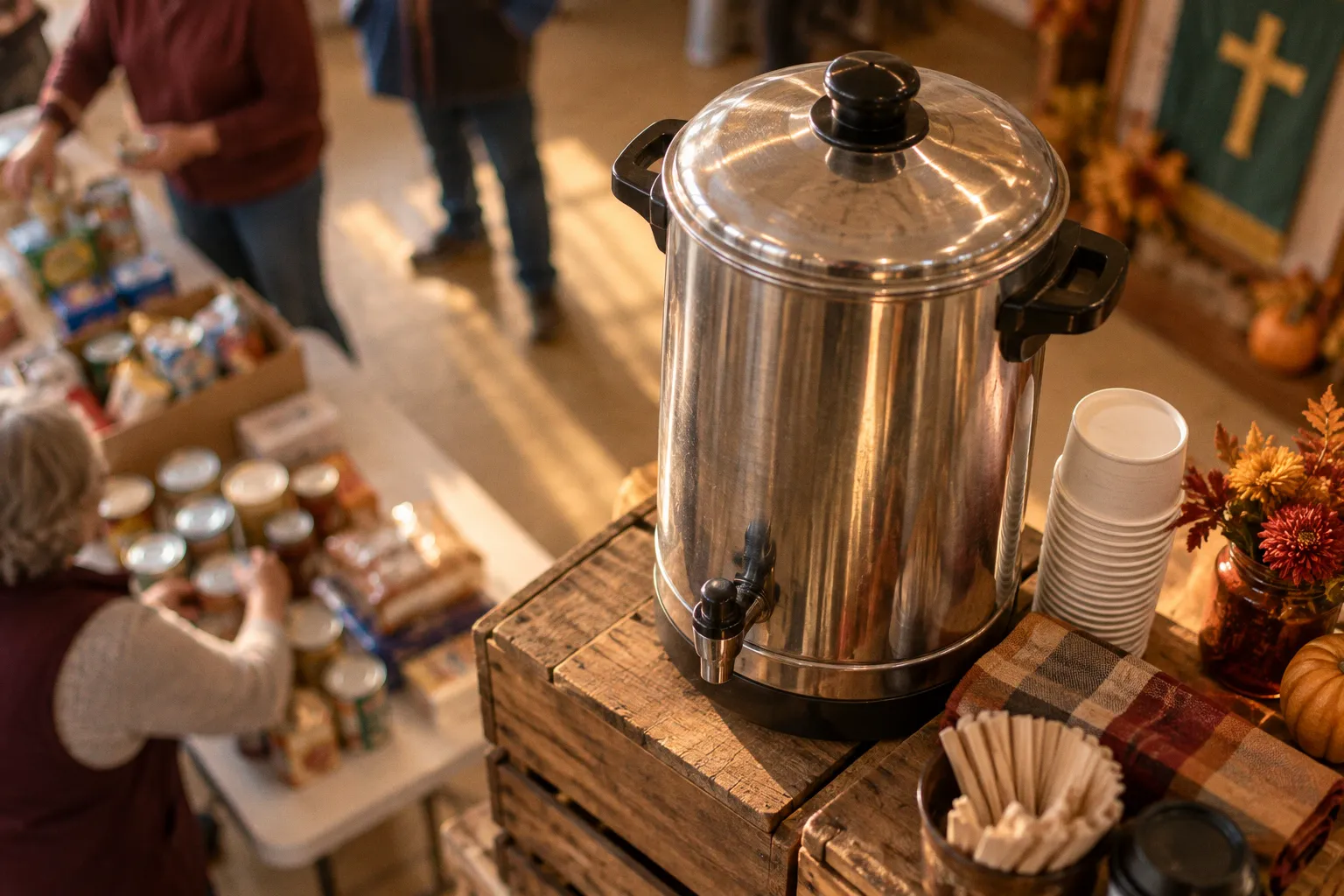
It is matching the right food to a partner’s current needs, assigning responsibility before the first donation arrives, protecting the food while it is on church property, and arranging a handoff that does not depend on luck.
That gap between a generous intention and a delivered, usable donation is a logistics problem. It is also a solvable one. A small congregation does not need a warehouse, a large staff, or a complicated software system. It needs a reliable partner, a short planning cycle, clearly owned tasks, and enough discipline to treat the collection as a ministry operation rather than an improvised Sunday activity.
A food drive is not a one-day event. It is a short logistics operation with a public collection window at the center.
Partner With a Local Pantry Before You Print a Flyer
The most common mistake in organizing a church charity food collection is starting with the collection date. A congregation chooses a weekend, places boxes in the narthex, and only afterward asks where the food should go. That reverses the order of the work.
The first call should go to a local food pantry, regional food bank, shelter, or established ministry that distributes groceries directly. The partner determines what is useful, what can be accepted, how donations must be packed, and when the delivery can happen. Those details should shape the drive before the announcement is written.
Begin with a short conversation rather than a general email. Ask:
- Which staples are in demand right now? Pantry inventories change. A partner may need canned protein, shelf-stable milk, rice, pasta, cereal, cooking oil, or other basics, while already having more than enough of another item.
- What are the intake rules? Ask about damaged packaging, expiration dates, homemade food, opened packages, glass containers, and products that require refrigeration.
- How should the food be packed? Some partners prefer sturdy boxes with similar items grouped together. Others may request smaller cartons that volunteers can lift and sort easily.
- What is the delivery or pickup process? Confirm the address, receiving hours, appointment requirements, vehicle access, and the name of the person who will receive the donation.
- Can the partner accept financial gifts or online donations? A virtual option can help people who cannot shop, transport heavy items, or attend the collection in person.
- How should the church report the results? The partner may want an estimated weight, a count of boxes, a dollar amount, or simply a confirmation that the delivery was completed.
Do not treat the pantry’s list as a suggestion to be edited by committee. If the partner says that certain items are temporarily overstocked, take those items off the public list. If the partner cannot accept refrigerated goods, do not invite them. A well-intentioned donation that cannot be distributed becomes a sorting and disposal problem for the ministry you meant to help.
It is also worth asking whether the partner has its own food-drive materials. A pantry may provide a current wish list, printable signage, a suggested collection calendar, or instructions for using its donation portal. Using the partner’s language reduces confusion and signals that the church is coordinating with an existing local system rather than creating a parallel one.
Turn the partner’s needs into a shopping list
“Nonperishable food” is too broad for most congregational announcements. It leaves donors guessing and tends to produce a familiar pile of whatever is easiest to grab at the supermarket.
A useful list names categories and gives examples:
- canned vegetables with intact labels;
- canned beans, fish, chicken, or other shelf-stable protein;
- peanut butter or other approved protein spreads;
- pasta, rice, oats, and whole-grain cereals;
- shelf-stable milk, if requested by the partner;
- low-sodium or culturally specific items, when the pantry identifies those needs;
- baby food, personal-care products, or household supplies only when the partner confirms that they can distribute them.
Keep the list short enough to read on a church bulletin or announcement slide. If everything is listed as equally urgent, nothing is actually prioritized. Put the partner’s most important categories first and explain that unopened, undamaged products are required.
Structure the Planning Committee Around Ownership
Small churches often have plenty of goodwill and very little spare administrative capacity. That is why a drive can become disorganized even when many people are willing to help. Tasks are mentioned in meetings, several people assume someone else is handling them, and the first real problem appears when the bins are already full.
You do not need a large committee. You need a small operating group in which every recurring task has one person responsible for moving it forward. Two to six leaders is usually enough for a modest congregation, provided the group has authority to make routine decisions and access to the church calendar, building, communications channels, and transportation plan.
A workable structure looks like this:
| Role | Main responsibility | Practical deliverable |
|---|---|---|
| Drive coordinator | Keeps the schedule, partner relationship, and decisions together | One-page plan with dates, contacts, and open questions |
| Logistics lead | Organizes bins, signs, collection points, storage, and loading | Site map and delivery-day loading plan |
| Volunteer manager | Recruits and schedules people for setup, intake, sorting, and transport | Roster with shifts and backup contacts |
| Communications lead | Prepares announcements, reminders, donor instructions, and thanks | Calendar of messages for the full drive |
| Food safety lead | Reviews donations and monitors storage conditions | Intake and storage checklist |
| Finance or portal contact | Tracks online gifts and reconciles the final amount | Donation record shared with the coordinator |
In a very small congregation, one person may hold two lanes. That is acceptable. What creates trouble is not a combined role; it is an unassigned role. If the coordinator is also handling communications, write that down. If the logistics lead is responsible for food safety, make that explicit and ensure the person has time to perform both tasks.
The committee’s first meeting should end with decisions, not just enthusiasm. Establish:
1. the partner organization and a named contact;
2. the collection dates and public hours;
3. the final pickup or delivery appointment;
4. the approved food categories;
5. the storage location;
6. the online donation method, if available;
7. the people responsible for each operating lane;
8. the date for the final review.
Shared concern is not the same as assigned responsibility. Every important task needs one name beside it.
A shared spreadsheet, printed binder, or simple planning document is enough. It should include the partner’s instructions, the volunteer roster, the building access plan, the collection schedule, and notes about unresolved issues. The tool matters less than having a single current version that the committee trusts.
Set Quantifiable Goals Without Pretending to Know the Future
A goal such as “collect as much as possible” sounds encouraging but does not help a committee make decisions. It does not tell volunteers how many boxes to prepare, the communications lead what to emphasize, or the coordinator whether the drive is on track.
Set several different goals because food drives produce more than one kind of result.
Start with a weight or meal-equivalent target
Many food banks use a conversion between donated weight and approximate meals. If the partner uses the USDA-related figure of 1.2 pounds per meal, use that figure consistently in the church’s internal reporting. If the partner uses another method, follow the partner’s method rather than combining formulas.
The conversion is a planning and reporting tool, not a promise that every pound produces an identical meal. A box of rice, a jar of peanut butter, and a can of soup do not have the same distribution pattern or nutritional role. The number helps the congregation understand scale; it does not replace the partner’s judgment.
For a small congregation, begin with a target that can be explained in one sentence:
- a total weight the committee believes the congregation can reasonably collect;
- an approximate meal-equivalent figure based on the partner’s conversion method;
- a deadline by which the donation will be weighed or estimated.
If you do not have enough history to set a confident number, make the first target a working estimate and label it that way. A hypothetical example might be a congregation aiming for several hundred pounds over two collection weekends, with the target adjusted after the first few days. The point is not to manufacture precision. The point is to give volunteers something more useful than a vague appeal.
Track actual results separately from the target. If the church collects less than expected but provides exactly the items the pantry requested, the drive may still have been highly successful. Weight is one measure of impact, not the only measure.
Set an item-mix goal
The partner’s list should determine the mix. If the pantry specifically requests shelf-stable protein, then the committee should count that category rather than accepting a large volume of unrelated canned goods and calling the total a success.
A simple tracking sheet can divide donations into broad categories:
- protein;
- grains and starches;
- fruits and vegetables;
- breakfast foods;
- shelf-stable dairy;
- personal-care or household products;
- other partner-approved items.
The categories do not need to become a public competition. They are there to reveal an imbalance while there is still time to correct it. If the church has received plenty of pasta but very little protein, the next announcement can explain the gap directly.
Add a participation goal
Participation is a useful measure for a congregation because it shows whether the drive reached beyond the same small group of regular volunteers. Count participating households, ministry groups, Sunday school classes, or community supporters if the drive is open to the public.
Avoid treating a participation percentage as a universal benchmark. A congregation with many homebound members, a small building, or limited parking will have different possibilities from a church with a large weekly attendance. Set a local goal based on the people and access points the church actually has.
Track financial gifts separately
Do not combine cash or online contributions with food weight in a single number. Record financial gifts as their own result, then report the two forms of support side by side.
The pantry may be able to purchase staple foods through wholesale channels or use financial gifts where the need is greatest. That does not make a virtual donation better than a bag of groceries; it makes it a different tool. A clear report can honor both:
- food collected and delivered;
- online or other financial gifts received;
- participating households or groups;
- any volunteer hours the church chooses to track.
Maintain Food Safety During Collection and Storage
Food safety is not a specialized concern reserved for large food banks. It begins at the church collection point. Volunteers need clear instructions about what they may accept, where donations should go, and when an item should be set aside for review.
The storage room does not have to be a particular type of room to be acceptable. A garage, utility area, or fellowship hall may be usable if the space is clean, dry, protected from pests and weather, and permitted under the partner’s requirements and local rules. Carpeted flooring is not automatically disqualifying either. The supported baseline is that dry goods should be kept at least six inches off the floor.
Use pallets, shelving, sturdy tables, or other stable supports that will not tip when boxes are loaded. Do not place cartons directly on concrete, tile, carpet, or any other floor surface. Keep food away from leaks, cleaning chemicals, heat sources, and areas where doors or equipment could damage the packaging.
Establish an intake standard
At the collection point, volunteers should know what to accept and what to place in a separate review area. Unless the partner gives different written guidance, a conservative standard generally excludes:
- opened packages;
- leaking, bulging, or badly rusted cans;
- severely dented containers, especially when the seam or lid is affected;
- products without readable labels;
- homemade canned goods;
- food that requires refrigeration when no safe refrigerated process has been arranged;
- products outside the partner’s accepted date or packaging policy.
Expiration and best-by labeling can be confusing, so do not ask volunteers to make complex safety judgments on their own. Get the partner’s policy in advance and post it at the intake table. When in doubt, set the item aside and ask the food safety lead or pantry contact.
The volunteer assigned to intake should have permission to decline or quarantine an item without creating an argument with the donor. The goal is not to criticize generosity. It is to protect the people who will receive the food and to prevent the partner from inheriting an avoidable disposal burden.
Protect refrigerated or perishable items
A church should not invite perishable donations unless the partner has specifically requested them and the congregation has a safe plan for receiving, monitoring, transporting, and delivering them. That may require a working refrigerator, temperature checks, insulated transport, and a short handoff window.
If refrigerated food is accepted, follow the partner’s temperature requirement. A common benchmark is below 40°F, but the partner’s current instructions and applicable local rules control. Assign one person to record temperatures and one person to confirm how quickly the items must reach the receiving organization.
For most small congregations, a shelf-stable drive is easier to manage and less likely to create a safety problem. Simplicity is not a lack of ambition. It is often the responsible choice when volunteer coverage and equipment are limited.
Make the storage route part of the plan
Map the path from the collection bins to the storage area and from storage to the vehicle. The route should not require volunteers to carry heavy boxes through an active worship service, block an accessible entrance, or leave food unattended outdoors.
Use manageable box sizes. Overfilled cartons slow down sorting and can injure volunteers. Label boxes by broad category when that helps the pantry, but do not spend hours repacking food in a way the partner did not request. Ask before creating a system that adds work at both ends.
Build a Four-Week Operating Calendar
A short, defined schedule keeps the drive visible without letting it drift. Four weeks is a useful model, but the right length depends on the partner, the collection site, and the congregation’s calendar. The important thing is that each week has a purpose and a decision point.
Week One: Confirm and design
During the first week:
- confirm the partner and its current needs;
- agree on the collection and delivery dates;
- appoint the planning committee;
- inspect the proposed storage space;
- choose the collection points;
- decide whether an online portal will be included;
- prepare the donor instructions.
At the end of the week, the committee should be able to answer where the food is going, what is wanted, what is not wanted, and when the partner will receive it.
Week Two: Announce and recruit
Open the drive with a concise explanation from the pulpit, in the church bulletin, and through the communication channels the congregation actually uses. Name the partner, list the requested categories, explain the packaging standard, and state the collection dates.
Recruit more than one kind of volunteer. A person who can greet donors during worship may not be available for loading or transport. Ask separately for:
- setup and signage;
- collection-point coverage;
- sorting and box preparation;
- storage checks;
- delivery or pickup;
- online donation tracking;
- follow-up communication.
Give every volunteer a start time, end time, location, and contact person. “Help with the food drive” is not a schedule.
Week Three: Collect and correct
During collection week, monitor the drive rather than waiting for the final Sunday. Check whether bins are filling too quickly, whether the requested categories are appearing, and whether donors are confused by the instructions.
A midweek reminder can correct an imbalance. If the pantry needs canned protein and the church has mostly received pasta, say so plainly. If the storage area is approaching capacity, arrange an interim transfer instead of stacking boxes in an unsafe way.
The food safety lead should inspect the collection and storage area regularly. Remove damaged or unapproved items promptly. Keep a running estimate of volume so the delivery vehicle and volunteers can be adjusted before the final day.
Week Four: Deliver, report, and close
Confirm the delivery appointment again shortly before the handoff. Verify who is driving, who has the keys, where the vehicle can be loaded, and whether the receiving site has special arrival instructions.
At delivery, record the result using the partner’s preferred method. Weigh the food if a reliable scale is available, or record the number and approximate size of boxes if that is what the partner requests. Do not claim a precise weight based on guesswork.
Close the drive with a thank-you that includes a useful report. Tell donors what was collected, where it went, and whether the partner identified a continuing need. If financial gifts were received through an online portal, report those separately and follow the church’s normal accounting procedures.
Use Virtual Donation Portals Without Losing the Local Connection
An online donation portal can extend a church food drive beyond the people who can bring cans to the building. It may reach members who are traveling, homebound donors, former members, relatives in another state, or supporters who prefer to give financially.
The portal should support the local partner, not replace the relationship with that partner. Before publishing a link, confirm that it goes to the correct organization and that the donation can be directed appropriately. Explain what the link is for, how the gift will be recorded, and whether the church is tracking it as part of the drive.
A blended campaign can offer three clear paths:
1. bring approved shelf-stable food to the church;
2. donate through the partner’s online portal;
3. volunteer for sorting, collection, or delivery.
That structure respects different abilities. Someone may be unable to carry groceries but able to make a financial gift. Another donor may want to shop with a printed list. A third may have no money to give but can cover a collection shift. Good ministry logistics make room for all three without implying that one form of support is more sincere.
Avoid making claims about how much a dollar will purchase unless the partner provides the figure. Wholesale purchasing can make financial gifts useful, but the exact purchasing power varies by organization and current conditions. Use the partner’s own explanation rather than inventing a conversion for promotional effect.
The Bottlenecks That Usually Decide the Outcome
Most small-church drives do not fail because nobody cares. They fail at handoff points where an assumption was mistaken for a plan.
No confirmed pickup or delivery window
A full storage area is not the same as a completed donation. Confirm the appointment before collection ends, and write down the date, time, address, contact name, and vehicle instructions. Keep a backup contact in case the primary person is unavailable.
Too few volunteers at the end
The final sorting and loading period is often the busiest part of the drive. Schedule backups rather than hoping that people who donated food will automatically stay to help. Give volunteers tasks that match their physical ability, and use smaller boxes when lifting is a concern.
Instructions that are too vague
A sign that says “Please donate nonperishables” creates unnecessary sorting. State what the partner requested and what the church cannot accept. Use large type at the collection point and repeat the instructions in the announcement.
Storage that expands without a limit
Decide where the donation will go before the first box arrives. If the area reaches capacity, pause collection at that location or arrange an interim transfer. Never solve a space problem by pushing food into an exit path, against a damp wall, or directly onto the floor.
No record of what happened
A simple after-action note makes the next drive easier. Record the partner’s feedback, the final food total, financial gifts, participating groups, volunteer gaps, storage problems, and three changes for next time. The document can be one page. Its value comes from being honest and specific.
Make the Drive Repeatable
The strongest local ministries are not necessarily the ones with the most elaborate campaigns. They are the ones that can repeat a sound process without exhausting the same two volunteers every time.
A small congregation can build that repeatability by keeping a current partner contact, a reusable planning page, a basic volunteer roster, approved donor language, a storage checklist, and a record of previous results. Review the process after every drive while the details are still fresh. If the pantry changed its intake rules, update the church materials immediately rather than waiting for the next collection.
Do not measure success only by the number of boxes in the fellowship hall. A successful drive delivers useful food safely, arrives when the partner can receive it, respects the volunteers’ time, and leaves the church better informed for the next effort.
You do not need a large congregation to run a meaningful food drive. You need a partner that will communicate its needs, a committee with clearly owned lanes, goals that can be tracked without false precision, safe storage at least six inches off the floor for dry goods, and a delivery plan made before the collection begins.
Run the process once with care and the church learns where its weak points are. Run it again with those lessons built in, and the collection becomes more than a seasonal appeal. It becomes a dependable part of the congregation’s local ministry.