Church charity drives: a pre-launch checklist for volunteers
A church charity drive usually fails before the first donation reaches the collection bin. The failure point is rarely generosity.
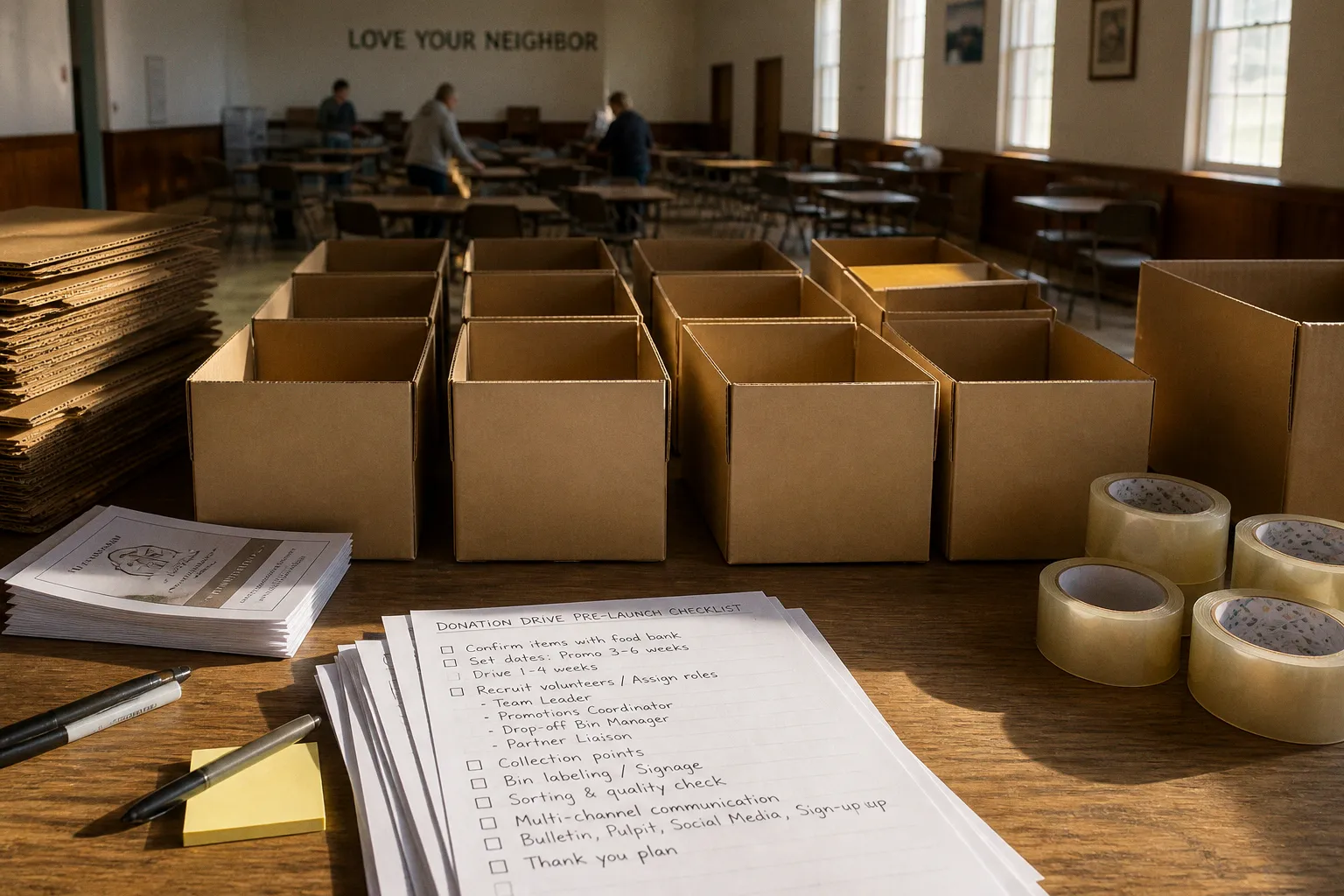
It is logistics: unclear needs, overlapping volunteer assignments, poorly placed drop-off points, and announcements that tell people to give without telling them what to bring.
Use a church charity drive planning checklist before you announce the project to the congregation. Build the operation in advance. Confirm the recipient’s actual needs. Assign one person to every critical task. Then launch with a clear timeline and a donation list people can follow without guessing.
For most congregations, promotion should begin three to six weeks before launch. The active collection period generally runs one to four weeks. That gives your team enough time to coordinate with a beneficiary partner, prepare volunteers, publish the campaign, and correct problems before they become visible to the whole congregation.
A church donation drive is not a pile of boxes. It is a short-term service operation with a recipient, a schedule, a supply chain, and assigned owners.
Start with the beneficiary partner, not the donation bin
The first action in any faith-based charity drive preparation is direct coordination with the organization receiving the donations. Do not announce a general request for food, clothing, toys, hygiene products, or household supplies until the partner confirms what it can use.
A food pantry may need specific shelf-stable products while having enough of other common items. A foster agency may have urgent needs related to age, size, or season. A homeless shelter may require sealed personal-care products rather than miscellaneous household goods. Your congregation cannot serve effectively if it sends items the partner cannot distribute.
Partner coordination checklist
Before publicizing the drive, schedule a conversation with the beneficiary organization and document the answers.
- What items are in high demand right now?
- What items should donors avoid?
- Are there restrictions on expiration dates, packaging, condition, or size?
- Does the organization accept opened packages, used clothing, furniture, or homemade goods?
- What quantity can the partner receive and process at one time?
- Who will receive the delivery?
- Where should the donations go?
- What days and times can the partner accept the shipment?
- Does the partner need donations sorted by type before delivery?
- Can the partner provide language for the public request?
Assign one volunteer as the partner liaison. This person owns all operational communication. Without a single point of contact, different volunteers may receive different instructions and publish conflicting lists.
Your partner liaison should produce one approved donation list. Keep it specific. “Help local families” is a purpose statement, not a supply request. A usable list identifies the exact categories and conditions donors need to follow.
For example, a partner-approved list might specify:
- unopened shelf-stable food;
- full-size hygiene products;
- new socks and undergarments;
- children’s clothing in selected sizes;
- diapers in selected sizes;
- gift cards in approved denominations;
- new blankets or other seasonally requested items.
Do not add items simply because they seem useful. Every extra category creates more sorting, more storage, and more opportunity for unusable donations to enter the system.
Confirm the handoff before launch
The delivery plan belongs in the pre-launch file, not in someone’s memory.
Record:
1. The final collection date.
2. The expected donation volume.
3. The transport vehicle or vehicles.
4. The loading team.
5. The delivery address.
6. The receiving contact.
7. The scheduled handoff time.
8. The procedure for items that do not meet the partner’s requirements.
This is basic capacity building. If your congregation collects more than the receiving organization can process, generosity turns into an unplanned storage problem. Ask the partner how much it can accept and whether it prefers multiple deliveries.
Build the timeline backward from the handoff
A church charity drive needs a fixed operating window. Open-ended campaigns create weak momentum and leave volunteers managing leftover supplies indefinitely.
A practical structure looks like this:
| Phase | Typical timing | Primary objective |
|---|---|---|
| Partner confirmation | Before public announcement | Define approved needs and delivery terms |
| Volunteer recruitment | Three to six weeks before launch | Fill leadership and shift roles |
| Promotion preparation | Three to six weeks before launch | Create the item list, announcements, signs, and digital posts |
| Active collection | One to four weeks | Receive, monitor, sort, and secure donations |
| Final sort and delivery | Final collection day or immediately after | Remove ineligible items and complete the handoff |
| Closeout | After delivery | Thank volunteers, report tangible results, and document improvements |
For an online or hybrid donation drive, a two-to-four-week active window often gives the congregation enough time to respond without allowing the campaign to lose urgency. The exact schedule should follow the partner’s needs and your congregation’s volunteer capacity.
Set benchmarks before the first announcement
Your team should know what must be completed at each stage.
Three to six weeks before launch
- Confirm the beneficiary partner.
- Approve the donation list.
- Select the collection dates.
- Appoint the drive coordinator.
- Recruit the core volunteer team.
- Reserve collection points.
- Prepare the communication materials.
- Confirm storage and transport capacity.
One to two weeks before launch
- Train drop-off bin managers.
- Publish the first announcement.
- Place signs in approved locations.
- Open digital volunteer sign-ups.
- Confirm the delivery appointment.
- Check bins, labels, carts, tables, and storage areas.
- Brief ministry leaders and worship-service volunteers.
During the collection period
- Inspect collection points on a set schedule.
- Replenish signs and printed lists.
- Move full bins safely.
- Track donation categories.
- Report progress without creating confusion.
- Contact the partner if the volume or item mix changes significantly.
At closeout
- Complete the final sort.
- Separate damaged, opened, expired, or otherwise ineligible items.
- Load and deliver the donations.
- Record the tangible outcome.
- Thank every volunteer.
- Save the final plan for the next campaign.
Do not wait until the collection period to discover that no one owns storage, transportation, or sorting. A drive can have enthusiastic promoters and still collapse at the handoff.
Assign roles before you recruit a crowd
The volunteer team needs structure. “We need helpers” is not a role description. It does not tell people when to serve, what they will do, or who will make decisions.
At minimum, assign these roles:
Drive coordinator
The drive coordinator owns the full deployment. This person maintains the timeline, calls team meetings, resolves conflicts, and confirms that every workstream has an owner.
The coordinator does not need to perform every task. In fact, that approach creates a bottleneck. The coordinator needs authority to move the project forward and a simple way to see what remains unfinished.
Partner liaison
The partner liaison communicates with the beneficiary organization. This includes confirming needs, clarifying restrictions, scheduling delivery, and reporting changes to the drive coordinator.
Keep this role separate from general volunteer recruitment. The person managing the partner relationship needs time to document details accurately.
Promotions coordinator
The promotions coordinator prepares and distributes the campaign message. This person works with worship leaders, bulletin editors, social media volunteers, ministry leaders, and anyone managing the congregation’s digital communication.
Every channel must use the same donation list and dates. If the Sunday announcement requests one set of items while the social post requests another, donors lose confidence and volunteers inherit the confusion.
Drop-off bin managers
Each collection point needs an assigned manager. The manager checks the bin, keeps the surrounding area orderly, replaces missing signs, and reports when donations need to be moved.
A bin manager should also know what to do with items that appear damaged, opened, or outside the approved list. Do not force every volunteer to make a new decision. Provide a standard escalation process.
Sorting team leader
The sorting team leader schedules volunteers, prepares the sorting area, and enforces the partner’s requirements. This role protects the quality of the final shipment.
Sorting should not become an informal conversation around a growing pile. Set up labeled areas before donations arrive. Use the approved categories from the partner’s list.
Transport and delivery lead
This volunteer confirms the vehicle, loading team, route, delivery appointment, and handoff documentation. The delivery lead should also plan for safe lifting and secure loading.
Data and closeout volunteer
Someone should record the campaign’s tangible results. Depending on the project, that may include the number of boxes, bags, kits, gift cards, or volunteer shifts. Do not promise precise measurements you cannot verify. Record only what your team can count reliably.
Use a volunteer structure that matches the workload
A small congregation may combine roles. That is acceptable if the responsibilities remain explicit. A larger drive should divide them.
Use a simple responsibility table during the planning meeting:
| Task | Primary owner | Backup | Deadline |
|---|---|---|---|
| Confirm recipient needs | Partner liaison | Drive coordinator | Before announcement |
| Approve donation list | Drive coordinator and partner liaison | Ministry leader | Before promotion |
| Prepare printed materials | Promotions coordinator | Communications volunteer | Before launch |
| Inspect collection points | Bin managers | Volunteer scheduler | Throughout collection |
| Manage sorting area | Sorting team leader | Drive coordinator | Before final sort |
| Confirm transportation | Delivery lead | Drive coordinator | Before collection closes |
| Publish results and thanks | Promotions coordinator | Data volunteer | After delivery |
This table prevents a common church donation drive problem: everyone assumes someone else has completed the task.
Recruit for shifts, not vague availability
Give volunteers a defined assignment:
- Saturday, 9:00–11:00: receive and label donations.
- Sunday after worship: move full bins to storage.
- Tuesday evening: sort hygiene products.
- Final collection day: load the vehicle and complete delivery.
Digital sign-up tools can help you identify gaps early. Make the shift length, location, physical requirements, and task clear. A volunteer should know whether the assignment involves lifting boxes, standing for an hour, making phone calls, or entering data.
Your congregation includes people with different capacities. Build useful roles for those who cannot lift or transport donations. They can manage sign-in, prepare labels, make reminder calls, assemble kits, coordinate schedules, or write thank-you messages.
That is not a secondary contribution. It is how you build a dependable volunteer operation instead of relying on the same few people for every deployment.
Prepare collection points for control and flow
A collection bin is part of your operating system. It needs a location, a label, an inspection schedule, and a plan for overflow.
Choose centralized collection points where donors naturally pass during worship services and ministry activities. Avoid placing bins where they block entrances, narrow walkways, interfere with accessibility, or create an unsupervised storage risk.
Every collection point should display:
- the name of the beneficiary organization;
- the exact collection dates;
- the approved donation categories;
- condition or packaging requirements;
- a contact for questions;
- a statement about items the partner cannot accept.
Standardize the branding across all bins. Use the same colors, wording, and category labels. Donors should recognize the campaign immediately whether they see it in the fellowship hall, church office, youth area, or another approved location.
Establish the sorting procedure before donations arrive
Sorting is where weak planning becomes visible. Create a procedure and brief every sorting volunteer.
A practical process includes:
1. Move donations to a designated sorting area.
2. Separate items by approved category.
3. Inspect packaging and condition.
4. Remove damaged, opened, expired, or ineligible items.
5. Place accepted items in labeled containers.
6. Record totals using a consistent unit.
7. Prepare the shipment according to the partner’s instructions.
8. Secure the items until transport.
Do not place questionable goods directly into the delivery load. Set up a separate review area. The partner liaison or sorting team leader can resolve unclear cases using the partner’s guidance.
The congregation also needs a respectful process for items that cannot be accepted. Do not shame donors. Communicate the requirement clearly, explain that the partner has specific distribution standards, and direct volunteers to the approved alternative process where one exists.
Control overflow
Assign a storage limit. When the space reaches capacity, the drive coordinator should know whether to schedule an interim delivery, move items to another approved location, or pause a category.
This is especially important for drives involving bulky goods. A congregation may have enough enthusiasm to collect far more than its building can safely store. Capacity planning protects the ministry, the volunteers, and the receiving partner.
Launch communication that gives people a job
A church community outreach drive needs more than visibility. It needs instructions that convert attention into action.
Every announcement should answer five questions:
- What is the need?
- Who will receive the support?
- What exact items should people bring?
- Where and when should they bring them?
- When does the campaign end?
Use multiple channels:
- parish bulletins;
- pulpit announcements;
- printed signs near collection points;
- congregation emails;
- social media;
- ministry newsletters;
- youth and small-group communications;
- digital volunteer sign-up tools.
The message must remain consistent. Give every communicator one approved information sheet. Include the final donation list, dates, location, partner name, and contact person.
Make the request specific
Weak message: “Bring donations for families in need.”
Operational message: “From May 5 through May 26, bring unopened shelf-stable food from the approved list to the labeled collection bins in the fellowship hall and church entryway. Please do not bring opened packages or items outside the listed categories.”
The second message reduces sorting problems before they occur. It also respects the donor’s time.
Create momentum without overstating results
During the active period, publish reminders tied to the schedule. Tell people what is still needed. If the partner reports that one category remains urgent, update the congregation through the same channels used for the original launch.
Avoid claiming a number you cannot verify. A visible progress update can use concrete but accurate language:
- The drive has entered its final week.
- The partner has requested additional hygiene products.
- The collection bins will close after Sunday worship.
- Volunteers are needed for final sorting and delivery.
- The congregation has filled the first set of labeled boxes.
If you track quantities, define the unit. “We collected 42 boxes” is more useful than “We received an incredible amount,” provided the boxes are counted consistently.
The strongest campaign message is not the loudest one. It is the clearest one, repeated at the right moments by every ministry channel.
Run the final week as a controlled closeout
The final week requires more coordination than the opening week. Donations arrive in a rush. Volunteers may assume the work is finished when the bins are full. Your team must shift from promotion to execution.
Final-week checklist
Confirm the following before the last collection day:
- The partner still needs the approved categories.
- The delivery appointment remains active.
- The transport vehicle is available.
- The loading team is scheduled.
- The sorting area is clear.
- Labels and containers are ready.
- Full collection bins have a secure storage location.
- The final reminder includes the closing date.
- Volunteers know where to report and whom to contact.
Schedule the final sort immediately after collection closes when possible. Delaying it increases the chance of misplaced donations, unclear ownership, and forgotten delivery arrangements.
During sorting, follow the partner’s standards without improvising. If a volunteer discovers a new issue, record it for the drive coordinator. Do not allow every shift to create its own rules.
Close the loop with the congregation
The ministry does not end when the vehicle leaves the church property. Report the outcome in a way that demonstrates tangible impact without turning the recipient into a publicity object.
Share:
- what was collected;
- when it was delivered;
- which volunteer teams served;
- what the partner said it still needs, if applicable;
- how the congregation can support the next approved action.
Thank the people who handled the unglamorous work: bin managers, sorters, drivers, schedulers, communications volunteers, and the partner liaison. Those roles determine whether the next drive can launch faster and with less strain.
Save the final campaign file. Include the timeline, approved item list, role assignments, communication copy, volunteer schedule, delivery notes, and problems encountered. Your next church charity drive checklist should reflect what happened in the last one.
Common planning failures to eliminate
A practical system becomes stronger when you identify failure points before launch.
Announcing before confirming the need
This produces excess or unusable goods. Contact the beneficiary partner first and publish only the approved request.
Assigning a single general volunteer team
A general team has no clear ownership. Divide the work into coordination, partner communication, promotion, collection-point management, sorting, transport, and closeout.
Using different donation lists across channels
This creates donor confusion and sorting delays. Give every communicator one current version of the list.
Leaving bins unsupervised
Unmanaged bins overflow, lose labels, and collect items outside the campaign scope. Assign inspection times and backup managers.
Treating sorting as an afterthought
Sorting requires space, supplies, instructions, and leadership. Prepare the area before collection begins.
Extending the drive indefinitely
A defined one-to-four-week collection period supports urgency and gives volunteers a clear finish line. If the partner needs more support, launch a new phase with a new plan.
Measuring enthusiasm instead of impact
Attendance and excitement matter, but they do not replace delivery. Track the tangible output your team can verify and confirm that the partner received usable support.
Final deployment check
Before the first announcement goes out, your congregation should be able to answer yes to each of these questions:
- Has the beneficiary partner confirmed the current high-demand needs?
- Do we have a specific, approved donation list?
- Are the promotion and collection dates fixed?
- Have we allowed three to six weeks for promotion when the project requires it?
- Is the active collection period limited to a defined window?
- Does every critical task have a named owner and backup?
- Are the collection points centralized, labeled, and accessible?
- Do volunteers know how to handle damaged or ineligible items?
- Do we have secure storage and a sorting area?
- Is the delivery appointment confirmed?
- Are all communication channels using the same information?
- Do we have a plan to record results and thank volunteers?
If any answer is no, pause the launch and close that gap. Your congregation does not need a more dramatic appeal. It needs a more reliable system.
Church charity drives succeed when compassion receives operational support. Confirm the need. Build the timeline. Assign the work. Control the collection points. Deliver what the partner can actually use. That is how a local ministry moves from good intention to tangible community impact.