Faith and fitness trails: common design pitfalls and fixes
The most common mistake churches make when planning a faith and fitness trail is treating the body and the spirit as separate errands.
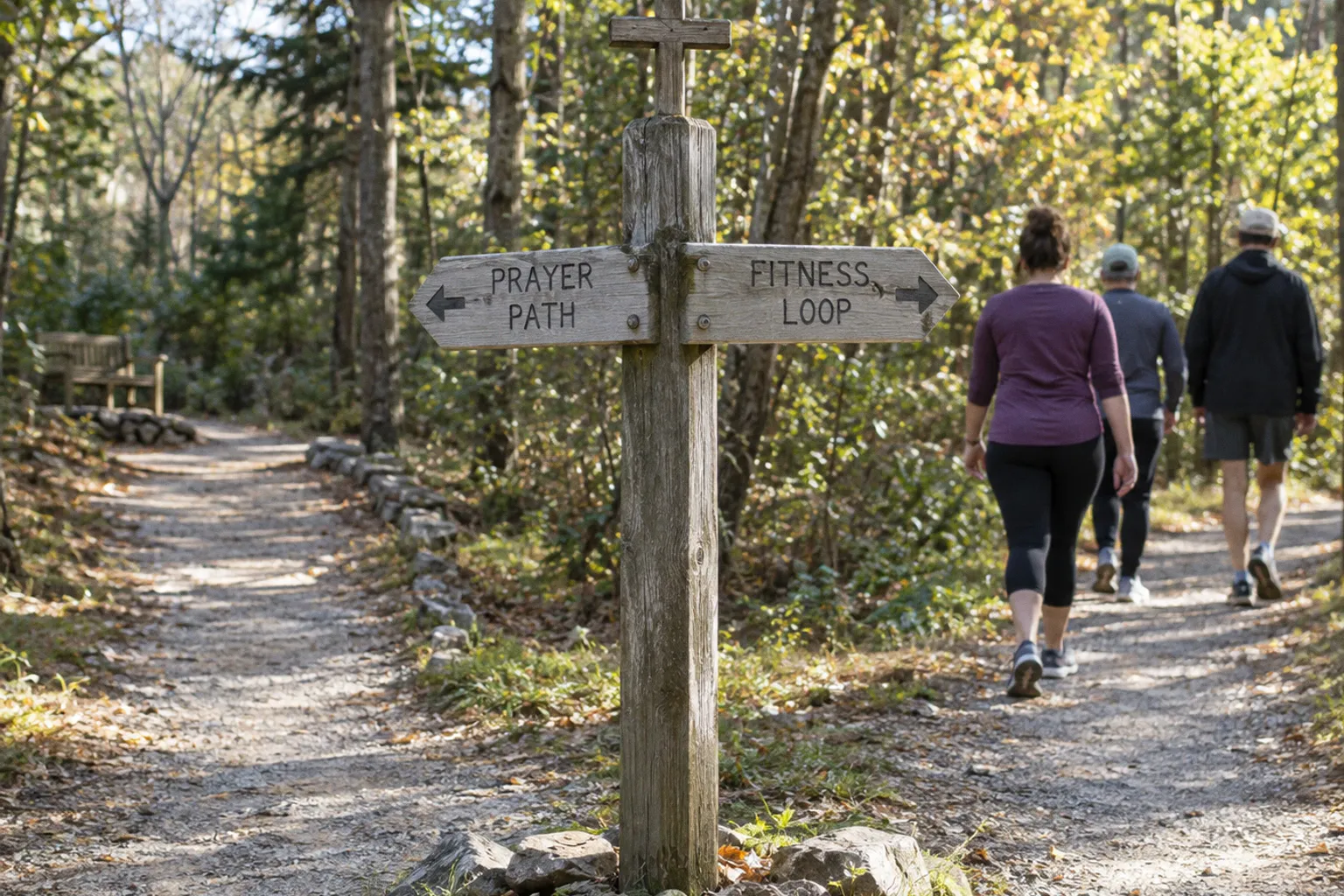
One committee lays out the path; another drafts the devotions; the two groups meet for the first time on ribbon-cutting morning, and everyone quietly notices that the prayer stations feel like decorations bolted onto a sidewalk rather than seams in the same fabric.
This fragmentation is a pastoral problem before it is a planning problem. We live in bodies that get tired, that carry grief in their shoulders, that need movement not as a productivity hack but as a way of inhabiting creation with gratitude. In Christian spiritual formation, Diane Chandler names physical health and wellness as one of seven facets of the Holy Spirit’s work in a believer’s life — not as a supplement to the interior life, but as a genuine strand of formation.
When a church builds a trail that separates exercise stations from contemplative stations, it sends an unspoken signal that the body belongs over here and the spirit over there. The gospel we preach does not divide the person that way. A trail that does will struggle to become more than a pleasant piece of property, no matter how well it is paved.
Bridging the Gap Between Physical Fitness and Spiritual Formation
Most trails fail in the planning binder, not on the ground. The minutes show a recreation committee working from a parks-and-recreation template and a spiritual-life committee working from a retreat guide. The two documents are filed in different folders, and the trail they eventually produce is the literal sum of both: a paved loop with devotional signage that reads as though it were airlifted in from another ministry.
That is the central church faith and fitness trail common mistake: confusing proximity with integration. A prayer station may stand beside a stretching area, but that does not mean the two belong to one coherent practice. Integration has to be present in the way the route is imagined, in the pace it invites, and in the questions the congregation is willing to ask about the relationship between movement, attention, prayer, and community.
A more faithful approach begins with a shared theological conviction. Before a single foot of path is measured, the team can sit with a few anchoring questions:
- What does it mean for our congregation to confess that the body is a creature of God, not merely a vehicle for the soul?
- What kinds of movement — walking, stretching, resting on a bench, accompanying a child — already exist in the parish’s week?
- How might a trail serve those practices rather than compete with them?
- Whose voices are missing from the room, especially people whose bodies move differently from the average adult?
- What kind of welcome should a visitor experience before they understand the church’s language or customs?
These are not abstract theological exercises. They affect whether the trail feels like a ministry or like a recreational amenity with religious language attached. A walker who is invited to notice breath, weather, birdsong, fatigue, and gratitude is being offered a different experience from someone who encounters a sequence of unrelated quotations while trying to find the next exercise marker.
The same principle applies to programming. A congregation might use the route for a walking group, a youth activity, a grief-support gathering, a quiet morning prayer, or an intergenerational event. Each use can emphasize a different part of the trail, but the underlying design should remain legible. The route should not require a separate explanation every time the church wants to use it.
A trail is not a sidewalk with Scripture bolted to it. It is a single practice, walked slowly, in which the lungs and the listening belong to the same person.
Designing church walking trails well therefore means planning for more than circulation. It means asking what kind of attention the route makes possible. A long, exposed straightaway may be efficient, but it can also feel institutional and offer little reason to pause. A loop with changes in texture, view, elevation, and pace can support both physical activity and reflection, provided those changes are accessible and maintained.
The goal is not to turn every walk into a devotional performance. Some people will come to exercise. Some will come to talk. Some will come because the church grounds offer a safe place to move. The ministry does not become less meaningful because every visitor does not stop at every station. Hospitality begins when the trail allows different people to use it in different ways without making any of them feel that they are doing it incorrectly.
The Four Pillars of Integrated Trail Infrastructure
A working faith and fitness trail rests on four interlocking systems, and weakness in any one of them eventually pulls the others down. Treating these as a checklist is itself a mistake; they are more like a four-strand rope, where each strand carries part of the load.
| System | What it actually does | What it looks like when it is thin |
|---|---|---|
| Movement infrastructure | Provides a route the body can use comfortably and predictably | Stable surfacing, clear distances, water access, shade, seating, and enough width for people to pass |
| Spiritual engagement points | Invites people to slow, read, listen, pray, or notice | Stations spaced along the route, each with a single focal practice rather than a wall of text |
| Safety and accessibility | Creates the conditions under which people can use the trail with dignity | Firm surfaces, manageable grades, clear sightlines, appropriate lighting, and a way to call for help |
| Ministry operating plan | Keeps the trail useful after the opening event | A named owner, scheduled reviews, volunteer support, and a recurring budget for upkeep |
The first system is often the easiest to see and the easiest to overemphasize. Committees may spend months discussing surfacing, borders, exercise equipment, and landscaping while treating the ministry purpose as something that can be added later. But a route is not successful simply because it is attractive or durable. It must also be understandable. Visitors should be able to tell where the trail begins, how far it goes, where they can rest, and what kind of use the church welcomes.
The second system requires restraint. A station should not attempt to carry an entire sermon, a doctrinal summary, a prayer, and a lesson in local history. When every sign tries to say everything, people stop reading. A short passage, a question, a sensory invitation, or a simple practice can often do more work than a crowded panel. The material should be visible from a standing or seated position, easy to read, and placed where a person can pause without blocking the route.
The third system is where many faith and wellness ministry challenges become visible. A path may technically exist, but the route to the path may be uneven. A bench may be present, but positioned in full sun with no back support. A station may be reachable by someone who walks steadily but impossible to approach for someone using a wheelchair, walker, or stroller. The distinction between having an amenity and being able to use it matters.
The fourth system is the one most likely to be postponed. It is also the one that determines whether the trail remains part of congregational life. Someone must know who checks the signs, reports damage, monitors vegetation, coordinates volunteers, answers questions, and brings concerns back to the appropriate committee. Without that ownership, even a modest problem can become a reason for people to stop returning.
Notice what is missing from this list: expensive exercise equipment. Messiah United Methodist Church in Vale, North Carolina built a fifth-of-a-mile finely ground gravel walking loop around its community garden and playground. That trail is low-cost, accessible, and already serving as a backbone for wellness in the parish — quiet proof that infrastructure, not machinery, is the foundation.
A church considering a similar project should be honest about its own scale. A shorter route with good seating, clear signs, and reliable maintenance may serve the congregation better than a larger plan that depends on equipment the church cannot repair or volunteers it cannot sustain. Outdoor spiritual wellness trail planning is not a contest in complexity. The strongest design is often the one the congregation can explain, use, and care for without strain.
Common Implementation Failures and How to Walk Back from Them
Faith and fitness trails can encounter several recurring pitfalls. None is inevitable, and none requires abandoning the project. The useful question is not whether a church can design a flawless trail. It is whether the planning process can recognize risks early enough to respond with humility and practical changes.
1. Building before listening. The route is chosen before anyone has walked the property in prayer, before neighbors and members with mobility differences have been consulted, and before the soil, drainage, and shade patterns have been observed across changing conditions. The fix is unhurried discernment: walk the land at different hours and in different weather, talk with the people who will use the trail, and let the property speak before the design freezes.
Listening should include more than a public meeting where the most confident voices do most of the talking. Invite people to walk the proposed route together. Ask where they would hesitate, where they would need to rest, where they would feel exposed, and where they would want to linger. A map can show distance, but it cannot show every place where a person loses confidence.
2. Overloaded signboards. Volunteers, eager to share everything they love, stack devotionals, doctrinal summaries, prayers, questions, and background information onto each station until the panel reads like a Sunday bulletin board. The fix is editorial discipline: one focal practice per station, kept under a few sentences, with optional deeper material available through a separate card or digital layer for those who want more.
The wording should also respect the setting. Someone may encounter the trail while tired, distracted, or walking with a child. They may not know the church’s preferred vocabulary. Plain language is not a reduction of faith; it is a form of welcome. If a theological idea matters, write it so that a neighbor can approach it without first learning the internal language of the congregation.
3. Accessibility as compliance. Ramps are added where a regulation requires them, slopes are checked, and the rest of the trail is left as it is. The fix is a wider imagination: accessibility is about who can use the trail with dignity, not who can technically reach it. That includes parents with strollers, grandparents with walkers, neighbors recovering from surgery, people with limited stamina, and children who need a calmer sensory environment.
The entire experience matters. A person should be able to get from the parking area or sidewalk to the trailhead, understand the route, approach the stations, find a place to rest, and leave without having to ask for special assistance at every stage. If the route includes a difficult section, the alternative should be clear rather than hidden behind an apologetic sign.
4. Digital dependence. The trail’s spiritual life is outsourced to a smartphone app, and when the app is down, the stations become blank. The fix is low-tech primary, high-tech secondary. Every station must work without a device, and digital layers should enrich rather than replace the embodied practice.
This is especially important for visitors who do not share the congregation’s technology preferences, for children who do not carry phones, and for people whose devices are inaccessible or unreliable. A QR code can lead to music, an extended reflection, or a guided meditation, but it should never be the only way to understand why a station is there.
5. Launching without ownership. A ribbon is cut, photographs are taken, and no one is named responsible for what happens in the following months. The fix is a single named steward or small team with a clear mandate and a budget line, not a hopeful sentence in a committee report.
Ownership does not mean one person must do every task. It means one person or team knows how the tasks are assigned and what happens when they are not completed. The stewardship team might coordinate seasonal walks, invite feedback, check for damaged surfaces, and bring larger concerns to the church council. The trail remains connected to the life of the congregation rather than becoming orphaned property.
6. Measuring only opening day. Success is counted by the crowd at the dedication and never revisited. The fix is a review rhythm. At thirty days, what is breaking, confusing, or being overlooked? At sixty days, who is actually coming, and what are they saying? At ninety days, what is forming, and what needs to change before the trail becomes familiar enough to be taken for granted?
These questions do not require a complicated data system. A sign-in option, informal conversations, notes from walking-group leaders, and regular observation may be enough to reveal patterns. The point is not to turn ministry into a spreadsheet. It is to remain attentive to the difference between what the church intended and what the trail is actually doing.
Success is not the ribbon. Success is whether, after the opening season has passed, an elderly member can walk the loop with her granddaughter and find a station that holds both of them.
These risks often overlap. Poor listening can produce inaccessible design. Overloaded signs can make the trail less welcoming. Weak ownership can allow drainage problems or faded materials to become permanent. That is why the planning conversation should not divide the concerns too sharply. The physical route, the devotional content, the maintenance plan, and the congregation’s theology of welcome are parts of one ministry.
Strategic Placement: Avoiding Noise and Maximizing Contemplation
A prayer station placed beside a busy road is, functionally, not a prayer station. The visual noise of traffic, the smell of exhaust, and the constant interruption of sound cannot be solved by better typography. Contemplation requires a quality of silence that the planning team must protect.
When you walk your own property, notice where sound already falls away. Look for low spots, hedgerows, the leeward side of a tree line, the corner of a garden where a fence absorbs street noise, or a section where the canopy changes the quality of light. These are contemplative anchors. Place the most reflective stations there, where the invitation to slow down is reinforced by the landscape itself.
More active or instructional stations can sit nearer the entry, where arrivals are still orienting themselves and conversation is natural. A welcome sign, route map, warm-up prompt, or simple movement suggestion does not need the same quiet as a station devoted to grief, confession, gratitude, or stillness. The route can gradually change character as the walker moves inward.
The goal is not to hide the trail from the world. A church is not building a retreat center that must be sealed off from ordinary life. It is creating a sequence in which the world’s demands can loosen their grip for a while. The street may be visible at the beginning. A child may be laughing near the playground. Someone may greet a neighbor on the path. Contemplation does not require a perfect absence of noise, but it does require deliberate attention to where noise is likely to overwhelm the invitation.
Placement also affects safety. Hidden corners may feel peaceful during daylight but uncomfortable after dusk. A secluded station may be appropriate for quiet prayer but should still have clear sightlines and a route that does not make a person feel trapped. Lighting, visibility, and the presence of other users are part of the pastoral design, not merely technical details.
This is also where the body’s role becomes pastoral. A person walking into silence is doing something the soul cannot do alone. The breath slows, the gait lengthens, the eyes lift. That is formation, not just fitness, and the trail design must honor it.
Integrating scripture into fitness trails works best when the text is allowed to meet the place. A passage about water belongs near a fountain, rain garden, or shaded resting place if the property offers one. A reflection on pilgrimage may sit along a stretch where the route changes direction. A text about rest should not be placed where there is nowhere to sit. The point is not to force a symbolic meaning onto the landscape. It is to let the material and the spiritual dimensions speak to one another without overexplaining.
Beyond Compliance: Designing for True Accessibility and Inclusion
Compliance gives a trail a floor. Inclusion gives it a welcome. The difference matters because the people a church most wants to reach — those grieving, those newly disabled, those returning to faith after a long absence, and those who do not yet know whether they belong — may be quietly turned away by a trail that meets code but not need.
A few pastoral questions sharpen this work:
- Can someone using a walker or wheelchair reach every station, not just the main path?
- Is there a bench at a useful interval, and is it placed where the view invites a person to sit rather than pass by?
- Can someone with limited vision distinguish the route, read the signs, and recognize changes in surface?
- Are devotional materials offered in the languages spoken in the surrounding neighborhood?
- Is the text readable without requiring a seminary degree or excellent eyesight?
- Can a parent stop safely with a stroller while another child continues walking?
- Is the trail usable after dusk, when some of the people who most need it are the only ones who can come?
- Does the route offer a quieter option for people who find crowded or highly stimulating environments difficult?
None of these questions is answered by a single inspection. They are answered by inviting the people who would raise them into the design conversation from the beginning — not as a courtesy, but as a structural commitment.
The church should also consider the social meaning of the trail. Is it clearly open to neighbors, or does the design make it look like a private facility reserved for members? Are the hours posted? Is there a simple explanation of whom to contact with concerns? If the trail sits near a worship building, will someone who does not attend services understand that they are welcome to walk there?
Inclusion does not mean pretending every person will have the same experience. It means refusing to design for one imagined body, one pace, one language, or one kind of family. A trail can support vigorous walking and quiet sitting. It can welcome people who want a devotional prompt and people who simply need a safe route through a green space. The ministry becomes stronger when those uses are not treated as competitors.
Church recreation trail maintenance issues also have an inclusion dimension. A broken surface, a missing handrail, an overgrown edge, or a faded sign does not inconvenience everyone equally. The person who can step around a problem may not notice how completely it blocks someone else. Regular maintenance is therefore part of hospitality. It tells people that their ability to use the space has been considered after the opening day, not merely during the dedication.
Operational Sustainability: Planning for Life After the Ribbon Cutting
The most fragile moment of a faith and fitness trail is the Monday after the dedication, when volunteers go home and the trail is left to weather, weeds, and the slow drift of neglect. A trail is a ministry, not a monument, and ministries require rhythms.
A 30-60-90 day cycle is one sturdy rhythm. At thirty days, walk the trail as if you were a guest. Note what is worn, what is faded, what is missing, what feels unsafe, and what is difficult to understand. At sixty days, look at who is actually using it, and listen to what they say when no one is taking notes. At ninety days, ask the harder formation question: is anything being changed in the people who walk here, or has the church built a pleasant loop and called it ministry?
That question should not be treated as a demand for measurable spiritual outcomes. Churches cannot reduce prayer, grief, belonging, or gratitude to a simple count. But they can pay attention. Are people lingering? Are different generations using the route together? Have walking groups formed? Do visitors know how to enter the space? Are the stations helping people notice their surroundings, or are they being ignored because the route itself does not support stopping?
Underneath the review cycle, several commitments keep the rope from fraying.
First, establish a budget line for upkeep. It can be modest, but it should be recurring and written into the annual plan rather than scraped together each spring. Surfacing, sign replacement, pruning, lighting, seating, and accessibility improvements all become harder when every repair requires a new fundraising campaign.
Second, create a small standing team that treats the trail as a year-round parish ministry, not a seasonal project. The team does not need to meet constantly. It does need a clear responsibility for observation, communication, and follow-through. A quarterly walk-through can reveal problems that a committee meeting in a church office will never see.
Third, build relationships with the people who already understand the property. Grounds volunteers, custodians, facilities staff, gardeners, parents, older members, and neighbors may notice different parts of the trail’s life. Their knowledge can prevent a design decision from creating a maintenance burden that looked invisible on the original plan.
Fourth, keep the content editable. Stations that no longer serve can be retired, rerouted, or rewritten. A sign that was meaningful for a particular season of congregational life may become confusing later. A route may need to change when a garden expands, a tree comes down, or drainage patterns shift. Humility is part of stewardship. A church does not honor its original plan by refusing to improve it.
Finally, decide how the trail connects to the wider ministry of the congregation. Will the church offer regular walking prayers? Will children’s groups use the route? Could a grief ministry invite participants to walk together? Might the congregation host a seasonal outdoor service without making every use of the trail explicitly programmatic? The trail should have opportunities to become woven into parish life, but it should not be so heavily programmed that individuals cannot claim it for their own quiet use.
We are finite creatures, and the trails we build must be honest about that finitude — modest in scope, sustainable in cost, and humble enough to be changed when they no longer serve the people they were made for.
A Closing Word for the Trail Committee
We do this work because we believe the body is not an inconvenience to the soul but a partner in the long work of formation. A well-designed faith and fitness trail says to a neighborhood: your walking, your breathing, your grief, your joy — all of it has a place in this community.
A poorly designed one says something else. It may suggest that the church values activity but has not considered fatigue, that it welcomes visitors but has not considered access, or that it wants to offer reflection without protecting the conditions reflection requires. Those messages are rarely intentional. They are built into the route through small decisions that no single committee member considers decisive.
The risks in front of a church are not mysterious. They are the ordinary failures of a congregation that plans in silos, launches in a rush, writes too much on every sign, treats accessibility as a final inspection, and walks away before the soil has settled. The responses are also ordinary: listen before you build, integrate body and spirit on paper before you integrate them on the ground, protect the silence your stations will need, widen your idea of accessibility, and stay with the trail long enough to be changed by it.
A church does not need a grand landscape to create a meaningful place for movement and prayer. It needs a route that tells the truth about its theology: people are embodied, different, limited, social, and worthy of care. It needs signs that invite rather than crowd. It needs surfaces and seating that allow people to participate without apologizing for their bodies. It needs a ministry plan strong enough to survive the enthusiasm of opening day.
Done this way, a trail is not simply a project or an amenity. It is a slow, embodied practice of being a people who hold space for one another’s bodies and souls at the same time.