Faith and fitness trail setup: fixing the spiritual gap
Most churches that build a faith and fitness trail start the same way. A grounds committee walks the property, picks a route, orders a few Scripture panels, and within a season the trail is up. Six months later, the walking path is used.
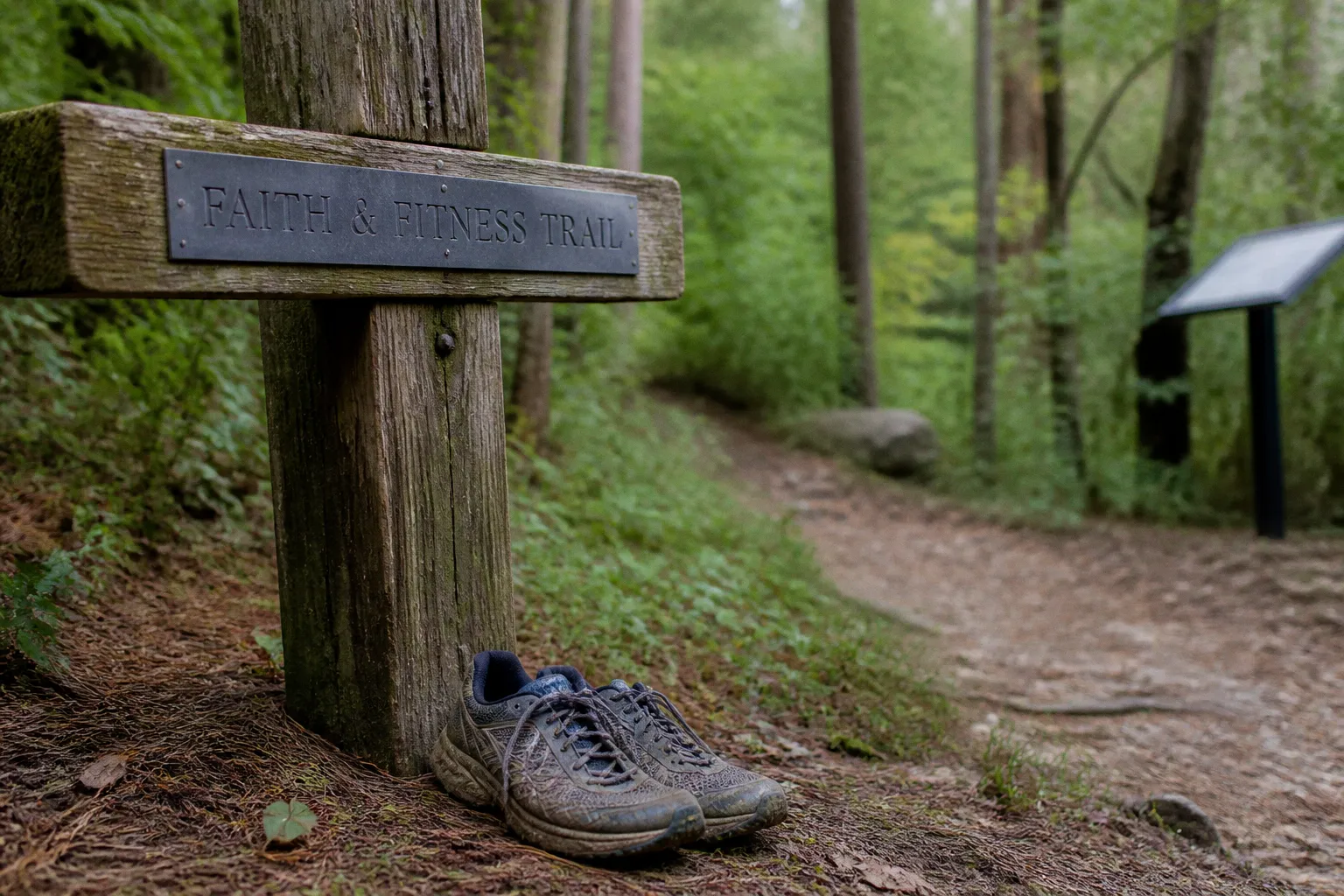
The prayer stations are not. Somewhere between the dedication service and the first hot afternoon of summer, the trail quietly became a sidewalk with a verse on it. That is the gap this article is meant to close, because the gap is not about funding or footpath width. It is theological. We build trails as if body and spirit were two separate errands, when the very witness of the incarnate Christ says they belong together.
We have watched this pattern repeat in congregations that genuinely love their people. A wellness committee forms around a real concern for sedentary members, for heart disease, for the quiet isolation of aging alone. The trail becomes a project. We measure it in linear feet, not in the slower arc of formation. Diane Chandler, writing on Christian spiritual formation, names physical health and wellness as one of seven facets of the Spirit's work in a believer's life. Seven, not one. When we build a trail and treat the physical portion as prelude to the spiritual, we have already undermined what we were trying to do.
A trail is not a sidewalk with a verse. It is a single practice where breath, body, and prayer are held together.
Bridging the Gap Between Physical Exercise and Spiritual Formation
The first mistake in faith and fitness trail planning is the one we make before any dirt is moved. We separate what God has joined. In our planning documents, the "fitness" section discusses heart rate targets, distance markers, and equipment specifications. The "spiritual" section, often written by a different committee, lists devotions and suggested Scripture readings. The two columns never meet. The committee that breaks ground in March does not know what the small group will pray about in July, because the two teams did not share a vocabulary.
This is where the pastoral work begins. Before a single post is driven into the ground, a faith and fitness trail needs a theological statement. Not a doctrinal one. A practical one. What does this congregation believe about the body? Is the body a vessel for the soul, a distraction from the soul, or a participant in the soul's formation? Our Lutheran heritage gives us rich language here. The incarnation is not incidental to salvation. The Word became flesh. If the Word became flesh, then our flesh is not a problem to be transcended on the way to devotion. It is part of the devotion itself.
When we name this clearly at the start, every later decision changes. Route selection begins to ask where this path slows the body enough that the mind can attend. Equipment choices begin to ask what this station invites the person to feel, not just accomplish. Scripture panel placement begins to ask whether the walker will reach this verse while breathing hard or while catching breath, and whether either posture serves the prayer. These are not small questions. They are the difference between a trail and a sidewalk.
The Five-Step Framework for Congregational Wellness Routes
Congregations that build trails that last tend to follow a recognizable shape. We have seen it in the planning documents of communities that have walked their paths for years, not seasons. The framework has five movements, and skipping any one of them tends to predict the failures we have come to expect.
| Step | Core Question | Common Mistake |
|---|---|---|
| 1. Name the purpose | Why does this trail exist, theologically and practically? | Jumping to route logistics before answering |
| 2. Map the route | Can a wide range of bodies actually walk this path? | Choosing the longest loop instead of the most accessible one |
| 3. Structure the group | Who walks together, and how? | Leaving it to self-organized drop-ins with no leadership |
| 4. Integrate prayer | Where and how does prayer enter the walk? | Treating prayer as a separate closing devotion |
| 5. Build the timeline | What sustains this past the dedication? | Front-loading all energy into opening month |
Step One: Name the Purpose Before You Measure the Land
Purpose is not a slogan. It is a sentence the planning team can repeat without flinching. Something like, "We are building a trail so our congregation can integrate physical stewardship with contemplative prayer." That sentence will get tested the first time a member asks whether the trail can host a 5K fundraiser. If the purpose is clear, the answer becomes obvious. If the purpose is vague, every later decision becomes a negotiation.
Purpose also names who the trail is for. Is it for members only, or for the surrounding neighborhood? Is it for the chronically fit, or for the widow who has not left her house in three weeks? Both are holy callings. They produce different trails. A trail built for neighborhood outreach needs wide, well-lit, accessible pathways from the start. A trail built for contemplative walking needs seclusion and quiet. Trying to be both usually means being neither.
Step Two: Map a Route the Body Can Actually Walk
Accessibility is not an afterthought. It is the route. The most common failure we see is a planning team that walks the property once on a cool spring morning, picks the longest scenic loop, and then discovers that the loop has a steep grade and a creek crossing. The members who most need a trail for their health are the ones who will find this loop impossible.
A reasonable benchmark for a general congregation is a route that a moderately conditioned adult can walk at roughly a fifteen-minute mile pace without strain, with rest stations spaced so that no segment asks more of the body than it can offer. For members using canes, walkers, or wheelchairs, an alternate paved portion of the path must be available, because a trail that excludes them is not a ministry trail. It is a recreational one.
Surface matters more than distance. A packed crushed-stone path, a paved quarter mile, and a mowed grass connector are not equally welcoming. The body knows. So does the person who wonders whether they will fall.
Step Three: Structure the Group, Not Just the Path
Many trails fail not because the path is wrong but because no one walks it. We have seen beautifully designed routes that, six months in, register only the occasional solo walker and a grandparent pushing a stroller. The trail becomes infrastructure, not community.
Groups need shepherds. A weekly walking prayer group with a designated leader, a posted start time, and a reliable presence will do more for the trail's life than any equipment purchase. Some congregations have found that pairing walking groups around existing small groups, Sunday school classes, men's or women's ministry cohorts, gives the trail an immediate community. Others have built the trail as a core offering for their grief support ministries, where the rhythm of walking alongside another person becomes its own form of presence.
The point is that a trail is not a self-organizing ministry. It needs a few people who will be there at nine in the morning on a Tuesday because they said they would be there at nine in the morning on a Tuesday.
Step Four: Weave Prayer and Scripture Into the Walk Itself
This is where the gap usually lives. The path is built. The panels are in. Now we need to decide how the walker actually prays.
There is a deep Lutheran instinct here that serves us well. Prayer is not a performance. It is not a recitation. It is conversation, sometimes silent, often wordless, held in the presence of God and the congregation of saints. A trail that demands extroverted prayer at every station will lose the introverts, the grieving, the anxious, and the curious newcomer who is not yet ready to pray aloud in a place where a passing car can hear.
Some stations invite spoken Scripture. Some invite silence. Some invite a single line read slowly, then three minutes of walking before the next line. Some invite bodily prayer: a stretch, a breath, a posture. The genius of the trail is that it can offer many modes of attention, and the walker chooses which one fits the day.
Step Five: Build a Timeline That Outlasts the Dedication
The dedication Sunday is not the finish line. It is mile one. We have watched trails wither because the planning team exhausted itself in the opening season and had nothing left for the long middle. Maintenance schedules, seasonal prayer themes, leader rotation, and a yearly recommitment are not bureaucratic add-ons. They are the difference between a trail that serves a generation and a trail that serves a dedication photo.
The Quiet Walk: Avoiding Performative Prayer on the Trail
There is a particular failure mode unique to outdoor prayer, and it is worth naming directly because it has wounded more than one congregation's witness. In Matthew 6:5, Jesus warns his listeners against praying in ways designed to be seen by others. The street corner is, of course, exactly where a faith and fitness trail places us.
We have all seen it. A prayer walking group moves along the trail with hands lifted, voices raised to be heard over the traffic, drawing attention to themselves in a way that is hard to distinguish from performance. Often the intention is good. Often the group has been praying earnestly for the neighborhood and wants the neighborhood to know. But the form betrays the substance.
A faithful prayer walking culture trains its people to pray quietly, often silently. It teaches that the prayer offered by a walker who passes in silence may be just as deep, just as earnest, and just as heard by God as the prayer shouted across a parking lot. Some congregations find it helpful to teach breath prayers, a single line repeated with each exhale, that anchor the walker without announcing them. Some establish visible norms at the trailhead: that this is a quiet prayer space, that we pray silently or in a low voice as we walk. That single sign does more for the trail's integrity than a dozen printed devotion guides.
We are not opposed to group prayer. We are opposed to prayer that has slipped into the register of performance without anyone noticing. The trail is meant to be a place where the inner life can breathe. That breath is hard to hear. That is the point.
Physical Health as a Facet of Christian Discipleship
The deeper reason a faith and fitness trail matters is theological, and it deserves a section of its own. In the work of Diane Chandler and others who have written carefully on Christian spiritual formation, physical health is named as one of seven facets of how the Spirit forms us. It is not the least of these. It is not a footnote. It is one of seven. To neglect it is to teach, by our practice if not by our words, that the body is incidental to the life of faith.
This has implications for how we plan. A trail that serves only the able-bodied and the already-fit is not a faith trail. It is a fitness club with a verse on it. A trail that genuinely serves the body as a facet of formation will include rest stations with seating, shaded portions for those who cannot tolerate heat, gentle grades for those rebuilding strength after illness, and gathering spots at the end where walkers can sit together with water and share what the walk surfaced. It will mark its distance in prayer stations, not in personal records.
The calendar helps, too. April is National Minority Health Month, Stress Awareness Month, and Move More Month. May is National Women's Health Month. These observances are not the reason to build the trail, but they are natural occasions for a congregation to invite the wider community onto the path, to offer walking groups during seasons of heightened stress, and to remember that stewardship of the body is a year-round vocation rather than a January resolution.
There is a long tradition of holy walking. The desert mothers and fathers walked and prayed. The pilgrims walked and prayed. The circuit riders of the revival tradition walked and preached. We are heirs of a faith that has long understood the legs as instruments of the soul. A faith and fitness trail, when built well, joins that tradition rather than inventing something new.
Sustainable Maintenance and Safety for Outdoor Ministry Spaces
A trail that is unsafe or unkempt is a trail that no one walks, and a trail that no one walks is a witness against itself. Maintenance is not a footnote to ministry. It is ministry, full stop.
The practical considerations are straightforward and worth naming clearly:
- Surface inspection — quarterly walks to identify washboarding, exposed roots, or washout after heavy rain. Crushed stone needs refreshing; paved portions need crack sealing; mowed connectors need regrading.
- Scripture panel care — wood panels need sealing or staining on a regular cycle; metal or composite panels need cleaning and anchoring checks. A faded or damaged panel signals neglect before any walker reads the verse.
- Equipment safety — stretching stations, balance equipment, and any strength elements need anchoring checks, rust inspection, and replacement of worn grips. Local building codes and insurance providers should be consulted for any equipment beyond simple walking surfaces.
- Lighting and sightlines — if the trail is used at dawn or dusk, lighting matters for both safety and the unspoken invitation that the path is welcoming. Even a modest solar lighting plan changes who feels comfortable on the trail.
- Accessibility continuity — an accessible route in spring can become inaccessible in winter. Snow and leaf management are part of the ministry, not separate from it.
- Weather policies — extreme heat, lightning, ice, and poor air quality days require clear cancellation norms. The leader who walks in dangerous conditions teaches the congregation to do the same.
A trail that says "come" must also mean it six months from now, in January, on the path with the cracked panel no one has fixed.
We would add one pastoral note here. Maintenance teams are themselves a form of quiet ministry. The retired member who checks the panels each month, the deacon who clears the leaves before the Wednesday prayer walk, the confirmation student who restocks the water station. These acts of care are not background logistics. They are the embodied faith the trail is meant to teach. Invite people into this work. The trail will be the better for it, and so will they.
A Closing Word
A faith and fitness trail is not a strategy for church growth. It is not a wellness program dressed in devotional language. At its best, it is a return to the embodied Christianity we have always confessed. The Word became flesh. Our flesh is not an obstacle to prayer. It is the ground on which prayer happens.
If you are standing at the beginning of this planning process, we would urge you toward three things. Slow down at the purpose step longer than feels comfortable. Build a smaller, more accessible trail rather than a larger, more impressive one. And when the trail opens, walk it yourself, often, in silence, and let it teach you what it was always meant to teach.
The gap we named at the beginning is not closed by better equipment or longer paths. It is closed by a community that has decided the body belongs in the sanctuary of the outdoors, and the outdoors belongs in the slow work of formation. When that decision is made early and held for years, the trail becomes what it was always meant to be. Not a sidewalk with a verse. A place where breath, body, and prayer are held together, one quiet step at a time.