Faith and fitness trails: a safety checklist for congregations
A faith and fitness trail can become one of the most life-giving places on church property: a path for prayer, gentle movement, conversation, grief, recovery, and the quiet renewal that sometimes arrives only when the body is allowed to move at its own pace.
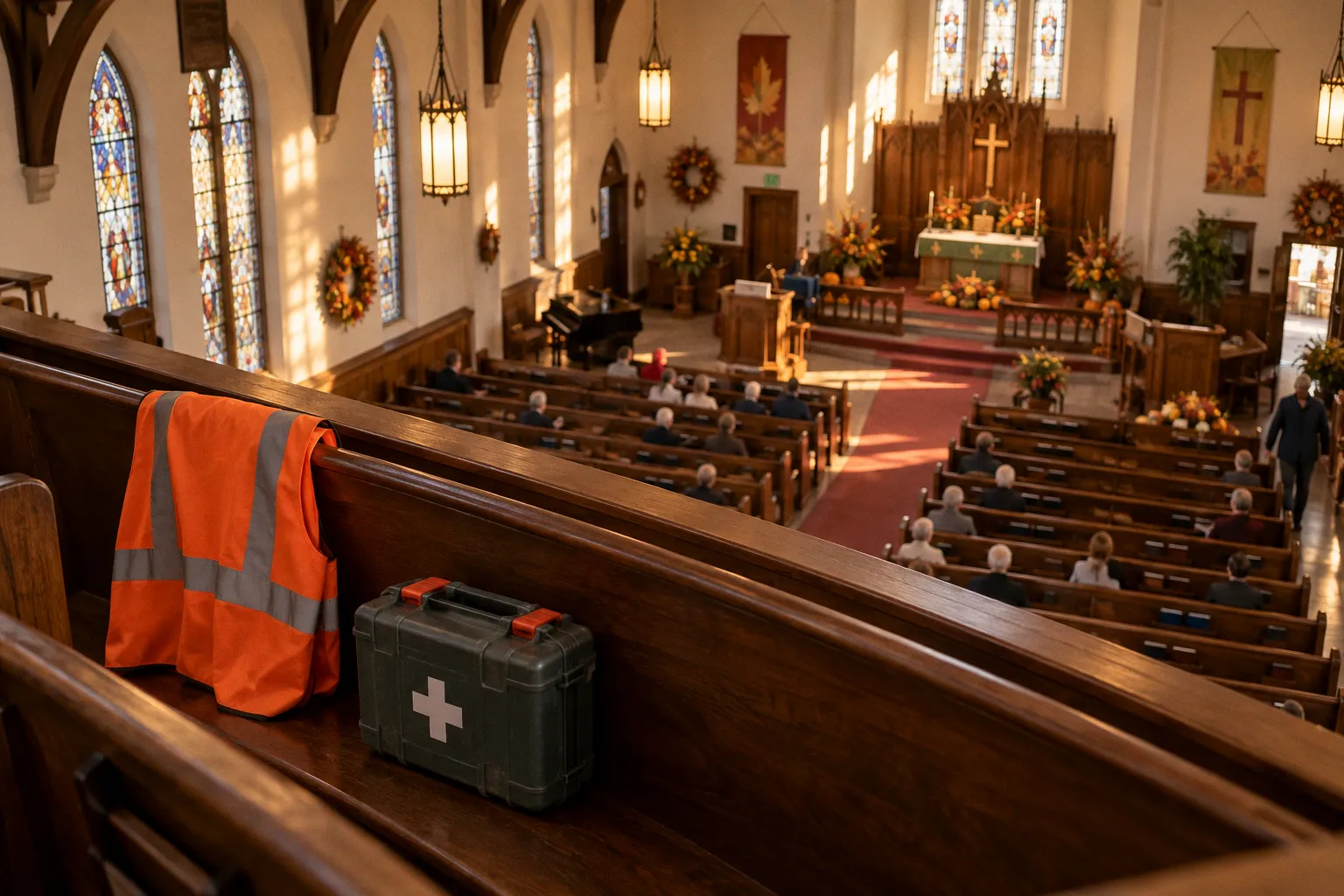
But the same trail that offers welcome can also expose a congregation to preventable hazards—unstable equipment, poor visibility, unclear routes, delayed emergency response, and maintenance practices that quietly deteriorate over time.
A sound faith and fitness trail safety checklist is therefore more than a list of repairs. It is a form of pastoral care made visible in the landscape. The congregation is saying, through its choices about surfaces, signs, lighting, equipment, and supervision, that people’s bodies are not an inconvenience to be managed but lives entrusted to communal attention.
The work does not require a promise that every risk can be removed. Finitude remains part of outdoor ministry, as it is part of every human undertaking. What we can do is build a trail whose risks are understood, inspected, communicated, and held with humility.
Begin with the trail’s purpose—and its actual users
Before selecting equipment or marking prayer stations, describe what the trail is meant to hold. A walking path used for silent prayer has different needs from a fitness circuit with elevated platforms, resistance stations, or group exercise areas. A route designed for older adults, children, people living with disabilities, and congregants recovering from illness must be considered differently from a strenuous recreational course.
The purpose of the trail should be written down in plain language. This helps the congregation distinguish between what it hopes to offer and what the property can safely sustain.
A useful planning conversation includes:
- Whether the primary activity is walking, prayer, stretching, strength training, group formation, or a combination of these.
- Which age groups and physical abilities are likely to use the route.
- Whether people may use the trail alone, after worship, early in the morning, or during evening programs.
- Which portions of the property are public, semi-public, or restricted.
- Whether the route remains usable during rain, heat, snow, fallen leaves, or periods of reduced daylight.
- Where a participant can rest, ask for help, or leave the route without retracing the entire path.
- How the trail will support people who need a slower pace or who cannot use exercise equipment.
This is also where congregations can make room for psychological safety. Not every person who comes to a prayer path wants to join a group. Some may be carrying grief, anxiety, chronic pain, or spiritual exhaustion. A trail that offers only strenuous activity may unintentionally communicate that wellness belongs to the strong. An embodied faith is broader than performance. It includes sitting, breathing, walking slowly, pausing, and being accompanied without having to explain everything.
A safe ministry space does not ask every body to move in the same way; it gives each person a dignified way to belong.
Structural integrity and EN 16630 compliance
Outdoor fitness equipment requires a more exacting review than a bench, signpost, or simple walking route. Platforms, pull-up structures, balance elements, stepping units, and resistance stations can create fall, impact, entrapment, pinching, and crushing hazards when they are poorly designed, incorrectly installed, or allowed to deteriorate.
In Europe, permanently installed outdoor fitness equipment on public or community recreation trails is governed by the EN 16630 safety standard. The standard addresses material quality, structural stability, hazard prevention, safety clearances, and impact-absorbing surfacing where falls from height create a foreseeable danger. Congregations elsewhere should not assume that EN 16630 automatically serves as their local legal requirement, but it can provide a useful technical reference while the church verifies applicable municipal, building, recreation, and insurance requirements.
Particular care is needed where a fall height exceeds one meter. In those locations, the surface beneath and around the equipment should be designed to absorb impact in accordance with the relevant standard or local code. Grass may look soft, but appearance is not a reliable measure of impact protection, especially after rain, drought, soil compaction, or repeated use.
A practical equipment inspection should ask:
- Is the equipment firmly anchored, level, and free from movement that was not present at installation?
- Are bolts, welds, joints, handles, steps, and support posts intact?
- Are there sharp edges, protruding fasteners, splintered surfaces, or cracked materials?
- Can clothing, fingers, hair, or limbs become caught in an opening or moving component?
- Are there adequate clearances around each station so users do not collide with another person, a tree, a sign, or a hard surface?
- Does the impact-absorbing ground cover remain deep, continuous, and free from exposed foundations?
- Are instructions and weight or ability limitations legible and understandable?
- Has the equipment been modified, repaired, or relocated without documentation from the manufacturer or a qualified professional?
The inspection should be documented rather than held only in someone’s memory. A simple record can include the date, person completing the review, equipment inspected, defect observed, temporary control applied, repair assigned, and date of closure. If an item presents an immediate danger, it should be removed from service until repaired or professionally assessed. A sign saying use at your own risk is not a substitute for maintenance.
Match equipment to the people you hope to welcome
The presence of exercise equipment does not by itself create a health ministry. A congregational fitness path should be proportionate to the community’s actual needs and capacity. If the trail is used by older adults, people with balance limitations, or those returning to movement after illness, the route should include stable resting points, lower-intensity alternatives, and clear transitions between surfaces.
Instructions should avoid assuming a uniform level of strength or mobility. Language that invites users to begin gently, stop when pain or dizziness occurs, and choose an easier variation can be more protective than competitive wording. This is not about making the trail timid. It is about refusing the cultural pressure to treat exhaustion as proof of faithfulness.
Where equipment is complex or physically demanding, the church should consider supervised demonstrations, trained program leaders, or partnerships with qualified recreation professionals. A pastoral leader may offer encouragement and prayer without possessing the technical expertise to teach resistance training, fall prevention, or rehabilitation exercises. Knowing the difference is part of responsible care.
Landscape management and visibility
A well-built path can become unsafe when vegetation, drainage, lighting, or seasonal debris are neglected. Church walking trail maintenance is not merely cosmetic. It shapes whether users can see one another, recognize changes in the ground, find assistance, and feel secure enough to remain present.
Trees and shrubs should be trimmed so that walkways and exterior areas remain visible. Church facility safety guidance specifically emphasizes removing hiding places and preserving unobstructed sightlines along paths and around buildings. This matters for security, but it also matters for orientation: dense growth can conceal a damaged surface, a fallen branch, a person who needs help, or a sign that has become difficult to read.
A regular landscape review should include:
1. Walking surfaces. Look for raised roots, loose gravel, cracked pavement, mud, standing water, erosion, ice, fallen branches, and abrupt changes in grade. Mark or close hazardous sections until they can be corrected.
2. Edges and transitions. Make the boundary between pavement, soil, mulch, grass, and exercise surfacing clear. Changes that seem obvious in daylight may be difficult to detect for someone with limited vision or in poor weather.
3. Drainage. Check whether water flows across the route after rain. Repeated pooling can damage surfaces, create algae growth, and make a path slippery.
4. Vegetation. Remove overgrowth from signs, lights, equipment, and walkways. Assess dead limbs and trees that could fall onto the route.
5. Visibility. Preserve clear views near entrances, corners, seating areas, and equipment clusters. Lighting should support orientation without creating glare or deep pockets of shadow.
6. Rest points. Provide stable seating at reasonable intervals, especially on longer routes or paths with changes in elevation.
7. Weather exposure. Identify areas that become excessively hot, icy, or difficult to navigate during seasonal changes, and communicate closures when conditions warrant them.
Visibility should be approached as a shared responsibility rather than as a surveillance project. People deserve to feel protected without feeling watched. Clear routes, open sightlines, appropriate lighting, and accessible emergency information can provide that balance.
Waste and recycling containers also belong in the safety conversation. Church security walkthrough protocols recommend keeping these containers at least three meters—approximately ten feet—from primary church buildings, reducing a potential fire hazard. The distance should be confirmed against local fire and property requirements, but the underlying practice is straightforward: storage, refuse, and combustible materials should not be allowed to accumulate beside the building or along a busy route.
Emergency preparedness is part of welcome
A prayer path may encourage solitude, but the church still needs to know how help will arrive when something goes wrong. A participant may fall, experience chest pain, become disoriented, or suffer a heat-related illness. The response plan should not depend on whoever happens to be nearby remembering a phone number or searching through a locked office for supplies.
Every safety walkthrough should verify the location, accessibility, condition, and inspection status of:
- First aid kits appropriate to the activities offered.
- Fire extinguishers.
- Automated External Defibrillators, where the congregation has one.
- Emergency telephones or reliable means of contacting emergency services.
- Site addresses and access points that responders can understand.
- Keys, gates, and routes needed by emergency personnel.
- Posted information about the trail’s location and the nearest building entrance.
- Weather alerts, shelter locations, and procedures for suspending outdoor activities.
An emergency plan should identify who calls for help, who meets responders, who stays with the injured person, who guides other participants away, and who communicates with church leadership. These roles should be practiced in a calm setting. People do not need to rehearse catastrophe dramatically; they do need enough familiarity that panic does not have to invent the response.
The trail’s address deserves special attention on larger or wooded properties. “Behind the church” may be meaningful to members and useless to emergency dispatchers. Numbered gates, labeled entrances, maps, and visible markers can shorten the distance between a crisis and competent assistance.
Where children or vulnerable adults participate, the emergency plan should also account for supervision, consent procedures, reunification with caregivers, and the handling of private health information. Compassion does not require public disclosure. A person can be cared for without becoming a story passed through the congregation.
Safe programming for prayer walks and fitness activities
The physical trail is only one part of outdoor ministry safety standards. The way a group is invited, briefed, accompanied, and dismissed has equal importance.
A trained group prayer walk can follow a simple structure: approximately 20 minutes for preparation, 30 to 40 minutes for the walk and designated stations, and 15 minutes for debriefing. This rhythm gives the group time to establish boundaries before movement begins and to notice what the experience stirred afterward.
The preparation period can cover:
- The route, estimated pace, rest points, and return time.
- Weather conditions and any areas that are closed or slippery.
- Who is leading, who is carrying communication equipment, and who remains at the rear.
- What participants should do if they become separated or feel unwell.
- How prayer stations will be approached, including the freedom to pass without explanation.
- Whether photographs, conversation, or sharing of personal experiences are appropriate.
- How the group will respond if someone discloses grief, trauma, suicidal thoughts, abuse, or another urgent concern.
The walk itself should have a pace that does not quietly exclude the slowest participant. If the group separates, the leaders should already have agreed on a regrouping point rather than treating separation as an individual failure. A buddy system can help, but it should not become a substitute for trained leadership or a way of placing responsibility on another participant who is not prepared to carry it.
A prayer walk also needs spiritual boundaries. Christian mindfulness, when practiced in a congregational setting, should not be presented as a guarantee of calm or healing. Silence may bring relief; it may also bring grief closer to the surface. Nature can provide beauty without resolving every question. Leaders can make room for both experiences without rushing toward a bright conclusion.
The debrief should not require emotional disclosure. Participants may reflect on what they noticed in the landscape, how their bodies felt, or what they need after the walk. A quiet departure is also a valid form of participation. Holding space means allowing the person who speaks, the person who listens, and the person who needs to remain private to be part of the same community.
Carrying supplies and setting physical limits
Participants sometimes bring water, first aid supplies, devotional materials, communication devices, or personal items in backpacks. General outdoor recreation guidance advises keeping a loaded pack below one-third of the participant’s total body weight. For many church-based walks, the better practice will be considerably lighter, particularly when the route includes uneven ground or when participants may already be managing pain, fatigue, or balance concerns.
Leaders should encourage participants to bring what they need without turning preparation into an equipment contest. Water, weather-appropriate clothing, medication carried according to the person’s care plan, and a way to contact help may matter more than elaborate gear.
The group should pause or end the activity when someone experiences:
- Chest pain, severe shortness of breath, faintness, confusion, or sudden weakness.
- A fall that may involve a head, neck, or spinal injury.
- Signs of heat illness, hypothermia, or serious allergic reaction.
- A level of distress that makes continued participation unsafe.
- A worsening of pain that is not relieved by rest.
Leaders are not expected to diagnose. Their task is to recognize concern, stop the activity, seek appropriate help, and remain present.
Liability, documentation, and the discipline of follow-through
Liability considerations for church trails are often discussed as though a waiver could settle the matter. It cannot. A signed acknowledgment may have a role determined by local law and the congregation’s insurer, but it does not replace reasonable design, supervision, inspection, maintenance, or response planning. Nor does it eliminate the human and pastoral cost of an injury.
The congregation should consult its insurance carrier and local authorities before constructing a new path or installing permanent fitness equipment. Requirements may differ according to jurisdiction, zoning classification, accessibility rules, building and fire codes, public access, and the specific terms of the church’s policy. No single checklist governs every property.
A modest documentation system can protect both participants and the congregation. Keep records of:
- Design decisions, maps, equipment manuals, and installation information.
- Inspection dates and the names of those completing reviews.
- Repairs, closures, and follow-up actions.
- Staff and volunteer training.
- Group program plans and attendance procedures.
- Weather-related cancellations or route changes.
- Incidents, near misses, and the response taken.
- Conversations with insurers, contractors, and relevant authorities.
Near misses deserve attention even when no one is injured. A participant who almost trips over a raised edge has given the congregation information about a condition that may later harm someone else. The response should be curious rather than punitive: what made the hazard difficult to see, why was it not noticed earlier, and what change would make the route safer?
A maintenance rhythm that can be sustained
A trail does not become safe because it was inspected once at opening. Congregations should establish a rhythm that matches use, weather, and the complexity of the site.
A workable pattern may include:
- Before each organized activity: a brief route and weather review, with attention to closures, equipment condition, and communication access.
- Regularly during active seasons: inspection of surfaces, signs, vegetation, lighting, drainage, and rest areas.
- After severe weather or construction: a focused review for fallen limbs, erosion, flooding, exposed foundations, and displaced equipment.
- At scheduled intervals: a more comprehensive walkthrough involving facilities leadership, ministry leaders, and, where appropriate, a qualified technical professional.
- After any incident or repeated complaint: a documented reassessment rather than a quiet return to routine.
The exact interval should be determined by the site and its use. A heavily used path with exercise equipment requires more attention than an occasional walking loop with no elevated structures. What matters most is that responsibility is assigned, the record is kept, and unresolved hazards do not disappear into the space between meetings.
The trail as an expression of communal care
A safe church recreation space is not necessarily the newest, largest, or most elaborate one. It is a place where design and ministry agree about the worth of the people who enter it. It offers movement without shame, prayer without pressure, and clear help when a person’s strength runs out.
For congregations considering a faith and fitness trail, the essential sequence is steady and unglamorous:
1. Define the purpose and the people the trail is meant to serve.
2. Inspect the route, equipment, surfaces, vegetation, lighting, and access points.
3. Apply the relevant technical standards, including EN 16630 where applicable, while verifying local requirements.
4. Create an emergency communication and response plan that real people can follow.
5. Train leaders for group walks, fitness activities, and sensitive pastoral situations.
6. Document inspections, repairs, incidents, and decisions.
7. Review the trail as a living ministry rather than a completed construction project.
There is grace in this kind of attentiveness. We do not maintain a path because carefulness can make us invulnerable. We maintain it because bodies tire, grief interrupts, weather changes, and ordinary people place trust in the spaces a congregation offers.
The trail’s deepest ministry may not be the exercise station or the prayer marker. It may be the quiet knowledge that someone has thought about the uneven ground, the locked gate, the emergency call, the person walking slowly behind the group. In that knowledge, safety becomes more than compliance. It becomes one of the embodied ways a church says: you are not carrying this life alone.