Hygiene kit drive setup for local church outreach
A church hygiene kit drive organization effort that bypasses recipient consultation produces predictable failure: rejected donations, wasted supplies, and idle volunteer hours.
The Operational Gap Between Charitable Intent and Recipient Requirements
The principal operational risk in any such drive is not insufficient generosity but insufficient specification. Local shelters and regional relief agencies maintain distinct, often non-negotiable requirements governing acceptable contents, packaging dimensions, prohibited items, and labeling protocols. A drive conceived without that downstream specification produces kits that cannot be deployed.
The corrective is structural rather than motivational. Effective church hygiene kit drive organization proceeds from the recipient backward: the receiving institution defines the parameters, the church builds the supply chain to match them, and only then does the collection and assembly phase commence. The framework below sequences those decisions and isolates the points where unverified assumptions most commonly derail a project.
Defining the Distribution Track
Before any procurement or promotion begins, the organizing committee must identify which distribution channel the kits will enter. The two principal tracks carry materially different specifications.
A disaster relief track supplies kits to agencies that aggregate, warehouse, and forward them to affected regions. Standard disaster relief hygiene kit assembly guidelines specify placing core items — bar soap, toothbrush, comb, nail clippers — inside a folded hand towel and washcloth before sealing them in a one-gallon re-sealable plastic bag. The specifications are uniform, the volume targets are high, and the review process is institutional.
A local shelter track supplies kits directly to homeless shelters, transitional housing programs, or food pantry partners within the congregation's immediate service area. Specifications here vary by partner. Each shelter specifies different allowed and prohibited items, and the receiving organization is the only authoritative source for that list. Homeless shelter hygiene kits donation programs operated through local faith-based charity drive ideas therefore require an institution-by-institution conversation rather than reliance on a generic template.
The first deliverable of any hygiene kit drive is a written list of contents, packaging, and prohibitions supplied by the receiving organization.
The track decision determines everything downstream: the procurement list, the donation bin signage, the assembly line configuration, and the volunteer briefing.
Pre-Procurement Partner Communication
Church hygiene kit drive organization fails most often at this stage. Organizers compose a generic kit list, publicize it, collect donations, and discover at delivery that the recipient requires different items, prohibits certain products, or imposes sizing constraints the drive never reflected.
The mitigation is a single preparatory conversation with the receiving institution. That conversation should produce written confirmation of several data points:
- Allowed core items, including acceptable dimensions. A 6-inch minimum length is the standard for sturdy combs used in disaster kits; hand towels for relief kits typically run 15 x 25 to 17 x 27 inches.
- Bar soap sizing. A 3 oz. or larger bath-size bar satisfies standard kits.
- Liquid sizing and prohibitions. Travel-size liquid items such as shampoo, deodorant, and lotion are generally capped at 3.4 ounces or less, and many agencies restrict alcohol-based liquids entirely.
- Status restrictions. All items must be brand new, unwashed, and kept in original packaging, unless explicitly directed to unpack tools such as wide-tooth combs or clippers.
- Container specifications. Standard kits are sealed in 1-gallon re-sealable plastic bags.
Relief agencies generally request that hygiene kits omit personal notes, money, advertisements, religious or patriotic symbols, and decorative branding on kit contents or container bags. Inserting devotional literature, evangelism cards, or church-branded stickers invalidates the kit under most disaster relief protocols. The exclusion is procedural rather than adversarial — agencies must maintain secular operational neutrality in distribution — and the organizing committee should communicate this restriction to donors and volunteers before collection begins.
Procurement and Kit Composition by Track
The table below contrasts typical specifications for the two principal tracks. Organizers should treat the figures as a reference baseline rather than a procurement order; final composition is governed by the receiving institution's written confirmation. Assembling hygiene bags for charity under either track produces the highest yield when the procurement order matches the confirmation list exactly.
| Parameter | Disaster Relief Kit | Local Shelter Kit |
|---|---|---|
| Container | 1-gallon re-sealable plastic bag | 1-gallon re-sealable bag or clear tote (varies) |
| Bar soap | 3 oz. or larger bath-size bar | 3 oz. or larger bath-size bar |
| Liquid items | 3.4 oz. or less travel-size only | Up to full-size, subject to partner restrictions |
| Comb | 6-inch minimum, sturdy | Any size unless restricted |
| Towel dimensions | 15 x 25 in. to 17 x 27 in. hand towel | Varies by partner |
| Permitted inserts | None — no notes, money, or symbols | Determined by partner |
| Razor inclusion | Generally prohibited | Determined by partner |
| Scented products | Often restricted | Determined by partner |
The shelter column emphasizes variability because shelter specifications diverge widely. Some partners accept full-size deodorant and shampoo; others restrict aerosols and alcohol-based products. Some accept disposable razors in sealed packaging; others prohibit them entirely. The disaster relief column reflects the standardized kit format used by major relief agencies and is the appropriate reference for any church community outreach projects that aggregate donations for regional forwarding.
Collection Logistics and Volunteer Coordination
Once the procurement list is finalized, the collection phase begins. The operational objective during this period is inventory accumulation against the confirmed specification, not general-purpose donation gathering.
Collection Bins and Placement
Organizers should secure clear, sturdy collection bins in high-traffic areas. Visibility drives volume; opaque bins reduce donor confidence in the destination of their contribution. Recommended locations include the church narthex, fellowship hall entryways, and adjacent corridors, each with posted signage indicating the receiving institution, the kit specification, and a photograph or sample of a packed bag.
Collection Window
A collection window of approximately 2 to 4 weeks balances donor awareness with volunteer throughput. Shorter windows produce inventory shortfalls; longer windows dilute urgency and produce donation drift toward off-specification items. The window should be announced in advance through bulletin inserts, email distributions, and a single coordinating announcement from the announcement slide or pulpit.
Restricting Off-Specification Donations
Donors frequently contribute items outside the confirmed list: full-size bottles when travel-size is required, scented products when fragrance-free is specified, used items when only new is permitted. The bin signage should enumerate the prohibited categories explicitly. A short printed list attached to each bin performs better than a paragraph of explanation, and a volunteer monitor assigned to the bin during high-traffic services can redirect inappropriate donations before they enter the inventory.
Managing Overflow and Off-Spec Donations
Off-specification donations are inevitable in any church community outreach projects of meaningful scale. The receiving partner should be consulted in advance regarding their disposition policy: some partners accept overflow for general distribution, others route it to auxiliary ministries, and a minority decline it outright. The organizer should also identify a secondary recipient — a school nurse's office, a domestic violence shelter, a veterans' transitional program — capable of absorbing items that do not match the primary kit specification.
Specificity at the bin reduces sorting labor at the assembly event.
Assembly Event Configuration
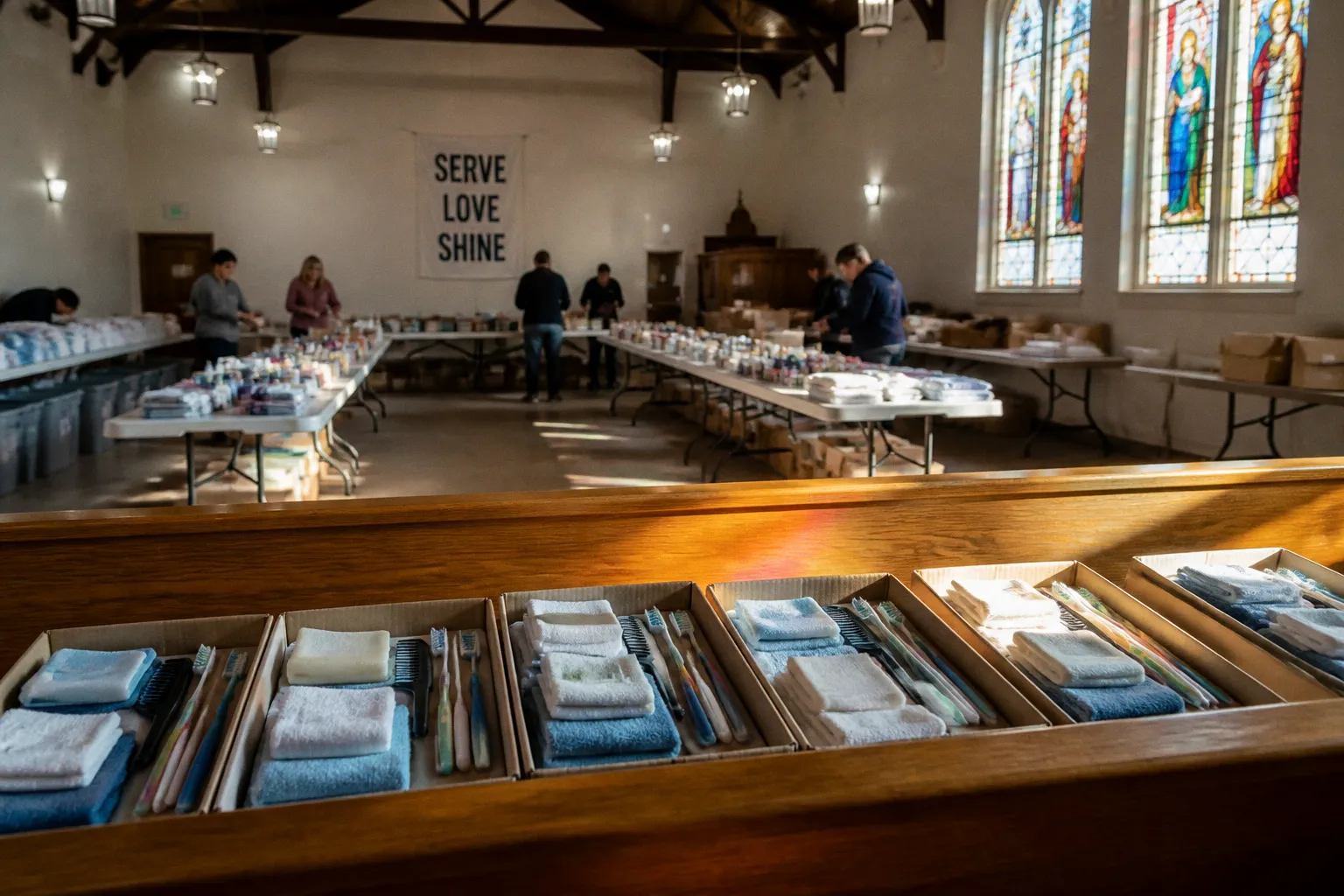
Efficient kit packing event setups utilize 3 to 4 long tables connected end-to-end to create assembly lines where volunteers perform dedicated sequential steps. The configuration mirrors industrial assembly: each station performs one operation, and the kit moves down the line until sealed.
A standard configuration partitions the work as follows:
1. Towel and washcloth folding station. Volunteers fold each hand towel and washcloth to the dimensions specified by the receiving organization and place them at the head of the line.
2. Core item insertion station. Bar soap, toothbrush, comb, nail clippers, and any additional solid items are placed into the folded towel.
3. Liquid item verification. Liquids are checked against size and content restrictions and inserted last to prevent spillage damage to dry goods.
4. Bagging and sealing station. The assembled kit is placed into the 1-gallon re-sealable bag, air is expelled, and the bag is sealed. The bag is inspected for completeness before stacking.
A volunteer briefing prior to the event should cover the prohibited items list, the sequential workflow, and the quality-control check at the sealing station. A designated quality-control volunteer at the final station catches omissions and mis-sized items before the kits are boxed. Briefing duration should run approximately ten minutes and should be repeated for each shift if the event extends beyond two hours.
Shipping, Delivery, and Per-Kit Cost
Most disaster relief agencies request a per-kit contribution — typically $2 to $3 per kit — to cover shipping and supplemental items. The contribution is collected at the assembly event or in parallel with the donation drive and is remitted to the receiving agency. Local shelter delivery rarely involves a per-kit fee; logistics are typically a single drop-off coordinated with the partner's intake schedule.
For disaster relief shipments, the organizing committee should confirm drop-off location, pallet requirements, and any required documentation: packing slip, kit count, and monetary contribution summary. For local shelter deliveries, advance coordination with the partner's intake coordinator prevents queuing and ensures immediate distribution. A follow-up communication with both partner types, confirming receipt and deployment, closes the loop with the congregation and supports the next drive cycle.
Typical Points of Failure
Three failure modes recur across church hygiene kit drive organization projects of every scale.
Specification drift. The drive begins with a generic list and adjusts only when the receiving organization rejects a portion of the kits. The correction is preparatory: written confirmation before any donation is solicited.
Insertion of prohibited items. Donors include religious literature, handwritten notes, or branded stickers. The kit is rejected at the receiving end. The correction is signage, a verbal briefing at the assembly event, and a final inspection at the sealing station.
Assembly line congestion. Too few stations or unclear task division produces bottlenecks, particularly at the folding and bagging stations. The correction is the 3-to-4-table configuration, the pre-event volunteer briefing, and a designated floater who steps into the most loaded station as inventory accumulates.
A fourth, less visible failure mode bears mention: insufficient post-drive reporting. A drive that ends at the drop-off leaves donors uninformed of the outcome and erodes the institutional memory required for the next drive. A short written summary — kits assembled, partner served, total dollars contributed, lessons for the next cycle — preserves organizational efficacy across annual iterations.
Conclusion
A hygiene kit drive is an exercise in stewardship: the resources donated by a congregation are held in trust until they reach a person in need, and the operational framework either preserves or dissipates that trust. Church hygiene kit drive organization succeeds when the receiving institution defines the specification, the congregation builds the supply chain to match, and the assembly event executes against a confirmed checklist. The result is a kit that is unpacked and used rather than sorted, rejected, and discarded — a small, repeatable act of mercy executed with the same discipline the liturgy demands of every other element of congregational life.