Christian walking meditation: spiritual benefits and practice
Christian walking meditation offers a way to pray when sitting still feels difficult, the mind is crowded, or the body itself needs to be welcomed back into the life of faith.
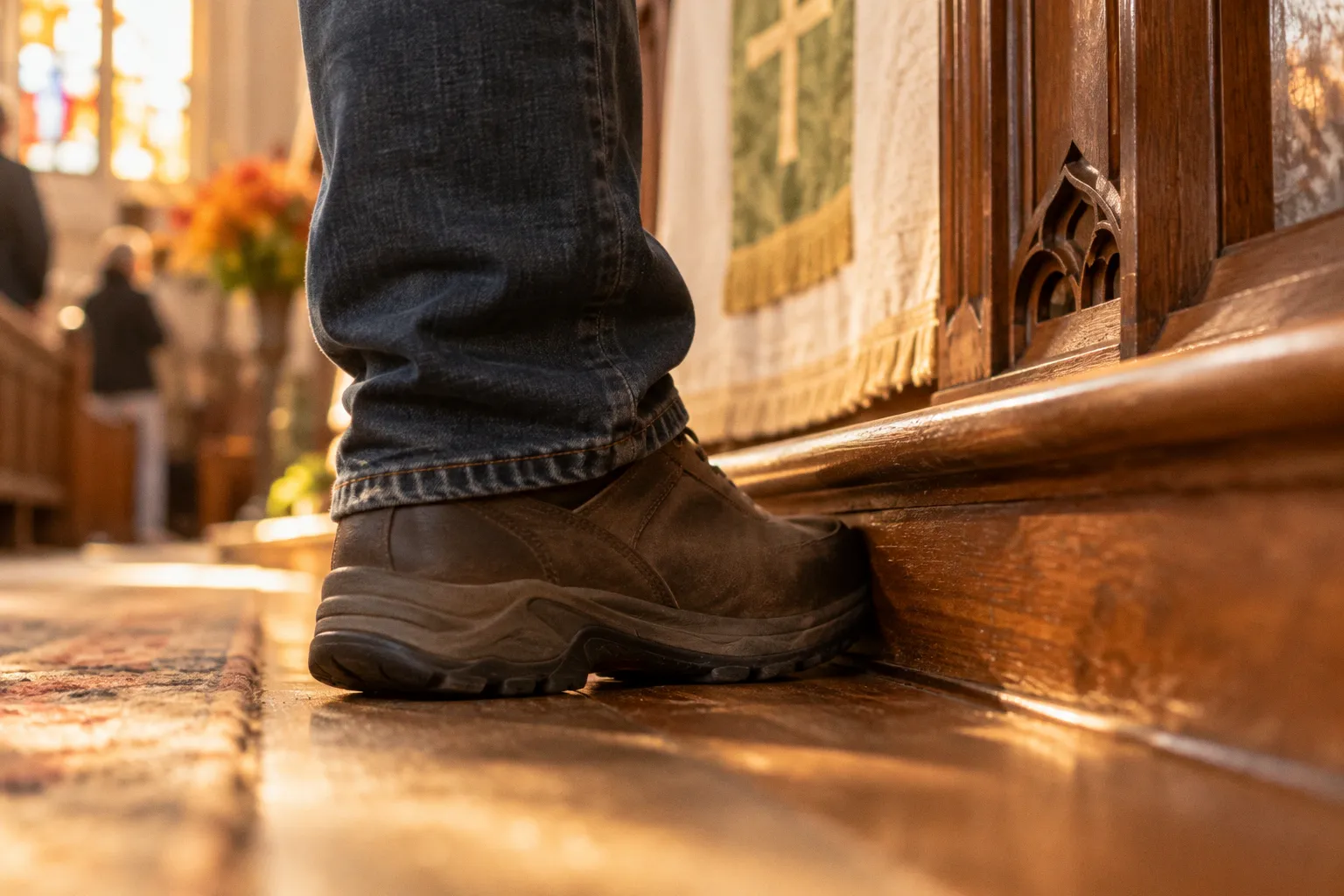
Through a steady pace, attentive breathing, Scripture, and prayer, ordinary movement becomes an opportunity for embodied faith rather than a distraction from it.
For congregations, the practice can be especially gentle and accessible. It does not require special equipment, athletic ability, or familiarity with contemplative traditions. A church walking group, a prayer path around the building, or a slow walk through a neighborhood can create room for spiritual renewal while also supporting friendship, physical well-being, and a deeper sense of belonging.
The Christian walking meditation benefits for congregations are not found in productivity or performance. They emerge through attention: attention to God, to one another, to the body’s finitude, and to the world we are passing through together.
The Theology of Movement: Walking at God’s Pace
Christian faith has never been concerned only with what happens inside the mind. We are embodied people. We kneel, stand, sing, wash, eat, embrace, grieve, and gather around a table. The body is not an inconvenient container for the spiritual life. It is one of the places where God meets us.
That is why walking can become a meaningful form of prayer. The movement is simple enough to leave space for reflection, yet structured enough to give a restless mind something steady to receive. One foot follows the other. The breath finds a rhythm. The world becomes less like a stream of demands and more like a place in which we are being held.
Mark Buchanan has described walking as a physical discipline of Christian spiritual formation, drawing attention to the biblical image of God walking with humanity and proposing a pace of roughly three miles per hour as a meaningful metaphor. The point is not that every person should walk at exactly that speed. The deeper invitation is to consider what becomes possible when we stop allowing urgency to set the tempo of our spiritual lives.
Much of modern life trains us to move quickly while remaining inwardly fragmented. We hurry between tasks, absorb information while doing something else, and carry several emotional conversations in the background of our minds. Prayer can then become another obligation to complete. Walking prayer offers a different posture. It gives us permission to proceed slowly enough to notice.
This does not mean every walk will feel peaceful. Sometimes the first thing we notice is irritation, fatigue, sadness, or the physical tension we have been carrying for days. That noticing is not a failure of meditation. It may be the beginning of truthfulness before God.
A Christian practice of walking can make room for:
- Attention, as the mind returns gently to a word of Scripture, a breath, or the presence of God.
- Lament, as grief and fear are acknowledged rather than covered with premature optimism.
- Resilience, understood not as emotional invulnerability but as the capacity to remain connected to life, community, and grace.
- Embodied awareness, as we notice our pace, posture, breathing, pain, strength, and limits.
- Shared belonging, when walking becomes a practice undertaken with others rather than a private spiritual achievement.
Prayer does not become more faithful because we force the mind to be empty; it becomes more truthful when we learn to return, again and again, to God’s presence.
The body also gives us a language for finitude. A person recovering from illness, living with disability, carrying chronic pain, or grieving a former level of mobility may not be able to walk in the same way as someone else. Christian walking meditation must therefore remain spacious. Walking may mean a slow path through a garden, several laps in a hallway, movement with a mobility aid, or a period of attentive sitting while watching the world pass by.
The spiritual practice is not measured by distance. It is measured by the honesty and care with which we inhabit the moment we have been given.
Historical Roots of Contemplative Walking in the Church
Walking prayer is not a modern import into Christian spirituality, nor does it belong exclusively to contemporary wellness culture. Christians have long encountered God while moving through the world: on pilgrimage, along roads between communities, in monastic gardens, through cathedral spaces, and on paths shaped by seasons of solitude.
The Christian tradition has also valued the connection between movement and thought. Martin Luther, Thomas Aquinas, Søren Kierkegaard, and C. S. Lewis are all associated with regular walking as part of their intellectual, spiritual, or creative lives. Their examples do not establish a universal rule, but they remind us that theological reflection has often taken place with the body in motion.
Pilgrimage offers one of the clearest historical forms of walking as spiritual practice. A pilgrimage places prayer into a journey with a beginning, a middle, and an uncertain arrival. The traveler does not simply think about transformation; the traveler submits to time, weather, fatigue, dependence, and the need for companionship. In that sense, walking becomes a physical parable of discipleship.
The labyrinth belongs to this wider Christian history of contemplative movement. Medieval Christians used labyrinths, most famously in places such as Chartres Cathedral, as a symbolic journey of prayer. The form itself is older than its Christian use, with labyrinth designs reaching back thousands of years, but Christian communities received and interpreted the pattern through the language of repentance, presence, and return.
A labyrinth is not a maze. A maze is designed to confuse and conceal the way out. A labyrinth has one continuous path leading toward the center and then outward again. The journey is often understood in three movements:
1. Releasing on the way in. The walker brings burdens honestly into prayer and allows some of the need to control or resolve everything to loosen.
2. Receiving at the center. The center becomes a place of attention, stillness, and openness to God’s presence.
3. Integrating on the way out. The walker returns to ordinary life carrying whatever insight, comfort, conviction, or unanswered question has emerged.
This pattern matters because Christian prayer is not an escape from the world. We do not walk inward merely to disappear from responsibility. We walk inward so that we may return with greater honesty and compassion.
A labyrinth walk may be silent, accompanied by Scripture, or shaped around a simple prayer such as “Here I am” or “Lord, have mercy.” It may also include no particular words at all. For some people, the most faithful prayer is the willingness to continue walking while remaining aware of God and of their own vulnerability.
A Three-Fold Practice for Christian Walking Meditation
Christian contemplative walking practices do not need to be elaborate. A short, consistent rhythm is usually more sustainable than an ambitious plan that quickly becomes another source of pressure.
A session of fifteen minutes or more can provide enough time for the body to settle and for attention to move beneath the surface of immediate distraction. Some people may need less, especially when beginning or when physical limitations are present. The purpose is not endurance. The purpose is presence.
1. Arrive before you begin
Choose a route that is physically safe and emotionally manageable. This might be a church courtyard, a quiet sidewalk, a park, a prayer path, or an indoor corridor. Before walking, pause for a moment and notice the condition in which you are arriving.
You might silently name:
- What is happening in your body?
- What emotion is nearest to the surface?
- What are you carrying into this time?
- What do you need from God today: comfort, courage, forgiveness, clarity, or simply companionship?
There is no requirement to produce a profound answer. The practice begins with consent to reality.
If you are walking outdoors, take ordinary safety seriously. Pay attention to traffic, weather, uneven ground, and the need to remain aware of your surroundings. Christian mindfulness is not a withdrawal from practical responsibility. Attentiveness to God includes attentiveness to the world God has entrusted to us.
2. Give the walk a gentle center
Select one focus rather than trying to pray about everything at once. A short passage of Scripture, a single line from a psalm, the Lord’s Prayer, or a simple name for God can provide an anchor.
The focus should be light enough to return to without strain. For example:
- With the inhale: “God of mercy.”
- With the exhale: “Hold me in peace.”
- On the first part of the path: “I receive this day.”
- At the turning point: “Show me what is mine to carry.”
- On the return: “Send me in love.”
Some people prefer to coordinate prayer with steps. Others repeat a verse quietly, notice the colors and textures around them, or allow the mind to move between Scripture and the needs of the community. There is no single correct technique.
When distraction arrives, we do not need to scold ourselves. We notice that attention has wandered and return with kindness. This returning is not a minor part of the practice; it is the practice. Human attention is limited. Grace meets us within that limitation.
3. Close with integration
At the end of the walk, stop rather than rushing directly into the next task. Notice whether anything has shifted. The change may be subtle: a little more space around a difficult thought, a softened body, a clearer next step, or a greater willingness to admit that the situation remains unresolved.
A brief closing prayer can help integrate the experience:
- Give thanks for one thing you noticed.
- Name one burden you are placing in God’s care.
- Ask for strength to take one concrete step.
- Pray for another person or for the wider congregation.
- Leave room for silence.
The closing matters because contemplative practice is not complete when we feel calm. Sometimes we leave with renewed peace; sometimes we leave with a sharper awareness of grief. Both can be honest outcomes. The goal is not to manufacture a particular emotional state but to remain present to God without abandoning the truth of our lives.
The Spiritual Benefits of Walking Prayer for Mental Health
Walking prayer can support mental and emotional well-being, but it should not be presented as a cure for depression, anxiety, trauma, or complicated grief. Spiritual practice and professional mental health care are not competing systems. Many people need both pastoral companionship and skilled clinical support, especially when distress is persistent, overwhelming, or connected to safety concerns.
Within those boundaries, walking can offer several meaningful forms of support.
First, it can interrupt the closed loop of rumination. A distressed mind often circles the same question without finding resolution. Gentle movement introduces sensory information—the rhythm of steps, the temperature of the air, the sound of birds or traffic, the feeling of the ground—which can help a person reconnect with the present moment.
Second, walking gives emotion a form. Grief may feel shapeless when we sit with it. A path provides a beginning and an end, even when the underlying sorrow remains. We can carry a prayer around the church grounds or along a familiar road and allow the body to say what words cannot yet express.
Third, walking can make prayer more accessible to people who feel uncomfortable with conventional devotional routines. Some members of a congregation may not readily join a Bible study, retreat, or formal prayer meeting. They may still be willing to walk with one or two other people, particularly when the invitation is framed around companionship rather than spiritual performance.
Finally, walking can help a congregation practice a more compassionate understanding of health. Physical, mental, and spiritual well-being are not separate compartments. Sleep, movement, grief, social isolation, prayer, illness, and hope often meet in the same human life.
The connection should be held carefully. Walking is not a substitute for medication, therapy, medical evaluation, or crisis support. Nor should a church walking group become an informal place where volunteers feel responsible for managing serious mental health needs alone. A wise ministry knows how to offer welcome while also maintaining appropriate boundaries and referral pathways.
Cultivating Community Through Congregational Walking Groups
A congregational walking group can begin with very little infrastructure. The first gathering might include only a few people and a short route. That is not a sign that the ministry has failed. Small beginnings often provide the safety in which trust can grow.
A group can meet once a week or begin three times a week if there is sufficient interest and leadership. The schedule matters less than its reliability. People living with loneliness or uncertainty often need to know that the invitation will still be there next week.
A simple pattern works well:
1. Gather for a brief welcome. Explain the pace, route, accessibility considerations, and whether conversation will be continuous or partly silent.
2. Open with prayer. Keep it short and grounded, asking for safe travel and attentive companionship.
3. Walk at a sustainable pace. The fastest person should not define the group’s rhythm.
4. Offer optional silence. Silence should be invited, not imposed. Some participants may need conversation to feel connected.
5. Pause at a midpoint. A Scripture verse, a prayer for the neighborhood, or a moment of gratitude can give shape to the gathering.
6. Return together. Close with thanks and a clear time for the next walk.
The group should make room for different bodies and different levels of energy. Routes need places to rest, accessible surfaces where possible, and alternatives for people who cannot complete the full distance. Someone who walks slowly is not a problem to be solved. Their pace may become part of the ministry’s theological witness.
Common mistakes to avoid
A walking ministry can lose its pastoral character when it becomes overly ambitious. Several patterns are worth noticing early:
- Turning the group into a fitness test. Spiritual companionship disappears when participants feel evaluated by speed, distance, or stamina.
- Treating silence as a measure of devotion. Some people pray through conversation, laughter, or attentive listening.
- Promising emotional transformation. A walk may help, but it cannot guarantee relief or resolution.
- Ignoring accessibility. A beautiful route that excludes people with limited mobility is not a complete ministry.
- Allowing one person’s crisis to become the group’s sole responsibility. Care requires compassion, discernment, and appropriate professional support.
- Assuming everyone wants religious conversation. A gentle invitation is more welcoming than pressure to disclose personal beliefs or struggles.
- Failing to plan for weather and safety. Indoor routes, alternate dates, and clear communication protect the ministry from unnecessary strain.
A church walking group is not a parade of the strong. It is a shared practice of making room for different bodies, different burdens, and the grace to travel at more than one pace.
In time, the group may expand beyond walking. Members might tend a prayer garden, organize a neighborhood prayer path, visit a labyrinth, or connect the practice with grief support and church recreation programs. The central question remains the same: does this activity help people receive one another as whole persons before God?
Integrating Movement into Prayer and Daily Life
Christian walking meditation does not have to remain a scheduled church activity. It can become a small rhythm within ordinary life.
A person might walk before reading difficult news, after a pastoral conversation, during a season of grief, or whenever the mind has become crowded with competing demands. A parent may pray along the sidewalk while a child rides beside them. An older adult may move slowly through a home while repeating a psalm. A congregation may begin worship with a short silent walk around the sanctuary or end a retreat by walking outward together.
The practice is most sustainable when it is connected to an existing rhythm. Rather than waiting for ideal conditions, consider attaching walking prayer to something already present:
- a morning commute from the parking area to work;
- the first ten minutes after returning home;
- a weekly visit to a loved one;
- a Sunday afternoon walk after worship;
- a familiar route through the church grounds;
- a brief indoor walk during winter or poor weather.
The language of “discipline” can sometimes become heavy, especially for people already exhausted by care, work, illness, or grief. A spiritual discipline is not a demand to prove our worth. It is a structure that helps us receive what we cannot manufacture by willpower.
Some days the practice will feel nourishing. Other days it may feel ordinary, distracted, or even difficult. That variation belongs to the life of faith. We are not trying to turn every walk into a sacred experience. We are learning to recognize that sacredness is not absent simply because our feelings are quiet.
Over time, walking may teach us to notice the difference between urgency and faithfulness. Urgency insists that everything must be solved immediately. Faithfulness asks what can be received, tended, or carried today. Urgency seeks control. Faithfulness makes room for dependence.
This is also where the practice becomes distinctly communal. We do not walk only for our own calm. We walk in awareness of neighbors, creation, public spaces, those who cannot walk safely, and those whose bodies bear burdens we cannot see. Prayer becomes wider as attention widens.
A Faithful Pace for the Road Ahead
Christian walking meditation is a modest practice, but modest does not mean insignificant. It offers a way to bring the whole person into prayer: breath, muscles, memory, sorrow, attention, and hope. It can help congregations welcome people who are uncertain about traditional ministry settings, while creating a shared language for physical health, mental well-being, and spiritual growth.
The practice does not ask us to deny distress or to decorate suffering with easy answers. It gives suffering somewhere to go. It gives gratitude a body. It allows Scripture to accompany us beyond the sanctuary and into the streets, gardens, hallways, and ordinary roads where much of life is actually lived.
We may walk toward clarity and find lament instead. We may begin seeking peace and discover the need for help from a pastor, physician, counselor, or trusted friend. We may arrive with no revelation at all, only the quiet knowledge that we have not been alone.
That, too, is grace.
The faithful question is not how far we have gone or how perfectly we have prayed. It is whether we are becoming more able to receive God’s presence, to honor the limits of our bodies, and to walk with greater tenderness toward one another. At the pace of a human life—finite, vulnerable, and held by mercy—we continue.