Prayer path meditation: fixing the distraction trap
Prayer path meditation can feel like the ideal answer to a scattered mind: the body moves, the route gives shape to the hour, and prayer is no longer dependent on sitting perfectly still.
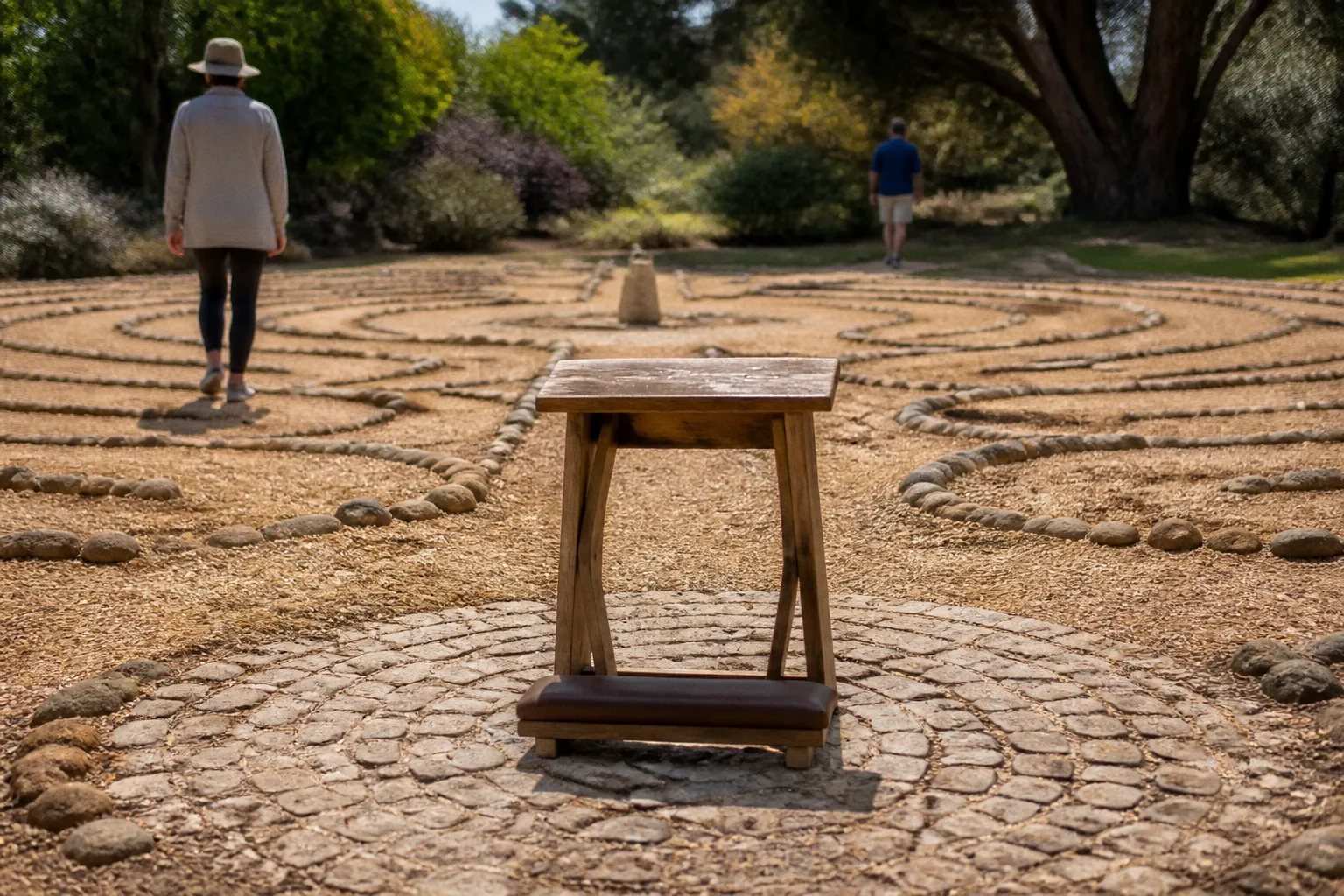
Yet many people discover that distraction does not disappear when we begin walking. It changes its clothing.
A concern about a family member becomes a rehearsal of possible conversations. A sudden task rises with surprising urgency. A memory, a regret, or a physical discomfort claims the center of attention. We may even begin to judge ourselves for being distracted, quietly concluding that our faith is weak or that we are somehow failing at prayer.
That conclusion is neither necessary nor kind. A wandering mind belongs to human finitude. Prayer path meditation is not a technique for becoming less human; it is a way of bringing our embodied, unfinished selves into the presence of God. The work is not to force every thought away, but to learn how to notice, release, receive, and return.
The Unicursal Path: Why Movement Can Aid Spiritual Focus
A prayer labyrinth is not a maze. A maze offers dead ends and competing choices, asking us to solve a problem of direction. A labyrinth or prayer path is unicursal: it follows one continuous, winding route toward the center and then back outward. There are no wrong turns to calculate and no puzzle to master.
That distinction matters for prayer. When the path has already received the burden of direction, the mind has fewer navigational decisions to make. We are not continually asking whether we should turn left or right, whether we have taken the correct route, or whether we have missed something important. The body follows the way. Attention is given room to settle.
This does not mean that walking automatically produces concentration. Movement can support spiritual attention, but it can also expose the contents of our inner life. The rhythm of footsteps may make grief more noticeable. The quiet may reveal how much stimulation we have been carrying. A familiar worry may become more vivid precisely because nothing else is competing with it.
For this reason, the most helpful question is not, How do I stop thinking? It is, What is happening in me as I walk?
That shift protects prayer from becoming another performance. We are not trying to manufacture a blank mind as proof of spiritual maturity. We are practicing a steady form of attention in which thoughts can be recognized without being obeyed immediately.
A prayer path may be indoors or outdoors. It may be marked with stones, plants, painted lines, or a simple route through a church property. Some congregations create faith and fitness trails that combine gentle movement with Scripture, silence, or stations for prayer. Others offer a labyrinth as part of a retreat, grief-support ministry, or broader spiritual wellness program.
The setting can influence the experience, but the essential movement remains the same: we travel a defined route while making space for God, for truth, and for the needs we carry.
A distracted prayer is not necessarily a failed prayer. Sometimes it is the first honest place from which prayer can begin.
The Three-Stage Framework: Releasing, Receiving, Returning
A reliable structure can help when attention is fragile. The classic three-stage framework for labyrinth walking is often described through the language of Purgation, Illumination, and Union. These terms may sound formal, but the pattern is gentle and practical:
1. Purgation: releasing distractions on the inward walk.
As we move toward the center, we notice what we are carrying and begin to loosen our grip on it. This is not an attempt to deny difficult thoughts. We name them before God and allow them, for a time, to rest outside our immediate task.
2. Illumination: receiving quiet reflection at the center.
The center is not a finish line or a place where we must receive a dramatic message. It can be a place of stillness, lament, gratitude, Scripture, or simple awareness of God’s presence. We remain receptive without demanding an answer.
3. Union: integrating what we have received on the outward walk.
The return journey turns prayer toward ordinary life. We consider how compassion, courage, repentance, patience, or practical wisdom might accompany us beyond the path.
The framework is not a rigid formula. Some walks will feel ordered; others will be interrupted by sorrow, physical fatigue, or persistent mental noise. The purpose of the stages is to give the mind a gentle container, not to impose a spiritual timetable.
Stage one: release without suppression
During the inward walk, we might silently name what has been occupying us:
- I am carrying fear about a medical appointment.
- I am angry about what happened in that conversation.
- I am tired of making decisions.
- I do not know how to help someone I love.
- I am grieving a future that will not take the shape I expected.
This language is not a demand that the concern vanish. It is an act of honest placement. We acknowledge the burden and place it in God’s keeping, even if our emotions have not yet caught up with that gesture.
Some people find it useful to pair the footsteps with a brief prayer such as, “Here is my fear,” or, “Lord, receive this.” Others prefer silence. Neither approach is more faithful by itself. The measure is whether the practice helps us remain present rather than adding pressure.
Stage two: receive without forcing
At the center, we may pause for several breaths or remain there as long as the setting allows. This is often where people make the mistake of expecting a clear insight on demand. If no revelation arrives, they assume the walk has accomplished nothing.
But prayer is not an extraction process. The center may offer no new information. It may simply give us a moment in which the body is less defended, the heart is less hurried, or the truth of our own limits becomes more bearable.
We can receive a word from Scripture, a memory, a tear, a sense of gratitude, or the awareness that we need help. We can also receive silence. A quiet encounter with our finitude is not a lesser spiritual result.
Stage three: return with one faithful response
The outward walk is a time for integration. Rather than leaving with a long list of resolutions, we might ask:
- What needs to be carried differently?
- Is there one conversation I need to approach with honesty?
- Is there one boundary that would protect my health?
- What form of support should I seek?
- What small act of mercy is possible today?
One response is usually enough. The purpose is not to turn prayer into an efficiency system. It is to allow embodied faith to touch the next real thing in front of us.
Managing the Mental To-Do List
Task-oriented distractions are especially persistent during prayer path meditation. The mind remembers an email, a bill, an appointment, or an idea for a project. It may insist that if the thought is not acted on immediately, it will be lost forever.
Arguing with the thought often gives it more energy. A better approach is to create a trustworthy place for it to go.
Carry a small notepad or prayer journal. When an urgent task or useful idea interrupts the walk, write down a few words and return to the path. The note does not need to become a full explanation. “Call dentist,” “send form,” or “ask about Saturday” may be enough to reassure the mind that the concern has not been discarded.
This physical act can be surprisingly important. It separates remembering from reacting. We can honor the practical need without allowing it to take over the whole prayer.
A journal can also help distinguish between different kinds of distraction:
| What arises during the walk | A helpful response |
|---|---|
| A practical task or appointment | Write a brief note and return to the next step of the path |
| A painful memory | Acknowledge it without forcing a solution; offer it to God |
| A repeated fear | Notice the pattern and pray for wisdom, support, or courage |
| A sudden spiritual insight | Record a few words so it can be tested later rather than treated as an immediate command |
| Physical discomfort | Slow down, adjust the pace, or stop if needed; the body is part of prayer |
| Irritation about being distracted | Offer the irritation itself as the next prayer |
The key is not to make every thought meaningful. Some thoughts are simply the mind doing what minds do. But neither should we assume that every interruption is meaningless noise. Discernment begins with noticing.
Use a return phrase
A short return phrase gives attention somewhere to go after distraction. It might be drawn from Scripture, a hymn, or a simple prayer:
- “Be still and know.”
- “Have mercy, Lord.”
- “Here I am.”
- “Into your hands.”
- “Guide my steps.”
The phrase should be light enough to repeat without strain. If it becomes another demand to perform correctly, choose something simpler. The purpose is not to overpower the mind but to offer it a path back.
Let the pace remain human
Walking too quickly can turn prayer into exercise with religious language attached. Walking too slowly can create unnecessary self-consciousness. There is no universal ideal pace. We are looking for a rhythm in which breathing, footsteps, and awareness can remain connected.
A prayer path is not a fitness test. If a person is living with pain, fatigue, mobility limitations, or balance concerns, the practice can be adapted. A shorter route, a seated position near the path, or a slow walk with support may be more appropriate. Spiritual wellness does not require us to disregard the body through which we are receiving the moment.
Ignatian Discernment: When Distraction Becomes a Prayer Topic
Not every distraction deserves prolonged attention, but some interruptions carry information. Ignatian spiritual direction encourages practitioners to evaluate persistent thoughts rather than dismissing them automatically. A recurring concern may point toward a real matter that needs prayerful discernment.
Consider the difference between these two experiences:
- A thought briefly appears, disappears, and returns only because we are anxious about losing focus.
- A concern continues to surface with emotional weight, moral significance, or a clear connection to something unresolved in our life.
The second may deserve a place in prayer. This does not mean that every persistent fear is a divine instruction, or that every strong feeling should determine our next decision. It means we can ask what the thought is revealing.
A useful process is to notice the concern, name its emotional tone, and postpone immediate judgment. Is it rooted in love, responsibility, grief, shame, resentment, or fear? Does it invite a truthful response, or does it drive us toward panic and self-condemnation? Does it become clearer when held in prayer, or more chaotic?
We should be careful here. Spiritual language can become unsafe when it turns inner pressure into unquestionable authority. A thought that produces terror, compulsion, or a demand to harm ourselves or others should not be treated as a sacred command. Pastoral conversation and qualified mental-health support may be needed, especially when anxiety, trauma, depression, or intrusive thoughts are involved.
The church can hold space for both spiritual and psychological realities. We do not honor God by pretending that every struggle is solved through greater effort or more disciplined prayer. Sometimes faithful discernment includes speaking with a pastor, counselor, physician, trusted friend, or support ministry.
A prayer path can help us identify what needs attention, but it is not a replacement for care.
The goal is not to make every thought disappear. It is to learn which thoughts need release, which need compassion, and which need wise action beyond the path.
Digital Fasting Before the Walk
A mind saturated with alerts will rarely become quiet the moment a prayer walk begins. Notifications keep the nervous system oriented toward interruption. Even when no message arrives, part of us may remain prepared for one.
A short technology fast can create a gentler threshold. Turn off notifications or set devices aside for approximately 30 to 60 minutes before beginning, when circumstances allow. This is not a moral judgment against technology. Phones support families, work, transportation, health needs, and connection. The point is to reduce cognitive stimulation long enough for attention to become less reactive.
If you need to remain reachable, use practical boundaries rather than an absolute disconnection:
- Allow calls from emergency contacts.
- Tell household members when you will be unavailable.
- Bring the phone for safety but silence nonessential alerts.
- Use a simple timer if you need help keeping the walk within a particular period.
- Avoid opening other apps before or after the walk if the purpose is contemplative attention.
Preparation can also include drinking water, choosing suitable shoes, and checking the route for weather or accessibility. These details may seem ordinary, but prayer is embodied. A body that is thirsty, cold, rushed, or unsafe will reasonably keep asking for care.
A simple preparation sequence
Before entering the path, take a few unhurried moments to do the following:
1. Choose a modest intention.
You might come seeking rest, courage, clarity, or a place to lament. The intention is an orientation, not a demand for a particular outcome.
2. Settle the body.
Notice your breathing, shoulders, jaw, and feet. Do not force relaxation. Simply become aware of the body’s present condition.
3. Name what you are carrying.
Keep the language plain. You do not need a polished spiritual sentence.
4. Decide where practical thoughts will go.
Bring a journal or notepad so that remembering does not require immediate action.
5. Begin without rushing.
Let the first section of the path be a transition from external activity into prayerful presence.
If the mind is still noisy, begin there. The first part of the walk may be less about contemplation than about becoming aware of how unsettled you are. That awareness is not wasted time.
Common Prayer Path Meditation Mistakes
Distraction fixes are helpful only when they remain humane. Several common mistakes can make the practice more demanding than it needs to be.
Treating distraction as spiritual failure
A wandering mind does not prove weak faith. Human attention is shaped by stress, grief, sleep, physical health, habit, and the unfinished responsibilities of daily life. Prayer makes room for the whole person, not only for the part that can concentrate.
Trying to eliminate every thought
The harder we attempt to suppress thought, the more tightly attention can become bound to the thought we are resisting. Notice, name, and return. Repetition is not evidence that the method has failed; repetition is part of the method.
Expecting a dramatic answer
A labyrinth has a center, but prayer does not always provide a conclusion. The center may offer rest rather than explanation. It may help us tolerate uncertainty, recognize a need for support, or remember that we are not the sole source of our own resilience.
Turning the walk into a productivity exercise
It is possible to leave a prayer path with more tasks than we had when we entered. If every insight becomes an assignment, the practice loses its spaciousness. Let one next step be enough.
Ignoring the body
Pain, dizziness, shortness of breath, or exhaustion should not be spiritualized. Adjust the route, pause, sit, or stop. A faithful practice includes care for physical limits.
Assuming every feeling is guidance
Feelings are real, but they are not always final interpretations of reality. Hold them with compassion and test significant conclusions over time, in conversation, and through the wider wisdom of Christian community.
Bringing the Practice into Congregational Life
Prayer path meditation does not need to remain a private activity. A congregation can offer it as part of a retreat, a grief-support ministry, a confirmation experience, a church recreation program, or a quiet alternative during a larger gathering.
A community path should be accessible and clearly explained. Participants benefit from knowing that there is no competition, no required speed, and no expectation of a particular spiritual experience. A facilitator can describe the route, identify places to rest, and offer several ways to participate, including seated prayer.
The practice can also be integrated into seasons of the church year. Advent may invite hope amid waiting. Lent may create room for honest release and repentance. Eastertide may shape the outward walk around renewed life and shared vocation. In a Lutheran setting, these practices are not attempts to earn grace through concentration. They are responses to grace already given, ways of making room for God’s work in lives that remain vulnerable and unfinished.
A congregation might provide journals at the entrance, offer a brief Scripture reading, or invite people to walk in silence before gathering for conversation. No one should be required to disclose what arose. Psychological safety is part of spiritual care. Some prayers need community; others need privacy.
The path can also become a place where the church acknowledges mental health without reducing it to religious language. A person may come seeking prayer while also living with panic, depression, bereavement, chronic pain, or caregiver fatigue. Welcoming that complexity is a form of ministry. We can speak of grace without denying the need for treatment, rest, medication, counseling, or practical support.
A Practice That Makes Room for Return
When prayer path meditation becomes difficult, the answer is usually not more force. We can simplify the route, shorten the time, set aside the device, carry a notebook, or use the three movements of releasing, receiving, and returning. We can also allow the distraction to tell the truth about what our lives are asking of us.
The path gives us a physical language for faith. We move inward with what we cannot resolve, pause in the presence of God without demanding certainty, and move outward carrying whatever small measure of wisdom or steadiness has become available. Sometimes that measure is very small. A breath. A softened judgment. The courage to ask for help. The willingness to begin again.
That is still prayer.
The deepest purpose of a prayer path is not perfect focus. It is faithful return: returning to the body, to the present moment, to honest lament, to discernment, to community, and to the grace that meets us before our attention is tidy.