Prayer path meditation: how to fix the rushing habit
We know the moment. You step onto the prayer path with the best intentions — a quiet heart, an open hour, a longing to listen.
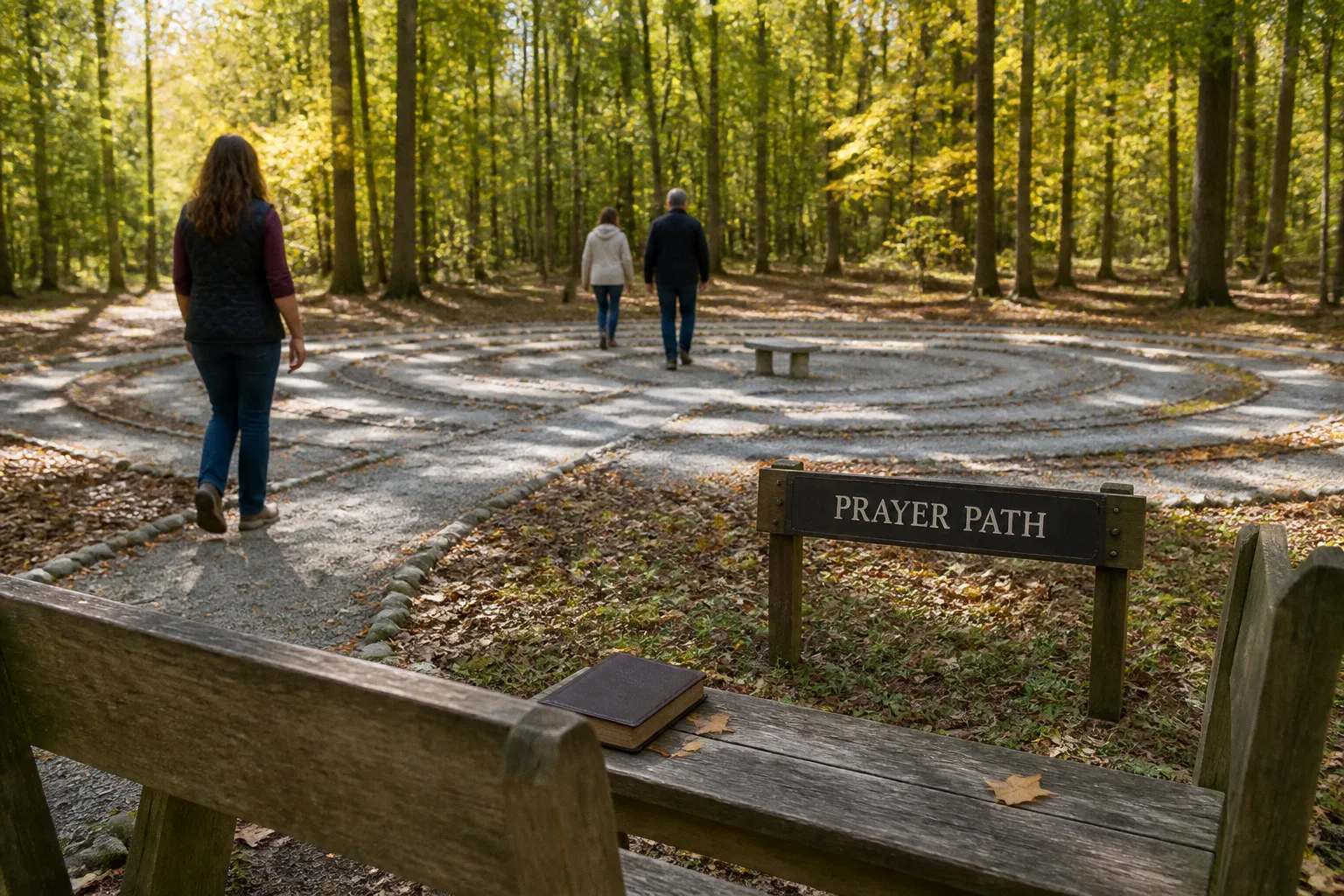
By the third turn of the path you are already mentally drafting the grocery list, replaying the difficult conversation from yesterday, calculating how many minutes you have left before you need to be home. The labyrinth that was supposed to hold you has somehow turned into a moving sidewalk back into your week. You walked the path, but you were not, in any meaningful sense, walked by it.
This is the most common pastoral complaint I hear about walking prayer: not that the path failed, but that the walker did. And yet the failure is not a moral one. It is not a sign of weak faith or scattered attention. It is the predictable, almost mechanical response of a body conditioned to move at the speed of obligation. Before we can recover the contemplative gift of a prayer path, we have to be honest about what we are walking against — and it is not, in the end, distraction. It is the chemistry of our own alertness.
The Biology of the Rush: Why Your Body Fights Stillness
The impulse to hurry has a name in your endocrine system, and it is older than your calendar. When you step onto a prayer path carrying the residue of a busy morning — the unanswered emails, the school run, the unspoken tensions — your hypothalamus does not file those experiences under "to be processed later." It files them under "ongoing." What follows is a quiet but persistent release of cortisol, adrenaline, and norepinephrine, the three hormones most closely associated with the fight-or-flight response.
Here is what makes this hard for contemplative practice: there is no actual threat on the path. No one is chasing you. The stones are smooth, the air is still, and the only danger is missing dinner. But the hormones do not wait for the threat to be real. They were already released when you were late for work, when you answered the third difficult email before breakfast, when you drove across town with the radio off and your jaw clenched. By the time you arrive at the prayer path, your body is mid-alarm. The path is inviting you to settle into prayer; your adrenal glands are inviting you to run from something.
This is why simply "trying to slow down" rarely works. Willpower is a thin resource when the body has decided to be vigilant. The pastoral invitation, instead, is to work with the body rather than against it — to give the nervous system a legitimate task slow enough to interrupt the alarm. Walking meditation, at its best, is precisely such a task. It does not argue with the alert body. It gives the alert body something honest to do.
Grace does not always arrive as a feeling. Sometimes grace arrives as a heel placed carefully on the ground.
A small honest word here: the body that arrives at the path hurried is not a defective body. It is the body of someone who has been faithfully carrying the weight of ordinary life. The prayer path does not require you to first become calm enough to deserve the walk. It offers the walk as one of the means by which calm is, by grace, recovered. The biology of the rush is not something to overcome before prayer. It is something to befriend within prayer.
Distinguishing the Path: Labyrinths and Mazes Are Not the Same
Before we move into technique, it helps to be clear about what we are actually walking. A prayer path is most often a labyrinth, and a labyrinth is not a maze. The distinction matters pastorally because the two structures invite two very different spiritual postures.
A maze is designed to confuse. It contains choices, dead ends, false turns, and the possibility of getting lost. Mazes engage the problem-solving mind. They are excellent for retreats that need to wake people up, and they pair well with teaching about the disorientation of sin or the cleverness of worldly navigation. If you walk a maze looking for the center, you will arrive intellectually, having solved a problem.
A labyrinth is unicursal. There is one path. It winds and turns, but it does not branch. There are no choices to make, no wrong turns to take, and no puzzle to be solved. The single path leads you in, and the same path leads you back out. This is a profound theological claim, made in stone or turf. In a labyrinth, the only thing you can do is keep walking. The mind that wants to strategize, to optimize, to get there faster, is gently undermined by the architecture itself. The labyrinth is a quiet sermon against the need to be efficient.
The two most common historical designs are worth knowing, because the walk can feel quite different depending on which one you are on.
| Feature | Cretan Pattern | Chartres Pattern |
|---|---|---|
| Estimated age | At least 3,500 years | Built in the 13th century |
| Origin | Pre-Christian, classical world | Medieval Christian cathedral |
| Path structure | Simpler, often seven circuits | Eleven circuits, with more complex turns |
| Religious symbolism | Generally non-figurative | Often laid out around a cross, with a six-petaled rose at the center |
| Felt experience | Often quicker, more open | Slower, more layered, more contemplative |
| Common setting | Outdoor parks, retreat gardens | Cathedral floors, dedicated contemplative rooms |
If you are walking a Chartres labyrinth for the first time, expect to feel briefly lost in the middle turns. That is a feature, not a flaw. The path is teaching you something about the geography of faith: that the center is rarely where you thought it would be, and that the journey out is part of the journey in. The Cretan pattern, by contrast, moves with a softer arc and rarely disorients. Both are good. They simply teach different lessons at different paces.
One more pastoral note on the architecture. The single-path design is itself a small theological argument about the Christian life. There is no shortcut to the center, and there is no clever way to outpace the journey. Grace arrives along the way, not at the destination. The walker who has internalized this does not need to hurry.
The Four-Part Step: A Physical Technique for Mindful Walking
When the body is flooded with stress hormones, the fastest way to interrupt the alarm is to give the body a slow, sequential task that requires real attention. This is why contemplative teachers across the centuries have emphasized the mechanical, almost tedious details of walking. The mystical moment is downstream of the physical one.
Formal walking meditation traditionally breaks each step into four distinct components, and learning to attend to all four is what makes the practice different from a brisk stroll with religious music in your ears.
1. Lifting the foot. Pause long enough to feel the weight of the foot on the ground before it leaves. Notice the small muscles of the calf and ankle. This is not a step of urgency.
2. Moving the foot forward. Move it through the air without rushing. Some teachers suggest a prayer-phrase length of movement — enough time to say a single word or to take one full breath.
3. Placing the foot heel-first. Bring the heel down gently, as if you were laying it on something that could break. This is the moment of contact with the path, and it is worth lingering over.
4. Shifting the body weight. Let the weight follow the foot, rolling forward through the ball of the foot and into the toes, transferring from the back leg to the front.
Most hurried walkers collapse all four of these into a single motion. The foot lifts, flies forward, lands, and the body lurches after it. This is not a moral failure, but it is a missed invitation. The four-part step is the practice. It is the thing you are doing before the practice becomes a meditation or a prayer. When you are faithfully attending to the four parts, you are, almost without noticing, no longer in a hurry.
This is also where embodied faith becomes more than a phrase. We are embodied creatures, and the body's posture is not incidental to the soul's posture. A walk that is hurried produces a hurried interior. A walk that is paced produces space for the things of God. The path itself is not doing the work; the attention given to the path is doing the work. Resilience in the spiritual life is rarely built in dramatic moments. It is built in the slow accumulation of careful steps.
If the four-part step feels awkward at first, that is a sign it is working. We are not accustomed to paying attention to ordinary movement. The first few walks may feel stilted, even self-conscious. That is part of the cost of recovering presence. With time, the four parts become a rhythm rather than a checklist, and the rhythm becomes a kind of prayer.
Synchronizing Breath and Pace to Anchor Your Prayer
Once the four-part step has begun to slow the body, breath becomes the second anchor. The two together — careful stepping and intentional breathing — can interrupt the fight-or-flight cascade in a way that willpower alone cannot.
A simple and time-tested pattern is to count steps to breath. Inhale for three steps, exhale for three steps. The pattern is less important than the rhythm. The aim is to give the mind a single, repeatable task that takes just enough attention to crowd out the planning mind and just enough repetition to let the body settle.
If three-and-three feels too long, begin with two-and-two. If three-and-three feels too easy, the tradition allows for four-and-four or five-and-five. The principle is that the breath counts are equal on the in-breath and the out-breath, and that they are coordinated with the steps. Uneven counts — in for four, out for two — can, for some walkers, actually amplify the rushing sensation, because the body keeps waiting for the out-breath.
The body does not need to be silenced. It needs to be given a slower song.
A few pastoral notes on the breath. Some walkers find that the structured breath triggers a mild anxiety of its own, especially if they have lived with chronic anxiety or panic. If the breath becomes a contest, abandon the count and return to the four-part step alone. The breath is a servant of the practice, not the other way around. Another gentle caution: if you have a respiratory condition, work with whatever pattern is comfortable. A prayer path is not a breathing exercise. It is a way of holding space for God.
For those who find words helpful, the breath offers a place to weave in a short prayer, a single line of a psalm, or the name of Jesus. The rhythm of breath and step becomes a kind of portable liturgy. One congregation I have walked with uses the prayer "Lord, have mercy" on the inhale and "Christ, have mercy" on the exhale, three steps per phrase. Others use the Greek Kyrie eleison, or a single word like "enough" or "home" or "Abba." The words are not the point. The rhythm is the point. The words are simply the body the rhythm takes on when the heart is ready to speak.
Establishing a Sacred Container: Why Fifteen Minutes Is the Minimum
Almost every problem of rushing on a prayer path is, at some remove, a problem of time. Not lack of time — lack of time for the practice. The walker who intends to spend ten minutes almost always spends six. The walker who intends to spend twenty almost always spends twenty. The shorter the intention, the more the agenda of the day erodes it.
For this reason, contemplative teachers have long suggested a minimum of fifteen minutes for a walking prayer. It is not a magic number. It is a humble recognition that the body needs time to come down from the baseline alertness of ordinary life, and that the mind needs time to recognize it is safe to be present. Fifteen minutes is a container; it tells the body, "We are not going anywhere for a while. You may stand down." Without a container, the wall of the day presses in around the practice and quietly reshapes it.
This is where the practice of finitude becomes pastoral. We live in a culture that treats focus as a commodity to be extracted from the moment, and contemplative practice as a productivity hack. The prayer path resists that. It is not asking you to extract fifteen minutes of spiritual insight from your day. It is asking you to give fifteen minutes of your body to the simple act of walking in the presence of God. The insight, if it comes, is a gift at the end of the walk. The walk is the gift.
Before stepping onto the path, a few practicalities help hold the container:
- Set a timer you can feel but not see. A watch vibration or a phone in a deep pocket. Looking at a clock mid-walk pulls the mind out of the practice and back into the schedule.
- Leave the phone in the car, or at least in a pocket you cannot easily reach. The screen is a portal back into the fight-or-flight state.
- Tell someone you are walking, not to be accountable, but so the body can stop rehearsing the next conversation.
- Decide, before you begin, what you will do at the center. Not a task — a posture. Some walkers pause. Some kneel. Some simply stand long enough to notice that they have arrived.
- Walk out the same way you walked in. The return path is not a victory lap. The second half of the walk is often where the deepest work happens, because the body has finally settled and the mind has run out of things to plan.
It is also worth naming aloud what the container is for. The fifteen minutes is not a goal to meet. It is a boundary to honor. The boundary protects the practice from the encroachment of the day, and it protects the rest of the day from the slow, faithful intrusion of the practice. In time, the container begins to feel less like a discipline and more like a room you are glad to step into.
Bringing It Home
The rushing habit is not a sin to confess and a promise to do better. It is an old habit of the body, learned in a world that rewards speed, and it can be unlearned — slowly, patiently, with grace — in a practice that pays attention to the body's own pace.
If you are new to a prayer path, do not begin with the four-part step, the breath count, and the fifteen-minute container all at once. Begin with one. Walk the path at a pace that feels embarrassingly slow. Notice every third or fourth step. Stay for ten minutes, even if your plan was fifteen. The next time, add the breath. The time after that, extend the container. The practices are additive; they layer gently, like a conversation that deepens over months rather than minutes.
And if you walk the path and still feel rushed at the end, walk it again. The labyrinth is not grading you. The path is not keeping score. The single path leads inward whether you arrived hurried or settled, distracted or attentive. The grace of the practice is that the path waits for you to catch up to it.
We are not, after all, trying to achieve a perfect walk. We are trying to recover the capacity to be present to our own lives — and to the One who walks them with us, step by step, all the way to the center.