Parish Calendar Planning: A Practical Step-by-Step Guide
Annual church calendar planning is not merely the placement of worship services, fellowship events, education classes, and administrative meetings on a shared grid.
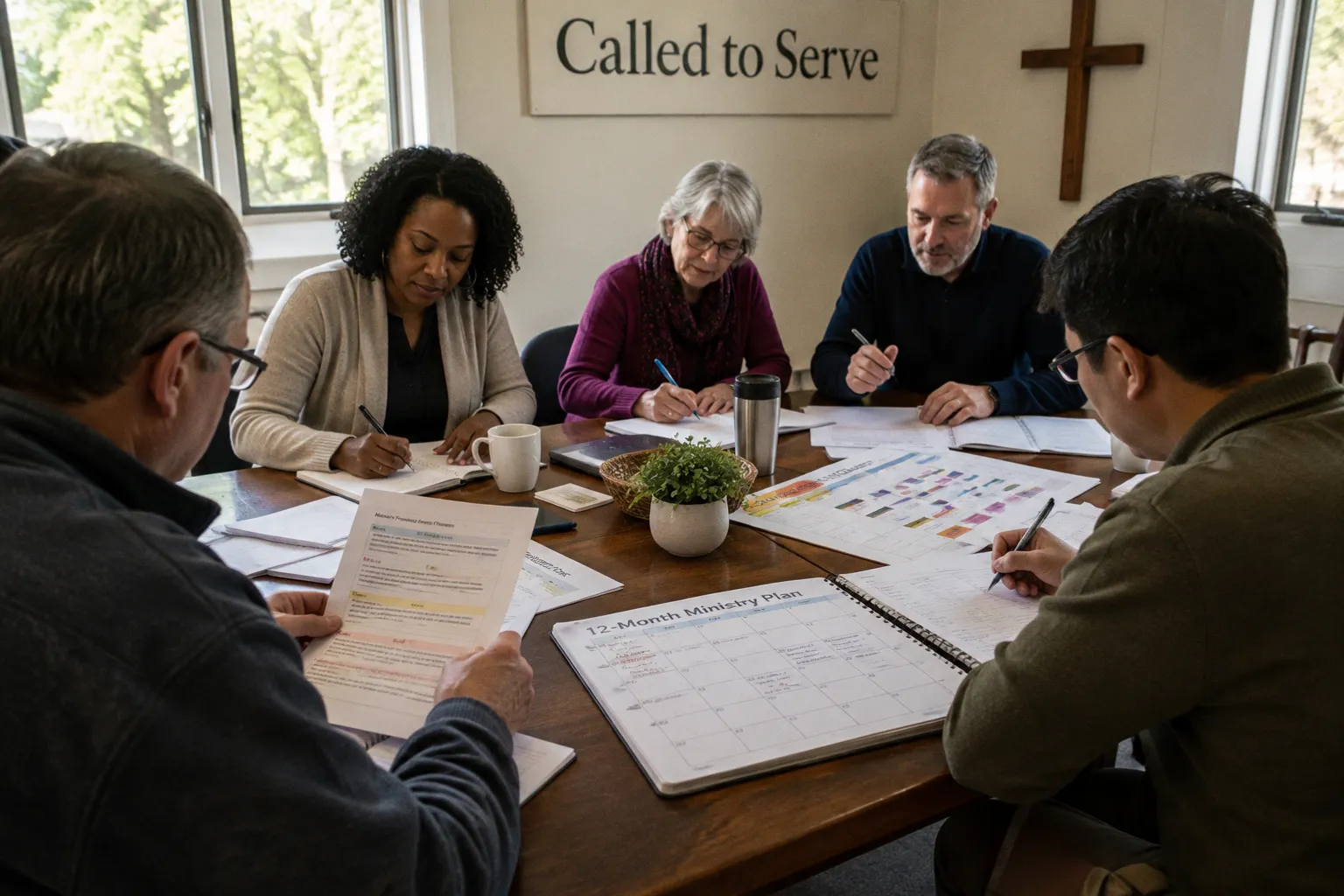
It is the operational framework through which a congregation converts its ministry priorities into a sequence of public, pastoral, educational, and financial commitments.
The central administrative error is to begin with available funds, room capacity, or recurring habits and then attempt to construct a ministry plan around them. A more coherent process reverses that order: establish the ministry priorities first, translate those priorities into a calendar, and then assign financial and staffing resources to support the resulting structure.
For a Lutheran congregation, this process must also account for the church year, the rhythm of Sunday worship, sacramental practice, Christian education, pastoral care, and the particular obligations of the local parish. The objective is not to eliminate variation or unforeseen pastoral needs. The objective is to create sufficient order that the congregation can respond to those needs without operating from permanent administrative confusion.
The Case for Ministry-First Scheduling: Why Budgeting Follows Vision
The first of the annual church calendar planning steps is to define what the congregation is attempting to accomplish before discussing the cost of accomplishing it. This distinction is procedural, but it also reflects a theological principle of stewardship: financial resources serve the ministry of the church; they do not independently determine the church’s ministry.
A ministry-first plan begins with a limited set of priorities. These may include:
- strengthening Sunday school and adult education;
- establishing a more consistent small-group or Bible study structure;
- expanding pastoral care for homebound members;
- improving preparation for major seasons of the church year;
- developing congregational fellowship events that support participation across generations;
- organizing a stewardship campaign around clearly stated ministry purposes;
- improving the training and scheduling of worship volunteers.
The list should remain limited. If every recurring activity is described as a strategic priority, the planning document has no hierarchy and therefore cannot guide decisions. A parish may have many worthy activities, but the calendar must distinguish between the work that directly advances its current ministry objectives and the work that continues because it has become customary.
Begin with a ministry brief
Before the planning meeting, the pastor or designated planning coordinator should prepare a short ministry brief. It should contain four elements:
1. The present condition.
Identify the operational facts that affect planning: participation patterns, staffing limitations, facility constraints, educational needs, pastoral care demands, and major changes in the congregation’s local context.
2. The annual priorities.
State the few outcomes that should receive concentrated attention during the next calendar cycle. These should be expressed as ministry aims rather than vague aspirations.
3. The seasonal framework.
Mark the fixed liturgical and congregational anchors, including Easter, Advent, Christmas observances, the beginning of the academic year, fall kickoff activities, and other established parish commitments.
4. The resource implications.
Describe the personnel, facilities, materials, communication capacity, and anticipated expenditure required to support each priority.
This document is not a final calendar. It is a governing framework. Its function is to prevent the planning group from treating every request as equally urgent.
Construct the ministry plan before the ministry budget
Tony Morgan’s planning recommendation is operationally sound: the ministry plan should precede the ministry budget. When the order is reversed, the available budget becomes the implicit theology of the calendar. Activities are retained because they have an existing line item, while new or less familiar ministries are rejected before their purpose has been evaluated.
The correct sequence is:
1. define the ministry priorities;
2. place those priorities within the annual and liturgical calendar;
3. determine the staffing and material requirements;
4. estimate the costs;
5. revise the plan where the required resources are unavailable;
6. approve the budget as an instrument of the ministry plan.
This sequence does not imply that every proposed ministry receives funding. It does require that financial decisions be made in relation to stated purposes rather than administrative inertia.
A parish budget should explain the calendar, not silently create it.
The same principle applies to volunteer allocation. A ministry may appear inexpensive in financial terms while imposing substantial demands on the pastor, office staff, musicians, teachers, or congregational volunteers. Stewardship includes the responsible use of time and institutional attention, not only money.
Assembling the Planning Team: Optimal Group Sizes for Consensus
Church master calendar planning is most effective when the working group is large enough to represent the principal ministries but small enough to make decisions. A full committee structure is rarely suitable for the initial planning retreat because every additional participant increases the number of interests that must be reconciled before the group can establish priorities.
Tony Morgan recommends a planning retreat group of no more than 12 leaders. Anthony Hilder recommends keeping the group under 10 people for maximum effectiveness and consensus. These figures are not a universal rule imposed on every parish, but they establish a useful administrative boundary: the core planning group should be compact.
A practical team may include:
- the pastor or another ordained leader responsible for the liturgical and pastoral framework;
- a congregational president or council representative;
- the treasurer or finance representative;
- the church administrator or calendar coordinator;
- a representative for Christian education;
- a representative for worship or music;
- a representative for fellowship and congregational events;
- a representative for youth or family ministry, where applicable;
- a facilities or property representative when room use is a significant constraint.
Not every ministry leader must attend the entire planning retreat. The core group can establish the framework and then obtain specific dates, requirements, and corrections from other leaders during a defined review period.
Separate decision-making from date collection
A common planning failure occurs when the meeting attempts to do two different tasks at once. Participants arrive with individual date requests, and the group spends the available time negotiating room reservations rather than determining the annual priorities.
Use two stages:
1. Framework stage: the core team establishes priorities, seasonal emphases, major ministry blocks, and budget assumptions.
2. Coordination stage: ministry leaders submit specific dates, staffing needs, facility requirements, and communication deadlines within that framework.
This separation gives the planning team authority to make categorical decisions before it becomes absorbed by individual scheduling conflicts.
Assign explicit responsibilities
The annual calendar should not depend on an assumed collective memory. Assign responsibility for each major area:
| Planning area | Responsible role | Required output |
|---|---|---|
| Liturgical and worship schedule | Pastor or worship coordinator | Principal services, seasonal observances, worship preparation deadlines |
| Christian education | Education coordinator | Sunday school, Bible study, confirmation, teacher preparation dates |
| Congregational fellowship | Fellowship leader | Major events, volunteer requirements, facility reservations |
| Pastoral care | Pastor or care coordinator | Visitation patterns, care-team meetings, member support activities |
| Finance and stewardship | Treasurer or stewardship leader | Campaign periods, budget deadlines, giving education |
| Communication | Office administrator | Publication dates, calendar updates, digital distribution |
| Facilities | Property or building coordinator | Room use, setup requirements, maintenance conflicts |
The purpose of this assignment is not to create unnecessary bureaucracy. It is to establish accountability for the information on which the calendar depends.
The September Start: Timing the Annual Planning Cycle
The parish annual scheduling steps should begin before the calendar year they govern. September or early October is a more functional starting point than January because the congregation is already operating within a new program year, while the next cycle remains sufficiently distant for deliberate planning.
Beginning in January creates predictable distortions. The first weeks of the year are often occupied by budget implementation, winter disruptions, reporting obligations, and the correction of unresolved decisions from the previous cycle. By the time the group begins planning, the congregation may already be committed to dates that should have been evaluated earlier.
A planning cycle may be organized as follows:
September or early October: review and orientation
At this stage, the leadership reviews the current year rather than immediately drafting the next one. Examine which activities were completed, which required excessive volunteer effort, which conflicted with worship or educational priorities, and which produced demands not reflected in the previous plan.
The review should distinguish between three categories:
- activities that should continue without substantial revision;
- activities that require a changed format, date, or staffing model;
- activities that should be suspended because they no longer serve a defined ministry purpose.
This is an administrative review, not a referendum on the worth of particular individuals or groups. Its subject is the structure of the ministry calendar.
October or November: establish priorities
The core team identifies the annual priorities and places the principal liturgical and congregational anchors on the draft calendar. At this point, the team should avoid filling every available week. Empty space is a scheduling resource because it permits pastoral response, weather-related changes, recovery after major events, and ordinary congregational life.
November or December: build the detailed calendar
The major events, education cycles, worship preparation dates, stewardship activities, council meetings, and publication deadlines are added. Senior Pastor Central advises preparing a detailed 12-month church growth calendar six months before the beginning of the targeted calendar year. The practical implication is clear: the detailed version should be substantially developed well before January 1.
Before publication: conduct a conflict review
The conflict review should examine more than duplicate room reservations. Review:
- overlapping demands on the same volunteer group;
- events scheduled immediately before major worship observances;
- excessive concentration of activities in a single season;
- conflicts between education schedules and family-oriented events;
- insufficient preparation time for worship, music, communications, or facilities;
- dates that depend on decisions not yet approved by the council or congregation.
The calendar should then be approved through the congregation’s established governance process. A planning team may prepare the document, but it should not bypass the authority responsible for adopting budgets, policies, or official parish commitments.
Reserve a revision window
No annual church calendar planning process can anticipate every pastoral need, facility issue, or external disruption. The calendar should therefore include a stated revision procedure. The procedure should specify who may authorize a change, how affected leaders are notified, and where the current version is maintained.
A controlled revision process is superior to informal changes made through scattered conversations because it preserves a reliable record. It also prevents the calendar from developing multiple competing versions.
Categorizing Ministry Priorities: Applying the Rocks, Pebbles, and Sand Framework
Once the principal priorities have been identified, they must be ranked. The “Rocks, Pebbles, and Sand” model, applied to ministry calendars by Servant Keeper, offers a practical way to distinguish events by strategic weight.
Rocks
Rocks are the commitments that express the congregation’s principal ministry priorities and require substantial coordination. They may include major outreach initiatives, significant seasonal programs, congregation-wide educational efforts, stewardship campaigns, or events connected to the central worship and pastoral life of the parish.
A Rock should receive a date before secondary activities are placed. It may also require a preparation schedule, a budget allocation, volunteer recruitment, communication materials, and a post-event review.
Pebbles
Pebbles are important activities that support congregational life but do not define the annual direction of the parish. Examples may include recurring fellowship gatherings, ministry team meetings, seasonal classes, or smaller educational events.
Pebbles should fit around the Rocks. If they repeatedly displace the primary priorities or consume the same limited volunteers, their frequency or format should be revised.
Sand
Sand consists of minor or optional activities that can be accommodated only after the principal commitments have been secured. Some administrative tasks, informal gatherings, and low-resource events belong in this category. Sand is not necessarily unimportant; it is simply not permitted to determine the structure of the calendar.
The model is useful because it converts a general concern about overload into a visible hierarchy. When the calendar is crowded, leaders can identify which category is producing the pressure and make a proportionate adjustment.
| Calendar category | Function | Scheduling rule | Typical resource pattern |
|---|---|---|---|
| Rocks | Advance the principal ministry priorities | Place first and protect preparation time | Significant coordination, staffing, or budget |
| Pebbles | Support established congregational life | Place after major priorities are secured | Moderate coordination and recurring volunteer effort |
| Sand | Provide optional or minor activity | Add only where capacity remains | Limited resources, but still requires an accountable owner |
Use the framework to test inherited events
Recurring events should not receive automatic placement simply because they appeared in the previous calendar. Each event should be associated with a stated purpose, a responsible leader, and a realistic resource estimate.
The review can be conducted through five questions:
1. Which ministry priority does this event serve?
2. What preparation does it require?
3. Which people or teams must provide that preparation?
4. What conflict would arise if the event were moved or omitted?
5. What evidence would show that the event fulfilled its intended function?
These questions do not reduce ministry to measurement. They establish sufficient clarity for stewardship. A congregation cannot responsibly allocate time, money, and volunteer labor when it cannot describe the purpose of an activity.
Integrating the Liturgical Calendar with Parish Operations
Lutheran church calendar organization requires more than recording major dates. The church year provides a theological structure within which worship, preaching, music, education, and congregational communication should be coordinated.
The planning team should begin with the fixed liturgical anchors and then determine the operational consequences of each season. A major observance may require additional music rehearsals, worship materials, volunteer scheduling, educational preparation, facility setup, pastoral communication, and changes to ordinary meeting patterns.
The calendar should therefore record at least three layers of information:
- the public event: the service, class, meeting, or fellowship activity visible to the congregation;
- the preparation activity: rehearsals, curriculum preparation, volunteer coordination, facilities work, and pastoral planning;
- the communication deadline: the point by which announcements, printed materials, digital notices, and registration information must be ready.
This layered approach prevents a frequent discrepancy: an event appears on the calendar, but the work required to make it possible appears nowhere.
Protect the weekly worship framework
Sunday worship remains the primary recurring structure of parish life. Other activities should be evaluated in relation to that structure rather than treated as independent entries.
For each major event, consider whether it:
- supports participation in worship;
- competes with worship preparation or attendance;
- requires the same leaders and volunteers;
- creates an educational or pastoral opportunity connected to the season;
- places excessive administrative demands on the days immediately before or after worship.
The purpose is not to subordinate every ministry to a single operational pattern. It is to identify cause and effect. A fellowship event may be well conceived but poorly placed if it exhausts the volunteers needed for a major worship observance. A Bible study may be valuable but difficult to sustain if its schedule repeatedly conflicts with family or pastoral-care obligations.
Coordinate curriculum and worship themes
Sunday school curriculum, confirmation instruction, adult Bible study, and seasonal worship planning should not be developed in complete isolation. The exact degree of coordination will differ by congregation, but the calendar should make related preparation visible.
A Christian education leader should know the principal worship themes and seasonal dates early enough to organize lessons, teacher materials, and communication. The pastor or worship coordinator should know when educational programs will require space, additional volunteers, or changes to the ordinary schedule.
This is one reason a 12-month view is more useful than a list of immediate events. It reveals whether a congregation’s educational activity is concentrated in a way that creates avoidable pressure or whether it leaves extended periods without a coherent formation plan.
Multi-Channel Communication: Publishing the Master Parish Calendar
A master calendar has no operational efficacy if only the planning team can access it. The final stage of congregational event calendar planning is publication through several channels, each serving a different use.
Ministry leaders need a detailed working calendar. Congregation members need a readable public calendar. Volunteers need specific assignments and deadlines. The church office needs a controlled version from which announcements and printed materials can be produced.
Ministry leaders commonly recommend a combination of:
- a single annual printout for broad visibility;
- monthly or seasonal physical calendars for regular distribution;
- an online calendar for updates and practical access;
- ministry-specific schedules where detailed volunteer information would make the public version difficult to read.
The channels must be synchronized. A printed annual calendar may remain useful as a stable reference, but it cannot communicate every revision. An online tool may provide current information, but it should not become the only source for members who do not use it regularly.
Establish one authoritative version
The parish should designate one master calendar as the authoritative record. All public versions should be derived from it. The calendar coordinator should maintain a change log or another simple record showing:
- the original date;
- the requested change;
- the person authorizing the change;
- the affected ministries;
- the date on which the revised information was published.
This is particularly important when several ministries share facilities or volunteers. Without a central record, a date can be changed in one communication channel while remaining unchanged in another.
Publish according to a fixed schedule
A publication schedule should be defined during the planning process rather than improvised each month. The schedule may distinguish between:
- annual publication of the principal calendar;
- seasonal confirmation of worship and education details;
- monthly publication of upcoming events;
- immediate notification of approved changes.
The schedule should also identify who prepares the copy, who approves it, and who distributes it. Administrative ambiguity at this stage often produces preventable errors: duplicate announcements, missing registration instructions, outdated times, or events that are technically scheduled but invisible to the congregation.
A calendar becomes a ministry instrument only when the people responsible for the work can see the same priorities, dates, and deadlines.
A Six-Day Planning Model for Larger Congregations
For congregations managing numerous ministries, one planning meeting may be insufficient. A more substantial annual process can use six total planning days divided across two or three deep-work blocks. This does not mean six uninterrupted days for every parish. It is a model for separating tasks that are often compressed into an ineffective single session.
A possible structure is:
1. Review block: evaluate the current year, identify recurring conflicts, and document unfinished obligations.
2. Priority block: define the ministry goals, classify proposed activities, and establish the liturgical and seasonal framework.
3. Calendar block: assign dates, identify preparation requirements, coordinate facilities and volunteers, and draft the publication schedule.
Between blocks, the coordinator can collect information from ministry leaders without allowing every detail to reopen the central priorities. The process is therefore both collaborative and bounded.
A 12-month calendar should remain the primary working horizon, while a 12- to 24-month view can identify fixed or recurring commitments that affect future planning. The longer view is especially useful for major outreach initiatives, facility projects, leadership transitions, curriculum changes, and events that require substantial advance preparation.
Typical Errors in Parish Calendar Planning
The same structural errors recur across congregations because they arise from the nature of the process rather than from a particular software platform or governance model.
Starting with January 1
January 1 is a useful reference point, not a sufficient planning strategy. Beginning only at the calendar-year reset compresses decisions and forces leaders to work reactively.
Allowing every ministry to set its own schedule
A congregation is not a collection of unrelated calendars. Independent scheduling produces competition for rooms, volunteers, communication space, and leadership attention.
Treating recurring events as automatically justified
An event’s history does not establish its current priority. Each recurring commitment should retain an identifiable purpose and an accountable leader.
Publishing dates without preparation deadlines
A service, class, or campaign requires work before it becomes public. If that work is absent from the calendar, the congregation has recorded the event but not planned the ministry.
Using a calendar without ownership
Every major entry should have a responsible person or ministry. Shared responsibility without a named coordinator frequently becomes unassigned responsibility.
Publishing one version and neglecting revisions
A printed annual schedule is useful, but it cannot substitute for a controlled process of updating the active calendar. The congregation should know where the current information is maintained.
Final Position
Effective annual church calendar planning steps follow a clear order: review the present structure, define ministry priorities, establish the liturgical and seasonal framework, classify commitments by importance, assign dates and resources, publish the result through coordinated channels, and maintain a controlled revision process.
The most consequential decision is the first one. The parish must determine whether the calendar will be governed by ministry purpose or by inherited habit. When priorities are established before budgets, when the planning group remains small enough to reach consensus, and when preparation work is recorded alongside public events, the calendar becomes more than an administrative list. It becomes a framework for stewardship, accountability, and orderly communal worship.