Church winter coat drive: a step-by-step planning guide
Every November, the same quiet pastoral moment repeats in congregations across the country.
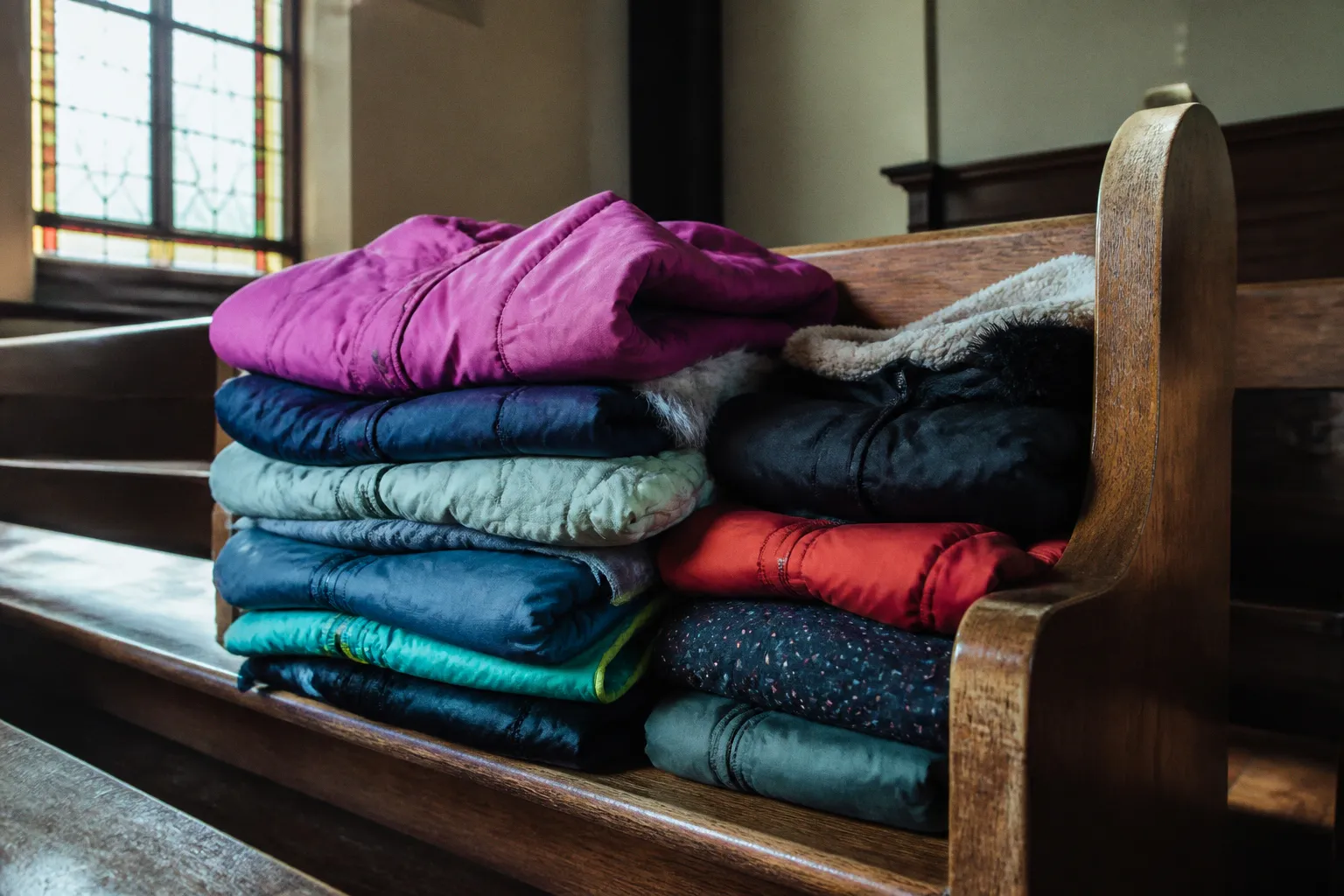
Church Winter Coat Drive: A Step-by-Step Planning Guide
A parent walks into the church foyer after the Wednesday supper program, child in tow, and quietly asks if anyone has an extra coat — theirs was outgrown last winter, and the next size up is not in the budget. Or an older parishioner arrives at early worship in a jacket two sizes too small, the kind worn thin from many seasons, because replacing it feels like an extravagance rather than a necessity. These are not abstract statistics; they are the embodied reality of finitude — the simple human fact that bodies get cold, and that warm clothing is a dignity, not a luxury. Pastors and Stephen Ministers quietly know this long before the first thermometer dips.
A church winter coat drive is one of the most concrete ways a congregation can hold space for that reality. Done well, it weaves together theology and logistics, hospitality and handcarts, the language of grace and the language of garment sizes. Done poorly, it produces boxes of mismatched coats that arrive too late, or never arrive at all, and leaves a planning team wondering what went wrong. The difference between the two is rarely generosity — most congregations have that in abundance. The difference is planning, and the difference between planning and hoping is a six-to-eight-week calendar.
A coat given in October is hospitality; a coat given in January is triage.
Establishing the Timeline and Partnering with Local Agencies
The first decision a planning team makes is also the one most likely to determine whether the drive will succeed: when to begin. National organizers and receiving agencies consistently recommend a planning runway of six to eight weeks before sustained cold weather arrives, with active collection campaigns typically running one to two weeks. That timeline is not arbitrary. It accounts for the time required to recruit volunteers, secure drop-off locations, promote the drive, collect donations, inspect and sort them, and place finished coats in the hands of partner agencies before the first hard freeze locks a community into triage mode.
In most of the continental United States, this means beginning conversations in early fall — sometimes even late summer — so that coats are ready to distribute in October or November rather than mid-January. A drive that begins after Thanksgiving is rarely a drive; it is a scramble, and scrambles rarely produce clean, sorted, size-appropriate inventory. The planning team's first act of stewardship is honoring the calendar.
Equally important is identifying a recipient agency before the first coat is collected. National organizations such as One Warm Coat work with networks of more than 1,500 nonprofit partners across the country and can help match a local congregation with an agency already equipped to receive, store, and distribute coats. Local shelters, transitional housing programs, schools, food pantries, and refugee resettlement offices are also natural partners — many already have intake processes for clothing and can tell organizers exactly which sizes and demographics are most needed in a given month. Partnering early transforms the drive from a one-way gesture into a two-way relationship.
A useful early conversation with a partner agency covers four questions:
- Which sizes and age groups are currently most in demand (infant, toddler, youth, adult, and extended sizing such as 4XL and beyond)?
- What is the preferred drop-off window, and how should coats be packaged — boxed, bagged, or hung?
- Are there restrictions on condition, such as a requirement for new coats only, or are clean and gently used coats acceptable?
- Can the agency accept monetary donations alongside physical coats, and if so, how are those funds applied?
These questions save hours of rework later. A coat drive that delivers exactly what the partner agency has asked for is a coat drive that ends well, and a partnership that ends well is one the agency will welcome again next year.
Defining Volunteer Roles for Logistics and Marketing
A drive that lives entirely in the head of one overcommitted parishioner rarely survives contact with reality. The second planning task is to recruit a small team and assign specific roles, because shared ownership is what turns a one-time event into a sustainable ministry. Four roles consistently emerge as essential in experienced drives:
| Role | Core Responsibilities |
|---|---|
| Drive Coordinator | Sets the timeline, convenes the team, and serves as the single point of contact with the partner agency |
| Communications Lead | Drafts promotional copy, manages social media and bulletin announcements, and updates the congregation on collection totals |
| Logistics Lead | Arranges drop-off bins, coordinates pickup from satellite locations, and manages transportation to the partner agency |
| Sorting Lead | Recruits and trains the team that will inspect, clean, sort by size and demographic, and pack the final delivery |
The drive coordinator does not need to do everything; the coordinator's job is to make sure everything has an owner. In a mid-sized congregation, each of these roles can be filled by a single volunteer, with a few helpers for the heaviest weeks — particularly during sorting, when many hands make light, accurate work. In a smaller congregation, two of these roles can be combined into one, as long as the combination is named and the workload is realistic rather than heroic.
It is also worth naming one or two "what if" roles early. Who handles a donation of fifty coats from a single business donor? Who fields the call from a local reporter? Who decides whether a coat with a broken zipper goes out the door or gets set aside? These small contingencies, assigned in advance, prevent the coordinator from becoming the bottleneck and protect the team from well-meaning improvisations that quietly exhaust everyone.
Hospitality is rarely the work of a single generous person; it is the steady rhythm of a team that has named its work in advance.
Expanding Collection Reach Beyond the Church Foyer
The instinct is to place one or two bins in the church entryway and call it a collection network. That instinct undersells what a congregation can do. Experienced organizers know that high-traffic community locations dramatically increase the total volume of coats collected — public schools, public libraries, coffee shops, community centers, and local workplaces all see more foot traffic in a single week than most church foyers see in a month. A coat drive that remains entirely inside the church building is, in a sense, a private ministry; one that extends outward becomes a visible, public act of pastoral presence.
A reasonable expansion plan follows a simple sequence:
1. Begin with the church foyer as the anchor location — visible, accessible, and symbolically central to the congregation's identity.
2. Identify two or three partner sites in the surrounding neighborhood. Schools and libraries are usually willing partners; local businesses often are too, particularly when the drive is framed as a community service opportunity rather than a request for staff time.
3. Place clearly labeled collection bins at each site at least one week before the active campaign begins, so regular visitors become accustomed to seeing them.
4. Brief each site manager on what is being collected (coats only, in clean condition) and confirm the pickup schedule in writing.
5. Promote the satellite locations through the church's communications channels so the congregation knows the drive extends beyond the building and so donors have multiple convenient drop-off points.
This expansion does more than increase volume. It also extends the congregation's pastoral reach into the wider community — a coat drive visible at the public library is a quiet signal that the church is present, organized, and oriented toward the neighbor rather than the interior life of its own members. For many partner agencies, that visibility matters as much as the coats themselves.
Managing Inventory: Sorting, Cleaning, and Distribution
The week the drive ends is not the week the work ends. Sorting, inspecting, and cleaning can easily double the total time invested in the project, which is why experienced organizers build this work into the original timeline rather than treating it as an afterthought. A drive that delivers dirty, mismatched, or damaged coats to a partner agency is a drive that has, however unintentionally, added work to people who are already stretched thin.
The sorting process generally moves through four stages:
1. Inspection. Each coat is checked for stains, tears, missing buttons, broken zippers, and odors. Coats that fail inspection are set aside for repair or recycling; coats that pass move forward.
2. Cleaning. Partnering with a local laundromat or dry cleaner can dramatically reduce the workload here. Many small businesses are willing to donate cleaning services for a charitable drive, particularly when the partnership is framed in advance and acknowledged in the church's communications.
3. Sorting by size and demographic. Coats are sorted into categories — infant, toddler, youth, adult women, adult men, and extended sizes such as 2XL, 3XL, and 4XL+ — and the count of each category is recorded for the partner agency.
4. Final delivery. The sorted inventory is transported to the partner agency at the agreed-upon time, with advance notice of the totals so distribution can be planned.
A common mistake is to skip the cleaning stage and hope the receiving agency will absorb it. Some larger agencies can; most smaller ones cannot. Building the cleaning partnership into the plan from week one is a small investment that pays off in the quality and dignity of the final delivery — a coat that arrives clean and ready to wear is a coat that honors the recipient.
Scaling Impact: From Infant Sizes to Adult 4XL+
One of the quieter failures of an under-planned coat drive is the size gap. Donors tend to give what they themselves own — adult medium, adult large, youth medium. The result is a delivery heavy in middle sizes and light in the categories most often requested by partner agencies: toddlers, infants, and extended adult sizes such as 3XL and 4XL+. The gap is rarely malicious; it is simply the natural limit of any closet-based giving model.
A mature drive addresses this gap directly in its promotional materials. Suggested language includes explicit size requests — "especially needed this year: infant and toddler sizes, youth XL and XXL, and adult 3XL and 4XL" — so donors without those sizes in their own closets can either purchase them new or make a monetary donation earmarked for size-specific purchases. Naming the gap honestly is, paradoxically, what closes it.
The size range a drive should aim to cover, when working with a national partner like One Warm Coat or a well-equipped local agency, typically spans from infant through adult 4XL+. Realistically, no congregation-run drive will fully cover every size in that range; the goal is to communicate clearly which sizes are most needed and to give donors a way to participate even when their own wardrobe has nothing to offer.
This is also where monetary donations become quietly essential. A modest monetary gift can often purchase a new toddler coat at wholesale cost through a partner agency — a coat the donor could not have produced from their own closet. Drives that frame monetary gifts as a legitimate, even preferred, form of participation tend to collect more useful inventory overall, because they widen the donor pool beyond people who happen to own the right sizes. Both forms of giving belong to the same vocation.
A Closing Word on Hospitality
There is a temptation, once the logistics are in place, to treat the coat drive as finished when the last box is delivered. It is not finished. The drive is finished when a parent at the Wednesday supper does not need to ask whether anyone has an extra coat — because the right coat, in the right size, was already in the hands of the partner agency weeks before the cold set in.
That is the measure of a well-planned drive: not the volume collected, but the quiet disappearance of the pastoral moment that prompted the planning in the first place. When a congregation's embodied faith — its willingness to spend six to eight weeks on logistics that the wider world considers somebody else's problem — closes a gap that finitude has opened, the drive has done its work, and the theology has become visible without a single word of preaching.
The remaining task, then, is simply to begin. Pick a date six to eight weeks before the first sustained cold. Make one phone call to a partner agency. Recruit three other volunteers. The rest is rhythm, and rhythm, given enough winters, becomes tradition — a tradition in which the congregation's theology of grace wears sleeves, has buttons, and arrives in the right size.