Church disaster relief team: organization steps
When the river crests the levee and the highway becomes a brown river of its own, when the tornado leaves a congregation standing in the wreckage of what was the fellowship hall only hours before…
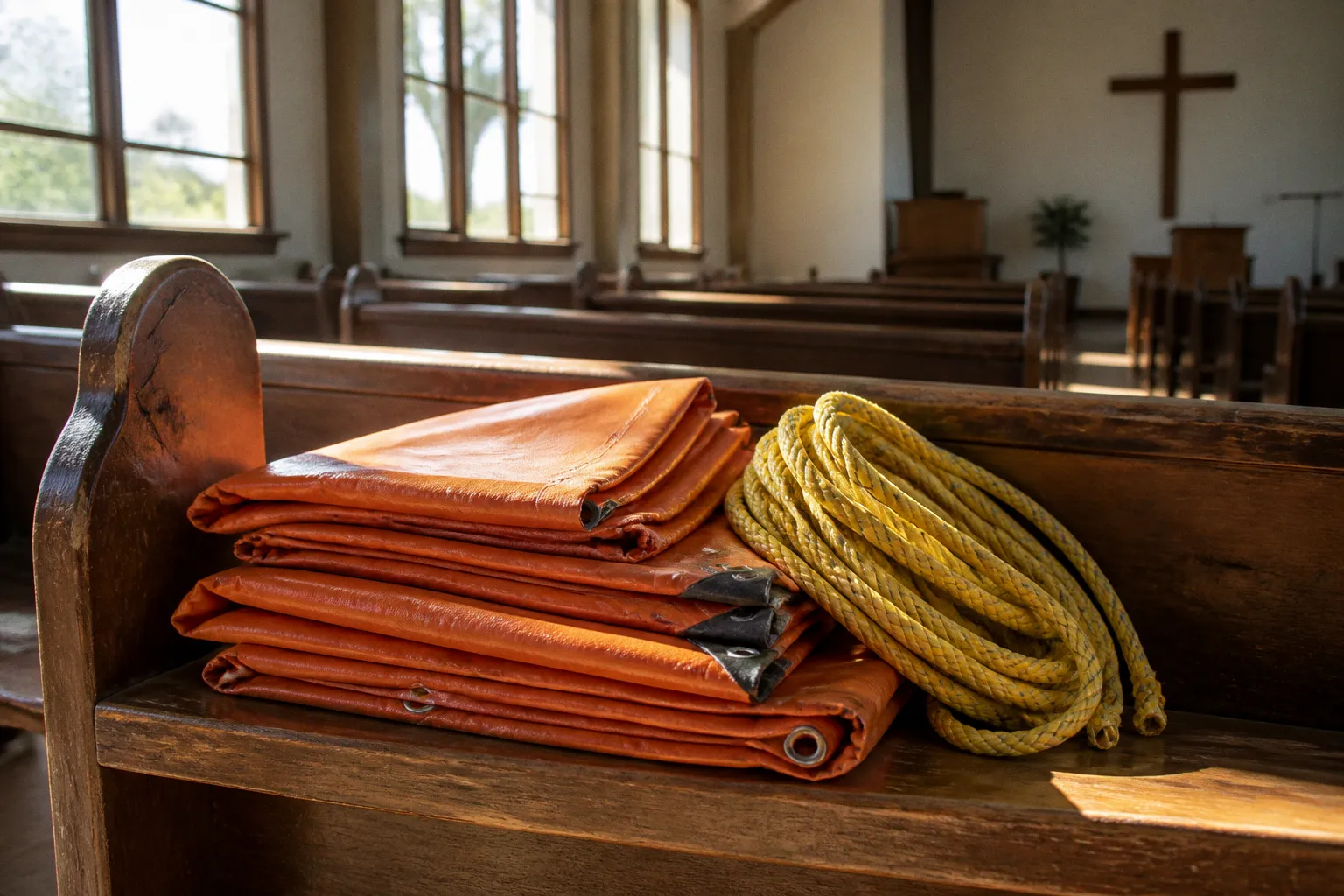
When the river crests the levee and the highway becomes a brown river of its own, when the tornado leaves a congregation standing in the wreckage of what was the fellowship hall only hours before, when the wildfire smoke turns the sanctuary lamps to amber haze — that is when a church discovers what kind of body it really is. Not in the calm Sundays of staffed programs and scheduled potlucks, but in the long hours after a disaster, when the question becomes: who shows up, with what training, under whose authority, carrying what? The answer is rarely improvised well. Disaster relief work, for a community of faith, is not a spontaneous eruption of goodwill. It is the fruit of careful, prayerful preparation done in what responders call "blue-sky" periods — the ordinary weeks when nothing is on fire and the asphalt is sound.
We are finite creatures, and so are our congregations. We cannot be everything to every neighbor in every crisis. But we can be something specific, well-prepared, and grounded in a theology that holds both the reality of human suffering and the unforced rhythm of grace. This is the work of building a church disaster relief team — not as a project of self-sufficiency, but as a practice of embodied faith that names our limits, gathers our gifts, and trains our hands before the ground shakes.
The Six-Step Framework for Disaster Preparedness
Disaster planning, like most faithful work, begins with attention. A structured six-step process — outlined by groups like the Southern Baptist Conservatives of Virginia and adaptable across denominations — walks a leadership team from confusion to clarity without rushing the work. The steps move through forming a collaborative team, understanding the likely situation, determining goals, developing the plan, preparing and approving that plan, and finally implementing and maintaining it over time.
The first step — forming the team — is more pastoral than administrative. This is not a committee of the willing and worried; it is a small group of people who can hold complexity, listen well, and stay at the table when the conversation gets uncomfortable. Two or three is often enough to begin; twelve quickly becomes unworkable. The team should include someone who understands buildings and grounds, someone who knows the congregation's people and their gifts, and someone who can write things down. Pastoral leadership belongs here too — not because the pastor will wield a chainsaw in the relief zone, but because the team will face decisions about whose needs take priority, and those decisions are theological decisions.
The second step asks us to understand our situation. Where do we live, and what disasters visit this place? A church in tornado alley faces a different reality than one on a coastal flood plain, and our preparation should reflect the geography of our fragility. Talk with county emergency management. Read the local hazard mitigation plan. Ask the fire marshal what the actual risks are, not what we imagine them to be. This is a discipline of honest attention — what our spiritual ancestors would have called acknowledgment.
Goals follow naturally from attention. What, specifically, do we hope to be able to do? Provide meals for displaced neighbors for three days? Offer shelter for a few dozen families? Send a trained team into a neighborhood to clear blocked roads? The answer shapes everything downstream. It is better to do two things well than to promise ten things poorly.
The fourth and fifth steps — developing the plan, then preparing and approving it — are where the work slows down and gets written. A plan that lives only in the heads of three people is not a plan; it is a hope. A plan that exists on paper, reviewed and approved by the congregation's governing body, is something that can be handed to the next leader when the current one moves on.
The sixth step — implementation and maintenance — is the longest of all. Plans decay. People move. Phone numbers change. The volunteer who was eager in March may be depleted by November. A disaster relief plan is a living document, revisited at least once a year, often after a regional incident that reminds the congregation why this work matters.
Building a Resilient Volunteer Roster During Blue-Sky Periods
The most important time to build a volunteer roster is when no one needs volunteers. This is counterintuitive to the rushed generosity that follows a crisis, but it is the sober truth of effective disaster response. A roster built in the aftermath of a flood is built from whoever happens to be available in that moment — a thin slice of the congregation, often emotionally flooded, with no time to assess skills, training, or limits.
A roster built during a blue-sky period is something different. It is a document, ideally kept in two places, that records the names of people willing to serve, their contact information, their availability windows, their transportation resources, languages they speak, care skills they carry (nursing, counseling, construction, cooking), and the limits they have set for themselves. The limits matter as much as the gifts.
A single parent with two small children may want to help but cannot deploy overnight. A retired electrician with knee problems may not be able to climb into an attic but can absolutely wire a temporary shelter. A teenager eager to volunteer may be the right age to stack supply boxes but not the right age to operate equipment. Recording these realities in advance — gently, without pressure — honors the embodied nature of service. We are not interchangeable hands; we are particular people, with particular bodies and particular callings.
| Roster Field | Why It Matters |
|---|---|
| Name & contact info | Reaching people quickly without relying on memory |
| Availability windows | Honoring work, family, and energy limits |
| Transportation access | Knowing who can deploy and who needs a ride |
| Languages spoken | Serving neighbors who otherwise go unheard |
| Care skills | Matching gifts to actual needs on the ground |
| Self-declared role limits | Protecting volunteers from overextension |
The roster is not a public document. It contains private information, and the people who hold it are entrusted with that privacy. This is part of what it means to hold space for one another: we extend trust by recording the truth of who we are and what we can offer, and we protect that record with care.
Defining Operational Roles and Safety Accountability
Once we know who we have, we need to know what they will do. A disaster response team without defined roles becomes a crowd of well-meaning people bumping into each other in a parking lot. Two roles deserve particular attention because they shape the safety of everyone else.
The Safety and Accountability Lead is the person whose job is to pause. When work is unsafe, when a volunteer has not checked in for too long, when the conditions on the ground have changed beyond what anyone anticipated, this person has the authority to stop the operation. This is not a popular role in the moment, and it is the most important role in the room. We name it, we train for it, and we protect the person who carries it from being overruled by enthusiasm.
The Intake Lead manages the requests for help. After a disaster, the phone rings, the inbox fills, and neighbors arrive at the door with needs that range from the urgent to the chronic. The Intake Lead records each request, protects private information, triages against the team's actual capabilities, and communicates clearly with those who have asked. This role prevents two of the most common failures in disaster response: duplicating effort and losing track of who said yes to whom.
Below these two roles, teams often include a Logistics Lead, a Communications Lead, a Spiritual Care Lead, and coordinators for specific functions like feeding, shelter, or debris work. The number of roles depends on the scale of the response. A small church supporting a few families will not need a twelve-person command structure; a regional relief effort will. Match the structure to the work.
Essential Documentation and the 'Go Box' Strategy
Some disasters damage the building itself. A church that has lost its office cannot easily retrieve the documents it now needs most — insurance policies, member directories, tax exemption certificates, equipment inventories, bank account information. The Go Box is a humble and practical answer to this vulnerability: a single container, stored off-site, that holds copies of the documents the congregation cannot afford to lose.
A well-prepared Go Box contains, at minimum:
- Copies of insurance policies for buildings and vehicles
- An equipment inventory with serial numbers and values
- A current member directory with emergency contact information
- Tax exemption certificates
- Key contracts with vendors and contractors
- A map of the property showing shutoffs for water, gas, and electricity
- Printed copies of the disaster response plan itself
- Credentials, badges, and certification records for trained volunteers
The Go Box should be stored somewhere accessible but protected from the same disaster — a bank safe deposit box, a secure location at a partner church, or a fire-resistant cabinet at the pastor's home. The Go Box is updated at least annually, and every update is logged. Documents lose their value when they become outdated. A member directory from five years ago may list people who have moved, died, or left the congregation; an insurance policy from three years ago may be superseded by a newer one. The annual review is also a moment to ask whether the plan itself still reflects what we believe we are called to do.
The work of preparing is itself a form of ministry — a quiet confession that we belong to a future we cannot fully see, and that we trust it to those who come after us.
Navigating Training, Certification, and Liability Standards
Goodwill is not a credential. A volunteer who has never been trained should not perform specialized tasks in a disaster zone, regardless of how strong the call to help feels. A volunteer who has never been screened should not work alone with displaced children, regardless of how kind their heart is. The training and certification requirements that exist in disaster relief networks are not bureaucratic intrusions on generosity; they are the conditions under which generosity can operate safely and continue to operate.
Established relief networks carry clear standards. Southern Baptist Disaster Relief, for example, requires volunteers to be at least 18 years old, to complete introductory and specialized training, to pass background checks, and to renew their credentials every five years. United Methodist Early Response Teams require "Safe Gatherings" certification and respond only when officially requested by the impacted community — a discipline that prevents well-meaning but uncoordinated arrivals from complicating an already strained response. Children's Disaster Services volunteers complete 25 hours of training before serving in shelters alongside displaced families.
These standards exist for two reasons. First, they protect the people being served. A volunteer who has not been screened may be a danger to children or vulnerable adults. A volunteer who has not been trained may create new hazards in a damaged environment. Second, they protect the volunteers themselves and the congregation that sends them. A volunteer injured while operating equipment they were not certified to use creates a liability that can shadow a church for years.
The path forward is to affiliate with an established relief network that provides training, credentialing, and insurance coverage. The denomination or judicatory in your area almost certainly has one. The investment of time — often a weekend of training, sometimes a series of them — is the price of admission to meaningful, sustained service. It is also the doorway through which most congregations discover that the work is deeper and more rewarding than they had imagined.
A common mistake is to send volunteers into a disaster zone without coordination or an official request from local emergency management. Self-deployment may feel faithful, but it almost always complicates an already strained response and can put untrained people into situations their bodies and judgment are not ready for. The discipline of waiting to be asked, of going only when invited, is itself a form of neighbor-love.
Scaling Capabilities: From Local Cleanup to Mobile Feeding Units
Church disaster relief capabilities exist on a wide spectrum, and a healthy team knows where on that spectrum it intends to operate. At one end, a congregation can commit to local cleanup: helping elderly neighbors clear debris from their yards, mucking out a flooded basement, providing meals to a displaced family for a week. At the other end, established networks operate mobile feeding units capable of preparing 1,000 to 25,000 meals per day, shower and laundry trailers, mud-out and ash-out teams, and disaster chaplaincy programs that walk alongside first responders.
Most congregations will live somewhere in the middle of that spectrum, and that is a faithful place to be. The work of feeding two hundred meals on a Saturday, of running a shelter for forty-eight hours, of sending a small trained team into a damaged neighborhood — these are not small things. They are the work of the body of Christ in its local expression. They do not require the capacity of a regional relief agency; they require the discipline of preparation and the humility of working within one's gifts.
When a congregation opens its building as a temporary disaster shelter, several practical matters deserve attention. Capacity must be determined against local fire codes, not against what the fellowship hall can technically hold. Procedures for weapons and valuables must be written down and posted. Entrances must be secured. Volunteers must be trained to recognize the signs of sex offenders who may attempt to access shelter populations. None of these are comfortable topics, and all of them are part of what it means to love our neighbors well in their most vulnerable hours.
A useful exercise is to write down what the team can actually do this year, with the resources and training currently available, and what it would take to expand that capacity in the next three years. This is not an ambition document. It is a stewardship document — a way of saying, here is what we have been given, here is what we can faithfully offer, here is what we are not yet ready to do.
Closing
To build a church disaster relief team is to practice a particular kind of hope. It is the hope that does not deny the reality of disaster but accepts it as part of the human condition — the condition to which the gospel speaks. It is the hope that says we will not be caught unprepared, that our yes will be a real yes, that our neighbors will be met by hands that have learned their work and hearts that have asked for grace.
The work is long, and most of it is quiet. It happens in committee meetings and training weekends, in the careful recording of who can do what and where the documents are stored. None of it looks like disaster relief on a Sunday morning. All of it is disaster relief when the moment comes.
We build the team now so that, in the moment, we do not have to become a team from scratch. We do the paperwork now so that the pastor standing in a damaged sanctuary does not have to wonder where the insurance policy is. We name the Safety Lead now so that, later, someone has the authority to stop what should be stopped. We train now so that the volunteer who shows up in the aftermath of a storm is a person whose hands know their work and whose presence does not add to the burden.
This is embodied faith. It is the body of Christ preparing itself, in advance, to be the hands and feet of Christ in a moment when the world has come undone. It is not glamorous. It is not finished in a weekend. But it is, in its own quiet way, a holy thing — a resilience that does not pretend to be invincible, and a grace that does not arrive late.