Church calendar planning: resolving scheduling conflicts
Every pastor knows the Sunday-morning phone call. The kind that arrives before the coffee has finished brewing. The choir director’s voice is tight, and she is asking whether anyone told the tech team that the praise band moved rehearsal up an hour.
Meanwhile, the family who reserved the fellowship hall for a reception after the baptismal service is standing in the narthex with sheet cakes balanced on their arms, watching the chairs being folded into rows for an unplanned committee meeting.
Nobody did this on purpose. Nobody set out to make the body of Christ look foolish. It happened because the calendar — that quiet, unglamorous backbone of parish life — had drifted into a state of beautiful, disorganized improvisation.
This is the texture of church calendar planning when it is left to chat threads, screenshot chains, and the well-meaning memory of one volunteer who always remembers everything until, one week, she does not. The cost is rarely visible in a spreadsheet. It appears in volunteers double-booked across ministries, in the small erosion of trust when members arrive to find their event displaced, and in the significant time staff spend untangling scheduling collisions that a clearer system could have prevented.
A parish calendar is not merely a scheduling tool. It is a practice of love for the people who show up.
That phrase — practice of love — may sound too grand for a conversation about software features and color-coded badges. But anyone who has been on the receiving end of a double-booked funeral reception or a youth-group lock-in that lost its room to an unannounced wedding knows that how we organize time is pastoral theology in action.
We are deciding whose bodies get to be where, and when, and with what kind of welcome waiting for them. To do that well is not bureaucracy. It is the slow, unglamorous work of holding space for one another.
The Hidden Costs of Decentralized Scheduling
Most congregations did not choose chaos. They inherited it.
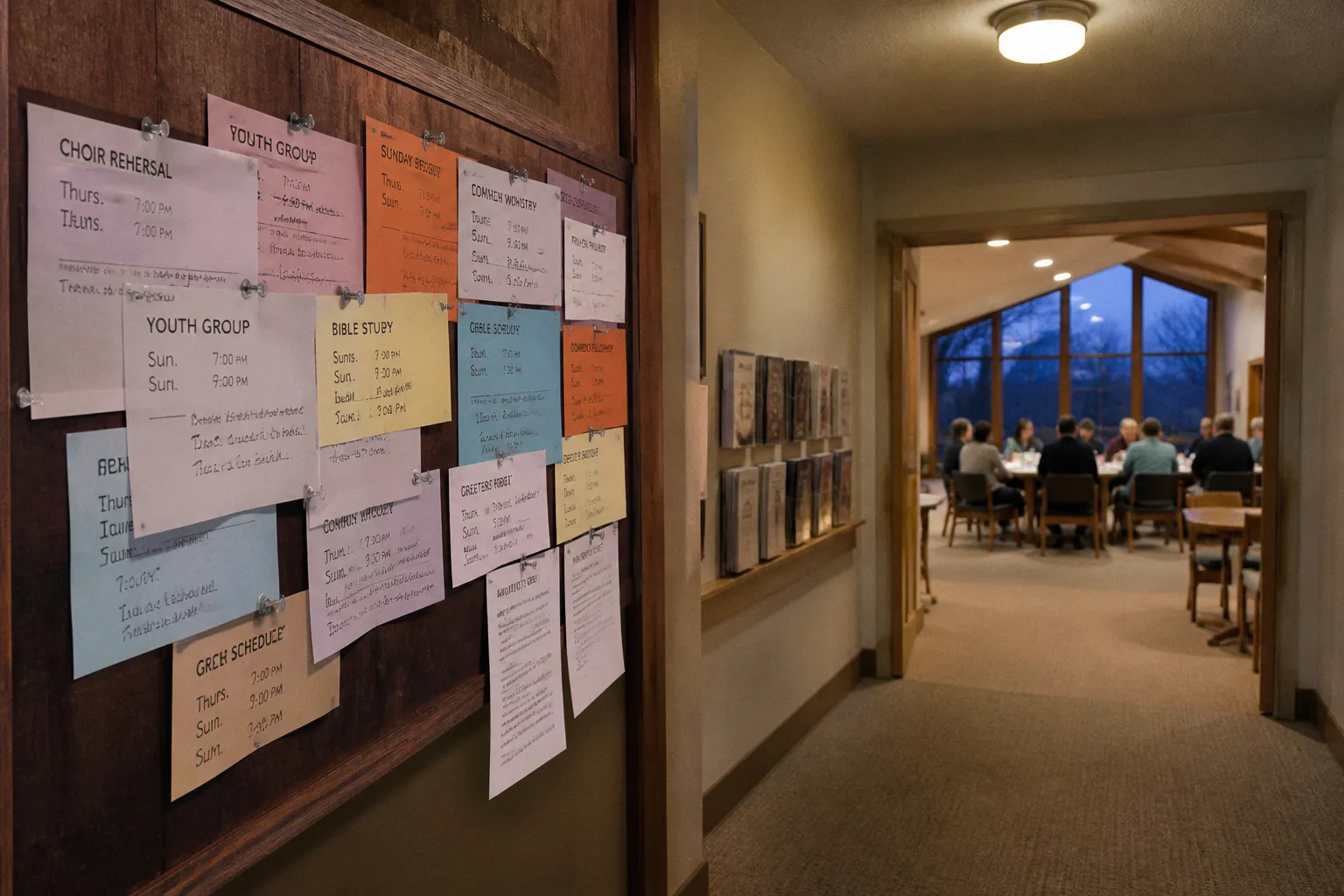
A WhatsApp thread started as a quick way to coordinate Wednesday-night supper. A GroupMe appeared when the youth pastor needed to rally volunteers for the lock-in. A paper calendar in the church office still has the only authoritative copy of the choir’s rehearsal week. Someone keeps a spreadsheet for room reservations, while another person relies on email folders and handwritten notes.
Each tool made sense in isolation. Together, they create a landscape in which no one — not the pastor, not the office administrator, not the volunteer who genuinely wants to serve in three different ministries — can see the full picture of what is happening at any given hour.
The costs arrive quietly, and they accumulate.
A volunteer signs up to greet at the early service and read at the late one, not realizing that the children’s choir runs in between. A family arrives for the reception following a memorial service to find a Bible study already filling the fellowship hall with folding tables and coffee urns. A facilities volunteer, trying to be helpful, moves a meeting to a room that another ministry had reserved first. The resulting domino fall may involve room changes, revised announcements, confused volunteers, and a series of apologetic messages that could have been avoided by a visible reservation.
Disorganization is not merely an administrative inconvenience. It is a slow-acting pastoral wound. Volunteers become reluctant to accept new responsibilities because they do not trust the information around them. Ministry leaders protect their own calendars rather than sharing them. Members stop assuming that an announcement means what it appears to mean. A congregation can remain outwardly busy while its internal confidence steadily weakens.
The burden also falls unevenly. People with flexible schedules may be able to absorb a last-minute change. Parents arranging childcare, older members relying on transportation, paid staff managing several ministries, and volunteers who already serve in multiple places often cannot. A scheduling error that looks minor from the church office may require someone else to rearrange a household, miss a meal, find a substitute, or arrive already frustrated.
There is another cost: the calendar becomes a source of institutional memory that lives only in people’s heads. The person who knows which rooms can be used for children’s programming, which doors are open after hours, which events require the sound system, and which groups cannot meet on a particular evening becomes indispensable. That may feel reassuring for a while. It is also fragile. When that person is sick, away, or simply overloaded, the church discovers that its scheduling system was never a system at all.
The deeper problem is structural. When scheduling lives in several chat threads, multiple paper calendars, and the working memory of long-serving staff members, the calendar itself becomes invisible. There is no single place where the truth of what is happening lives. Every announcement is a copy. Every copy drifts a little further from the original.
Identifying Organizational Silos in Ministry Coordination
The word silo comes from farming and from military storage, and both meanings apply to the way many congregations unintentionally organize themselves. Each ministry — choir, children’s formation, youth, hospitality, outreach, trustees, the quilting circle — develops its own scheduling practice. Each is, in its own way, faithful and well-intentioned. Each is also, by design, only partially aware of what the others are doing.
A ministry silo is not necessarily a personality problem. It does not mean that a director is selfish or that a committee refuses to cooperate. Often, the silo is simply the natural result of people trying to get their own work done with the tools available to them. The children’s ministry creates a calendar because it needs to communicate with families. The music ministry creates another because rehearsals and services have their own rhythms. The facilities team keeps a separate list because rooms, keys, equipment, and building access create practical concerns that are easy to miss in a general announcement.
The trouble begins when these partial views are mistaken for the whole.
The most painful collisions are rarely between strangers. They happen inside families and across dedicated volunteers who serve in more than one place. A parent who sings in the choir and serves on the welcome team may find herself scheduled to be in two places at once during Advent. A trustee who has also volunteered to lead a Wednesday-night small group may not realize that the budget meeting has been moved into the same window. A teenager may be expected at youth rehearsal, confirmation, and a service role without anyone noticing that the commitments overlap.
These are not failures of commitment. They are failures of visibility. The calendar cannot show what it does not know.
A useful review begins by asking how an event enters parish life. Who proposes it? Who approves the date? Who checks the room? Who confirms equipment and staffing? Who communicates the final version? If the answers change from ministry to ministry, the congregation is likely working with several incompatible processes.
It also helps to distinguish between different kinds of scheduling information:
- Events tell people where they need to be.
- Reservations indicate which rooms, facilities, or equipment are unavailable.
- Assignments identify the people responsible for serving.
- Blackout dates show when a ministry, leader, or facility cannot participate.
- Dependencies connect one activity to another, such as a reception that can happen only after a baptism or a rehearsal that requires the sanctuary to be prepared first.
Many church event coordination problems occur because these categories are mixed together. A meeting may appear on a calendar without showing that it requires the fellowship hall. A volunteer assignment may be confirmed without accounting for travel between buildings. A room may be marked as reserved while the people responsible for unlocking it remain uninformed.
The pastoral invitation here is gentle but real: we are being asked to look honestly at the way our organizational structure makes invisible the very people we most rely on. Silos do not protect ministry identity. They exhaust the volunteers who carry that identity across multiple rooms of the church at once.
Implementing Real-Time Conflict Detection Systems
The first move toward a healthier practice is often the simplest and the most resisted: choose one calendar, and make it the calendar.
Not the official calendar, with two or three other calendars quietly continuing alongside it. One shared source of truth that every ministry enters into, that every volunteer can consult, and that the church office treats as authoritative.
This does not mean that every ministry must abandon its own working habits overnight. A choir director may still need a rehearsal plan. A youth leader may still need a communication channel for families. A kitchen coordinator may still need a list of supplies. The shared calendar is not meant to replace every ministry document. Its purpose is to hold the information that other ministries need in order to avoid stepping on one another.
Modern church-management platforms such as Planning Center, Pushpay, Ministry Scheduler Pro, and similar tools are designed for parts of this work. They can allow a children’s ministry director to schedule Sunday-morning volunteers while a music director records rehearsals in the same environment. When these functions are connected, a conflict can become visible at the moment of entry rather than at the moment of arrival.
That distinction matters. A problem found while someone is submitting a request is usually manageable. The same problem discovered when twenty people are already standing in a hallway is pastoral damage in progress.
Real-time conflict detection does not need to be elaborate to be useful. It may appear as:
- A warning when a volunteer is assigned to overlapping roles.
- A notice when a requested room is already reserved.
- A prompt when an event requires equipment that is committed elsewhere.
- A visible blackout when a facility is unavailable.
- A reminder that a recurring event has changed for a holiday, school break, or seasonal service.
- An approval step when a request affects worship, funerals, weddings, or other high-priority commitments.
The point is not to make the calendar scold people. The point is to make the consequences of a request visible before another person has to absorb them.
| Calendar signal | What it means | Why it matters |
|---|---|---|
| Overlap warning | A person, room, or resource is booked in overlapping time windows | Catches a volunteer or facility conflict before the event begins |
| Unavailable or blocked status | The requested slot collides with an immovable reservation or declared blackout | Prevents a group from arriving at a locked or occupied space |
| Shared calendar view | Ministries enter events into the same recognized source of truth | Replaces scattered screenshots and partial copies |
| Resource details | The event identifies rooms, equipment, access needs, and responsible leaders | Helps staff see the practical requirements behind a simple title |
| Approval status | A request is pending, confirmed, declined, or changed | Keeps tentative plans from being mistaken for final commitments |
| Change notification | People affected by a revision receive the same update | Reduces the quiet spread of outdated information |
A calendar should also make uncertainty visible. “Tentative,” “awaiting confirmation,” and “confirmed” are not interchangeable states. When every event looks equally settled, people make plans around information that may still change. A simple status field can prevent a great deal of confusion, particularly when several ministries are planning seasonal programs at the same time.
The same is true of event titles. “Meeting” is not enough information for someone trying to coordinate a building. A useful entry identifies the ministry, purpose, room, expected setup, and a responsible contact. This does not require a paragraph of administration. It requires enough detail that the next person does not have to reconstruct the event through a chain of messages.
The pastoral instinct may be to worry that this kind of structure will make the church feel corporate, cold, or mechanical. The opposite can be true. When people trust the calendar, they relax into their ministry. They stop carrying the low-grade anxiety of not knowing whether they are about to be embarrassed by a forgotten commitment. The system holds the structure so that the people do not have to.
Technology, however, cannot settle a disagreement that the congregation has never been willing to name. A platform can detect that two groups want the same room. It cannot determine which gathering should move, whether one can share the space, or how to speak to the ministry that must change. Conflict detection is therefore only the beginning of responsible coordination.
Establishing Priority Tiers for Shared Church Facilities
Once a parish begins to see its schedule clearly, a second question surfaces almost immediately: when two faithful things collide, how do we choose?
This is not primarily a software question. It is a discipleship question.
A congregation does not need to pretend that every event has the same purpose, urgency, or pastoral weight. Nor should a priority system become a permanent ranking of ministries, with some groups treated as more valuable members of the body than others. The purpose of priority tiers is to give people a shared way to make difficult decisions before the next conflict arrives.
Many congregations benefit from naming several broad tiers in writing and revisiting them as ministry shifts. A typical framework might look something like this:
1. Worship and sacramental commitments — Sunday and festival services, funerals, baptisms, weddings, and the rehearsals and hospitality directly tied to them.
2. Core formation commitments — Sunday school, confirmation, adult education, and small groups that have met consistently over time.
3. Recurring fellowship and service commitments — Wednesday-night suppers, food pantry distribution, scheduled outreach partnerships, and established community programs.
4. One-time and seasonal events — fundraisers, concerts, anniversary celebrations, lock-ins, and special gatherings.
The point is not to make these tiers rigid. A funeral may require a different response from a routine worship rehearsal. A community ministry may carry obligations that are not obvious from the calendar title. A small group may be able to move more easily than a food distribution program that serves people beyond the congregation. The categories provide a starting language, not an automatic verdict.
The more important work is agreeing on the questions that accompany the tiers:
- Is the event tied to worship, a sacrament, a funeral, or another pastoral obligation?
- Is the date flexible, or does changing it create serious hardship?
- Does the event serve people who have limited alternatives?
- Can the group use another room, building, or time without losing the purpose of the gathering?
- Does the request require specialized equipment or staff support?
- Has the church already communicated the event publicly?
- Would moving one event create a second conflict somewhere else?
- Who needs to be consulted before a decision is made?
This kind of framework keeps the church from treating every request as equally urgent simply because every ministry matters. A ministry can be valued without receiving every date or room it requests. Clear priorities make that distinction less personal.
They also protect staff from becoming the permanent source of judgment. Without a shared policy, the person holding the calendar has to negotiate every parish calendar scheduling conflict from scratch. One week, the loudest voice wins. The next week, the request that arrived first wins. Another time, the decision turns on who happens to have a closer relationship with the office. Even when the decision is reasonable, the process can feel arbitrary.
A written priority structure does not remove the need for mercy. It gives mercy a stable place to operate.
Shared facilities require more than a room name
The fellowship hall, sanctuary, chapel, classrooms, kitchen, and outdoor spaces are not interchangeable containers. Each has conditions that affect whether an event can actually take place there.
A room reservation should account for setup and cleanup, not only the formal start and end of the gathering. It should note whether tables, chairs, sound equipment, food preparation, childcare, or secure storage are required. A room that is technically vacant for an hour may not be available if the previous group needs that hour to clear equipment or if the next group requires a careful setup.
This is where many managing church calendar overlaps become practical rather than abstract. Two events may not overlap on paper, but they may still compete for the same people, equipment, entrances, parking spaces, or preparation time.
A reliable calendar therefore records the resources attached to an event:
- The primary room and any secondary spaces.
- Setup and teardown needs.
- Audio, visual, musical, or kitchen equipment.
- Building access and key responsibility.
- Childcare or accessibility considerations.
- The person responsible for confirming the space is ready.
- Any dependencies on worship, transportation, meals, or another event.
The more often a particular room or resource creates tension, the more useful it becomes to establish a local rule rather than renegotiate the same issue repeatedly. A kitchen may require one coordinator. The sanctuary may require a standard buffer around services. A classroom used for children’s programming may not be available for overflow without a safeguarding review. These are not signs of inflexibility. They are ways of making the congregation’s practical knowledge available to everyone.
The question is not which ministry matters more. The question is what arrangement will let people serve without asking another group to carry an invisible burden.
The Role of Designated Conflict Resolvers in Parish Life
Even with a shared calendar and clear priorities, real life will produce the occasional collision.
A family is grieving the loss of a member and has asked to use the fellowship hall the same evening a long-scheduled small group meets there. A wedding rehearsal needs the sanctuary on the same Saturday the choir has planned a recording session. A funeral reception must be ready quickly, while another group has already prepared the room for its gathering. A change in one ministry’s schedule affects volunteers who serve in two others.
These are the moments when a congregation benefits from having named, in advance, one or two people as conflict resolvers. Their role is not to be referees handing down victories and defeats. Their role is to be mediators who know the parish well enough to ask the right questions.
Can the small group meet in a different room this week? Is the choir session able to shift? Can the wedding party rehearse in the chapel and walk through the sanctuary beforehand? Can the events share a portion of the space with a clear transition plan? Does the church need to provide additional volunteers so that a change does not become an unreasonable burden?
A good conflict resolver carries institutional memory and pastoral sensitivity. They understand the difference between a genuine emergency and a request that simply arrived late. They know that moving an event may affect transportation, childcare, accessibility, food preparation, or a volunteer’s work schedule. They also know that kindness does not require avoiding every difficult conversation.
The first responsibility is to establish the facts. Which event was entered first? Which commitments are fixed? What resources are actually in conflict? Has either group already communicated a public date? Who will be affected by a change? Once those questions are answered, the resolver can help the parties identify options rather than arguing from assumption.
The second responsibility is to communicate directly. A vague note on a shared calendar is rarely enough when people are being asked to change plans. The ministry leader who must move needs to hear what happened, why the decision was made, what alternatives are available, and what support the church will provide. A clear explanation cannot make every change pleasant, but it can keep disappointment from becoming suspicion.
The third responsibility is to notice patterns. If the same room creates repeated conflicts, the issue may not be a series of bad requests. It may be an unclear rule, an inadequate approval process, or a calendar that does not capture setup and cleanup time. If the same volunteer is repeatedly double-booked, the problem may be a ministry structure that depends too heavily on one person. Conflict resolution should repair the immediate collision while also asking what made it likely.
This work requires boundaries. A conflict resolver should not become the only person who understands the calendar. Decisions should be documented in the shared system, especially when they establish a precedent. The goal is not to create a new gatekeeper. It is to build enough shared wisdom that fewer conflicts require rescue.
Nor should every disagreement be escalated to the pastor. Pastoral leadership remains important, especially when a conflict involves grief, worship, safeguarding, or a serious relational breach. But routine room changes and ordinary scheduling disputes can often be handled by people who are trusted, trained, and given clear authority. That protects the pastor’s time while giving lay leaders a meaningful role in the care of parish life.
What We Are Really Building
If we step back from the questions of software, badges, room reservations, and priority tiers, we can name what is really at stake.
A church calendar is not a productivity tool. It is the visible shape of how a community loves its people in time. When it is chaotic, the chaos is felt not in the schedule itself but in the bodies of the volunteers and members who live inside it. When it is clear, the clarity is felt in the same place — in the relief of arriving at the right room at the right hour, of being greeted by someone who knew you were coming, of being held by a community that has made room for you.
There is something embodied about this. Our faith is not only a faith of the soul abstracted from place. It is a faith of gathered bodies in particular rooms at particular hours, of bread broken at a real table, of voices lifted in a real nave. To plan a calendar well is to honor the physicality of that faith. To plan it poorly is to ask the same exhausted volunteers, over and over, to carry the weight of our collective disorganization.
The work begins with visibility. A congregation cannot resolve church calendar planning mistakes it cannot see. It continues with shared language: what counts as a confirmed event, which commitments take precedence, who may approve a change, and how affected groups will be informed. It becomes durable when the process does not depend on one person’s memory or one ministry’s private system.
That does not mean every calendar must be elaborate. A small congregation may need only a carefully maintained shared calendar, a room-reservation process, and a short written agreement about priorities. A larger parish may need connected ministry-management tools, permission levels, automated notifications, and a designated coordinator. The scale can vary. The principles do not.
Use one recognized calendar. Record the resources an event requires, not only its title. Make tentative plans visibly tentative. Build in the time needed to prepare and restore shared spaces. Review recurring conflicts instead of treating them as isolated accidents. Give people authority to mediate before frustration hardens into resentment. Above all, keep the system connected to the reason for having one: people are not interchangeable entries on a schedule.
We are not choosing between structure and spirit. We are learning that good structure is one of the ways the spirit gets a steady place to rest.
That is the invitation. Not a new program. Not a silver-bullet platform. A slow, honest practice of looking at how we hold time together, naming what is broken, choosing one calendar, setting clear priorities, naming our resolvers, and then keeping at it.
Sunday by Sunday, season by season, the calendar becomes a quieter, kinder instrument. The people who show up to serve, to grieve, to celebrate, and to be formed may not be able to name every decision that made the day work. They will know something simpler: their presence was expected, their room was held, and their time was treated as something worth caring for.