Christian mindfulness workshops: a step-by-step planning guide
A Christian mindfulness workshop begins with a pastoral reality: many people arrive carrying minds that have forgotten how to become still.
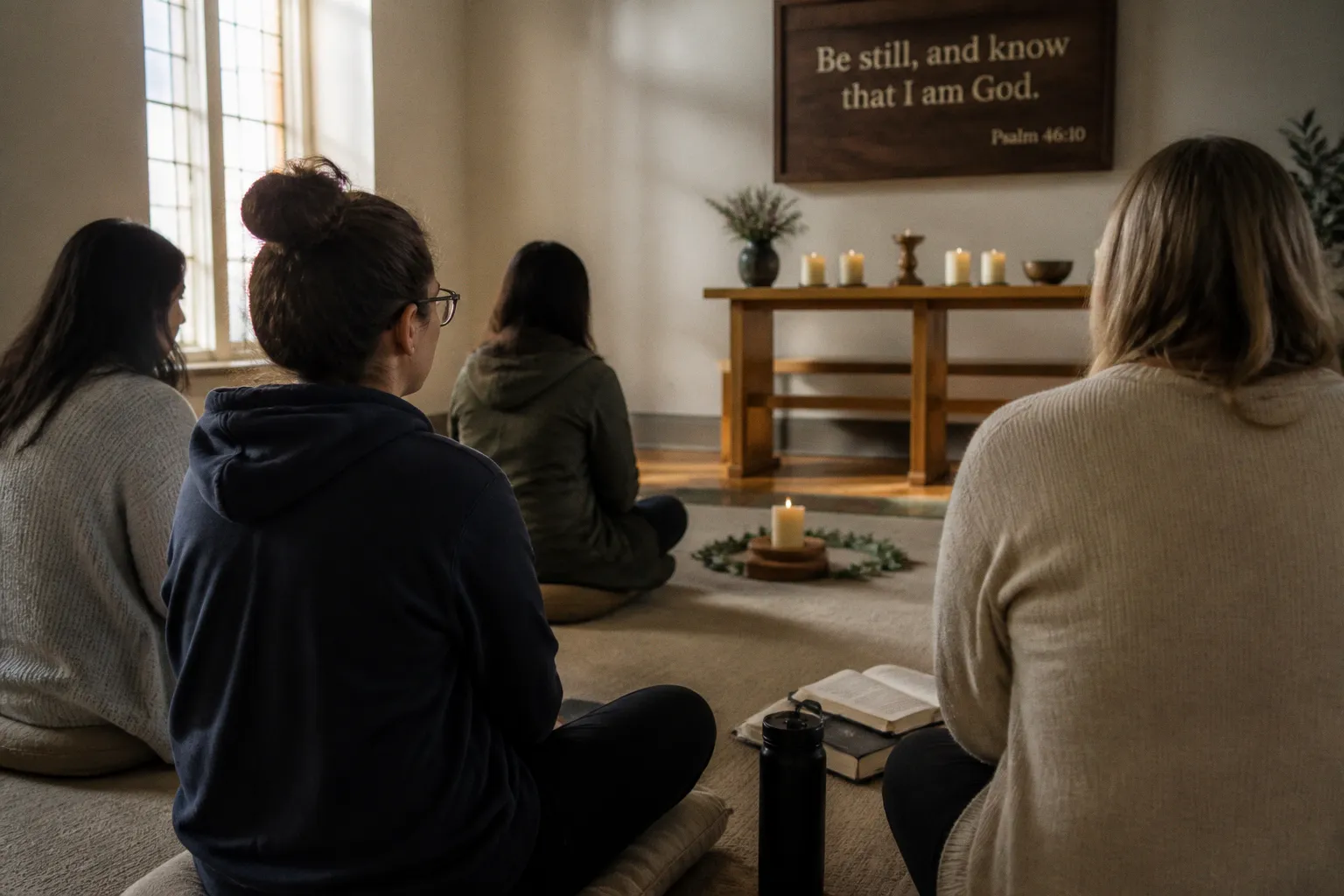
They may be grieving, caring for an aging parent, living with anxiety, recovering from exhaustion, or simply moving through days so crowded that prayer has become another task to complete. They are not necessarily looking for a new technique. Often, they are looking for a faithful way to notice what is happening within them while remaining rooted in God’s presence.
That is the particular work of Christian mindfulness workshop planning. The goal is not to empty the mind, manufacture serenity, or borrow a spiritual practice without examining its foundations. The goal is to create a safe, embodied space where Scripture, silence, breath, attention, and fellowship can help people receive the grace that is already holding them.
A well-designed workshop gives participants both theological clarity and practical structure. It explains what Christian mindfulness is, distinguishes active meditation from stillness meditation, establishes a rhythm for the gathering, and offers simple practices that can continue at home. Just as importantly, it leaves room for lament, distraction, uncertainty, and the ordinary finitude of being human.
Defining the theological foundation of Christian mindfulness
Before choosing exercises or writing a church mindfulness workshop outline, begin with the theological question: What is the practice asking people to notice, and where is that attention directed?
Christian mindfulness focuses awareness on God’s presence, the truth of Scripture, and the reality of the person before God. It does not require participants to pretend that difficult thoughts are absent. It does not treat the body as an obstacle to spiritual life. Instead, it can help people notice their thoughts, emotions, physical sensations, and surroundings without immediately being ruled by them.
For a Lutheran community, this distinction matters. Christian life is not built on our ability to achieve a perfectly calm internal state. We are not justified by how well we meditate, how steadily we breathe, or how consistently we can keep our attention from wandering. The practice can become a place of receiving, but it is not a spiritual performance.
A workshop should make this clear from the beginning. Participants need permission to be distracted, restless, tearful, skeptical, or tired. Some may find silence nourishing. Others may discover that silence brings grief or fear closer to the surface. Neither response indicates spiritual failure.
Biblical grounding can be offered through passages that affirm the dignity of the human person and the holiness of embodied life. Genesis 1:27 speaks of humanity as created in the image of God. First Corinthians 6:19 describes the body as a temple of the Holy Spirit. These texts do not create a technical mindfulness method, but they provide a meaningful theological frame: attention to the body and present moment need not be separated from faith.
The facilitator can describe Christian mindfulness through several connected commitments:
- God is present before we become aware of that presence. The practice does not summon God into the room. It helps us become more attentive to the God who is already with us.
- Scripture remains a trustworthy center. Reflection is not guided only by personal preference or whatever thought happens to arise. Biblical language helps shape and test what we are receiving.
- The body belongs within prayer. Breath, posture, tension, fatigue, and physical comfort can all be noticed with compassion rather than shame.
- Attention is an act of love. When we listen carefully to God, ourselves, and one another, we resist the hurried habits that make people feel invisible.
- Grace is not earned through concentration. A wandering mind is part of being human. Returning gently can itself become an embodied expression of trust.
This theological foundation protects the workshop from two opposite errors. One is to make mindfulness so vague that it could mean anything. The other is to make it so rigid that participants feel they must perform the practice correctly in order to be faithful.
Christian mindfulness is not the achievement of an empty mind; it is the patient return of attention to God, Scripture, and the truth of our embodied lives.
Naming what the workshop is—and is not
A short introduction can prevent unnecessary confusion. Christian mindfulness is not identical to secular mindfulness programs, nor should a church gathering present Buddhist or Eastern meditation methods without theological clarification and re-centering. The workshop may share certain tools of present-moment awareness, such as noticing breath or bodily sensations, but the meaning of those tools depends on the spiritual framework in which they are used.
It is also not a replacement for pastoral counseling, medical care, psychotherapy, or crisis support. A participant may be living with depression, trauma, severe anxiety, or thoughts of self-harm. Silence and prayer can be supportive, but they cannot carry responsibilities that belong to trained mental health professionals and emergency services.
That boundary should be stated without alarmism. A facilitator might explain that the workshop offers spiritual formation and communal support, while participants remain free to seek clinical or pastoral care when their circumstances call for it. This is part of psychological safety. It honors the whole person rather than asking a spiritual practice to solve every kind of suffering.
The same care applies to confidentiality. Participants should know that personal sharing is invited but not required, and that what is shared in the group should be treated with respect. The facilitator can also explain the limits of confidentiality when someone is at risk of serious harm. Clear boundaries make the room safer, especially for people whose histories include betrayal, coercion, or religious pressure.
Distinguishing active and stillness meditation practices
Christian meditation practices can be organized into two broad forms: active meditation and stillness meditation. Both belong in a faith-based mindfulness session guide, but they serve different needs and should not be blended carelessly.
Active meditation uses the mind to reflect on Scripture, God’s attributes, the life of Christ, or a particular theological theme. It gives attention something meaningful to consider. This can be especially helpful for participants who find unstructured silence unsettling or who are new to contemplative practice.
Stillness meditation quiets the pace of mental activity so that participants can rest in awareness of God’s presence. It does not demand total mental emptiness. Thoughts will arise; sensations will change; memories may interrupt. The practice is not to defeat these experiences, but to notice them and return, with gentleness, to the chosen focus.
Active meditation: reflecting with Scripture
Lectio Divina is one useful pattern for active meditation. The facilitator selects a brief passage rather than a long reading, allowing the group to remain with a small number of words. The passage may be read slowly several times, with quiet intervals between readings.
A simple structure might include:
1. Reading: Hear the passage once without analysis, allowing its sound and movement to settle.
2. Noticing: Read it again and invite participants to notice a word, phrase, image, or question that draws their attention.
3. Reflecting: Give time to consider what the passage may be revealing about God, the self, or the present circumstances of life.
4. Responding: Invite a quiet prayer, written response, or inward conversation with God.
5. Resting: End with a period of silence rather than forcing a conclusion.
The facilitator should avoid turning this into a test of interpretation. Participants do not need to produce an impressive insight. A person may notice only that a particular phrase feels difficult, comforting, or strangely distant. That response is still part of honest attention.
When using Scripture, choose passages that can bear silence. A text should not be selected merely because it contains an obvious lesson. Passages involving lament, waiting, creation, healing, or Christ’s compassion can open a deeper space for reflection. The facilitator can also acknowledge that some biblical texts may be painful for people shaped by spiritual abuse, grief, illness, or exclusion. Gentle framing is not a dilution of Scripture; it is an act of pastoral responsibility.
Stillness meditation: Centering Prayer
Centering Prayer offers a more explicitly quiet form of Christian contemplation. Formalized by Trappist monks in the 1970s, it focuses on resting in God’s presence during a period of silence. Participants commonly choose a sacred word or use awareness of the breath as an anchor when attention wanders.
The sacred word is not a magical formula. It is a simple reminder of the intention to consent to God’s presence and action. Words such as “grace,” “peace,” “Abba,” or “mercy” may be meaningful to some people, but a participant should not be pressured to choose a word that feels artificial.
A facilitator can introduce the practice in plain language:
- Sit in a posture that is alert but not rigid.
- Let the eyes close or soften, according to personal comfort.
- Notice the natural rhythm of breathing without trying to control it.
- When thoughts, plans, sounds, or emotions arise, acknowledge them without argument.
- Return gently to the sacred word or breath as a sign of turning toward God.
- When the period ends, allow a few moments to reorient before speaking.
The phrase “return gently” is central. Christian stillness is not a contest against distraction. The mind will wander because minds wander. Each return can be received as a small act of resilience, not as evidence that the participant has failed.
A twenty-minute period of silent meditation is a commonly used length for Centering Prayer in a group setting. It may be appropriate for an established community, but a new group may need a shorter beginning or a gradual progression. There is no pastoral wisdom in imposing a duration that leaves participants feeling trapped. The purpose is not to prove endurance.
Choosing between the two forms
Active and stillness meditation can be offered as complementary practices rather than competing methods.
| Consideration | Active meditation | Stillness meditation |
|---|---|---|
| Primary focus | Scripture, theological themes, or God’s attributes | Quiet awareness of God’s presence |
| Best entry point for | Participants who need language, structure, or a clear passage | Participants seeking rest, simplicity, and reduced verbal stimulation |
| Main practice | Reading, noticing, reflecting, and responding | Returning to a sacred word or breath when attention wanders |
| Common difficulty | Overanalyzing the passage or searching for a perfect insight | Treating distraction as failure or expecting an empty mind |
| Facilitator’s role | Guide the movement of reflection without controlling meaning | Establish safety, explain the practice, and protect the silence |
| Suitable closing | A written prayer, brief sharing, or spoken blessing | Slow reorientation, a short prayer, or a hymn verse |
A workshop may begin with active meditation and move toward stillness. This progression gives participants a scriptural foothold before inviting them into quiet. Alternatively, the group may practice stillness first and then reflect together on what it was like to remain present. The best sequence depends on the community’s experience, pastoral context, and level of trust.
Structuring the five core components of a session
A strong Christian mindfulness group setup does not depend on novelty. It depends on a dependable rhythm. Participants should know what kind of space they have entered, what will happen next, and how they may participate without being forced into disclosure.
A useful lesson plan contains five core components:
1. an overall theme;
2. an opening practice;
3. a guided exercise;
4. reflection;
5. a take-home activity.
These components provide enough structure for clarity while leaving room for the Spirit’s work and the unpredictability of human lives.
1. Establish one theme
Choose a theme narrow enough to inhabit during one gathering. “Spiritual wellness” is too broad for a single session. “Receiving God’s presence in a season of uncertainty” gives the group a place to begin. Other possibilities include:
- attending to grief without rushing toward resolution;
- the relationship between rest and trust;
- noticing the body as part of prayer;
- practicing compassion toward oneself and others;
- waiting faithfully when no clear answer is available;
- remembering that resilience can include receiving help.
The theme should shape the Scripture, meditation, discussion prompt, and take-home practice. When every element points in a different direction, participants may leave with a collection of activities but no coherent experience.
2. Open with a simple practice
The opening practice helps the group cross the threshold from ordinary activity into shared attention. It might include two or three minutes of quiet breathing, a short prayer, a slow reading of a psalm, or an invitation to notice the support of the chair and the floor.
Keep the language concrete. Rather than telling people to “release all stress,” invite them to notice where the body is tense and allow the shoulders to soften if that feels possible. Rather than promising peace, offer permission to arrive as they are.
An opening prayer can name both God’s nearness and human limitation. It might acknowledge that some participants are calm while others are carrying anger, numbness, fatigue, or fear. This makes space for lament and prevents the gathering from implying that faithful people are always composed.
3. Lead one guided exercise
The guided exercise is the center of the session. Resist the temptation to fill it with several techniques. One well-held practice is usually more fruitful than a rapid sequence of breathing exercises, visualizations, readings, and discussion prompts.
For an active session, use a short biblical passage and guide the group through reading, silence, noticing, and response. For a stillness session, explain the sacred word or breath anchor, set the length of silence, and offer only occasional reminders.
Guidance should be sparse once the practice begins. Too much narration can make participants listen to the facilitator rather than attend to God. Too little explanation can make silence feel abrupt or unsafe. The balance is learned through preparation and attentiveness to the group.
If the workshop includes body awareness, use language that preserves autonomy. Invite participants to notice their feet, hands, breathing, or posture, but do not require eyes to close or bodies to adopt a particular position. Some people need to keep their eyes open because of trauma, anxiety, or practical concerns. Embodied faith is not dependent on one posture.
4. Make room for reflection
Reflection allows experience to become shared wisdom without turning the group into a performance of spiritual insight. Offer several ways to respond:
- write privately in a journal;
- sit in silence for another minute;
- share one word or phrase;
- describe a bodily sensation without explaining its cause;
- name a question that remains open;
- pray silently for another person.
A useful prompt is: “What did you notice, and what do you need now?” This is gentler than asking whether the practice “worked.” It also allows a participant to say that the practice was difficult, confusing, or emotionally activating.
Group sharing should be invitational. A person may pass. The facilitator can model concise listening by thanking participants without immediately interpreting their experiences. Advice is often less helpful than presence, particularly when someone speaks from grief.
5. Send participants home with one practice
The take-home activity should be small enough to fit into real life. A practice that requires ideal conditions will quickly become another source of guilt. Offer a choice between active and stillness meditation, and encourage participants to try the option that feels most accessible.
Examples include:
- reading a short Scripture passage slowly once each morning;
- taking three attentive breaths before answering a difficult message;
- noticing one physical sensation during an ordinary task;
- pausing at a doorway to remember God’s presence;
- writing a brief prayer of lament without trying to resolve it;
- sitting quietly with a sacred word for five minutes;
- walking outdoors while attending to both creation and the people around you.
The practice should be framed as an invitation, not a spiritual assignment. The point is not to maintain a perfect streak. It is to discover how faith can become more present within daily life.
Implementing a recommended 65-minute workshop schedule
A predictable schedule is especially valuable for a church mindfulness workshop because silence can feel unfamiliar. The outline below provides a 65-minute framework while preserving enough spaciousness for arrival and transition.
Arrival and settling: 10 minutes
Invite participants to enter quietly. Soft instrumental music may be used, but silence is often more consistent with the purpose of the gathering. Provide chairs with enough space between them and make the room physically accessible.
During this period, participants can:
- find a comfortable seat;
- receive the handout or Scripture passage;
- place phones on silent;
- notice the room and their own breathing;
- speak privately with the facilitator if they need support.
The facilitator should avoid filling every moment with conversation. A quiet arrival communicates that the group does not need to rush into productivity.
Opening prayer and orientation: 5 minutes
Welcome the group and explain the purpose of the session. This is the moment to name the theme, offer the confidentiality guidance, and clarify that participation is voluntary.
A brief orientation might include:
- how long the silence will last;
- whether participants may keep their eyes open;
- what to do if they become uncomfortable;
- whether there will be sharing afterward;
- how to leave the room quietly if needed.
The explanation should be calm and ordinary. Overly dramatic warnings can increase anxiety, while no guidance at all can leave participants uncertain about what is expected.
Silent meditation: 20 minutes
Lead the group into a twenty-minute period of stillness, using Centering Prayer or another clearly Christian practice. Introduce the sacred word or breath anchor before the silence begins. Make it clear that thoughts are not interruptions to a successful practice; noticing them and returning is part of the practice.
A gentle reminder halfway through may help: “If you have become absorbed in a thought, you can notice that with kindness and return to your sacred word or breath.” The reminder should be brief. The silence belongs to the participants.
At the end, do not move immediately into discussion. Offer a gradual transition: notice the chair, the floor, the room, and the sounds beyond it. Invite participants to open their eyes when ready.
Teaching and guided reflection: 15 minutes
Use this portion to explain the day’s theme and connect the practice with Christian theology. If the session centers on Lectio Divina, guide the group through the selected passage. If it centers on stillness, discuss what it means to rest in God’s presence without requiring an empty mind.
Teaching should remain close to the lived experience of the participants. A short explanation of Christian mindfulness is more useful than a long history of meditation. Give enough context for confidence, but preserve time for actual practice.
Fellowship sharing: 10 minutes
Invite participants to share only what they wish. Small groups of three or four can feel safer than a single large circle, particularly when the community is new. Offer one focused question rather than several.
Possible prompts include:
- Where did you notice ease or resistance?
- What helped you return when your attention wandered?
- How did the Scripture or sacred word meet your present circumstances?
- What would compassionate attention look like in the coming week?
The facilitator should watch for the difference between sharing and teaching. Some people process by explaining extensively; others need quiet. A clear time boundary helps preserve balance without shaming anyone.
Closing practice and take-home invitation: 5 minutes
End with a brief prayer, blessing, or period of silence. Name the take-home activity and offer alternatives for participants who found the main practice difficult. A closing blessing can emphasize that God’s grace does not depend on the quality of the session or the steadiness of anyone’s attention.
The total rhythm is therefore:
| Segment | Suggested time | Purpose |
|---|---|---|
| Quiet arrival | 10 minutes | Help participants settle and enter the space without hurry |
| Opening prayer and orientation | 5 minutes | Establish theological focus, consent, and practical expectations |
| Silent meditation | 20 minutes | Practice present-moment awareness directed toward God |
| Teaching and guided reflection | 15 minutes | Connect experience with Scripture and Christian formation |
| Fellowship sharing | 10 minutes | Offer communal witness without requiring disclosure |
| Closing and take-home invitation | 5 minutes | Send participants into daily life with one manageable practice |
This schedule is a framework, not a law. A group with little experience may need more orientation and less silence at first. A mature contemplative group may want longer silence and less teaching. The guiding question is whether the rhythm serves the people who are actually present.
Developing practical take-home exercises for daily faith
The workshop becomes meaningful when it accompanies participants beyond the church room. Daily practices should be modest, repeatable, and connected to ordinary circumstances. Christian mindfulness does not need to be separated from cooking, commuting, caregiving, exercise, or the moments before sleep.
A Scripture pause
Invite participants to choose a short verse or phrase from the session. Once a day, they can read it slowly and remain with one word that seems to hold their attention. They may ask what the phrase reveals about God, what it brings to the surface, or where it touches the present day.
There is no requirement to arrive at a spiritual conclusion. Some days the passage may feel alive; other days it may feel distant. Faithfulness includes both experiences.
A breath prayer
A breath prayer pairs a short phrase with natural breathing. The person might silently receive a word such as “Lord” while breathing in and offer “have mercy” while breathing out. Another person may prefer “Here I am” and “You are with me.”
The prayer should not become a demand to control breathing or regulate emotion perfectly. If focusing on breath is uncomfortable, participants can use a visual object, a verse, or the feeling of their feet on the ground instead.
A prayer path or spiritual wellness walk
Walking can become an accessible form of embodied faith. Participants might walk slowly for several minutes, attending first to the body, then to sounds, light, weather, and the life around them. They can offer thanks for one thing, lament one burden, and pray for one person.
The purpose is not to turn nature into a substitute for worship or to promise that a walk will remove distress. It is to let movement and attention create a little room in which the person can meet the day with greater awareness.
Church recreation programs can incorporate this practice through a faith and fitness trail, a brief prayer walk around the building, or a quiet outdoor gathering. Accessibility should remain central. A prayer path can be adapted for people who cannot walk far, using seated outdoor prayer, a garden bench, or sensory attention near an accessible entrance.
A pause during conflict
Mindfulness becomes especially tangible when practiced before a difficult conversation. Participants can notice the impulse to defend themselves, feel the feet on the floor, take one natural breath, and pray for the grace to speak truthfully without abandoning compassion.
This does not mean tolerating abuse or remaining in unsafe circumstances. Spiritual attentiveness should never be used to pressure someone into silence or reconciliation without accountability. Sometimes the faithful response is to seek help, establish a boundary, or leave a harmful situation.
An evening examen of grace
At the end of the day, participants can reflect on three questions:
1. Where did I notice life, connection, or grace today?
2. Where did I feel closed, hurried, resentful, or afraid?
3. What can I place into God’s care before sleep?
This practice can include gratitude, but it should not force gratitude where lament is more honest. The point is to review the day with God rather than judge oneself from a distance.
A take-home practice is successful when it can accompany an ordinary Tuesday, not only an unusually peaceful morning.
Common planning mistakes and how to repair them
Even a sincere workshop can become unhelpful if its structure does not honor human vulnerability. Several mistakes appear repeatedly in Christian mindfulness group setup.
Presenting calm as the promised outcome
Participants may leave feeling disappointed if the facilitator implies that mindfulness will make them peaceful. A person can sit quietly and become more aware of grief, anger, or exhaustion. That awareness may be difficult, but it is not necessarily a bad result.
Use language of accompaniment rather than guaranteed transformation. The practice may help people notice more clearly, respond less automatically, or remain connected to God in difficulty. Those are meaningful forms of resilience, but they are not instant relief.
Treating distraction as spiritual weakness
A wandering mind is not evidence of weak faith. It is one of the conditions of human attention. If participants are corrected too often, the workshop will reproduce the shame many already carry.
Teach the return. The return is the heart of the practice: notice, receive the moment with compassion, and come back to the chosen focus.
Overloading the session with techniques
A workshop that includes multiple breathing patterns, visualizations, Scripture readings, body scans, movement exercises, and group discussions may appear rich while leaving participants internally scattered. Choose one main practice and one supporting practice.
Depth often comes from repetition. Participants need time to understand what they are doing and to discover how their own bodies and minds respond.
Using clinical language without pastoral warmth
Terms related to nervous-system regulation or trauma may be useful, but they should not replace ordinary human speech. People are not problems to be managed. They are neighbors, worshipers, caregivers, children of God, and fellow travelers in a world of finitude.
When clinical concepts are necessary, explain them plainly and connect them to care. Do not use diagnostic language to label participants or interpret their experiences from a position of authority.
Making disclosure a condition of belonging
Some participants will speak openly. Others will need to listen quietly for several weeks before they feel safe. Both forms of participation matter.
Never require people to describe trauma, confess private struggles, or explain why they came. A community can hold space without demanding access to every hidden part of a person’s life.
Ignoring the physical environment
The room itself teaches. Harsh lighting, uncomfortable chairs, inaccessible entrances, and constant interruptions can undermine the most carefully written plan. Consider:
- seating that supports different bodies and mobility needs;
- a visible clock so participants do not have to check their phones;
- water and tissues;
- clear exits;
- a quiet alternative space;
- permission to change posture or leave briefly;
- a facilitator who can respond if someone becomes distressed.
These details are not peripheral. They are part of an embodied theology of care.
Preparing facilitators for pastoral responsibility
A Christian mindfulness workshop needs more than a schedule. It needs a facilitator who can remain present when the group does not unfold neatly. Someone may cry during silence. Another participant may challenge the practice’s theological basis. Someone else may speak at length about a crisis that requires care beyond the workshop.
Preparation should include familiarity with the chosen meditation practice, but it should also include discernment about referral and boundaries. The facilitator should know how the congregation connects people with pastors, licensed counselors, medical professionals, crisis services, and trusted community resources.
The facilitator does not need to have an answer for every sorrow. In fact, the pressure to produce an answer is often what makes spiritual spaces feel unsafe. A measured response may be to acknowledge the weight of what was shared, ask what support the person already has, and offer to speak privately after the gathering.
Co-facilitation can be especially helpful. One person can guide the practice while another notices practical needs, welcomes late arrivals, or accompanies someone who needs to step outside. This arrangement also reduces the burden of believing that one leader must carry the entire emotional life of the room.
The best preparation includes the facilitator’s own limits. A leader who is exhausted, isolated, or trying to prove spiritual competence may unintentionally hurry the group toward resolution. Rest, supervision, prayer, and honest consultation help preserve the spaciousness the workshop hopes to offer others.
Building a continuing ministry rather than a one-time event
A single workshop can be valuable, but ongoing formation usually grows through consistency. If the congregation plans a series, keep the basic rhythm recognizable while allowing the theme to change. Participants can then spend less energy learning logistics and more energy inhabiting the practice.
A four- or six-session series might move through themes such as:
1. attention and the presence of God;
2. Scripture and active meditation;
3. stillness, distraction, and returning;
4. grief, lament, and compassionate presence;
5. embodied faith in work, rest, and relationships;
6. carrying a practice into community life.
Each gathering can include the same five elements—theme, opening practice, guided exercise, reflection, and take-home activity—while developing greater depth over time.
The congregation may also connect the workshop with existing ministries. A grief support group might use a brief Scripture pause. A youth or adult education program might include a two-minute transition into silence. A church recreation program could offer a prayer walk. Pastoral care visits might include a simple breath prayer when the person welcomes it.
These connections should be made carefully. Not every ministry needs to become a mindfulness program. The purpose is not to create a branded activity, but to strengthen a culture in which people can attend to God, their bodies, and one another with greater compassion.
Evaluation can remain pastoral rather than bureaucratic. After a session, ask what helped participants feel safe, what felt confusing, and what they would change. Pay attention not only to enthusiasm but also to quiet signs of strain. A person who says little may still have been deeply affected. A person who praises the workshop may also have encountered something difficult afterward.
Christian mindfulness workshop planning is, at its heart, an exercise in faithful hospitality. We prepare the room, the words, the silence, and the boundaries, but we do not control what grace will do there. We offer a structure sturdy enough to hold uncertainty and gentle enough not to turn spiritual practice into another demand.
The work is not to make people invulnerable. It is to help them remain present to God and one another within the vulnerability they already carry. In that space, resilience can mean returning after distraction, asking for help, telling the truth about grief, or allowing the body to rest. It can mean discovering that prayer is not always speech, and that silence is not the absence of faith.
A well-held workshop will therefore end where daily Christian life continues: not with a promise that suffering has been solved, but with a practice, a community, and the quiet assurance that we do not meet our finitude alone.