Christian mindfulness routine: five steps for daily peace
A Christian mindfulness daily routine is not a replacement for worship, Scripture study, pastoral care, or clinical treatment. It is a small devotional framework for directing attention toward God in the middle of ordinary activity.
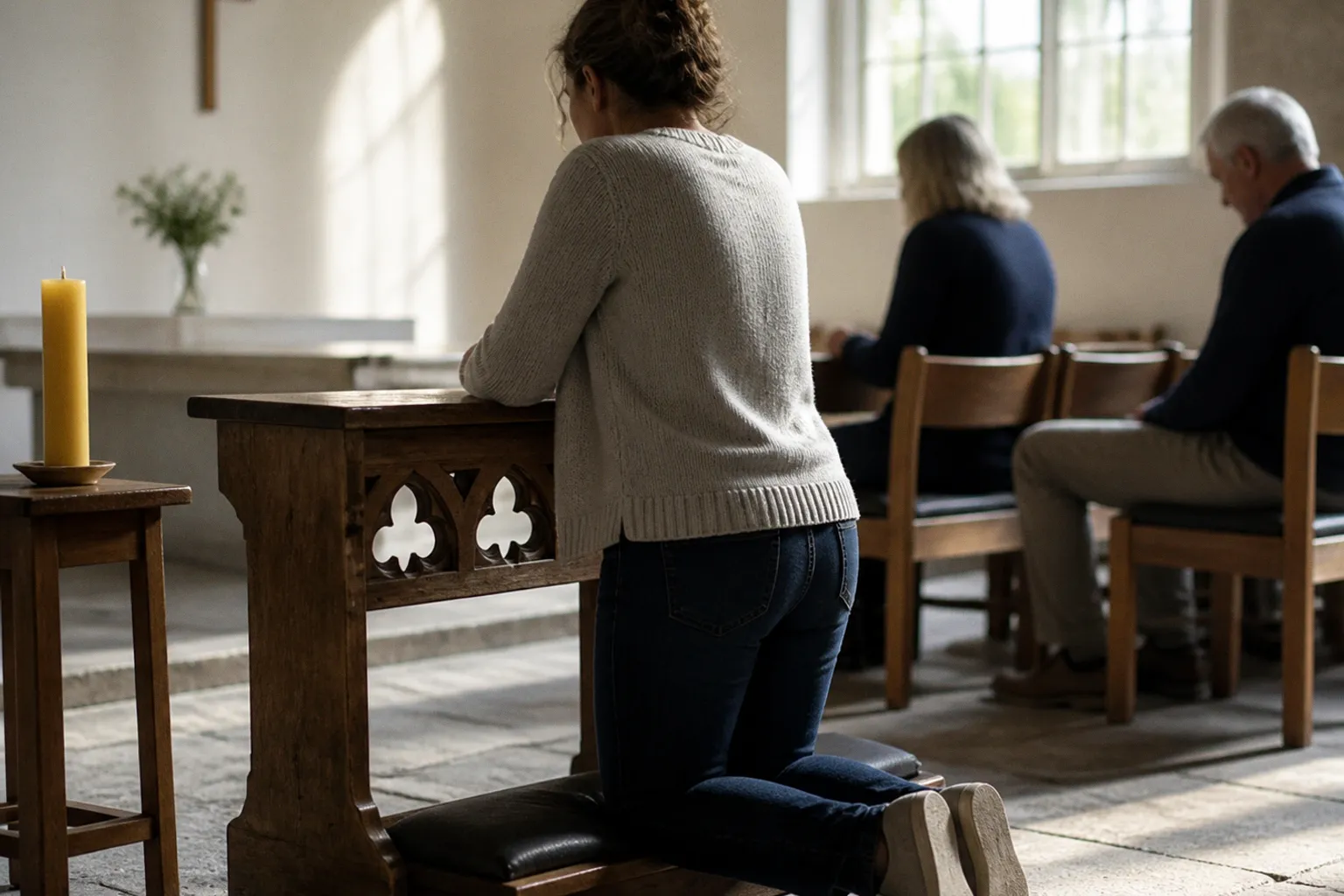
Its efficacy depends less on duration than on structure: a defined Scripture anchor, deliberate breathing, silence, and a concluding prayer prevent the practice from becoming an undefined exercise in self-observation.
For many Christians, the central administrative problem is not the absence of prayer but the absence of a repeatable form. A person may intend to pray during the day, yet without a time, text, posture, or sequence, the intention is displaced by work, domestic responsibilities, and constant digital interruption. A five-minute routine addresses this problem by reducing the practice to five ordered movements.
Christian mindfulness is best understood as an ordered act of attention: the body becomes still, the mind receives a biblical object, and prayer directs the whole person toward God.
The framework below is suitable for an individual devotional practice and can also be adapted for a Lutheran congregation, small group, prayer path, or church wellness program. It does not establish a universal liturgical rubric. The Lord’s Day liturgy remains a public act of Word and Sacrament; this routine is a private or small-group discipline that supports attentiveness during the week.
The anatomy of a five-minute devotional pause
The most useful Christian mindfulness exercises begin with a bounded time period. Five minutes is sufficient for a beginner because it creates a practice that can be repeated without requiring a major reorganization of the day. The duration is not a theological measure of devotion. It is an operational limit that makes the routine accessible and measurable.
A complete sequence consists of five steps:
1. Select a Scripture verse — 30 seconds.
Choose one short passage before beginning. The verse should be familiar enough to repeat without consulting a page, although a printed Bible, prayer card, or phone application may be used.
2. Begin deep breathing — 1 minute.
Sit or stand in a stable position. Breathe slowly and direct a brief inward prayer toward God’s presence. The purpose is not to create a special spiritual state but to interrupt hurried attention.
3. Recite the verse slowly — 2 minutes.
Repeat the selected text at a measured pace. Allow the words to remain the object of attention instead of immediately converting them into analysis or personal commentary.
4. Remain in silence — 90 seconds.
Stop speaking and sit quietly. When attention moves toward unfinished tasks, physical discomfort, or internal criticism, return to the verse without treating distraction as failure.
5. Close with prayer — 30 seconds.
Give thanks, name a concern, or ask for the grace to act according to the text. End the practice deliberately rather than allowing it to dissolve into the next task.
| Element | Duration | Primary function | Common distortion |
|---|---|---|---|
| Scripture selection | 30 seconds | Establishes a biblical anchor | Choosing a long passage that invites study instead of attention |
| Deep breathing | 1 minute | Reduces physical haste and gathers attention | Treating breathing as an independent spiritual technique |
| Slow recitation | 2 minutes | Keeps the mind oriented toward the Word | Repeating words mechanically without attending to their meaning |
| Silence | 90 seconds | Creates space for reception and reflection | Expecting an immediate mystical experience |
| Closing prayer | 30 seconds | Returns attention to petition, thanksgiving, and vocation | Ending without connecting the practice to the day ahead |
The sequence may be practiced in the morning, during a work interval, before a difficult conversation, or at the end of the day. The selected time should be sufficiently stable that the practice can become part of the household or personal rhythm. A routine placed at an unpredictable point in the schedule will generally remain an intention rather than a discipline.
The physical setting requires less attention than the temporal setting. A quiet room is useful, but a kitchen chair, office, parked car, or outdoor prayer space can also serve. The body should be supported without being arranged theatrically. Feet may rest on the floor, hands may remain open or folded, and the eyes may be closed or lowered. The objective is alert stillness, not discomfort.
Why the sequence matters
Each part answers a different problem.
Scripture addresses the problem of content. A person cannot direct attention indefinitely toward an empty mental field; attention will attach itself to planning, memory, anxiety, or sensory interruption. A verse provides an external and theological object.
Breathing addresses the problem of physiological acceleration. Rapid or shallow breathing often accompanies hurried activity, although it is not itself a diagnosis of distress. Slowing the breath can create a modest transition between one activity and another.
Recitation addresses the problem of mental dispersion. Speaking the verse slowly gives the mind a defined task that is neither entertainment nor abstract concentration.
Silence addresses the problem of constant verbal production. It permits the practitioner to receive the text without immediately explaining it.
Prayer addresses the problem of self-enclosure. The routine does not end with a person congratulating himself for becoming calm. It ends with dependence on God and a return to vocation.
This distinction is particularly relevant in Lutheran settings. Christian mindfulness should not be framed as a technique by which a person manufactures divine acceptance. The promise of God is not produced by successful concentration. The practice is instead a disciplined response to the external Word, carried out within the larger framework of grace, faith, and ordinary Christian vocation.
Scripture anchors: selecting verses for centering
A Scripture anchor is a short biblical phrase that can be read, remembered, and repeated without extensive preparation. The best selection is not necessarily the verse with the most familiar wording. It is the passage that can sustain attention for several minutes while remaining theologically clear.
Several texts are suitable for beginning a scripture-based mindfulness practice:
- Psalm 46:10: “Be still, and know that I am God.”
This verse gives a direct instruction concerning stillness and identifies the object of that stillness: the knowledge of God.
- Philippians 4:6–7: the apostolic instruction concerning prayer, petition, thanksgiving, and the peace of God.
This passage is useful when the practitioner is carrying a defined concern, because it connects attention to petition rather than avoidance.
- Psalm 23:1: “The Lord is my shepherd; I shall not want.”
Its short form makes it appropriate for repetition, especially when the mind is occupied by scarcity, planning, or perceived lack of control.
- Isaiah 26:3: the promise of steadfast peace for the person whose mind is stayed on God.
This text supports a practice concerned with mental stability without presenting concentration as a technique that earns peace.
- Matthew 11:28–29: Christ’s invitation to those who labor and are burdened.
The passage can be used when physical exhaustion or accumulated responsibility is the immediate context.
The verse should be selected according to the purpose of the pause. A person preparing for a demanding task may use a text concerning wisdom or service. A person experiencing grief may select a psalm of lament rather than forcing a verse of apparent resolution. A church ministry that serves people with varied levels of biblical familiarity should provide several options instead of assigning one text to every participant.
A disciplined method for working with the text
The 30-second selection period should remain brief. Do not spend most of the practice searching for the perfect verse. A simple procedure is sufficient:
1. Read the verse once for its plain meaning.
2. Identify one phrase that can be repeated.
3. Note the grammatical form of the text. Is it a command, promise, confession, petition, or description?
4. Use the phrase without modifying it to fit the practitioner’s immediate preference.
5. Return to the full passage during regular Bible study if questions of interpretation arise.
The final point protects the devotional routine from becoming detached from context. Mindfulness is not a method for extracting isolated sentences from Scripture and assigning them private meanings. A verse used in silence remains part of a larger canonical and ecclesial framework. The devotional pause may simplify attention, but it should not simplify doctrine by removing the passage from its biblical setting.
The practitioner should also distinguish between observing a thought and accepting its theological claim. During silence, a thought such as “I will not be able to manage today” may arise. It can be noticed and released without being treated as an authoritative judgment. The verse then functions as a return point. This is not denial of the concern; it is a refusal to let the concern control the entire field of attention.
The Scripture anchor is not a private slogan. It is a concise point of contact with the biblical text, whose meaning remains larger than the moment in which it is repeated.
Breath prayer and sensory grounding
Breath prayer gives the five-minute routine a physical rhythm. One simple form uses a sacred word or short phrase on inhalation and exhalation. For example, the practitioner may inhale while silently praying “Jesus” and exhale while releasing bodily tension. Another form divides a biblical sentence across the breath: “Be still” on inhalation and “and know that I am God” on exhalation.
A breath prayer may be practiced for three to ten minutes when used independently. Within the five-minute routine, one minute is sufficient. The purpose is to establish a stable transition into prayer, not to regulate every bodily sensation or produce a particular spiritual experience.
The following principles preserve the theological and practical boundaries of the exercise:
- The breath is part of embodied human life; it is not divine in itself.
- A slower breath may assist attention, but it does not guarantee spiritual peace.
- The sacred word is a prayerful prompt, not a magical formula.
- Physical symptoms that are severe, persistent, or medically concerning require appropriate professional evaluation.
- A person who finds breath-focused practice uncomfortable may keep the eyes open, breathe normally, or use the sound of the Scripture reading as the primary anchor.
Sensory grounding in a Christian framework
The 5-4-3-2-1 grounding method can be adapted for Christian use when attention has become excessively future-oriented or detached from the immediate environment. The practitioner names:
- five things that can be seen;
- four physical sensations, such as the chair, floor, clothing, or air;
- three sounds;
- two smells;
- one taste.
The Christian adaptation adds thanksgiving without claiming that every sensation carries a hidden message from God. A person might silently name a tree, the texture of a table, the sound of traffic, the smell of coffee, and the taste of water, giving thanks for each ordinary perception. This directs attention to the created world while avoiding the theological error of treating creation as interchangeable with the Creator.
Sensory grounding is especially practical for a spiritual wellness walk, an outdoor prayer space, or a church recreation program. A congregation could mark a short path around its property with stations corresponding to a psalm, a petition, a period of silence, and a concluding prayer. Such a path should be designed for accessibility, safe movement, and quiet use. Its spiritual purpose is not improved by unnecessary complexity.
For people experiencing acute anxiety, grounding may help re-establish present-moment orientation, but a five-minute exercise is not a substitute for mental health treatment. A church’s stewardship includes maintaining clear referral practices for pastoral counseling, licensed therapy, medical care, and crisis services. Spiritual exercises should be offered within that network rather than presented as a complete response to severe depression, trauma, or anxiety.
Integrating mindfulness into ordinary tasks
A daily Christian meditation routine does not need to occur only in a dedicated chair at a predetermined hour. The same structure can be applied to mundane tasks, provided the task itself remains primary. Washing dishes, walking between buildings, preparing food, folding clothing, or watering a garden can become occasions for deliberate attention and thanksgiving.
The governing rule is simple: perform one task at a time, notice the physical action, and connect it to a brief prayer. While washing dishes, the practitioner may attend to the temperature of the water, the movement of the hands, and the sequence of rinsing and placing each item. A short prayer can express gratitude for food, bodily ability, household provision, or the people who will use the dishes. The task is not abandoned for an elaborate meditation; it is carried out with less fragmentation.
This practice has three limits.
First, mindfulness does not justify neglecting safety. A person operating a vehicle, handling machinery, supervising a child, or performing a medical task must give priority to those responsibilities.
Second, attention to the present does not eliminate planning. Christian vocation includes preparation, responsibility, and concern for neighbors. The aim is to prevent planning from occupying every moment, not to prohibit it.
Third, ordinary work should not be romanticized. Some tasks are repetitive, physically demanding, or associated with economic pressure. A devotional framework can give the worker a way to pray within the task, but it cannot resolve unjust conditions or substitute for institutional change.
A practical task-based pattern
Use the following sequence when adapting Christian mindfulness to a physical activity:
1. Name the task.
State internally what is being done: “I am washing the dishes,” “I am walking to the meeting,” or “I am preparing this meal.”
2. Notice the body.
Identify contact with the floor, movement of the hands, posture, temperature, and pace.
3. Reduce unnecessary switching.
Keep the phone out of reach when possible, and complete a defined portion of the task before moving to another activity.
4. Attach a short prayer.
Use a phrase such as “Give thanks in all circumstances,” or pray for the people connected to the task.
5. Return to responsibility.
Finish the work and continue with the next appropriate action. Do not treat the pause as an escape from vocation.
For congregations, this approach can be incorporated into ministries that connect spiritual growth with physical health. A walking group may begin with a Scripture reading, maintain several minutes of quiet movement, and conclude with intercession. A grief support ministry may use a short outdoor walk as a setting for lament, silence, and prayer, while ensuring that trained leaders remain available for conversation. A church’s physical wellness program becomes more credible when it recognizes both bodily limits and spiritual limits.
Building consistency through habit stacking
The primary obstacle in daily practice is often not theological disagreement or lack of available material. It is inconsistency. The routine is attempted at an ideal time, missed when the schedule changes, and eventually treated as impractical. Habit stacking addresses this by attaching the devotional pause to an existing behavior.
Suitable anchors include:
- after drinking morning coffee;
- after brushing the teeth;
- before checking a phone;
- immediately after arriving at work;
- before beginning a regular walk;
- after turning off the evening lights;
- before opening a daily calendar.
The anchor should already occur with reasonable consistency. “When I have free time” is not an anchor; it is a variable condition. “After I place the coffee cup on the table” is specific enough to initiate the practice without additional decision-making.
A useful implementation framework has four components:
1. Choose one existing behavior.
Select a routine that occurs at approximately the same point in the day.
2. Prepare the materials.
Keep the Bible, verse card, timer, or printed prayer in the location where the anchor behavior occurs.
3. Define the minimum form.
Use the five-minute sequence as the standard. On a disrupted day, complete a shorter version rather than abandoning the practice entirely, but do not redefine the shortened form as the full routine.
4. Review the pattern weekly.
Record whether the routine occurred, what interrupted it, and whether the selected time remains functional.
This is administrative stewardship applied to personal devotion. A congregation that introduces Christian mindfulness should apply the same logic at the program level. Leaders need to specify the duration, location, Scripture texts, accessibility provisions, leader responsibilities, and referral procedures. Vague invitations produce vague participation. A clear framework gives participants a defined point of entry.
Common implementation errors
Several errors recur when churches or individuals attempt to establish these practices.
Replacing Scripture with generalized positivity.
A Christian practice may include gratitude and constructive attention, but it should not be reduced to optimistic self-talk. The biblical text contains command, promise, judgment, lament, confession, and consolation. A responsible routine permits that range.
Treating silence as proof of spiritual maturity.
Silence is a method of attention, not a measurement of holiness. Some people will experience intrusive thoughts, grief, physical discomfort, or difficulty remaining still. The appropriate response is adjustment and pastoral awareness, not condemnation.
Using breath prayer as a guarantee of physiological control.
Breathing can influence attention and bodily tempo, but the exercise does not promise a uniform result. Participants should be permitted to stop, modify, or replace the technique.
Confusing private mindfulness with public worship.
A five-minute routine does not reproduce the congregation’s proclamation of the Word, confession, absolution, preaching, Eucharist, or communal prayer. It belongs to a different category of Christian practice.
Assigning the same text to every circumstance.
A person in grief may require a psalm of lament. A person preparing for service may require a text concerning wisdom or love of neighbor. The ministry should maintain a small, curated set of passages rather than imposing a single verse as a universal solution.
Presenting the practice as treatment.
Christian mindfulness can support daily attention and prayer, but it does not replace therapy, medication, medical evaluation, or crisis intervention. Leaders should state this before the practice begins, not after a participant has relied on it beyond its proper scope.
From private routine to congregational practice
A local Lutheran church can incorporate a Christian mindfulness routine without altering its confessional and liturgical identity. The practice is most coherent when it is presented as a resource for daily prayer, bodily awareness, and preparation for service rather than as an alternative spirituality.
A congregation may use the framework in several settings:
- a short weekday prayer gathering;
- a walking group connected to physical wellness;
- a retreat session focused on Scripture and silence;
- a grief support ministry;
- a prayer station in a fellowship hall or outdoor space;
- a pastoral care resource for people learning to establish daily devotional habits.
The operational details matter. A leader should introduce the purpose in one or two sentences, read the selected text in context, explain the silence period, and make clear that participants may keep their eyes open or change posture. Silence should have a stated beginning and end. Without that boundary, some participants will interpret the absence of instruction as an oversight.
An outdoor prayer space can use the same principles. It does not need elaborate signage or a large capital investment. A bench, a Scripture plaque, a stable walking surface, and a clearly identified beginning and endpoint may be sufficient. Stewardship requires attention to lighting, weather, accessibility, maintenance, and the privacy of the surrounding area. A spiritual wellness walk that cannot be used safely or consistently is an incomplete ministry design.
Theological instruction should accompany the practice. Participants need to understand that Christian attention is directed toward God through the biblical witness, not toward the discovery of an autonomous inner self. They should also understand that silence may expose unresolved grief, fear, or anger. This is not necessarily a defect in the practice, but it does require appropriate pastoral and clinical support when the material is substantial.
A complete five-minute script
The following script can be used without modification by an individual or adapted for a small group.
First: Scripture, 30 seconds.
Read Psalm 46:10: “Be still, and know that I am God.” Identify the phrase “Be still” as the short anchor, while retaining the full verse in view.
Second: breathing, 1 minute.
Sit with both feet supported. Inhale slowly and pray silently, “Be still.” Exhale without forcing the breath. Repeat at a comfortable pace. If breath-focused attention is uncomfortable, read the verse quietly instead.
Third: recitation, 2 minutes.
Repeat the verse slowly. Attend to the command “Be still,” then to the confession “I am God.” Do not attempt to manufacture a sensation of peace. When attention moves elsewhere, return to the verse.
Fourth: silence, 90 seconds.
Remain quiet. Notice bodily contact with the chair and the sounds in the room. If a concern arises, acknowledge it and return to the Scripture anchor. No additional interpretation is required during this period.
Fifth: closing prayer, 30 seconds.
Pray: “Lord God, keep my attention ordered toward your Word. Give me wisdom for the work before me and make me attentive to the needs of my neighbor. Amen.”
The text can be changed, but the sequence should remain stable during the first weeks of practice. Stability makes it possible to evaluate the routine accurately. If the person changes the verse, time, posture, duration, and setting every day, it becomes difficult to determine whether the practice is ineffective or merely undefined.
Final framework
The Christian mindfulness daily routine steps are straightforward: choose a Scripture anchor, breathe deliberately, recite the text, remain in silence, and close with prayer. Their value lies in the relationship between the parts. Scripture gives the practice its content; breathing gathers the body; recitation stabilizes attention; silence allows reception; prayer returns the person to God and to the responsibilities of ordinary life.
This routine should be used with theological precision. It is not a substitute for the Divine Service, not a technique for earning divine favor, and not a treatment for serious mental health conditions. It is a modest devotional instrument whose proper efficacy depends on clear limits, repeated use, sound Scripture handling, and integration with the wider life of the church.
A five-minute practice will not reorganize every pressure in a person’s day. It can, however, establish a defined interval in which attention is no longer governed entirely by urgency. Within that interval, the Christian receives a verse, practices stillness, prays with the body, and resumes vocation under a more ordered framework.