Sunday school teacher training: step-by-step parish guide
A Lutheran Sunday school teacher training program requires more than lesson preparation and supply distribution.
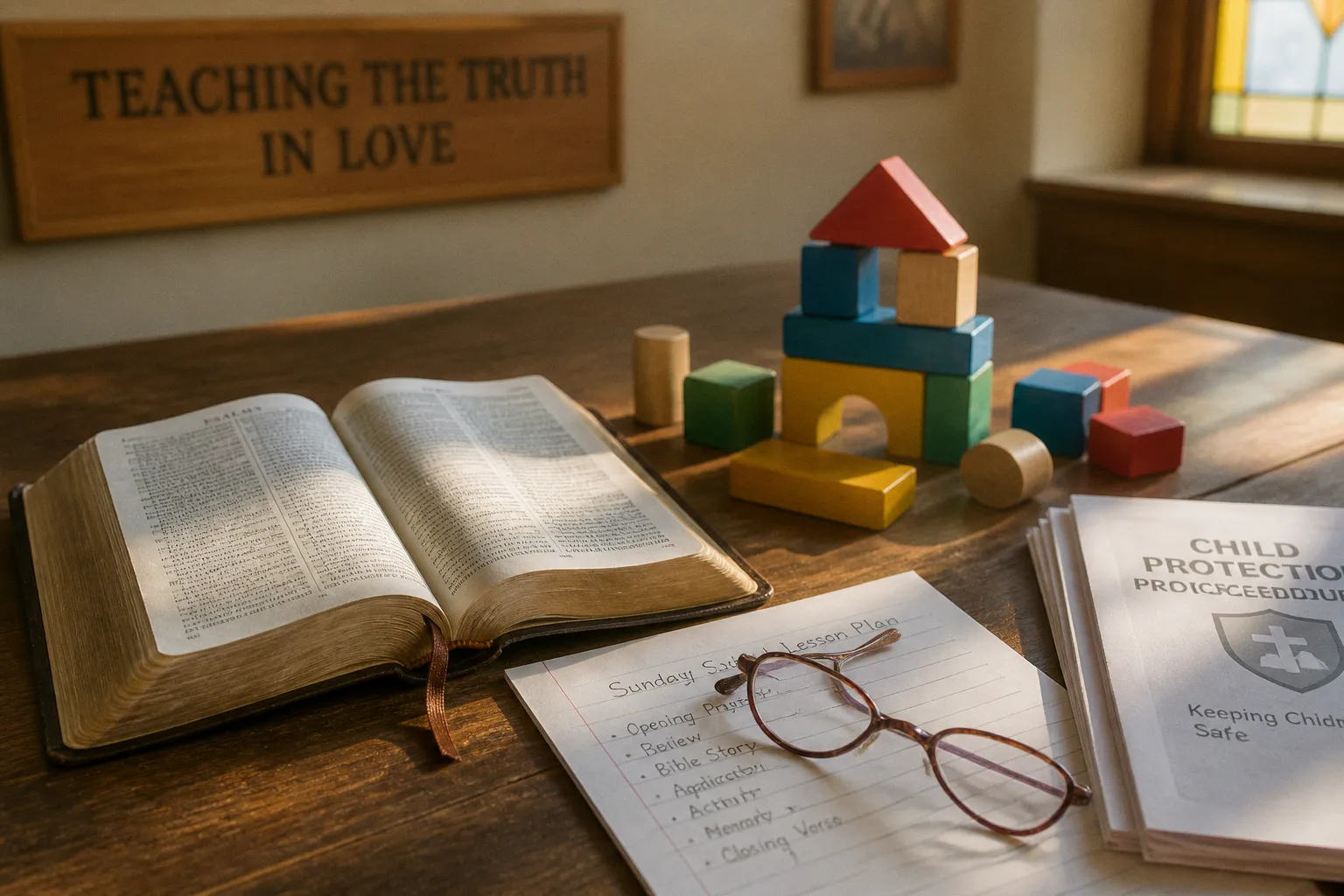
The parish must equip volunteers to teach within a defined theological framework, manage a classroom responsibly, protect minors, and operate according to procedures that remain consistent when different adults serve on different Sundays.
The central administrative problem is usually not the absence of willing volunteers. It is the absence of a common operating standard. One teacher may explain a biblical text through moral instruction, another through historical information, and a third through an unstructured activity. Without a shared framework, the congregation’s Christian education program becomes dependent on individual preference rather than on coherent Lutheran teaching.
A workable program therefore combines four elements: theological formation, pedagogical preparation, safeguarding procedures, and continuing supervision. These elements should be introduced through an initial training session and reinforced during the year through brief, scheduled instruction.
1. Establish the theological foundation before selecting activities
The first responsibility of a parish training program is to establish what teachers are being asked to communicate. Lutheran Sunday school instruction is not simply a general program in religious literacy. It is an educational ministry shaped by the distinction between Law and Gospel, by the biblical witness, and by the congregation’s confession and teaching practice.
This distinction should be stated in operational terms. The Law identifies sin, exposes human inability to justify oneself, and clarifies God’s commands. The Gospel announces God’s gracious action in Christ, including forgiveness, reconciliation, and salvation received by faith. In a classroom, the distinction prevents two recurrent errors:
1. Reducing the lesson to moral improvement.
Biblical characters are presented as examples of courage, kindness, or obedience, while the text’s account of sin and divine promise is minimized.
2. Presenting grace without theological definition.
Children are told that God loves them, but the lesson does not explain the relation between that love, Christ’s work, forgiveness, and the promises of Scripture.
A teacher does not need to deliver a seminary lecture. The teacher does need to understand the doctrinal movement of the lesson well enough to avoid replacing the biblical message with generic advice.
A practical Law and Gospel preparation framework
Before teaching, volunteers should be able to answer four questions:
- What does this passage reveal about God, humanity, sin, promise, judgment, mercy, or redemption?
- Where does the lesson expose a false expectation that people can secure righteousness through their own performance?
- What specific promise or declaration of grace is present in the text or in the Gospel’s fulfillment of it?
- How can the lesson be expressed at the children’s developmental level without changing its theological substance?
This framework should guide curriculum selection as well as lesson preparation. A visually attractive curriculum that provides crafts and games but does not support clear biblical teaching creates additional work for volunteers and weakens instructional consistency.
The training objective is not to make every teacher sound identical; it is to ensure that every teacher works from the same theological framework.
A parish may use resources from a Lutheran publishing house, denominational body, or another established provider, but the curriculum should be reviewed locally before adoption. The review should identify its biblical basis, theological assumptions, age-level suitability, preparation requirements, and treatment of Law and Gospel.
Define the local teaching standard
The congregation should document a concise teaching standard that volunteers can use throughout the year. It may include the following provisions:
- Lessons are grounded in Scripture and connected to the congregation’s Lutheran confession.
- Teachers distinguish biblical proclamation from general moral instruction.
- Activities serve the lesson rather than replacing it.
- Children are addressed with language appropriate to their age without being treated as incapable of serious theological learning.
- Teachers do not improvise sensitive doctrinal claims without consulting the pastor or designated education leader.
- The classroom is understood as a ministry of the congregation, not as an independent program operated by individual volunteers.
This document need not become a long policy manual. Its purpose is to create a common reference point for recruiting, training, lesson review, and evaluation.
2. Organize the initial teacher training session
The initial session should be intensive enough to establish procedures and expectations, but focused enough that volunteers can retain and apply the material. A three-hour Saturday seminar is one workable format for core training, particularly when it is scheduled before the annual Sunday school launch.
The agenda should not devote the entire session to crafts or room decoration. Those tasks are necessary, but they should follow the more consequential questions of theology, safety, and operating procedure.
A structured launch seminar can be organized as follows:
1. Opening orientation and ministry scope
Explain the purpose of Sunday school within the congregation’s wider worship and education framework. Clarify how teachers, the pastor, the Sunday school coordinator, parents, and church staff relate to one another.
2. Theological foundation
Introduce the Law and Gospel distinction, the congregation’s doctrinal expectations, and the role of Scripture in lesson planning.
3. Curriculum and lesson preparation
Show volunteers how to read the teacher guide, identify the central biblical text, distinguish required content from optional activities, and prepare an age-appropriate explanation.
4. Classroom management
Establish expectations for transitions, attention, movement, correction, disruptive behavior, and communication with parents.
5. Child protection and risk management
Review background checks, abuse awareness training, supervision requirements, reporting procedures, and prohibited situations.
6. Operational logistics
Demonstrate check-in and check-out procedures, attendance records, supply storage, room access, emergency contacts, and communication channels.
7. Practice and review
Ask teachers to prepare a short segment of a lesson or explain how they would handle a defined classroom situation. The objective is not performance assessment in isolation; it is verification that the procedures are understood.
The parish should provide the agenda and written materials in advance. Volunteers who arrive without knowing the scope of the seminar will often interpret it as an informal meeting, and the training will then become a sequence of disconnected announcements.
Distinguish required instruction from optional enrichment
A common administrative error is to treat every topic as equally important. Core instruction should be mandatory for all volunteers who work directly with children. Optional workshops can then address music, storytelling, visual presentation, special events, or particular age groups.
The distinction may be recorded in a simple table:
| Training area | Core expectation | Appropriate follow-up |
|---|---|---|
| Lutheran theology | Understand the Law and Gospel framework and local doctrinal standard | Lesson review with pastor or education leader |
| Child protection | Complete required screening and abuse awareness instruction | Annual renewal and policy updates |
| Classroom management | Follow procedures for supervision, correction, transitions, and emergencies | Case-based discussion during planning meetings |
| Curriculum use | Prepare lessons from the approved materials and identify the central teaching point | Demonstration of a lesson segment |
| Student logistics | Use attendance, check-in, check-out, and communication procedures | Periodic audit of records and room process |
| Supplies and facilities | Maintain appropriate materials and return rooms to defined condition | Quarterly inventory or coordinator review |
This separation improves stewardship of volunteer time. It also prevents optional creative preparation from displacing requirements that protect children and preserve instructional integrity.
3. Make child protection a mandatory component
Risk management is not an administrative appendix to Sunday school teacher training. It is part of the ministry’s operating framework. A congregation that provides theological instruction without safeguarding instruction has trained volunteers for only part of their responsibility.
The exact requirements vary by synod, denomination, jurisdiction, and local policy. The parish should therefore use its governing church-body standards and applicable civil requirements as the controlling authority. It should not assume that an informal local custom is sufficient.
Core safeguarding procedures commonly include:
- Background checks for adults serving in defined ministry roles.
- Abuse awareness and prevention training.
- Clear supervision requirements for classrooms and hallways.
- Rules concerning one-adult/one-child situations.
- Defined procedures for restroom assistance and movement through the building.
- Documentation of incidents, injuries, or concerning disclosures.
- A designated reporting chain that volunteers can follow without delay.
- Rules for communication with minors through digital platforms, text messages, or social media.
- A process for responding to allegations that protects children, preserves records, and directs the matter to the proper authorities and church leaders.
These procedures must be taught concretely. A statement such as “maintain appropriate boundaries” is not sufficient unless the volunteer knows what the parish considers appropriate and what action is required when a boundary is at risk.
Use formal arrival and dismissal procedures
A formal check-in and check-out system is especially important when children move between worship, Sunday school, fellowship activities, and other parts of the building. The system should answer three operational questions:
1. Who is responsible for the child during the class period?
2. How is attendance recorded?
3. Who is authorized to receive the child at dismissal?
The precise method may be paper-based or digital, depending on the congregation’s resources and privacy practices. The method matters less than consistency. Teachers should know where records are kept, how absences are documented, and what to do when an unfamiliar adult attempts to collect a child.
Procedures should also account for late arrivals, early departures, visitors, children with medical needs, and changes communicated by parents after the class has begun. These situations are routine; they should not depend on improvisation.
A safeguarding procedure is effective only when a substitute teacher can execute it without relying on institutional memory.
Train teachers to respond to disclosures
Volunteers should receive basic instruction on how to respond if a child discloses abuse, neglect, fear, or another serious concern. The training should emphasize listening without conducting an investigation, avoiding leading questions, recording the child’s words as accurately as possible, and reporting through the required channel.
Teachers should not promise secrecy. They should not attempt to determine whether the disclosure is true, interview other children, confront a suspected person, or delay reporting until the next planning meeting. The parish’s written policy should identify who receives the report and when outside authorities must be contacted.
This is an area in which the pastor, church council, education coordinator, and designated safeguarding officers must maintain a unified procedure. Conflicting instructions create risk for children and volunteers alike.
4. Design an annual training calendar
A one-time seminar does not constitute a complete Sunday school teacher training program. Volunteers forget procedures, new situations arise, curricula change, and the practical demands of a classroom become clearer only after instruction has been applied.
The most sustainable model combines:
- One annual launch session.
- Two to four auxiliary workshops during the calendar year.
- Short instructional segments integrated into monthly teacher planning meetings.
- Additional orientation for new or substitute teachers.
- Periodic review of safeguarding and emergency procedures.
Brief training is easier to sustain when it is attached to an existing meeting. A ten- to fifteen-minute segment during each monthly planning meeting provides approximately two hours of continuing instruction across a year. The segment should have one defined objective rather than a list of announcements.
Example annual framework
| Period | Primary training emphasis | Administrative purpose |
|---|---|---|
| Late summer or early autumn | Core theology, curriculum, safeguarding, classroom procedures | Establish the operating standard before classes begin |
| First month of classes | Arrival, dismissal, attendance, transitions | Correct procedural weaknesses while they are visible |
| Mid-autumn | Age-level pedagogy and lesson adaptation | Improve teaching without altering theological substance |
| Advent or pre-Christmas period | Special-event supervision and worship coordination | Align Sunday school activity with the church calendar |
| Winter | Classroom management and volunteer communication | Address recurring issues before they become normalized |
| Lent or spring | Teaching biblical narratives and doctrinal connections | Review lesson structure and Law–Gospel clarity |
| Late spring | Evaluation, supplies, records, and recruitment | Close the year with usable information for the next cycle |
The calendar should correspond to actual parish operations. Training about Christmas programs should occur before rehearsals begin, not after the event. A review of check-in procedures should occur early in the program year, when attendance patterns and staffing gaps can be observed.
Use micro-learning to address recurring problems
Micro-learning is not a substitute for initial formation. It is a method for maintaining efficacy after the initial training has concluded. Each short segment should resolve one practical or theological issue, such as:
- How to state the central teaching point in one sentence.
- How to distinguish a discussion question from a comprehension question.
- How to handle a child who repeatedly leaves the group.
- How to record an incident without editorial language.
- How to adapt an activity for a child with limited mobility or attention.
- How to connect a seasonal lesson to the church calendar.
- How to identify when a craft has displaced the biblical text.
The education leader should maintain a record of topics covered and topics still required. This prevents the monthly segment from becoming an unplanned series of reminders and ensures that the annual curriculum remains balanced.
5. Equip teachers with age-appropriate pedagogical tools
Theological clarity and pedagogical clarity are related but not identical. A teacher may understand the lesson accurately and still present it in a form that children cannot follow. Conversely, a teacher may conduct a highly active class that has no identifiable instructional center.
Training should therefore address the mechanics of communication across age groups.
For younger children
Younger students generally require shorter instructional units, visible transitions, repetition, concrete language, and predictable routines. A teacher can divide the lesson into a sequence such as:
1. Opening ritual or consistent welcome.
2. Short presentation of the biblical account.
3. Repetition of a central phrase or verse.
4. Guided response through movement, drawing, music, or simple discussion.
5. Closing prayer or recitation connected to the lesson.
The activity should not introduce a second subject that competes with the biblical text. If the lesson concerns God’s promise, the craft or movement should reinforce that concept rather than function as an unrelated reward.
For elementary-age students
Elementary students can manage more complex narrative structure, cause-and-effect explanation, comparison, and guided interpretation. Teachers can ask them to identify what a person in the text does, what the text reveals about the human condition, and where the Gospel promise is located.
At this level, the teacher should avoid turning every biblical character into a model of self-improvement. David, Peter, Moses, and other figures should not be presented as uncomplicated heroes. Their failures, limitations, and dependence on God are part of the text’s theological content.
For older students
Older children can work with historical setting, literary structure, doctrinal vocabulary, and connections between Old and New Testament texts. They can also compare interpretations, provided that the teacher has sufficient preparation and knows which questions require pastoral or theological follow-up.
Older students should not be treated merely as assistants for younger classes. A parish that provides only simplified stories for them risks creating a gap between childhood religious education and more mature participation in worship, Bible study, and confirmation instruction.
Train teachers to plan a central sentence
Every lesson should have a central sentence that states what students should understand when the class concludes. The sentence should contain theological content, not only an activity objective.
Weak objective:
- Students will make a picture about kindness.
Stronger objective:
- Students will identify how the biblical account reveals human failure and God’s continuing promise of mercy.
The second formulation does not dictate the activity. It gives the activity a purpose. Teachers can then determine whether discussion, drawing, memorization, role-play, or another method serves that purpose.
Prepare for different learning needs
A parish education program should account for differences in reading ability, attention, mobility, hearing, language, and prior biblical knowledge. The teacher training guide should identify practical adaptations, including:
- Reading key instructions aloud rather than relying only on printed text.
- Providing visual sequence cards for multi-step activities.
- Offering a quiet alternative when group noise prevents participation.
- Using paired discussion before asking for whole-group responses.
- Allowing additional time for writing or craft work.
- Avoiding public correction when a child needs individual direction.
- Coordinating with parents or guardians when a child requires a defined support plan.
Accommodation does not require changing the theological content of a lesson. It changes the route by which students receive and express that content.
6. Standardize classroom logistics and volunteer communication
The quality of Sunday school depends partly on ordinary administrative details that are easy to overlook. Supplies, room access, attendance records, emergency contacts, and substitute coverage determine whether teachers can devote attention to instruction rather than to avoidable confusion.
The parish should assign ownership for each recurring task. A useful responsibility framework may include:
- Pastor or theological supervisor: doctrinal oversight, sensitive questions, and pastoral escalation.
- Sunday school coordinator: calendar, staffing, curriculum distribution, meetings, and records.
- Teachers: lesson preparation, classroom supervision, attendance, incident reporting, and room reset.
- Church council or designated administrator: policy approval, budget, background-check process, and facility coordination.
- Parents or guardians: registration information, authorized dismissal instructions, medical details, and communication about absences or special needs.
Without defined ownership, tasks migrate to the most available volunteer. That arrangement may function temporarily, but it produces fragility when that person is absent.
Build a standard teacher packet
A teacher packet, whether printed or digital, should contain only information that volunteers need to perform their role. It may include:
- Annual calendar and meeting dates.
- Approved curriculum schedule.
- Lesson preparation template.
- Room assignments and access instructions.
- Check-in and check-out procedures.
- Emergency contacts and evacuation instructions.
- Safeguarding policy summary.
- Incident-reporting form.
- Supply inventory and ordering process.
- Substitute-teacher instructions.
- Contact information for the pastor and Sunday school coordinator.
The packet should have a revision date. Policies that change without a visible date create uncertainty about which version governs current practice.
Maintain a supply and room system
Supply logistics should be assigned rather than assumed. Each room should have a defined location for curriculum materials, attendance records, writing instruments, age-appropriate equipment, cleaning supplies, and emergency information. Materials should be labeled according to age group or class.
A monthly or quarterly inventory can identify shortages before they affect instruction. The objective is not bureaucratic accumulation. It is stewardship: purchasing what the program actually uses, preserving reusable materials, and preventing teachers from bearing hidden costs for ordinary parish ministry.
Room reset procedures should also be explicit. At the end of class, teachers should know whether they are expected to clean surfaces, return furniture, secure materials, remove personal information, and report damage or hazards. These tasks protect the next class and reduce the administrative burden on custodial staff.
7. Evaluate the program without reducing it to attendance
Attendance is useful but incomplete. A class can be full and still lack theological coherence, safe procedures, or adequate preparation. Program evaluation should therefore review both measurable operations and instructional quality.
The coordinator can collect information through several methods:
1. Attendance and staffing records
Identify recurring shortages, age-group imbalances, late arrivals, and substitute dependence.
2. Teacher preparation review
Confirm that teachers receive curriculum materials in time and understand the central teaching point.
3. Safeguarding compliance review
Verify that required checks, training, attendance records, and incident procedures are current.
4. Parent or guardian communication
Gather specific observations about dismissal, information flow, accessibility, and recurring concerns.
5. Teacher debriefing
Ask which procedures functioned, which lessons required adaptation, and where additional training is needed.
6. Pastoral and theological review
Examine whether lessons maintain the congregation’s theological standard and connect appropriately with worship and the church calendar.
Evaluation should result in defined actions. If teachers report that transitions consume too much class time, the response may be a revised room schedule or a visual transition procedure. If lesson preparation is inconsistent, the coordinator may introduce a short planning template. If volunteers are uncertain about reporting procedures, the parish should repeat the safeguarding segment and distribute the policy in a more accessible form.
The purpose of evaluation is not to rank volunteers; it is to locate weaknesses in the parish framework before those weaknesses become normal practice.
Common errors in parish teacher training
Several patterns repeatedly weaken otherwise competent programs.
Treating training as craft preparation
Crafts, games, and visual materials are useful instructional tools. They are not the curriculum’s theological center. When training focuses primarily on production, volunteers may leave with attractive activities but no method for identifying the lesson’s doctrinal substance.
Assuming experienced volunteers need no orientation
Experience in a classroom does not guarantee familiarity with the congregation’s safeguarding procedures, curriculum standard, attendance system, or reporting chain. Every volunteer should receive local orientation, even when the person has taught elsewhere for many years.
Presenting safeguarding as a legal formality
Background checks and required training are necessary, but compliance alone does not create a safe ministry. Volunteers must know how supervision works in the actual building, how children are released, and how to respond to a disclosure or incident.
Relying on verbal instructions
Verbal reminders disappear when staff and volunteers change. Written procedures create continuity and allow substitute teachers to operate within the same system.
Ignoring the church calendar
Sunday school planning should not exist in isolation from worship. Advent, Christmas, Epiphany, Lent, Easter, Pentecost, and other congregational observances provide a framework for connecting classroom instruction with the church’s common life. The relationship should be deliberate, not forced; classroom lessons should support the calendar without becoming a series of disconnected seasonal decorations.
Offering no continuing formation
An annual launch meeting establishes the framework but cannot resolve every issue. Short monthly instruction and several auxiliary workshops provide a proportionate method for maintaining consistency without creating an unsustainable schedule.
A final operating framework
A Lutheran parish can establish a reliable Sunday school teacher training program by completing the following sequence:
1. Define the theological standard, including the Law and Gospel framework.
2. Select or review curriculum according to that standard.
3. Schedule an initial training seminar before the program year begins.
4. Require safeguarding, screening, and procedural orientation for all applicable volunteers.
5. Teach lesson preparation, age-level pedagogy, classroom management, and accessibility.
6. Document check-in, check-out, attendance, emergency, and reporting procedures.
7. Assign ownership for curriculum, staffing, supplies, records, and pastoral escalation.
8. Add ten- to fifteen-minute training segments to monthly planning meetings.
9. Schedule two to four additional workshops for recurring or seasonal needs.
10. Evaluate attendance, safety, preparation, communication, and theological coherence at the end of the year.
The resulting framework is neither a seminary curriculum nor a collection of administrative forms. It is a parish operating system for Christian education. Its efficacy depends on the alignment of doctrine, teaching practice, child protection, and stewardship of volunteer labor.
When those elements are documented and reinforced throughout the year, Sunday school becomes less dependent on individual improvisation. Teachers receive a clear standard, children receive more consistent instruction, and the congregation can treat its educational ministry as an accountable part of worship and communal life rather than as an informal activity placed beside it.