Sacramental Union: The Lutheran View of Holy Communion
Every communion service your congregation prepares has one quiet bottleneck nobody on the altar guild wants to name out loud: the moment the elements are set out, a doctrinal claim is being made.
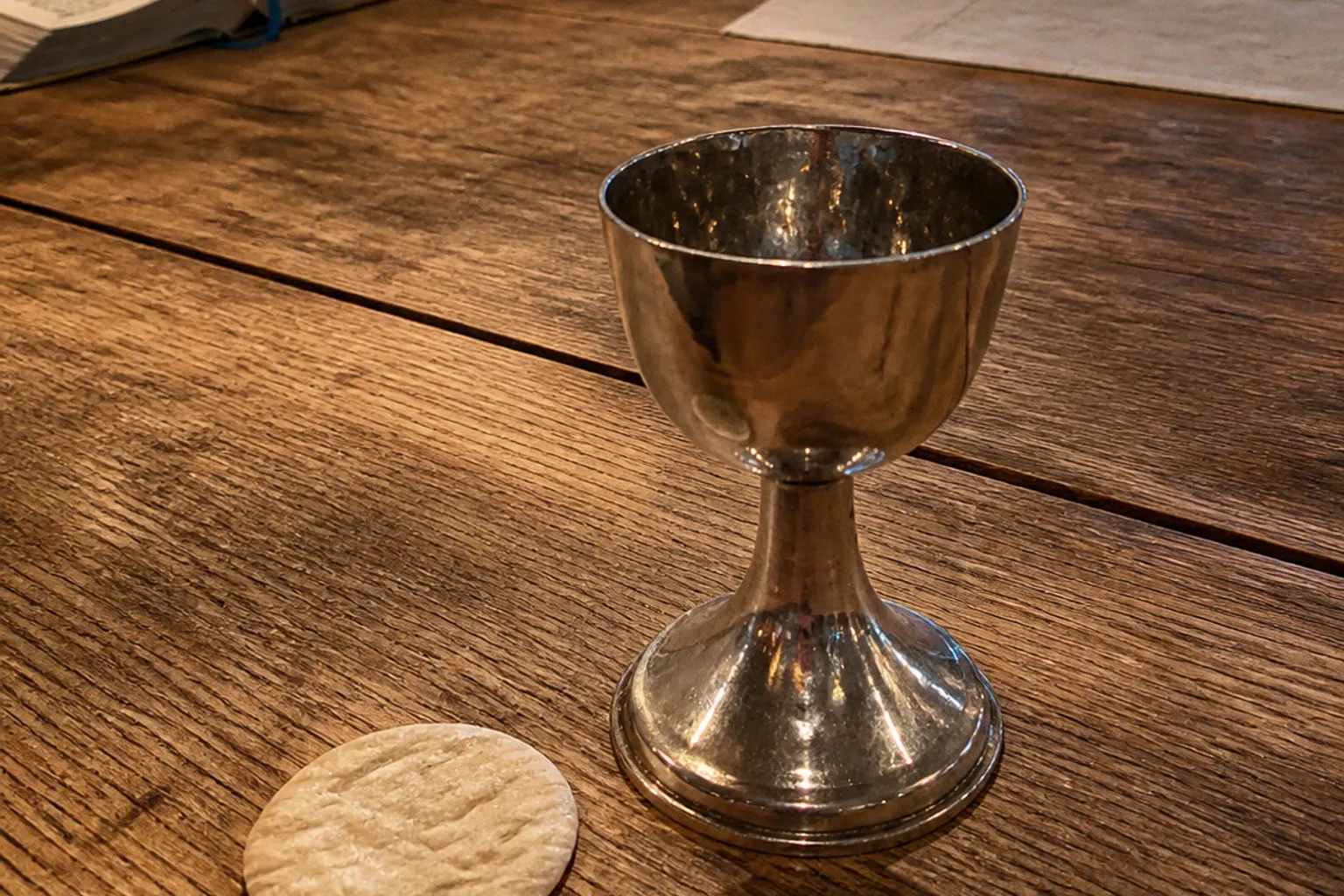
Your people walk forward, receive bread and wine, and walk back to their pews believing something happened. Whether you have taught them what that something is — in one sentence they can repeat to a neighbor at coffee hour — is the test.
Here is your working lutheran sacramental union definition, in language your communion assistants can teach: the bread is bread. The wine is wine. The body of Christ is present. The blood of Christ is present. All four are present in the same act, in the same hand, at the same moment — without one becoming the other. That is the Lutheran position, full stop. The Formula of Concord compresses it into three Latin verbs your elders can memorize in a single Tuesday-night meeting: adesse (present), exhiberi (offered), sumi (received). The rest of this article is the scaffolding so your congregation can hand that sentence forward with confidence.
Origins and the 1528 Confession: Defining the Mystery
Luther coined the term sacramental union — unio sacramentalis in Latin, sacramentliche Einigkeit in German — in 1528, in a treatise titled Confession Concerning Christ's Supper. The year matters. By 1528 the Reformation had been public for eleven years, the controversy over what happens at the Lord's Table was no longer a theological parlor debate, and congregations were splitting over the meaning of the bread and the cup.
Luther's problem was specific and logistical. His opponents on one side were teaching that the bread stops being bread and becomes the body — the Roman position he would come to call transubstantiation. His opponents on the other side were teaching that the bread is just bread and Christ's presence is only spiritual or symbolic — the position he associated with Zwingli and the Reformed tradition. Luther refused both. He needed a third category, and he built one in 1528.
Sacramental union is not a compromise between two errors. It is a positive doctrinal claim: two distinct things — the earthly element and the heavenly gift — are present together, fully, in the same sacrament.
The Confession of 1528 is the founding document your pastor can hand a new member who asks, "Where does this teaching come from?" It is the first place Luther wrote the words down, and it gives the doctrine its technical name. Teach your Bible study that name. It anchors five centuries of Lutheran confession to a specific text, a specific year, and a specific pastoral crisis.
Two years later, in 1530, the Augsburg Confession carried the same doctrinal claim to the imperial diet. Article X of the Augsburg Confession states plainly that the body and blood of Christ are truly present under the form of bread and wine and are distributed to those who eat — and it rejects those who teach otherwise. When the confession was read before Emperor Charles V and the assembled princes of the Holy Roman Empire, the Lutheran position on the Lord's Supper became a matter of public, imperial record. Your members should know that their church did not whisper this doctrine in a study group. It was confessed in the highest political forum of the age.
Practical action: print the Latin term unio sacramentalis on the back of your worship folder the week you preach on this doctrine. People remember the technical term once they see it in writing.
The Mechanics of Presence: In, With, and Under the Elements
The Formula of Concord (1577) gives your congregation the phrase they will actually use at the rail. Christ's body and blood are present in, with, and under the forms of bread and wine. Three prepositions. One sentence. Memorizable for an eight-year-old walking forward to receive the host.
- In — the body and blood of Christ are present within the bread and the cup.
- With — the presence is not isolated from the elements; it accompanies them.
- Under — the presence is hidden beneath the visible form. Your eyes see bread. Your hand holds bread. Yet the gift is more than bread.
This is not wordplay. It is a confession about how the sacrament functions in the liturgy you run every Sunday. When the Words of Institution are spoken and the elements distributed, the communicant receives the real, physical body and blood of Christ alongside the bread and wine — not after one changes into the other, not in a separate spiritual experience detached from the physical act.
Lutherans have historically been careful to mark this as a mystery. The Augsburg Confession and the Formula of Concord both refuse to define the how. Your elder preparing communion does not need a metaphysical explanation to distribute the elements faithfully. He needs to know what he is distributing and to whom.
Adesse, exhiberi, sumi. Present, offered, received. Three verbs. That is the entire Lutheran confession of the real presence lutheran doctrine in three words your communion team can drill.
Three Latin verbs from the Wittenberg Concord (1536): adesse (Christ is present), exhiberi (Christ is offered), sumi (Christ is received). Print these on the back of the communion helper's card. When a communion assistant hesitates at the rail, hand them the card.
One nuance worth teaching at your next elder meeting: Luther himself preferred the language of Christ's body and blood being present "in and under" the bread and wine, while the Formula of Concord standardized the full trio — in, with, and under. The difference is not a contradiction. Luther was resisting Rome's language of local, spatial presence, and "in" and "under" served his polemical purpose. The Formula added "with" to make clear that the elements are never separated from what they convey. Bread does not arrive alone. The body arrives with it, in the same distribution, to the same mouth.
Action step for your worship team: walk through the distribution once a quarter with the words in, with, and under spoken aloud at the rail. Muscle memory matters. The doctrine is being confessed by your hands whether or not anyone has explained it.
Distinguishing Sacramental Union from Transubstantiation and Symbolism
Your people will hear three terms from three Christian traditions about the same act. They need to know which one is yours and why. Here is the comparison worth printing and posting in the narthex:
| Position | What happens at the altar | Who holds it | Lutheran verdict |
|---|---|---|---|
| Transubstantiation | The substance of bread and wine changes into the substance of Christ's body and blood; only the outward appearance (accidents) remains | Roman Catholic (defined at the Fourth Lateran Council, 1215; reaffirmed at Trent) | Rejected — implies the bread ceases to be bread |
| Consubstantiation | The body and blood are locally joined to or "mixed" with the bread and wine, like two bodies sharing one space | A label sometimes applied to Lutherans by critics | Rejected — Lutheran theologians historically refuse this term because it suggests a mechanical joining of two physical substances |
| Sacramental Union | Bread remains bread. Wine remains wine. The body and blood of Christ are truly present in, with, and under the elements, without change or mixture | Lutheran (confessed in the Formula of Concord, 1577) | Held as the biblical and confessional position |
| Symbolic or Spiritual Presence | The bread and wine are signs pointing to a spiritual reality; Christ is present only in the believer's heart or in memory | Reformed (Zwingli; later Calvin's "spiritual eating") | Rejected — denies the bodily, objective presence of Christ in the sacrament |
Use that table in your adult instruction class. It preempts the three questions your members will actually be asked by Catholic relatives, Reformed friends, and Baptist in-laws. They are not being asked "what do Lutherans believe about the Bible" or "what do Lutherans believe about justification." They are being asked, "What happens at your altar?"
A word on the sacramental union vs consubstantiation confusion, because it will come up. The term "consubstantiation" was never used by Luther, Melanchthon, or any author of the Lutheran confessions. It was coined by later theologians — sometimes as a neutral description, sometimes as a polemical weapon — and Lutheran orthodoxy has consistently rejected it. The reason is precise: "consubstantiation" borrows from Aristotelian metaphysics the concept of two substances coexisting in the same space, the way two stones might occupy a box. That picture implies a spatial, physical jostling of bread and body. Luther's sacramental union does not operate in that category at all. Christ's presence in the Supper is sacramental — tied to the promise of Christ's own words, "This is my body" — and cannot be captured by a metaphor about two objects in a container. When someone accuses Lutherans of believing in consubstantiation, the correction is simple: "We don't use that term. We confess sacramental union. The difference matters."
Lutherans do not believe in transubstantiation. Lutherans do not accept consubstantiation. Lutherans confess sacramental union — a real, bodily, objective presence that is neither a change nor a mixing.
Action step: memorize one sentence and one sentence only — "Christ's true body and blood are really present in, with, and under the bread and wine." If a member can say that sentence to a non-Lutheran visitor at coffee hour, your teaching ministry has done its job at the altar rail. This is the core of lutheran holy communion theology in one line your people can carry.
The Wittenberg Concord and the Formula of Concord: A Unified Confession
This doctrine did not stay a private opinion. By 1536 — eight years after Luther coined the term — both Lutheran and Reformed theologians signed the Wittenberg Concord, publicly confessing the sacramental union together. Martin Luther and Philipp Melanchthon signed on the Lutheran side; Martin Bucer signed on the Reformed side. That agreement later fractured, but in 1536 it was the official, signed, working position of two reform movements at the same table.
The Formula of Concord (1577) locked the Lutheran position in place. Six theologians drafted it: Jacob Andreae, Martin Chemnitz, Nikolaus Selnecker, David Chytraeus, Andreas Musculus, and Christoph Cornerus. The Formula uses the phrase in, with, and under the forms of bread and wine as the operative definition, and it explicitly rejects the Reformed view of a merely spiritual presence. Three years later, in 1580, the Book of Concord collected the Formula alongside the Augsburg Confession, the Apology, the Smalcald Articles, the Small and Large Catechisms, Luther's two catechisms, and the Treatise on the Power and Primacy of the Pope. The Lutheran position on the Lord's Supper has been a settled confession, not a private opinion, since 1580.
For your congregation, this means you are not teaching a pastor's hobby or a theologian's speculation. You are teaching a doctrine your church confessed in writing, defended in controversy, and packaged in a book your members can hold. The Book of Concord is on your shelf. Use it.
One detail your confirmation teachers can pass along: the Formula of Concord does not merely assert presence. It names the opponents it rejects by theological position, not by church name. It rejects the Roman view that the bread's substance changes. It rejects the Reformed view that Christ's body is in heaven and therefore absent from the altar. It rejects the view that presence depends on the faith of the receiver. The Lutheran confession stands in positive contrast to each — and the precision of those rejections is what keeps the doctrine from drifting in either direction across the centuries.
This is not a single theologian's view. It is a confession signed, drafted, and published — and your congregation inherits it.
Action step: keep three copies of the Book of Concord in your narthex. When a member asks where this teaching comes from, hand them the Solid Declaration, Article VII. The doctrine lives in a document, not in a debate. This is the sacrament of the altar explained by the Lutheran church itself.
Manducatio Indignorum: The Reality of Reception for All Communicants
One more practical implication your communion team cannot afford to skip. Lutheran theology teaches manducatio indignorum — literally, the eating of the unworthy. The doctrine says this: even an unbeliever or an unworthy communicant who comes to the altar receives the true physical body and blood of Christ. The presence does not depend on the faith of the receiver. The reception does — but the gift does not.
This is not a small point. It is the answer to a question every communion pastor eventually hears from a first-time visitor: "What if I don't feel worthy?" The Lutheran answer is precise and pastoral: the sacrament does not measure your worthiness. Christ is present whether or not you feel it, believe it, or deserve it. The unworthy receive Christ — to their judgment rather than to their blessing. That is why the church practices closed communion and confession and absolution: not to keep people away from the altar, but to keep them from receiving Christ to their harm.
The historical roots run deep. Luther confronted this question directly because the medieval penitential system had turned the altar into a place of anxiety. Penitents were told they must achieve a certain interior disposition before they could receive, and the result was mass avoidance of the Supper. Luther's recovery of manducatio indignorum was a pastoral revolution: the sacrament is Christ's gift, not the believer's achievement. The Words of Institution do not say "This is my body, if you feel worthy." They say "This is my body, given for you."
Three implications for your communion practice:
- Closed communion is pastoral, not exclusionary. You restrict participation because the sacrament is real, not because you are gatekeeping a metaphor.
- Public announcement matters. Tell visitors what to expect and what the church believes before they walk forward. Do not surprise them at the rail.
- 1 Corinthians 11:27–29 is a working warning. "Whoever eats the bread or drinks the cup in an unworthy manner will be guilty concerning the body and blood." This is the Bible's own language, and it presumes the presence is real.
The sacrament does not depend on your faith to be what it is. It depends on Christ's word.
Action step for communion prep: print the phrase manducatio indignorum and its one-sentence definition on the back of the communion helper's card next to the three Latin verbs from the Wittenberg Concord. Your communion team now has four terms they can teach in under three minutes.
What You Hand Forward at the Rail
Here is the whole Lutheran confession in one paragraph your members can memorize and your worship team can teach: at the Lord's Supper, the bread is bread, the wine is wine, and the true body and blood of Christ are really present in, with, and under those elements. The presence is real, objective, bodily, and not dependent on the faith of the receiver. This is sacramental union — unio sacramentalis — and it has been the public, written confession of the Lutheran church since 1528, affirmed at the Augsburg Confession in 1530, confirmed at Wittenberg in 1536, defined by the Formula of Concord in 1577, and bound into the Book of Concord in 1580.
Your job at the altar rail is not to explain the metaphysics. Your job is to distribute the elements faithfully and to teach the people who receive them what they have received. Three Latin verbs. Three prepositions. One doctrine. One confession. Five centuries of Lutheran Christians who have handed the same teaching forward.
That is what is happening at your communion table — every Sunday, in every church that confesses it.