Lutheran Advent Wreath Devotions: A Step-by-Step Guide
The domestic observance of the Advent wreath presents a recurring administrative and theological challenge for Lutheran households: the practice is widely embraced, yet its rubrics are inconsistently understood.
Lutheran Advent Wreath Devotions: A Step-by-Step Guide
Families inherit the wreath as a cultural artifact without a coherent framework for its liturgical function, and the result is often a ritual reduced to candle-lighting without doctrinal substance. What distinguishes a properly structured Lutheran Advent devotion from a merely sentimental one is the integration of three elements—the historical origin of the form, the theological content of its weekly observance, and the disciplined sequence of its physical actions. A wreath without these components is decorative; a wreath with them is a catechetical instrument of considerable efficacy.
This guide provides the structural and theological scaffolding necessary for leading Advent wreath devotions in a Lutheran home with precision and faithfulness to the tradition. It moves from historical context through liturgical symbolism to a concrete, week-by-week sequence of practice.
The Origins of the Wreath: From Wichern's Orphanage to the Home
The modern Advent wreath does not originate in the early church or in medieval monastic practice. Its provenance is specific and documented: in 1839, Johann Hinrich Wichern, a German Lutheran theologian and founder of the Rauhes Haus orphanage in Hamburg, constructed the first recognizable Advent wreath to address a practical problem. The children in his care asked repeatedly how many days remained until Christmas. Wichern's solution was a large wooden cartwheel fitted with candles—nineteen small red candles for the weekdays and four larger white candles for the Sundays of Advent. Each day, a candle was lit; the visual accumulation served as both a calendrical device and a pedagogical tool for teaching the children the rhythm of the church year.
The original form bore little resemblance to the four- or five-candle wreath now standard in Lutheran homes. Wichern's wreath contained twenty-three candles in its 1839 configuration—a density that was later simplified as the practice spread beyond the Rauhes Haus. By the early twentieth century, German Protestant and Roman Catholic congregations alike had adopted a reduced form: a single wreath of four candles, one for each Sunday of Advent, set among evergreen boughs. The practice crossed the Atlantic in the 1930s and entered mainstream North American Lutheran use by mid-century.
Understanding this history is not an exercise in antiquarian interest. It reveals a critical design principle: the Advent wreath was conceived as a counting structure—a framework for marking progressive movement through the season of expectation. Every element of its modern use—the weekly addition of light, the association of each Sunday with a specific theological theme, the culminating illumination of the Christ candle—descends from Wichern's original pedagogical intent. When a household deploys the wreath without attention to this sequential logic, it loses the structural foundation on which the practice was built.
Understanding Liturgical Colors: Blue, Purple, and the Gaudete Rose
The question of candle color in Lutheran Advent use is more theologically layered than it appears, and the variation between denominations is not arbitrary—it reflects differing liturgical emphases within the broader Lutheran confessional tradition.
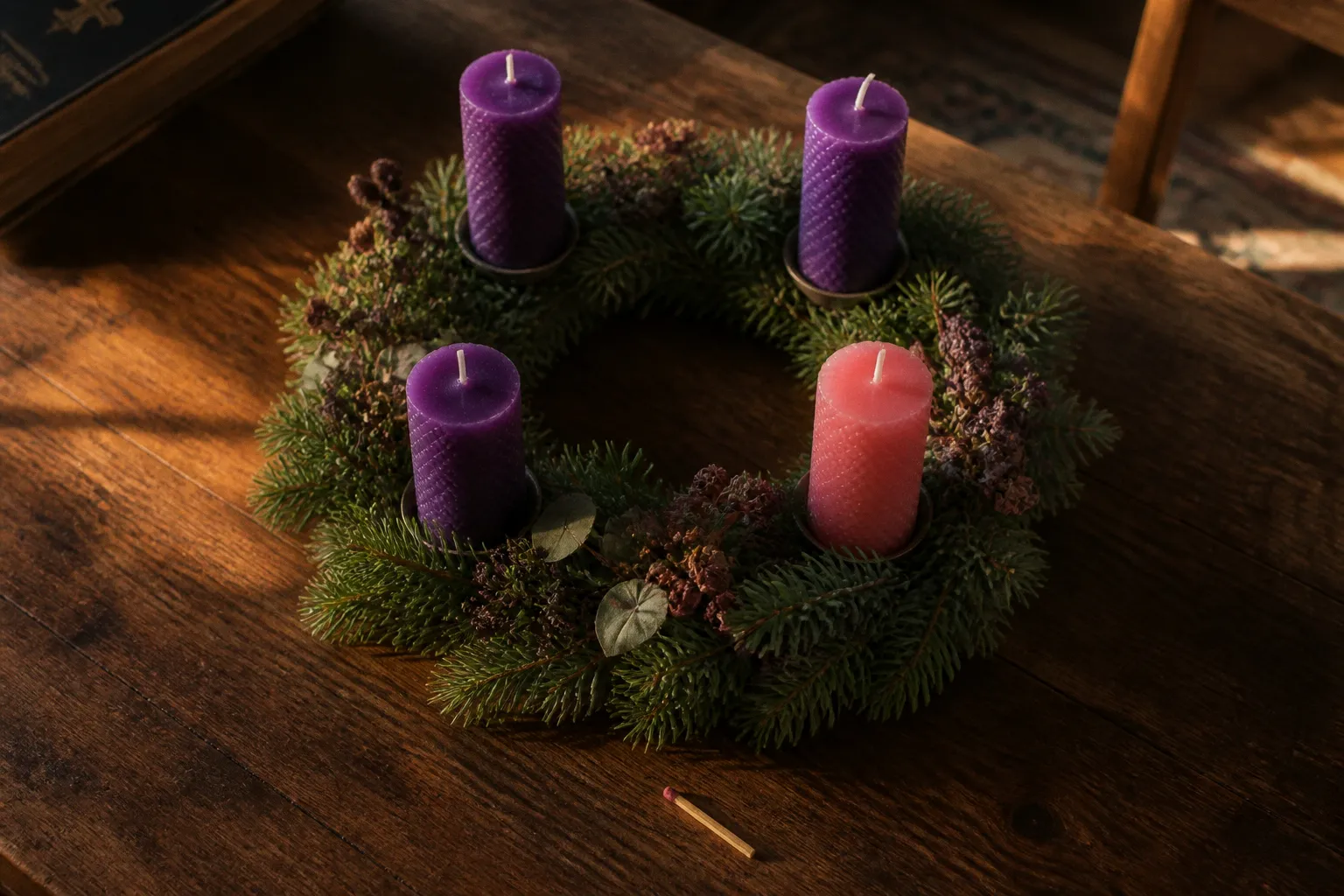
The Evangelical Lutheran Church in America (ELCA) has, since the latter decades of the twentieth century, tended toward blue as the liturgical color for Advent. Blue carries the symbolism of hope and expectation; it marks Advent as a season distinct from Lent, which is characteristically purple. The Lutheran Church—Missouri Synod (LCMS), by contrast, more frequently employs purple, drawing on the penitential dimension of the Advent season and aligning with the broader Western liturgical tradition in which purple signifies both royal anticipation (the coming King) and repentance (preparation of the heart). Neither usage is incorrect. The governing rubric is that the household or congregation should be intentional about its choice and consistent in its application.
A third candle, typically rose or pink, is reserved for the third Sunday of Advent—Gaudete Sunday. The name derives from the Latin introit for the day, Gaudete in Domino semper ("Rejoice in the Lord always," Philippians 4:4). Gaudete Sunday marks a brief relaxation of the Advent fast, a moment of anticipated joy within the broader season of waiting. In practice, this means the third candle is lit in place of what would otherwise be a uniform sequence, and its distinct color serves as a visual and theological punctuation point.
| Candle Position | Typical ELCA Color | Typical LCMS Color | Liturgical Significance |
|---|---|---|---|
| First Sunday | Blue | Purple | Hope, expectation, the patriarchs and prophets |
| Second Sunday | Blue | Purple | Love or Faith, preparation, John the Baptist |
| Third Sunday (Gaudete) | Rose/Pink | Rose/Pink | Joy, the relaxation of the Advent penitential tone |
| Fourth Sunday | Blue | Purple | Peace, the final preparation, the Virgin Mary |
| Christ Candle (center) | White | White | Christ's entry into the world, lit Christmas Eve/Day |
The practical implication for the home is straightforward: if your congregation uses blue, use blue; if it uses purple, use purple. The rose candle on the third Sunday is a constant across both traditions. The white Christ candle, placed at the center of the wreath, is likewise universal. What matters is not the color per se but the reason behind it—color without comprehension is ornamentation without pedagogy.
The Theology of the Three Comings: Structuring Your Weekly Devotions
The LCMS's devotional framework for Advent identifies a tripartite structure that provides the theological backbone for the season's home observance. This framework, articulated in resources such as the LCMS's "Brief Advent Devotions for the Family Table," organizes the season around the three comings (adventus) of Christ:
1. The First Coming: Christ in the Flesh. This is the historical event commemorated at Christmas—the Incarnation, the Word made flesh in Bethlehem. The devotions of the first and second Sundays build toward this reality, with readings and prayers drawn from the prophetic tradition (Isaiah, Jeremiah) and the infancy narratives (Luke 1–2, Matthew 1–2).
2. The Coming in Word and Sacrament. Christ's ongoing presence in the preached Gospel, Baptism, and the Lord's Supper constitutes a continuous advent—a coming that is not past or future but present. The third and fourth Sundays often emphasize this dimension, grounding the household's expectation not merely in historical remembrance but in the living encounter with Christ through the means of grace.
3. The Coming at the Last Day. The eschatological dimension of Advent—Christ's return in glory—is the horizon toward which the entire season gestures. The readings for the final Sundays of Advent and the Christ candle's lighting on Christmas Eve hold together the already and the not-yet: the child born in Bethlehem is the Lord who will come again to judge the living and the dead.
This threefold structure has practical consequences for devotion planning. Each week's Scripture reading, hymn or song, and prayer should be selected with a specific coming in view, so that the household's observance progresses not randomly but through a coherent theological sequence. A devotion that addresses all three comings every week will blur the distinctions; a devotion that addresses only the first will flatten the season into a pre-Christmas countdown. The framework provides the discipline of selectivity.
Step-by-Step Lighting Sequence and Candle Symbolism
The physical action of the Advent wreath is its most distinctive feature and the one most easily performed without theological reflection. The lighting sequence, however, is itself a rubric—each step carries meaning, and the pattern of progressive illumination is the wreath's primary catechetical mechanism.
The following procedure should be followed each Sunday of Advent, ideally at a consistent time—before the evening meal is a common and practical choice for families.
1. Gather the household around the wreath. The wreath should be placed at the center of the family table or in another location where it can serve as a focal point for the devotion. The communal nature of the act is essential: this is not a private meditation but an ecclesial practice scaled to the domestic church.
2. Light all previously lit candles first, then the new candle. The order matters. On the first Sunday, only the first candle is lit. On the second Sunday, the first candle is relit, and then the second is added. On the third Sunday, the first and second are relit, and then the third (the rose candle) is added. On the fourth Sunday, all four are lit. This creates what is sometimes called a "stair-step" effect as the earlier candles burn down further each week—a visual representation of increasing light and approaching fulfillment.
3. Read the appointed Scripture passage. Assignments vary by household and tradition, but the LCMS and ELCA both publish recommended lectionary readings for each Sunday of Advent. The readings should correspond to the theological theme of the week—hope, love or faith, joy, and peace, respectively, in the commonly used thematic scheme.
4. Offer a prayer. The prayer should be brief, liturgical in tone, and responsive to the week's theme. Many households use the collect for the day from the Lutheran Book of Worship or the Lutheran Service Book, adapting the language as needed for the household context. The prayer should name the specific coming of Christ appropriate to the week.
5. Sing or recite a hymn or song. This need not be lengthy. A single stanza of an Advent hymn—"O Come, O Come, Emmanuel," "Savior of the Nations, Come," or "Come, Thou Long-Expected Jesus"—provides a musical conclusion that reinforces the week's theological content through the vehicle of the church's song.
6. Extinguish the candles. The extinguishing should be deliberate, not hurried. Some households use a candle snuffer as a sign of reverence; others simply blow the candles out. The method is less important than the intentionality.
The Advent wreath is not a decoration with devotions appended; it is a liturgical instrument whose structure—sequential illumination, progressive theological depth, culminating arrival—teaches the household the shape of Christian hope.
The critical discipline is repetition with variation: the physical form is the same each week, but the theological content shifts, so that the household moves through the season with cumulative understanding rather than static repetition.
Incorporating the Christ Candle: Marking the Arrival of the Messiah
The Christ candle—the white candle placed at the center of the wreath—serves a distinct liturgical function that must not be conflated with the four Sunday candles. It is not the fifth candle in a sequence but the terminus of the sequence, and its lighting marks a qualitative shift in the wreath's symbolism.
On Christmas Eve or Christmas Day, the four Advent candles are lit first, and then the Christ candle is added. At this point, the wreath's pedagogical work is complete: the darkness of the season has been progressively overcome, and the light that was promised has arrived. The Christ candle is white because white is the color of resurrection, purity, and festal celebration in the Western liturgical tradition—it belongs to the Twelve Days of Christmas, not to Advent, and its introduction into the wreath signals the transition from expectation to fulfillment.
The readings and prayers for the Christ candle's lighting should draw on John 1:1–14 ("The light shines in the darkness, and the darkness has not overcome it"), Isaiah 9:2–7 ("The people walking in darkness have seen a great light"), or Luke 2:1–20 (the nativity narrative). The hymn should be explicitly incarnational—"Hark! The Herald Angels Sing," "Silent Night, Holy Night," or "From Heaven Above to Earth I Come."
Several points of stewardship deserve attention. The Christ candle should be of sufficient size to burn throughout the Twelve Days if the household intends to keep it lit during meals or devotions through Epiphany. Its central placement on the wreath should be visually distinct—not merely another candle in the ring but a focal point around which the four Advent candles orbit. And its introduction should be marked by a clear verbal cue in the devotion—a brief explanation, especially for children, of why this candle is different from the others and what its lighting signifies within the threefold structure of Christ's comings.
A Summary of Best Practice
The Lutheran Advent wreath, properly administered, accomplishes what few other domestic devotional practices can: it provides a weekly catechetical framework that is simultaneously accessible to children and theologically substantive for adults. Its efficacy depends on three conditions: historical awareness of the practice's origins in Wichern's 1839 orphanage, which grounds the wreath in pedagogical purpose rather than folk tradition; theological precision in the selection of readings, prayers, and hymns, organized around the three comings of Christ rather than generalized sentimentality; and liturgical discipline in the physical sequence of candle-lighting, color assignment, and the culminating introduction of the Christ candle.
Households that adopt this framework will find that the wreath does not merely accompany the Advent season—it structures it. And a structured season, attended to with care and consistency, forms the household in the shape of the Gospel: a movement from darkness to light, from promise to fulfillment, from expectation to arrival.