Lutheran home altar setup: a five-step guide
The household that attends Divine Service every Sunday yet possesses no fixed location for daily prayer faces a structural deficiency in its devotional life.
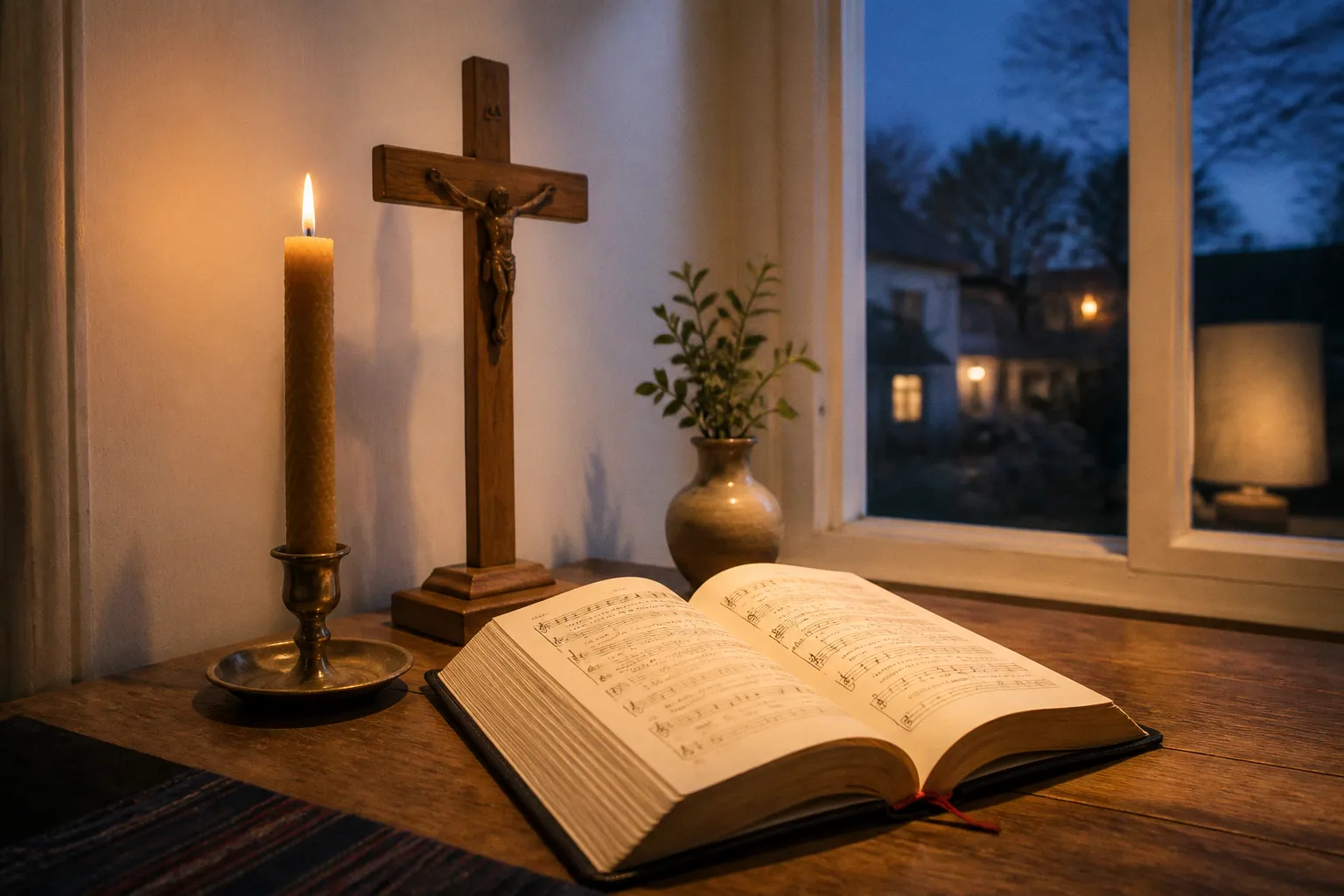
Lutheran Home Altar Setup: A Five-Step Guide
Corporate worship feeds the Christian through Word and Sacrament, but the intervening six days require a deliberate architecture of practice — a physical anchor that draws the individual back to Scripture, hymnody, and intercession with consistent regularity. Without such an anchor, private devotion defaults to happenstance: a verse read hastily before bed, a prayer muttered in traffic, a catechism lesson deferred until it is forgotten entirely. A Lutheran home altar corrects this by establishing a designated domestic space whose arrangement communicates purpose, orders the household’s prayer life, and extends the rhythm of the church year into the living room, study, or bedroom.
This is not a matter of pietistic sentiment. It is a question of stewardship — of treating the home itself as a context in which the baptized receive the gifts of God through structured, daily engagement with His Word. The practice has deep roots in Lutheran catechetical life, but it does not require a large house, expensive furnishings, or an elaborate collection of devotional objects. Its strength lies in ordered use: a stable place, a clear center, a few reliable books, and a household willing to return to them.
The most useful Lutheran home altar setup steps can be understood as five decisions: establish the location and base, center the crucifix, provide the essential devotional tools, mark the church year, and personalize the space with reminders of God’s promises to the household.
Choosing the Ideal Location and Base for Your Sanctuary
The first decision concerns where the altar will stand, and the second concerns what will serve as its base. These questions are related, but they should be resolved in that order. A beautiful crucifix cannot compensate for a location that makes prayer inconvenient, while a perfectly chosen cabinet will not become a devotional space simply because religious objects have been placed on it.
Locating the Space
Tradition holds that a home altar may be placed against an east-facing wall, echoing the ancient Christian orientation toward the rising sun — a symbol of Christ’s resurrection and His anticipated return. This orientation is not a binding liturgical rubric. It is a venerable custom that carries theological weight for those who observe it, but the floor plan of a modern home will often determine the practical choice.
Any wall that supports regular use can serve. When considering a location, look for four qualities:
1. Visibility. The altar should be in a place the household passes or enters regularly — a corner of the living room, a section of the bedroom, a quiet alcove in a hallway, or a study. A space hidden behind a door or relegated to an unused guest room will not naturally generate consistent use.
2. Accessibility. The worshipper should be able to stand before the altar comfortably and, if kneeling prayer is practiced, kneel without having to move furniture every time.
3. Quietude. The area should permit sustained attention. Placing the altar directly beside a television, a gaming station, or a high-traffic kitchen entrance makes prayer harder than it needs to be.
4. Practical light and safety. Natural light is helpful for morning devotion, but it is not a theological requirement. More important is keeping books dry, protecting the surface from heat, and ensuring that candles are never placed where they can be knocked over.
The altar does not need to occupy the most prominent wall in the house. It does, however, need to be legible as a place set apart for prayer. If the household must clear away mail, toys, and chargers before every use, the arrangement is asking too much of its users. A small, orderly corner that remains ready is often better than a grand arrangement that requires preparation.
Selecting the Base
The altar base determines the ergonomic viability of the entire arrangement. A surface too low forces the worshipper to bend excessively while reading; a surface too high makes kneeling prayer awkward. A waist-high or slightly taller structure — approximately 30 to 36 inches for many adults — accommodates both standing and kneeling postures, though the best height depends on the people who will actually use it.
Several furniture types serve effectively as altar bases:
- A small bookshelf or bookcase offers integrated storage for devotional volumes beneath the surface.
- A sturdy cabinet or chest conceals supplies while presenting a clean, uncluttered surface.
- A narrow console table works well in a living room or hallway where a traditional cabinet would appear too heavy.
- A wall-mounted shelf suits tight spaces where floor area is limited, though it must be anchored securely enough to hold books and candles without flexing.
- A small table or nightstand can be appropriate for a bedroom altar, provided it is not so crowded that ordinary household use constantly displaces the devotional materials.
The material and finish are secondary to stability and proportion. The base should not wobble under the weight of a Bible and hymnal, and it should not dominate the room to the point of appearing ostentatious. The altar serves the household, not the reverse.
Storage is worth considering at this stage. A Bible, hymnal, catechism, and prayer book should be close enough to reach without interrupting prayer. A drawer can hold matches, a candle snuffer, seasonal cloths, and prayer cards. The point is not to accumulate equipment. It is to remove small obstacles that make a daily practice less likely.
Centering the Cross: The Role of the Crucifix and Icons
The focal point of a Lutheran home altar is a crucifix or an image of Christ, positioned front and center on the surface or mounted on the wall behind it. This placement is not merely decorative; it is structural. The crucifix directs the worshipper’s attention toward the objective work of Christ on the cross, anchoring every prayer, psalm, and hymn in the reality of atonement.
A confessional Lutheran understanding of images distinguishes sharply between use and veneration. The crucifix or icon at the home altar — whether a carved corpus on a wooden cross, a printed depiction of Christ, or a simple brass cross — functions as a visual aid and an educational instrument. It is not an object to which prayer is directed. It is the means by which the eye is drawn to the One to whom prayer is offered.
That distinction matters when considering home altar crucifix placement. The cross should not be buried beneath flowers, hidden behind books, or treated as one decorative object among many. Its purpose is to give the space a clear theological center. Other images may be used, but they should serve rather than compete with that center.
Placement Principles
- Central axis. The crucifix or image of Christ occupies the middle of the arrangement, both horizontally and, where possible, vertically.
- Clear sightline. The cross should remain visible when the worshipper is standing or kneeling. A book stand, candle, or seasonal ornament should not block the central image.
- Simplicity of frame. Avoid surrounding the primary image with numerous subsidiary images that compete for attention. The cross is singular in its significance.
- Proportion to the base. A crucifix should be large enough to function as the visual anchor at arm’s length but not so large that it overwhelms the altar surface.
- Secure mounting. Wall-mounted crosses should be fastened properly, especially in homes where children or pets may brush against the furniture.
Icons and biblical images can have a legitimate place in Lutheran devotional practice when they direct the mind toward Christ and the testimony of Scripture. An image of the Annunciation, Nativity, Baptism of Christ, or Resurrection may be placed to one side of the crucifix or changed with the season. The test is not whether the image is elaborate. The test is whether it clarifies the confession of the space or turns the altar into a collection of competing religious objects.
The crucifix does not decorate the altar; it defines it. Remove the cross, and what remains is a shelf. Place the cross, and the space becomes a locus of confession, prayer, and the hearing of God’s Word.
Essential Devotional Tools: Bibles, Hymnals, and Candles
An altar surface that holds only a cross is incomplete. The worshipper requires materials for active engagement with Scripture, confession, hymnody, and prayer. These materials should be arranged with deliberate order, not accumulated haphazardly.
The goal is not to reproduce the entire contents of a parish sacristy. A home altar becomes useful when its core materials are immediately available and familiar enough to be used without ceremony.
The Core Library
A practical Lutheran home sanctuary setup begins with three categories of text:
| Category | Useful Examples | Function |
|---|---|---|
| Holy Scripture | A readable and reliable Bible translation | The primary text for readings, psalms, study, and prayer |
| Hymnal and liturgical book | Lutheran Service Book or The Lutheran Hymnal | Provides orders of daily prayer, hymns, collects, and catechetical resources |
| Devotional companion | Treasury of Daily Prayer or a similar lectionary-based guide | Structures readings, psalms, and prayers according to the church calendar |
A copy of the Small Catechism is also appropriate, whether it is included in the hymnal or kept as a separate volume. For a household with children, the catechism can remain visible rather than being treated as a book reserved for confirmation class. Its presence reinforces the connection between Sunday instruction and weekday prayer.
These volumes should sit together on or immediately adjacent to the altar. A shelf beneath the altar surface is ideal. A small book stand on the surface itself is the next best arrangement, provided it does not displace the crucifix from its central position. If several family members use different translations or devotional books, the arrangement can accommodate them, but the surface should still retain a visible center.
The books do not need to be open at all times. Leaving a Bible permanently open can damage the binding and create unnecessary maintenance. It is enough for the Bible and hymnal to be ready to reach, with the current seasonal book or prayer guide placed where it will actually be used.
Candles
Candles serve a dual function at the home altar. Practically, they provide focused light and signal to the household that a dedicated period of prayer is underway. The flame becomes a visual cue, marking the beginning of a distinct activity. Theologically, it carries the scriptural association of Christ as the Light of the World, though the symbolism should not be confused with the source of the altar’s meaning. The Word and promises of God do not depend on an open flame.
Both traditional wax candles and battery-operated alternatives are acceptable. Wax candles offer the sensory dimension of real flame and the discipline of tending a small light. Battery-powered candles eliminate fire risk in households with small children, pets, or limited ventilation. The choice is one of stewardship and household safety, not theological propriety.
A useful candle arrangement might include:
1. Two candles flanking the crucifix. This is the most common arrangement, establishing visual symmetry and framing the central image.
2. A single candle to one side. This is suitable for a narrow altar surface or a wall-mounted shelf where space is constrained.
3. A central candle before the crucifix. Some households use this arrangement during particular devotional seasons, especially when candlelight itself becomes part of the household’s observance.
Candles should be placed in stable holders on a heat-resistant surface, with matches and snuffers stored away from children. The candles are lit at the beginning of the devotional period and extinguished at its conclusion. This act provides a liturgical boundary — a physical gesture that marks the transition into and out of structured prayer time.
The boundary does not need to be dramatic. A household office may consist of a psalm, a hymn stanza, a reading from the catechism, and the Lord’s Prayer. What matters is that the altar supports this practice rather than intimidating the household into waiting for a more impressive occasion.
Reflecting the Church Year Through Liturgical Colors
One of the most distinctive features of the Lutheran home altar is its capacity to keep the household attuned to the rhythm of the church year. The mechanism is straightforward: altar cloths — fabric coverings placed on the altar surface — are changed to correspond with the liturgical color of the current season.
This practice mirrors the color discipline observed in the chancel of the parish church and reinforces, at the domestic level, the same theological narrative that the congregation follows corporately. The household that changes its altar cloth when Advent begins is performing a small but significant act of catechesis — teaching children, and reminding adults, that the church year has a shape, a movement, and a purpose.
The home altar need not display the exact same colors as the parish on every occasion. Congregations may follow different local customs, and some families may have only one or two cloths available. The point is not visual precision for its own sake. The point is to let the changing seasons become visible in the ordinary life of the home.
Liturgical Color Reference
| Season or Festival | Common Color | Theological Emphasis |
|---|---|---|
| Advent | Purple or blue | Preparation, expectation, and the coming of Christ |
| Christmas | White or gold | Incarnation, celebration, and the Nativity of Our Lord |
| Epiphany | White or gold | The manifestation of Christ to the nations |
| Lent | Purple | Penitence, self-examination, and the road to the cross |
| Holy Week | Red or, in some traditions, black on Good Friday | The Passion, suffering, and sacrifice of Christ |
| Easter | White or gold | Resurrection, victory over death, and the empty tomb |
| Season after Pentecost | Green | Growth in faith, discipleship, and the ongoing life of the Church |
| Festivals such as Reformation or All Saints | Red or white | The particular emphasis of the festival |
A single cloth in each of the primary colors — purple, white, gold, green, and red — is sufficient for a household that wants a complete set. These need not be elaborate. A simple cotton or linen rectangle that covers the altar surface or hangs over its front edge is enough.
Some households fold the cloth to cover only the front edge, allowing the surface to remain usable for books and candles. Others drape it fully and place the devotional items on top. Either method is consistent with the practice’s purpose. A family with a very small shelf may use a colored runner or a narrow strip of fabric rather than a full altar cloth.
The act of changing the cloth typically takes less than a minute but carries disproportionate catechetical weight. It gives children a visual answer to a question that can otherwise remain abstract: why does the Church speak differently during Advent than during Easter? The cloth does not teach the faith by itself, but it creates an opening for conversation, prayer, and attention.
Personalizing Your Space with Sacramental Reminders
The final layer of the home altar concerns the household’s own sacramental history — the moments at which God has acted upon its members through Baptism, the Lord’s Supper, and the preached Word. This layer transforms the altar from a generic devotional station into a space that testifies to what God has done in this family, in this home.
The altar should not become a family display cabinet. Personal items belong there when they direct the household back to God’s promises rather than toward nostalgia alone.
Sacramental Items Commonly Displayed
- Baptismal certificates or framed baptismal records can be displayed on the altar or mounted on the wall above it. They remind the household of the foundational gift of incorporation into Christ’s body.
- Baptismal candles may be kept nearby and relit on the anniversary of a member’s Baptism — the “baptismal birthday” — as a confession of ongoing identity in Christ.
- Wedding bulletins or certificates can serve as reminders that the marriage was surrounded by God’s Word and the Church’s prayer.
- Confirmation certificates may be meaningful for households with children approaching or having recently completed catechetical instruction.
- Prayer cards or handwritten names can be kept in a drawer or small box rather than spread across the altar surface, making intercession concrete without creating clutter.
These items are not relics. They are documentary witnesses — physical evidence that the promises of God have been applied to real persons in real moments. Displaying them on or near the home altar situates them within the context of daily prayer, so that the worshipper sees them not as artifacts of the past but as ongoing affirmations of present faith.
A small rug placed before the altar defines the prayer space on the floor and provides comfort during kneeling. A common recommendation is approximately 5 by 7 feet, though the household should choose a size suited to the room. Families with the means and space may add a prie-dieu — a dedicated kneeling bench with an integrated armrest and book shelf — which improves the ergonomics of extended kneeling prayer. Neither item is required. Both are investments in the sustainability of the practice, not marks of greater devotion.
Seasonal and Personal Additions
Beyond the permanent elements, the home altar may incorporate:
- A prayer rope or Lutheran rosary for meditative, repetitive prayer. Prayer-rope lengths and repetition counts vary by practice; no single number is required for faithful use.
- Fresh flowers on festival days, such as lilies at Easter, poinsettias at Christmas, or seasonal foliage during the Season after Pentecost.
- A small icon or image of a biblical scene — the Annunciation, Nativity, Baptism of Christ, or Resurrection — placed to one side of the crucifix as a secondary devotional focus.
- A seasonal prayer card or printed collect that helps the household pray with the current Sunday or festival.
- A small dish or box for written intercessions, allowing family members to add names and concerns that can be remembered during the evening office.
The question with every addition is simple: does it help the household hear, remember, and respond to God’s Word? If an object becomes a distraction, it can be removed. A Lutheran devotional space does not gain authority through quantity. Its value comes from how faithfully it directs the household toward Scripture, prayer, and the life of the congregation.
The home altar is not a miniature church. It is the Church’s extension into the household — a place where the baptized hear the Word, confess their sins, and commend themselves to God in the same faith that gathers them at the parish rail on Sunday morning.
Making the Five-Step Arrangement a Living Practice
The five-step framework — location and base, crucifix and image, devotional tools, liturgical colors, and sacramental reminders — provides the structural foundation. What converts that foundation into a living devotional practice is regularity.
The altar that is arranged beautifully but used sporadically is a furnished corner. The altar that is used daily, even for a brief office of prayer and a single psalm, becomes what it was built to be. This is why convenience matters so much in the first step. The best location is not necessarily the most impressive one; it is the place where the household can return without friction.
A workable routine might follow the same broad pattern each day:
1. Begin with the sign of the cross, standing or kneeling before the crucifix.
2. Read the appointed Scripture or a selected psalm, using the Bible or devotional guide.
3. Sing or read a hymn stanza, drawing on the hymnal when time permits.
4. Speak the Lord’s Prayer and other intercessions, including the names written by family members.
5. Close with a familiar blessing or collect, then extinguish the candle if one has been lit.
Not every devotion needs to include every element. A full office may be suitable in the morning or evening, while a midday visit to the altar may consist of the sign of the cross, a verse, and a short prayer. The purpose of structure is not to create a burden but to make prayer possible when attention and time are limited.
The altar can also become a place of shared instruction. Parents may use it to review the catechism with children, to explain why the cloth has changed, or to connect a Sunday sermon with the week’s prayers. Children can help carry out the seasonal changes, place the hymnal on the stand, or extinguish the battery-operated candle. These small responsibilities make the altar part of the household’s life rather than an adult object that children are expected to observe from a distance.
No two home altars will look identical, nor should they. The practice is voluntary, adaptable, and shaped by the space, resources, and devotional needs of each family. A household in a large home may have room for a cabinet, kneeling bench, and seasonal storage. A household in a small apartment may use one shelf, a wall-mounted crucifix, and a single candle. Both can provide a faithful setting for prayer.
What matters is not uniformity of appearance but consistency of use. Begin with the cross, the Bible, and a place that can remain ready. Add the hymnal, candles, colors, and sacramental reminders as the household’s practice develops. The home altar does not replace the parish church or the Divine Service. It points back to them, carrying their language and rhythm into the ordinary hours of the week.