Church nursery volunteer training: a foundational guide
There is a particular moment, repeated in churches every Sunday morning, that rarely makes its way into a sermon illustration.
A parent arrives at the nursery door with an infant on one hip and a toddler gripping their hand, and for a brief, suspended second they pause. They are handing over the most vulnerable people in their lives to a volunteer they may have met only in the fellowship hall over coffee. The relief on the parent's face is real, and so is the tremor of hesitation beneath it. That pause is the entire ministry of the nursery distilled into a single gesture of trust.
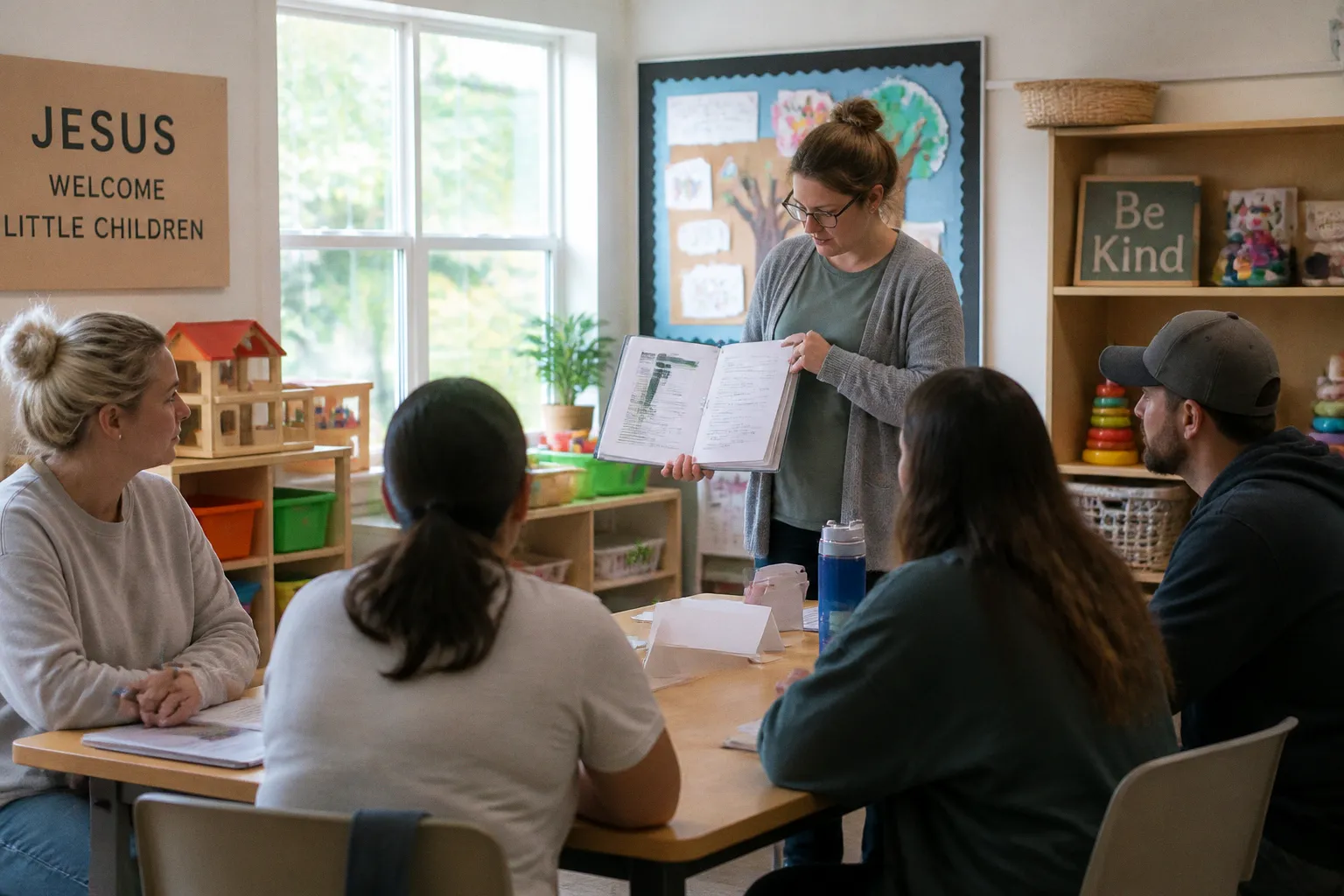
Nursery volunteers, then, are not simply filling a schedule slot. They are stewards of an arrangement that holds a family together for an hour — a small but indispensable scaffolding for the wider work of worship, formation, and pastoral care. And because the work is so intimate, because it touches bodies and fears and the deepest anxieties of parenthood, it deserves more than goodwill. It deserves a training manual that is clear, thorough, and rooted in the kind of careful attention we would want for our own children.
What follows is a foundational guide for any Lutheran congregation seeking to build or refresh a nursery volunteer training program. It is written for pastors, children's ministry coordinators, and seasoned volunteers who want a working framework — one that balances the procedural clarity required for child protection with the pastoral warmth that should always shape our common life.
Establishing the Foundation: Volunteer Eligibility and Vetting
Before a volunteer ever changes a diaper or rocks a fussy infant to sleep, the congregation has work to do. The most loving thing a church can offer its nursery is the patient work of preparation: establishing who is eligible to serve, why they are eligible, and how that eligibility is renewed.
A Season of Belonging Before Serving
Most established church nursery policies ask prospective volunteers to have attended services regularly for a defined period — commonly six months to a year — before stepping into a children's ministry role. This is not gatekeeping, and it is certainly not a way of testing anyone's sincerity. It is a recognition that nursery work requires familiarity with the rhythms of the congregation: the way a particular family communicates, the unspoken choreography of Sunday morning, the names and faces of the regulars.
When a volunteer has been present in the pew for months, they begin to recognize the parents whose children they will hold. They have heard the prayers offered for those families. They have watched the children grow. By the time they enter the nursery, they are not strangers; they are members of a body who have learned to recognize one another.
Background Checks and Ongoing Renewal
Standard child protection policies across denominations include background checks for anyone working with minors, and most churches that follow current best practices renew these checks annually. The annual rhythm matters because circumstances change — a volunteer's home life, their mental health, their access to vulnerable people — and the renewal is a quiet act of communal accountability. It tells parents, "We have not assumed; we have asked again." For congregations navigating insurance requirements or regional regulations, the specifics of what a background check includes will vary. The principle, however, does not: the church commits to knowing who is in the room with the children.
Distinguishing Youth Helpers From Adult Lead Teachers
A particular clarity is needed around the difference between a youth helper and an adult lead teacher. Most policies treat anyone under the age of eighteen as a junior assistant rather than a primary caregiver. Youth between eleven and eighteen may assist an adult volunteer — passing out snacks, sitting with a calm toddler, helping with cleanup — but they do not serve alone, and they do not hold the responsibility of lead teacher until they themselves are adults.
| Role | Age | Allowed Responsibilities |
|---|---|---|
| Youth Helper | 11–17 | Assists an adult; passes out supplies, plays alongside children, helps with cleanup |
| Adult Lead Teacher | 18+ | Primary caregiver; supervises diaper changes, feeds infants, manages the room |
This distinction is not a commentary on the character or capability of teenagers. It is a structural protection for everyone in the room: for the youth, who are still forming, and for the children, who deserve the steadiness of a grown adult whose training and authority are unambiguous.
The Rule of Two is not a regulation imposed upon us — it is the way we agree to care for one another's children, two pairs of eyes, two steady presences, always.
The Rule of Two: Maintaining Supervision Standards
If there is one practice that anchors the entire nursery ministry, it is what child protection professionals call the Rule of Two. The rule is simple in form and profound in its implications: at least two approved adult caregivers must be present in the nursery at all times when children are in the room.
What the Rule Looks Like in Practice
In practical terms, this means no volunteer should ever be alone in the nursery with children. If one volunteer must step out — to retrieve a forgotten bottle, to escort a child to a parent, to use the restroom — another approved adult remains in the room. If a parent arrives to breastfeed or settle a fussy infant, the second adult is still present. Most congregations also expect volunteers to arrive at least fifteen minutes before the service begins. This buffer is not bureaucratic; it allows the team to settle into the space together, review any notes about specific children, and pray, if that is the congregation's custom, before families arrive.
Why Two Adults Matter Beyond Liability
The Rule of Two is often presented as a protection against false accusations, and that is part of it. But its deeper purpose is pastoral. A single caregiver, however gifted, will eventually face a moment of fatigue, a child in genuine distress, or a sudden emergency that exceeds what one person can hold. Two adults share the weight. They can trade off when one needs a breath. They can notice things the other has missed. They become, in the simplest sense, a small community of care — consistent with our Lutheran understanding of the priesthood of all believers, that we are given to one another and no one carries the work alone.
Scheduling Around the Rule
Coordinators should build the volunteer schedule with the Rule of Two as a non-negotiable constraint. Pairing volunteers consistently for a season — so that the same two adults work together for several Sundays at a time — builds trust and rhythm. When that is not possible, the coordinator should ensure that any single volunteer is never the only scheduled adult for a given Sunday. The schedule itself is part of the care: a calendar that quietly promises two presences in every room.
Secure Check-in and Pick-up: Protecting Every Child
The transitions into and out of the nursery are moments of particular vulnerability. Children are arriving from one trusted caregiver (the parent) into the care of another (the volunteer), and then making the same passage back. Any weakness in these transitions is a weakness in the entire system.
Matching Tags and Codes
Most churches that take child security seriously use a check-in system involving matching physical or computerized tags. A parent receives a numbered tag at drop-off; the matching tag stays with the child. At pick-up, the volunteer verifies that the two tags match before releasing the child to the accompanying adult.
This is a small act of administrative grace. It does not require parents to feel suspected, and it does not slow the morning more than a few seconds. What it does is ensure that no child is ever handed to the wrong person, and that no unauthorized adult can simply walk in and claim a child. The system is the quiet guardian of the threshold.
Why Verbal Confirmation Is Not Enough
It is tempting, especially in a tight-knit congregation, to think that we know everyone and that a parent's word should be enough. But the whole point of a security system is that it functions even when our ordinary powers of recognition fail us. A grandparent who has not visited in months may be unknown to the volunteer. A custody situation may have changed without the church being informed. An unauthorized person may, in a moment of confusion, attempt to pick up a child. Verbal identification is a warm and human beginning to a conversation, but it cannot be the final safeguard. The matching tag — physical or digital — is the final safeguard.
The Liturgy of Drop-off and Pick-up
There is a pastoral dimension to the check-in process that is worth naming. When a volunteer greets a parent and child at the door, looks the parent in the eye, and confirms the child's tag, they are not performing a procedure. They are enacting a small liturgy of trust. They are saying: your child will be held, named, and watched. They are saying: we have not forgotten the weight of what you have entrusted to us.
Emergency Preparedness and Incident Documentation
Even in the most carefully run nursery, things happen. A child falls. A bottle spills. A toddler bumps heads with another toddler. Two-year-olds are remarkably creative in finding new ways to be small, brave, and bruised. Preparation is not a way of fearing these moments; it is a way of being free to stay present when they arrive.
Written Incident Reports
Standard nursery policy requires that any accident or safety incident be documented in a written report. A complete report typically includes the elements below, and the parent or guardian is informed at pick-up — or by phone shortly thereafter — and asked to sign as well.
| Report Element | What to Record |
|---|---|
| Time and date | Approximate time of the incident |
| Description | What happened, who was present, what was observed |
| Care given | First aid administered, comfort provided |
| Volunteer signature | Name and signature of the reporting adult |
| Parent acknowledgment | Parent or guardian signature at notification |
This practice serves multiple purposes. It creates a clear record that can be shared with the family and, if necessary, with insurance carriers or medical providers. It helps the nursery team notice patterns — perhaps a particular toy that causes frequent falls, or a particular time of morning when children are most likely to collide. And, perhaps most importantly, it ensures that no incident goes unspoken. A congregation that handles its incidents with documentation and honesty is a congregation that parents can trust.
Evacuation and Emergency Procedures
Every nursery should have a written evacuation plan that is reviewed with volunteers at the start of their service. A solid plan includes:
- Primary and secondary exit routes from the room.
- The location of the first-aid kit and the fire extinguisher.
- A designated outdoor meeting point, posted visibly in the room.
- A method for accounting for every child and every volunteer.
- Clear instructions for assisting infants and toddlers, including how carriers and blankets should be used during a quick exit.
- A protocol for sheltering in place if evacuation is not safe, particularly relevant in regions prone to severe weather.
This is not paranoia; it is prudence, the kind of prudence that allows us to be present to the children rather than frozen with anxiety when something unexpected occurs.
Communicating With Parents After a Scare
The first instinct of many volunteers, after a child is injured, is to minimize. "It's just a small bump," we say, before the parent has even had a chance to see the wound. We should resist this instinct. Parents deserve clear, factual information delivered with compassion. They deserve to see the incident report, to ask questions, and to be told what the church will do in response. A parent who leaves the nursery feeling well-informed is a parent who will return.
Professional Boundaries and Interaction Guidelines
Nursery volunteers are entering a space of profound intimacy. They will hold infants. They will wipe tears. They will be the trusted adult in a toddler's world for a brief, bright hour. This closeness is a gift, and it is also a place where careful boundaries are needed.
Discouraging Over-Familiar Behavior
Standard nursery guidelines discourage over-familiar physical contact — the extended lap-sitting that can shade into something uncomfortable, the frequent kissing of a child's face, the prolonged tickling that becomes a struggle. These guidelines exist not because affection is bad, but because children deserve adults who relate to them with consistency and respect for their developing autonomy. An infant cannot tell a familiar adult from a stranger; a toddler is just beginning to learn the difference between appropriate touch and inappropriate touch. The adults in the nursery are, in a real sense, teaching the children what adults are. We want to teach them that adults are steady, warm, and predictable.
Affection That Honors Dignity
There is plenty of room within healthy boundaries for genuine warmth. A pat on the back. A hand on a toddler's shoulder. Sitting on the floor to be at a child's eye level. Reading a picture book aloud with expression. Singing a song. These are the small acts of presence that make a nursery feel like a place of welcome rather than a place of management. The principle is simple: we relate to children in ways that their parents would recognize as loving and that the children themselves experience as safe.
Holding Space Without Overstepping
Some children arrive at the nursery with weights that are not visible — a recent move, a parent's deployment, a difficult week at home. Volunteers are not therapists, and they should not attempt to be. But they can be the kind of presence that does not add to a child's burden. They can be unhurried. They can listen. They can notice a child who is unusually quiet, and quietly tell the parent at pick-up, "She seemed a little sad today." This is the work of holding space, and it is part of what it means to embody our faith in a nursery.
A Ministry Worth the Care It Requires
A nursery is one of the smallest ministries a church operates, and one of the most consequential. Every Sunday, in parishes of every size, parents make a quiet decision: they will trust us with their children. They will walk into a room full of unfamiliar toys and unfamiliar adults, and they will leave their most precious people behind, so that they can go and hear the Word proclaimed and pray without the weight of small hands tugging at their sleeves.
Our response to that trust is not a single gesture but a sustained habit of care. It is the slow, unglamorous work of background checks and tag systems and incident reports and pairings of volunteers and whispered prayers before the first family arrives. It is the willingness to be trained, and then to be trained again, year after year, because the work is worth doing well.
A nursery is not a holding room for children while adults worship. It is itself an act of worship — a place where the body of Christ learns, in small and tender ways, what it means to love one another.
When we build a nursery volunteer training program with the seriousness this ministry deserves, we are not merely following best practices. We are forming a community that takes seriously the bodies and souls of the smallest among us. We are saying, in every tag we match and every report we file, that the children in our care are not abstractions of the Gospel — they are the Gospel, received and held.
That is a ministry worth every page of a manual, and every hour of training it asks of us.