Analyzing Marin County Worship Schedules for Lutheran Ministry Planning
A weekly listing published by the Marin Independent Journal offers a concise cross-section of how congregational worship is actually structured across denominational lines in one Northern California…
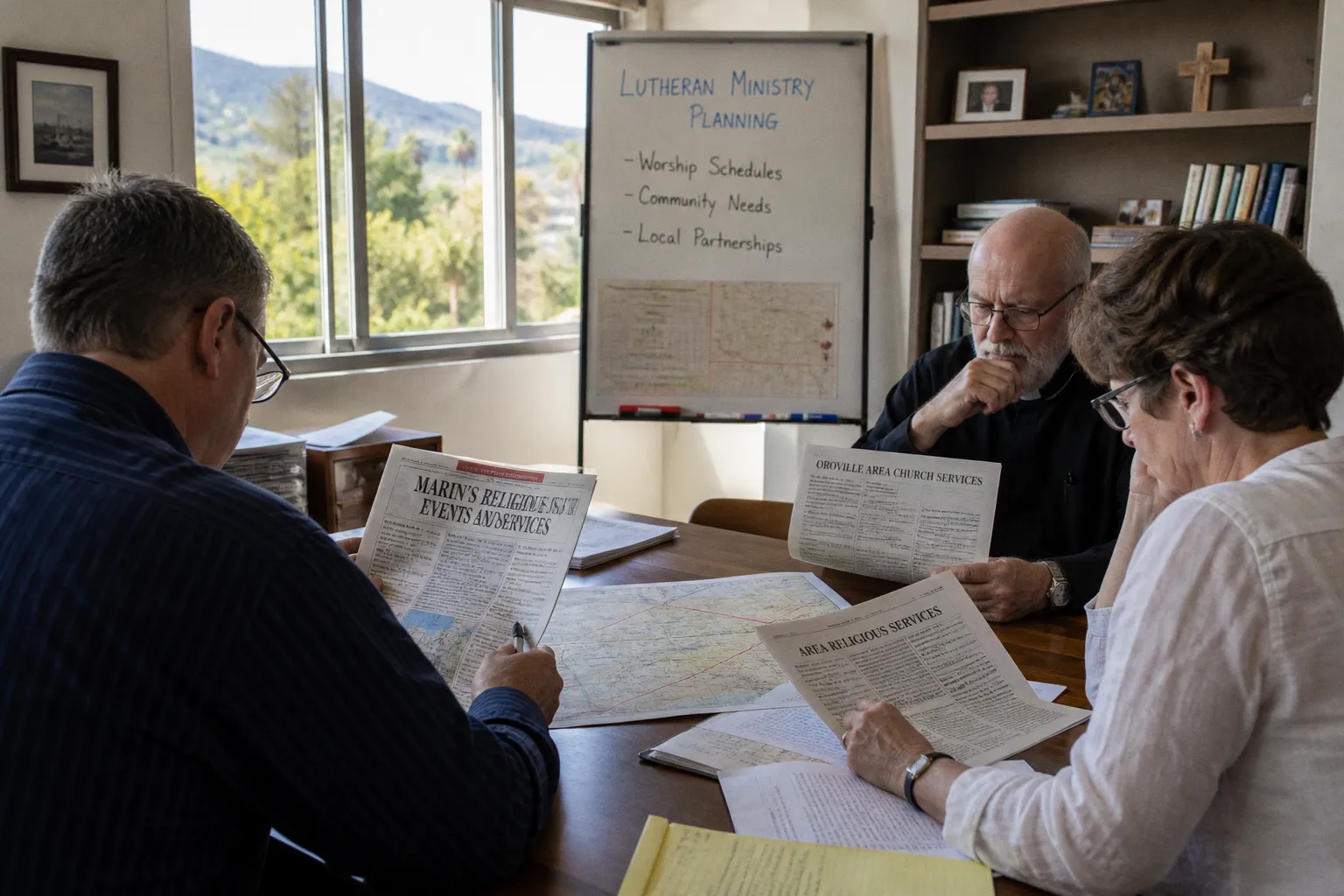
A weekly listing published by the Marin Independent Journal offers a concise cross-section of how congregational worship is actually structured across denominational lines in one Northern California county — instructive material for Lutheran communities auditing their own service calendar.
The listings, compiled for mid-August, document recurring offerings across Orthodox, Catholic, Presbyterian, Jewish, and independent Christian contexts, alongside interfaith contemplative and mindfulness sessions. The structural taxonomy is the point: scheduled gatherings fall into a small number of recognizable categories, each with its own rubric of time, place, and required form.
Liturgical Form and Recurring Schedule
The Catholic parishes in the listing (Our Lady of Mount Carmel, St. Anthony of Padua, St. Hilary, St. Patrick) maintain the most densely scheduled weekly Mass calendar, with multiple identical offerings repeated across the week at fixed times — 7:45 a.m., 8 a.m., 9 a.m., 11:30 a.m. — both in person and via livestream. St. Nicholas Orthodox Church lists Vespers once weekly at 7 p.m., a structure consistent with the Orthodox horologion. Congregation Kol Shofar lists a morning minyan at 7:15 a.m. Sunday, with the in-person location and a phone number for arrangements specified.
The recurrence pattern is itself a framework: it reveals how each tradition resolves the tension between a centralized liturgical form and the accessibility demands of a dispersed congregation. The Roman solution is multiplication; the Orthodox and Jewish solutions consolidate corporate prayer into a single weekly observance, trusting the laity to gather at the appointed hour.
Formational and Supplementary Programming
A second category comprises shorter, repeated formation events: Bible study at Trinity Community Church (7 p.m., in person and Zoom), a men's Bible study at Presbyterian Church of Novato (7:15 a.m., Zoom), and the Christian contemplative practice circle at St. Columba's Inverness (3:30 p.m.). These are not liturgical services but instructional and devotional adjacencies — and in a Lutheran context, they correspond directly to the catechetical and devotional life that surrounds the Divine Service rather than competing with it.
The mindfulness club at College of Marin's Emeritus Students program and the Tibetan singing bowl meditation hosted by the Praktikos Meditation Circle fall outside the Christian liturgical framework entirely. Their inclusion in the same listing is a reminder that the contemporary category of "religious gathering" is broader than any single tradition's self-definition, and that a parish bulletin now coexists with a wider spiritual marketplace.
Application for the Bulletin
For Lutheran communities, the listing functions as a comparative rubric. Three points merit direct attention:
1. Specify the liturgical form by name. The Marin listings consistently name the service (Vespers, Mass, minyan) rather than a generic "worship time." Internal consistency in bulletin nomenclature aids both regular members and visitors.
2. State the format alongside the time. In-person, livestream, and Zoom options are identified per service in the source; the same precision is achievable in a single-page bulletin without expanding the layout.
3. Separate liturgical services from formation events. Conflating the two in a single calendar obscures the structural distinction between the gathered Means of Grace and supplementary programming — a distinction the Lutheran tradition has historically been careful to maintain.
The listing, in short, is not news. It is a working inventory — and inventories are precisely the administrative instrument liturgical planning requires.