Lutheran Parishes Expand Diaconal Outreach Through Partnerships with Disability Services
According to Outlook Newspapers, a Lutheran congregation has formally welcomed an organization serving the developmentally disabled.
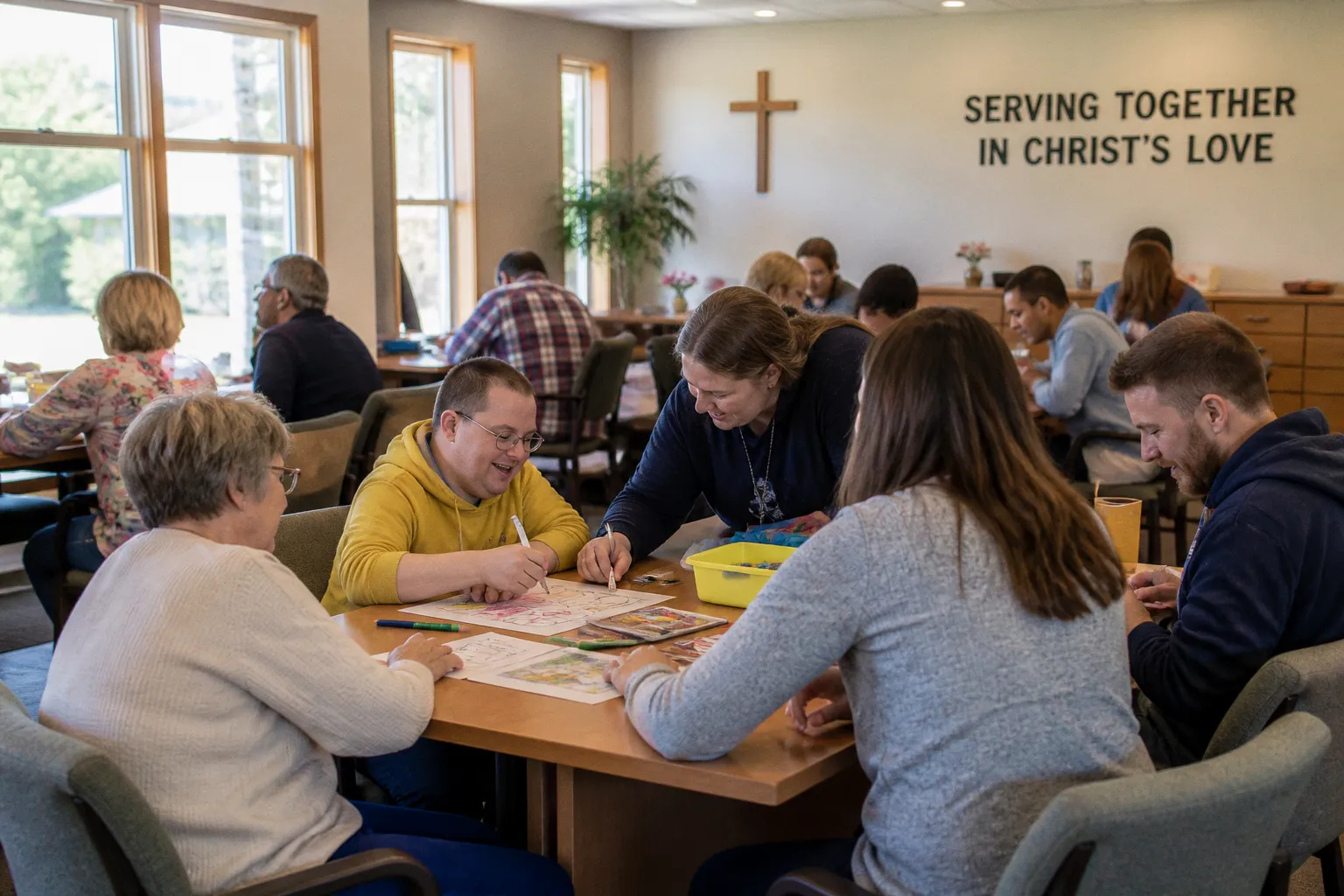
The published notice, dated Aug. 27, does not specify the host parish, the partner organization, or the operational terms of the welcome, leaving the structural shape of the arrangement — facility use, volunteer staffing, liturgical accommodations, governance provisions — to be clarified in subsequent reporting.
Why this pattern matters in congregational stewardship
Lutheran parishes routinely maintain weekday facilities whose principal hours of intense use are confined to Sunday morning and midweek formation. The stewardship logic of welcoming an external mission partner therefore rests on a straightforward calculation: underutilized space, surplus volunteer capacity, and pre-existing relationships with local civic organizations can be redirected toward diaconal ends without competing with the congregation's core liturgical function. Reported arrangements of this kind typically surface in two configurations — shared-facility agreements, in which the host congregation provides space at nominal or no cost, and integrated-programming partnerships, in which both parties contribute staffing and curate shared activities.
The doctrinal framework for such partnerships derives from the Lutheran distinction between the mission of the church and the institutional forms through which that mission is discharged. Facility-sharing with a developmentally disabled services organization neither compromises the Means of Grace nor substitutes for them; rather, it extends the congregation's presence into the civic sphere in a manner consistent with the historic office of deacon and the Free Church tradition of civic engagement.
Administrative framework before formal welcome
Congregations considering a parallel arrangement are advised to work through the following four-step framework before extending formal welcome:
1. Constitutional review. The church council confirms that the proposed welcome does not conflict with the congregation's articles of incorporation, bylaws, or any applicable district or synodical facility-use policy. Where ambiguity exists, the district president is consulted in writing.
2. Written agreement. A facility-use or memorandum-of-understanding document specifies permitted hours, designated spaces, supervisory responsibilities, maintenance obligations, and term length, with provisions for termination by either party on reasonable notice.
3. Insurance and indemnification. The agreement requires the partner organization to carry general liability coverage at a specified minimum and to name the congregation as an additional insured. Accident and incident reporting procedures are itemized in an attached schedule.
4. Safeguarding of formation spaces. Access to the sanctuary, nave, and instructional areas is reserved to the congregation during all scheduled worship, catechesis, and formation hours. Volunteer personnel from the partner organization who interact with children or vulnerable adults are screened in accordance with the congregation's safeguarding policy.
Open questions and what to monitor
The Aug. 27 Outlook Newspapers report leaves several variables unresolved. Subsequent coverage is expected to identify the host congregation, its denominational affiliation, the partner organization, and the operational scope of the welcome — specifically whether the arrangement is limited to facility sharing or extends to volunteer deployment and joint programming. Lutheran congregations evaluating their own response should track the original source and consult district-level guidance on facility-sharing before initiating analogous conversations.